Tags
alexanders, Blue tit, Bryn Euryn Nature Reserve, colour in winter woods, fragrant wild flowers, Great Spotted Woodpecker, Great Tit, hazel catkins, lamb's tails, lesser periwinkle, mosses & liverworts, Robin, snowdrop, Spurge laurel, treecreeper, woodland flowers
February 18th-Bryn Euryn-Woodland Path
A bit fed up with dull drab winter days, a sunny start to the day inspired me to go out and seek signs of the coming Spring and hopefully some colour. A Robin sang from a tree branch at the beginning of the Woodland Path, then minutes later the delightful and uplifting sight of a bank of Snowdrops in full flower made the perfect start.
Our Snowdrop display may not be on the scale of that of those boasted by our local National Trust gardens, but it is no less beautiful and uplifting; and I didn’t have to drive anywhere to see it. 

Lesser Periwinkle- Vinca minor
Nearby, peeping out shyly from beneath a bramble, the bright blue face of a Periwinkle.
A Barberry shrub arches gracefully over the pathway, its golden-orange flowers not yet quite open. I thought it was a bit early for it to be flowering? Barberry- Berberis vulgaris is a native plant, but it is scarce in the wild although widely naturalised. This one, or an ancestor of it may have been planted when this woodland was part of the grounds of the house that used to stand where our apartment building is now. Either way it’s pretty and a splash more colour to add to my collection. 
Another shrub I found flowering, Mahonia, has also likely arrived here from a garden. Its bright yellow flowers also look good and smell lovely.


Of course green is still the predominant colour, but there are splashes of bright fresh shades breaking up the dark evergreens. Mosses are at their best at this time of year, brightening the shady woodland floor, smothering rocks and the bases of tree trunks with patches of vivid green. I have yet to learn to identify the different species, so for now I think of this one as ‘looking like a forest of miniature pine trees’!

Although I walk this path often I can still see things I’ve not spotted before, like this pretty clump of Navelwort. Its pretty round leaves, dimpled in the centre and with frilled edges look a bit like green flowers.
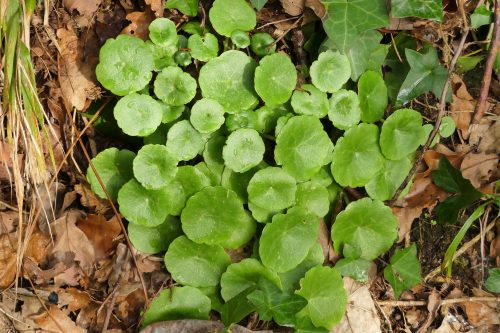
Navelwort-Umbillicus rupestris
There are a number of Spurge laurel plants in this part of the woods and they too are flowering now. The flowers are a subtle lime green-yellow colour but they are pretty and in common with those of other members of the daphne family they are deliciously scented, with an aroma that really is like warm honey.


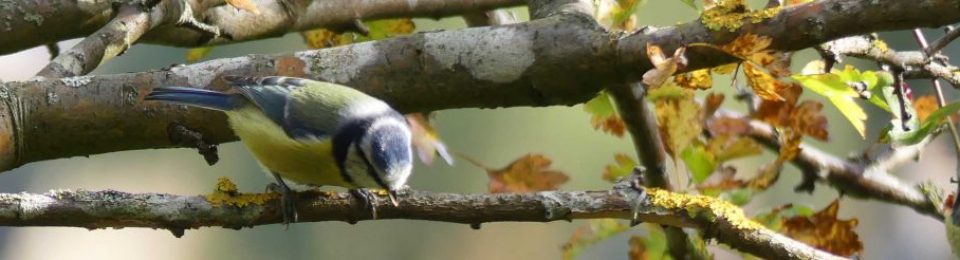
It’s wonderful to hear the woods full of bird sounds again. Throughout most of this walk I was surrounded by the sounds of birds, mostly the cheerful chirps and chatter of tits keeping contact with one another. Blue tits were everywhere, up high in trees and lower down in the shrubs, investigating every nook, cranny and leaf for potential food. They are bright colourful little birds, but still blend surprisingly well into the woodland background.
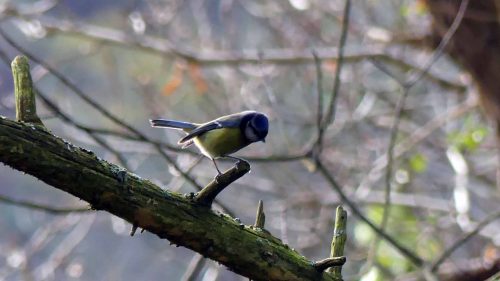
Great tits are also about, but their favoured place is around the Scots Pines where there are often several. They are more easily heard than seen and have a huge repertoire of calls and phrases at their disposal. Years ago I learnt from a bird-watching master that if you hear a bird sound you don’t recognise the chances are it will be a Great Tit!
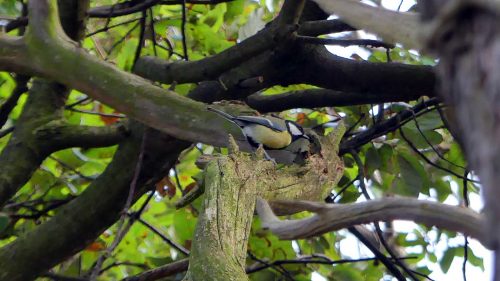
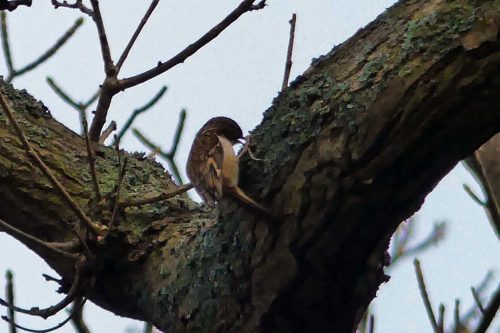
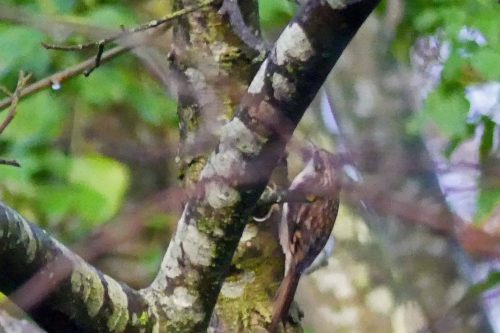
I stood and watched them there for a few minutes until my neck ached from craning upwards.Thankfully I was distracted by a Treecreeper up in a big sycamore tree nearby.
 It was exceptionally well-camouflaged against the shaded, heavily textured bark and hard to see when not mobile and flashing its white undersides. It was fascinating to watch as it contorted itself, using its tail to steady itself to probe its beak into its deep fissures. From this spot I also heard the screeching of Jays and caught a glimpse of one before it sped off through the trees.
I passed by the remains of the Scots Pine that was sadly felled in a storm two years ago. Much of it has been sawn and removed; what’s left is being gradually absorbed back into the fabric of the woodland. I liked its rich colour and texture.

Looking across the boundary fence here the colours of the landscape in general are still predominantly brown and green, but taking time to look properly you appreciate the are a myriad of shades of those colours. And I’m sure the grass is getting greener by the day!

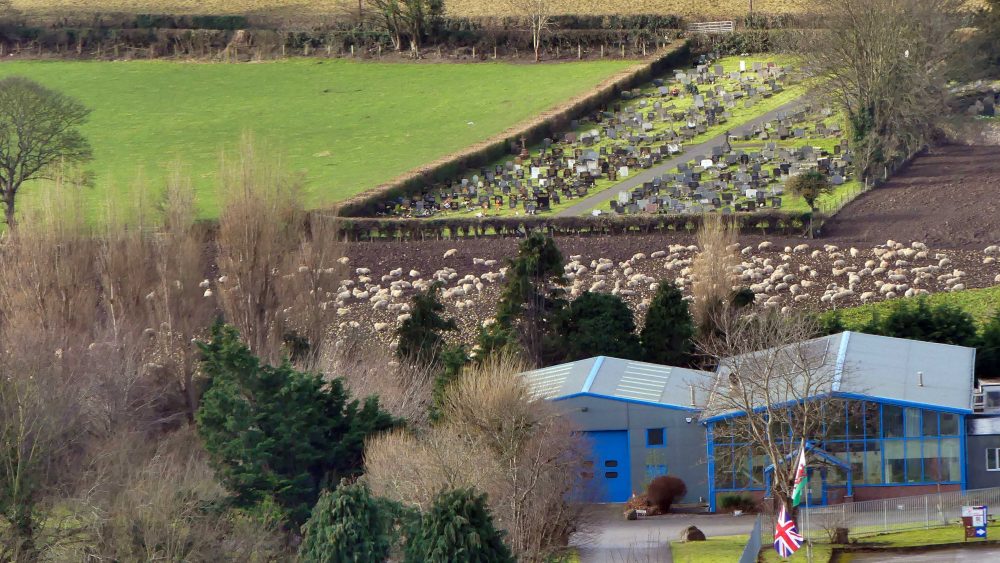
I usually concentrate on the more scenic aspects of this view, but zooming in and down onto an edge of the far landscape reveals an interesting slice of a community. An interesting juxtaposition caught my eye – Modern Industry and a Final Resting Place separated by a field full of sheep turned out to eat turnips!
On the field-woodland boundary is more colour. Gorse is blooming bringing forth its warm golden glow. I think this line of gorse was probably planted here as a boundary hedge. This was a common and effective practice in Wales to prevent animals wandering and remnants of such hedges can still be found in the countryside, particularly in Anglesey.

I heard a Robin singing and noticed bird movement amongst the Gorse. Zooming in I found the rusty-red of two Robins there, one being the source of the song. I wonder if they were mates prospecting for a nest site or rivals claiming territory?

Two birds in a bush
Honeysuckle twining up the wire boundary fence has well-grown fresh leaves already; quite surprising in this exposed spot.
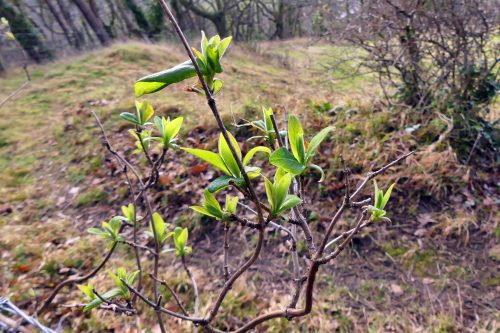
Honeysuckle leaves are well-grown
Amongst leaf litter, ivy and feathery moss, Wood Sorrel has shown some of its bright green shamrock-like leaves throughout the winter. It will be flowering soon.

Leaves of Wood Sorrel
The top end of this path is becoming increasingly lined with Alexanders’ plants. Most are well-grown now, particularly those sheltered against tree trunks. They will flower soon; last year their flowers were much appreciated by some of the earlier hoverflies.

Alexanders-Smyrnium olusatrum
Woodland – Summit Trail

Emerging from the beneath the canopy of the woods onto the open Woodland Trail the first colour I noticed was the blue of the sky!
Heading towards the track that leads up to the Summit Trail I heard a Woodpecker tapping. I’ve had several good sightings of Great Spotted Woodpeckers in the past few weeks, the latest one just this morning as it came down almost as far as our bird feeders. I scanned the trees for a sight of it but no luck. A Raven flew overhead, ‘cronking’ as it travelled to alert all to its presence.
Surprisingly there were a few bright red berries left on the big Holly bush; there are so many Blackbirds about I thought every last one would be gone by now. Perhaps they can’t reach those left at the end of branches. Many holly leaves have been ‘mined’ by insects so display bright pale splashes where there is now no chlorophyll.


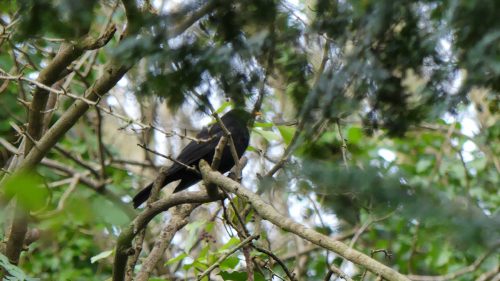
 As I said earlier, Blackbirds were numerous and have turned their attentions to the Ivy berries, many of which are finally ripe. Everywhere there were berries there were birds from low down to the tops of trees. They rustle noisily around seeking the bunches of berries using a variety of techniques to reach the fruits. Their familiar scolding and alarm calls ring out from almost every tree as they chase away competitors.
 Hazel catkins have been present since the autumn, gradually lengthening and maturing. Now their soft golden tassels are long and fluffy, resembling the ‘lamb’s tails’, which gave rise to the old country name for catkins.
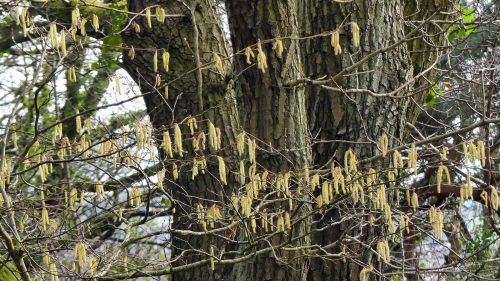
Common Hazel (Corylus avellana)
Catkins are the male flowers of the plant, producing pollen to fertilise the tiny red female flowers that sit tightly on the twigs.


I heard the Woodpecker again, this time drumming loudly on a tree trunk. It was too far away to try to locate it, but was good to hear. The males don’t have a song with which to claim ownership of their chosen patch of woodland, so they use the tool they have, their powerful bill to drum on dead trees. They can be clever in their choice of drumming spot, often choosing a site where the sound is amplified by surrounding features. A Thrush was singing nearby too, so I stopped to listen. Then two birds making sounds I didn’t recognise at all crashed into the top of a tree in front of me on the other side of the track. With the sun behind them they were drained of colour, but there was no mistaking their outlines – two Woodpeckers! I have no idea if they were a pair or two rivals chasing, but they left without a sound, one behind the other.

After the activity of the woods the almost-summit was surprisingly calm. This must be the first time for months that there has been not even a breath of wind and it was actually enjoyable to be up there! The sea of Colwyn Bay seemingly flat calm and mirroring the sky, now sunless, was a most unusual shade of blue-grey.
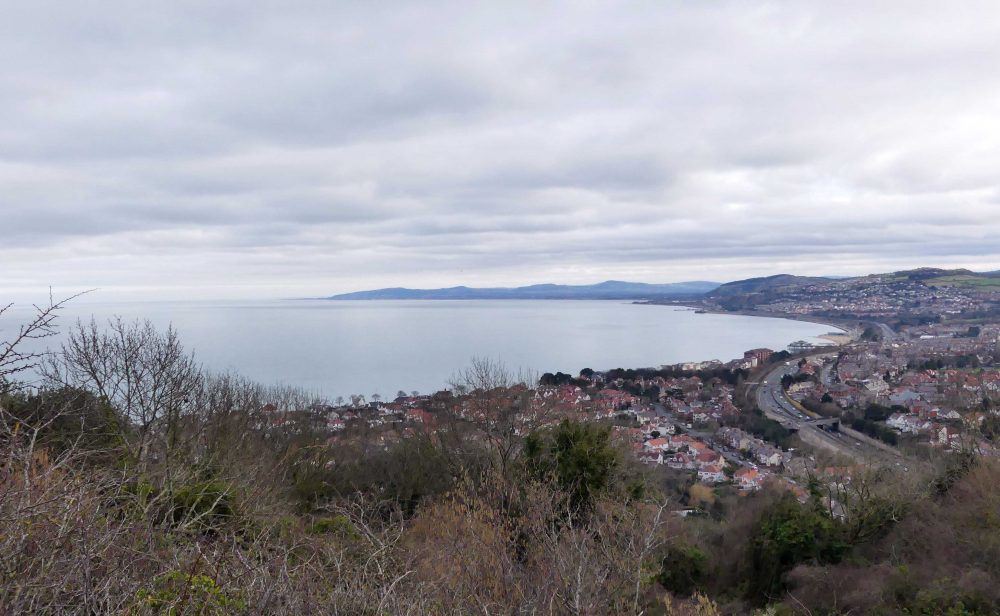 Swinging around to my right the snow-capped higher peaks of the Carneddau mountains rising above the river Conwy show remind that there is some Winter still to go.
Continuing up to the Summit you pass thickets of blackthorn; they take on a completely different appearance in the winter as their leafless black twigs and branches are richly encrusted with gold and silver-grey lichens.


Crossing to the North-facing side of the hill the view is down the coast along Penrhyn Bay to the Little Orme; the sea is still calm but more blue. The field (on the opposite side of the road to the golf course) has a lot if standing water and I could see there were gulls and Oystercatchers feeding there. This is the ‘Curlew field’ that I’ve mentioned many times. I couldn’t make out if there were any Curlew there, but I did hear one and the tide appears to be in, so there most likely were.
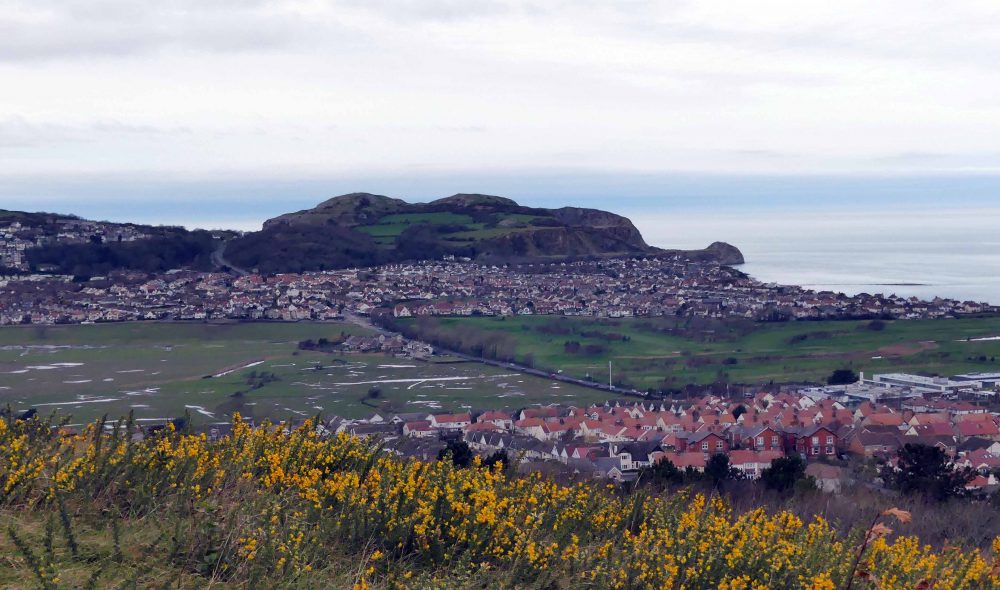
Below is a panoramic view starting from past the Little Orme on the right of the image and travelling along to the hills at the end of the Carneddau. Anglesey lies on the horizon behind the stretch of water which is the Menai Strait. It would have looked better if the sun had still been out, but it’s still pretty spectacular.

click for bigger image
Going down, the Gorse on the hillside is in full golden flower. It was only planted in recent years but has quickly thickened and grown taller.

I walked home across the field where a Long-tailed tit flew in front of me: it was so close I could almost have touched it. They are so pretty. It was one of a party but the others took a more cautious route around the field via the trees rather than the direct crossing.

I completed the circuit of the Bryn walking back along the Woodland Trail. It was much quieter now but I did get one last look of two Great Spotted Woodpeckers together, so fingers crossed they are a pair. I’ll be keeping an eye out.


 everyday nature trails