Tags
bombus terrestris, buff-tailed bumblebee, meadow flowers, medicinal plants, red clover, trifolium pratense, wayside flowers
There is a beautiful patch of red clover growing alongside the road leaving Old Colwyn and I just had to stop and have a closer look on my way home on Friday before it is past its best.

Red Clover- Trifolium pratense
Red Clover –Trifolium pratense is a species of clover that is native to Europe, Western Asia and northwest Africa, but widely planted and naturalised in many other regions.
Red clover is said to be the national flower of Denmark, although apparently not officially designated . It is however the state flower of Vermont. “No. 159 of the Acts of 1894, effective February 1, 1895, designated the Red Clover as the official State Flower. Both an integral part of many a cultivated hay field and a common sight along numerous Vermont roadsides, the Red Clover is symbolic of Vermont’s scenic countryside generally and of its dairy farms in particular. Oddly enough, however, Trifolium pratense is not a native of Vermont but was “naturalized” from Europe”. http://www.50states.com

The dark pink/purple flowers are held in dense rounded heads and have two leaves just below the top of the peduncle
An herbaceous, short-lived perennial plant, with hairy erect stems; variable in height, growing to 20–80 cm tall. The leaves are alternate, trifoliate (with three leaflets), each leaflet 15–30 mm long and 8–15 mm broad, green with a characteristic pale crescent in the outer half of the leaf; the petiole is 1–4 cm long, with two basal stipules.
The plant was named Trifolium pratense by Carolus Linnaeus in 1753. Trifolium simply means ‘three-leaves’ and Pratense is the Latin for “of meadows”.
Agricultural uses
High in vegetable protein, red clover is widely grown as a forage crop and is also valued for its nitrogen fixation, which increases soil fertility and is used as a green manure crop. It has become naturalised in many temperate areas, including the Americas and Australasia as an escape from cultivation.
Medicinal uses
Red clover has been reported to be used for a variety of medicinal purposes, such as the treatment of bronchitis, burns, cancers, ulcers, sedation, asthma, and syphilis. These days its use may be recommended to alleviate symptoms of menopause; red clover contains isoflavones (oestrogen-like compounds) which may relieve the discomfort of ‘hot flushes’.
Folklore
Clover was an ancient protective herb. The Druids considered the trefoils, symbolic of the eternal verities of Earth, Sea and Sky. The Celts saw the clover as a sacred, magical plant. A 4-leafed clover is a sign of good luck and is a charm against snakes, witches, the devil and other dangerous creatures. It is also said to give the gift of second sight, enabling one to see fairies. In the language of flowers clover means “think of me” or “be mine”.
Pollinator plant
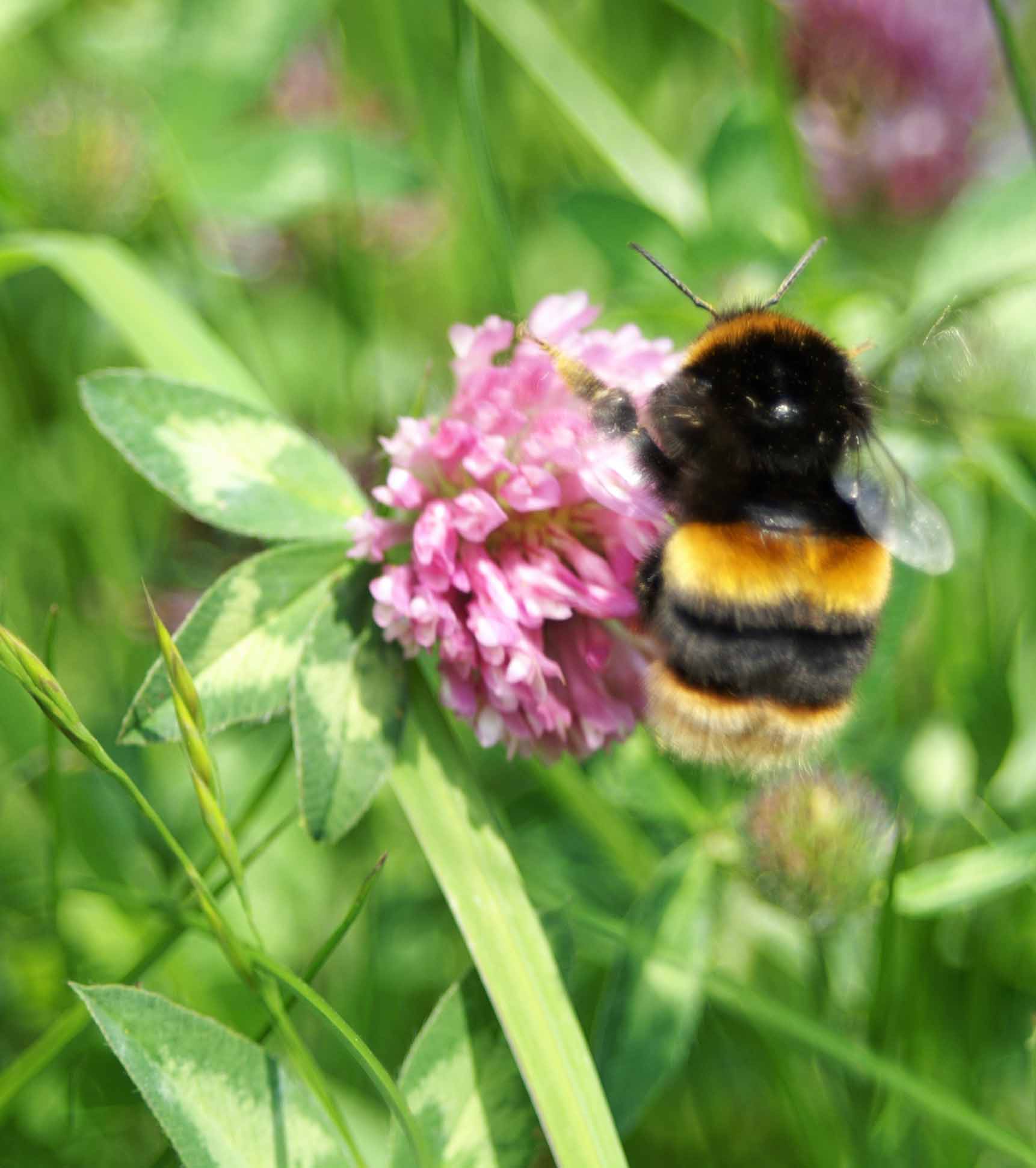
Buff-tailed Bumblebee – Bombus terrestris

Buff-tailed Bumblebee-Bombus terrestris on red clover
 everyday nature trails