• Home
  • about
  • about the photographs
  • Local Nature Reserves
    • Bryn Euryn Local Nature Reserve
    • Mynydd Marian
  • Wales Coast Path
    • Grey Seals in North Wales
    • St.Trillo’s Chapel
    • Wildflowers of North Wales Coastal Paths, Cliffs and Dunes

everyday nature trails

everyday nature trails

Tag Archives: the importance of ivy

In and Out of the Ivy

15 Thursday Feb 2024

Posted by theresagreen in Nature, Nature of Wales, woodland birds

≈ 3 Comments

Tags

bird behaviour, birds that eat ivy berries, Blackcap, Bryn Euryn, ivy berries, the importance of ivy, wood pigeon, wood pigeon bonding, Wych Elm

The view I have from my kitchen window, looking out over an unkempt, ivy-covered, frankly scruffy patch of scrubby woodland edge may not be to everyone’s taste, but it’s great habitat for a variety of wildlife and watching it has taught me a lot about the everyday local wildlife. Without having to set foot outside, I have privileged, often close-up sightings of a variety of birds, insects, the occasional fox and the ubiquitous grey squirrels on a daily basis. It’s like having a personalised all-seasons luxury hide, heated and with tea and snacks always to hand. 

First weeks of February – Part 1

The focal point central to my view, and the stage for much of the wildlife activity I am privileged to see every day is a wych elm tree. Situated a few metres up on a very steep slope, its branches seem to almost weep to the ground and its trunk is now covered with ivy. Perhaps because of its accessibility, the poor tree has been subjected to much battering by grey squirrels who nibble its leaf and flower buds, gnaw at its bark and devastate its seed cases. Despite all of that, it somehow continues to survive, although possibly not thrive, and this month, with Spring definitely underway, there’s a lot going on in and around its tangled branches. Here’s my view on some of its visitors so far this year that have been enticed to linger by ripened ivy berries.

On a sunny day, mid-morning the building casts a shadow

Surrounded by woodland, it’s not surprisingly that one of the most numerous birds in our locality is the wood pigeon. A species that divides feelings towards them, I’m on the fond side, maybe because here they’re in an appropriate habitat and not damaging my garden or crops. But I also love their looks, their plumage, gently shaded grey with hints of mauve the perfect foil to that warm pink breast. In addition they are characterful and obligingly easy and calming to watch. Most mornings they are the first birds I see. Often it will be a single one, surveying his territory from a lofty perch high up in an ash tree, but from this time of year onwards there will be pairs of them sitting together, and many others are drawn here by a bountiful crop of ripe ivy berries.

On alert and guarding ivy berries

Notoriously voracious eaters, there’s always competition for these nutritious berries and a particularly good, easily accessed spot will often be jealously guarded. Interlopers might be threatened with surprisingly aggressive-sounding cooing and pecking, or chased away with much noisy flapping of wings.

Big and with plump bodies, wood pigeons don’t appear to be built for acrobatics, but a good patch of ripe berries is irresistible, and they will often go after seemingly unreachable ones, after all, those who dare, win.
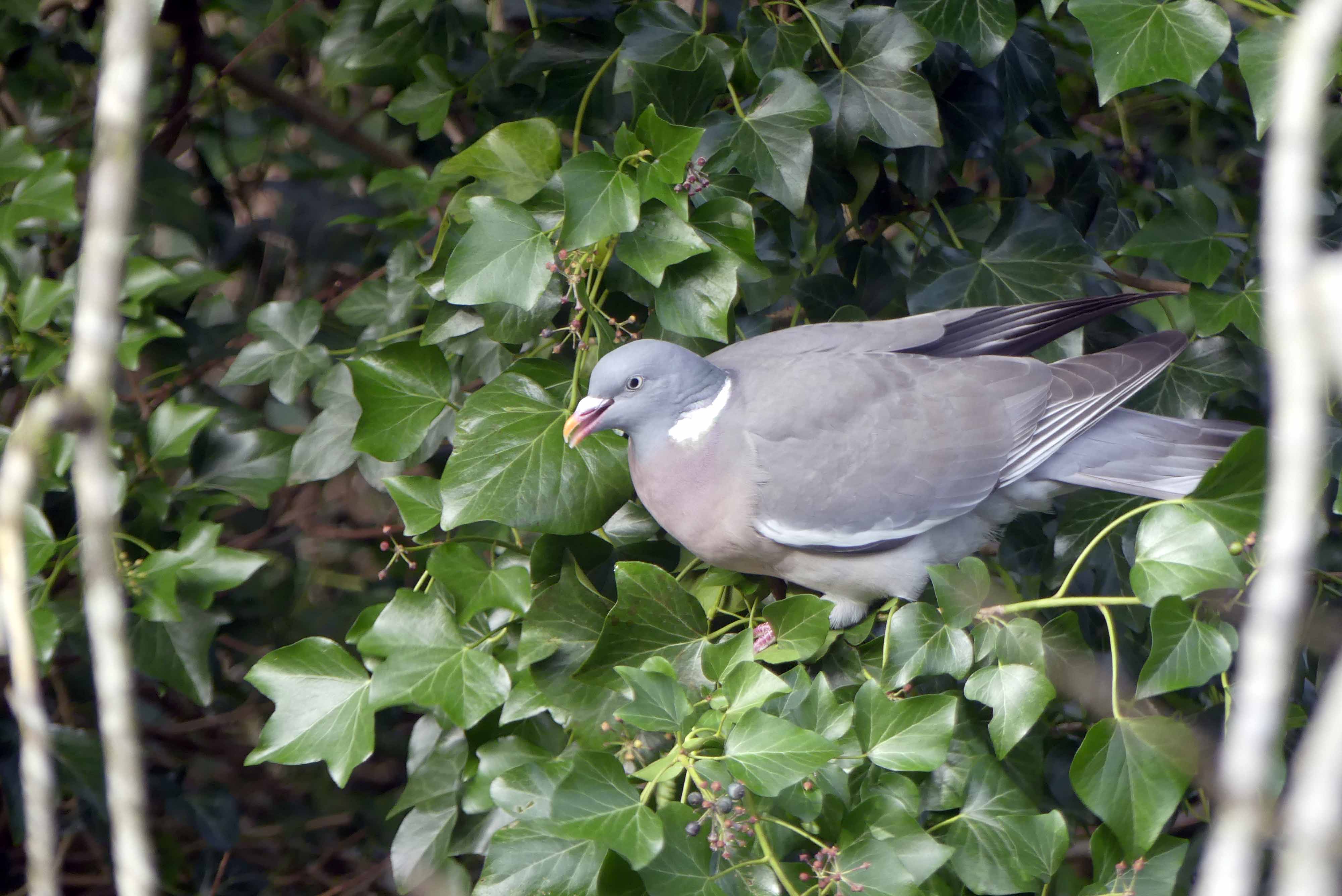
Wings and tails are fully deployed to assist balance to surprisingly good effect

and those scrawny necks have great powers of extension

The breeding season for wood pigeons is exceptionally long, and although the main season is between April and October, the species has been recorded breeding in every month of the year. Certainly, my local pair made an early start and have already re-committed to their monogamous relationship.
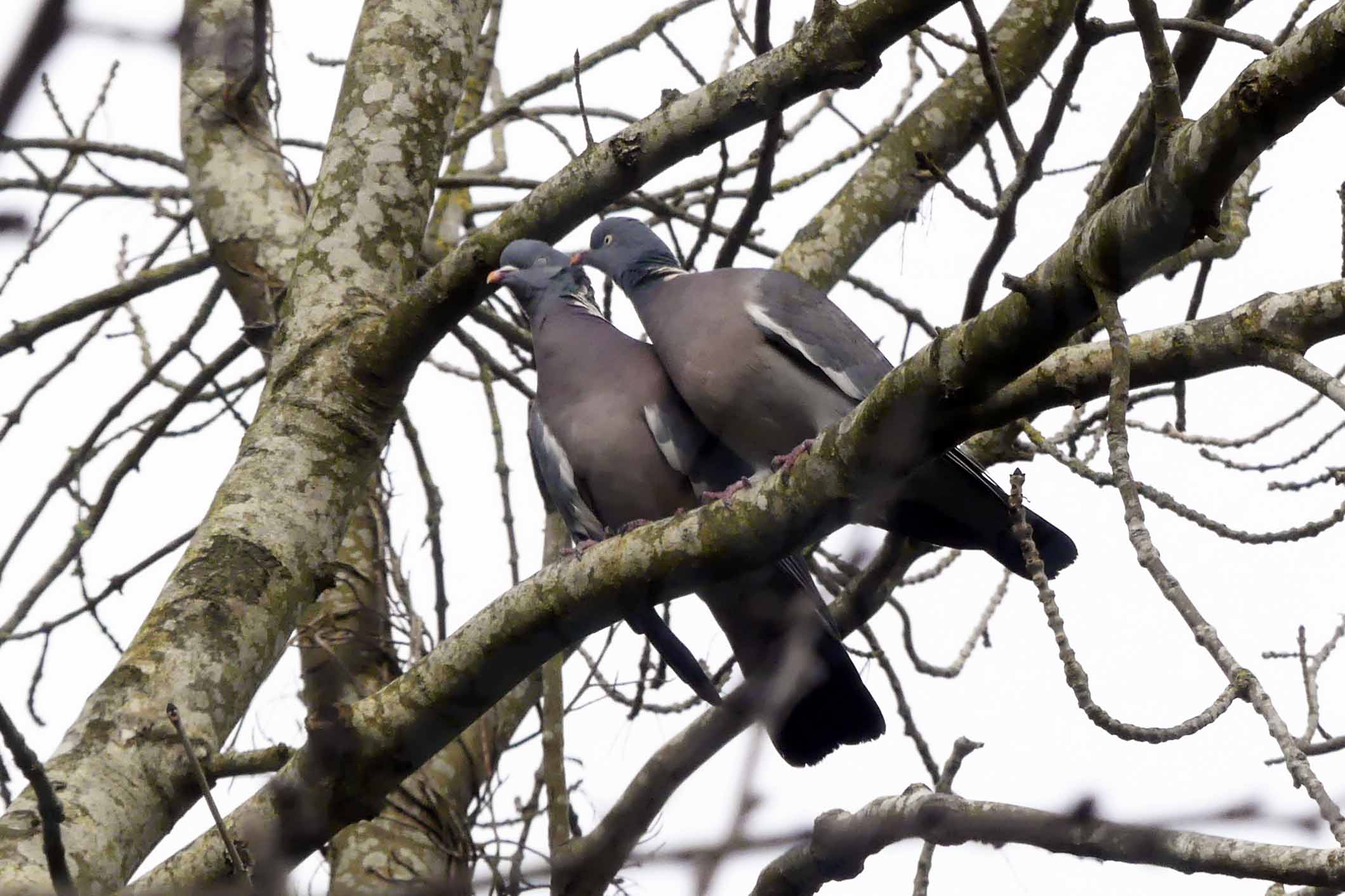
For as long as it takes to raise their latest brood, they will be closely bonded and spend much of their time in close proximity to one another, sometimes enforcing their bond with some neck-nuzzling and touching together of bills (the origin of ‘billing and cooing as a term of affection).

The picture below is set to become one of my all-time wood-pigeon favourites; a pair together on a branch of an ash tree. One sleeps, head tucked into that beautiful dusky pink cushiony breast, while the one behind sits quietly preening its feathers.

For the last few years there has been a pigeon’s nest in the depths of the laurel hedge, located to the side of the wych elm and a couple of metres away from our building. The female of the pair it belongs to, known to me as Priscilla, has begun the process of what I assume to be renovations, and has been out and about gathering materials. Now, if you’ve ever seen a wood pigeon’s nest you’ll know it’s not much more than a flimsy-looking platform of twiggy sticks, so you might be surprised by how carefully each of those sticks is selected. She spends long minutes walking deliberately around the branches of the wych elms, and probably other trees close by too, stopping now and then to peer closely and tweak a likely-looking twig to see if it will break off. Eventually she will be successful and carry off the chosen prize to add in to her pile. On her way she’ll often stop briefly, perching on the fire escape to check the coast is clear before going in to her nest site.

Another firm favourite bird of mine is the blackcap, a species that also includes ivy berries in its winter diet. Over the past years I’ve seen them often enough to be sure that some at least have remained here over the winters, and on occasions over the past weeks I’ve seen a male and less frequently a less-confident female, both around the ivy and the laurel hedge.

male blackcap lining up ivy berries in his sight

Blackcaps can be tricky to catch out in the open, preferring to stay within easy reach of cover, so I was lucky to catch sight of this one tucked in on a low (dead) branch of the tree, where he sat working out which ivy berries he could reach. Firstly he launched himself upwards and grabbed a berry in his beak, which he quickly ate, then launched again, this time landing on a very bendy tip of an ivy stem, stretching out to take a few more.
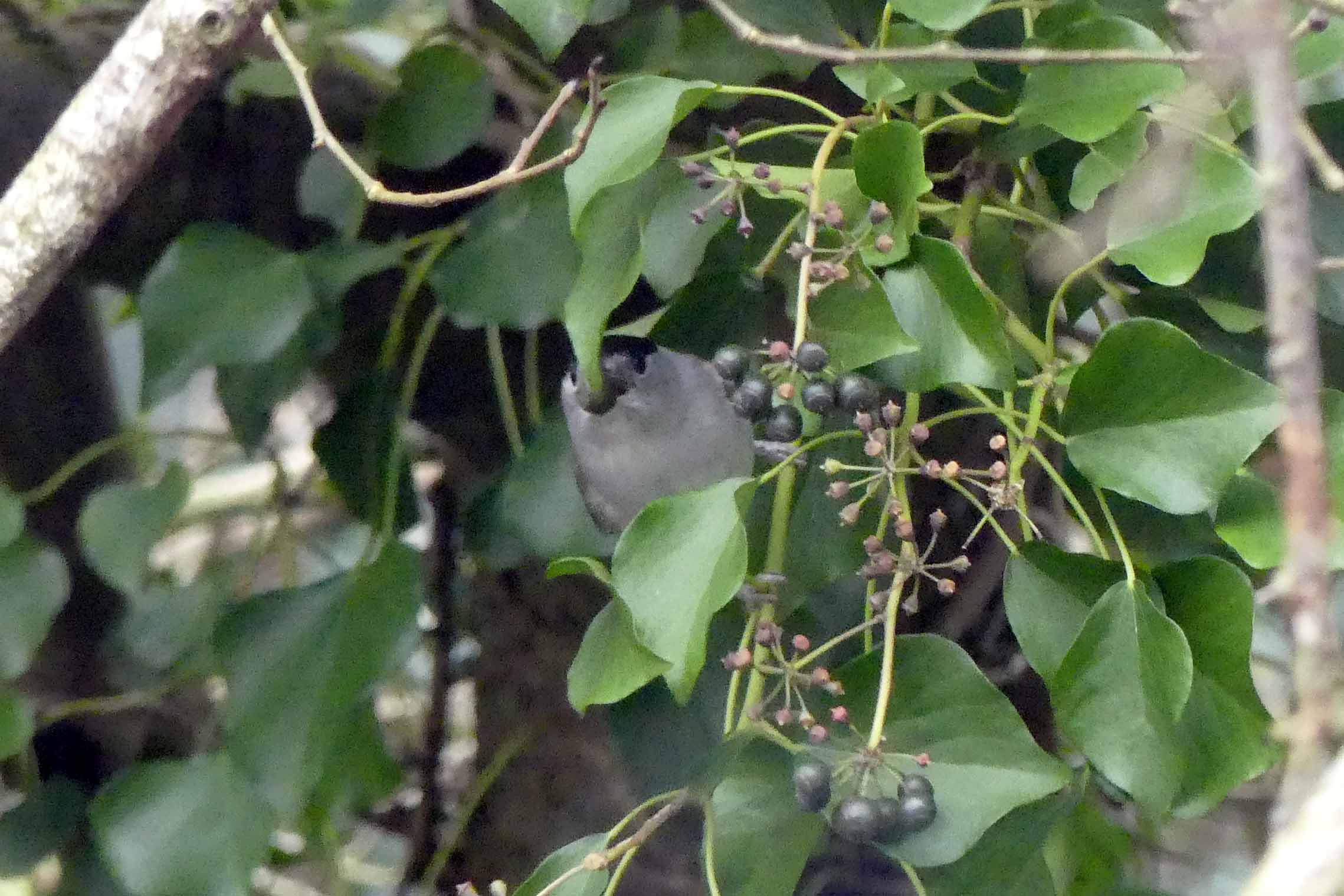
blackcap with a berry in his beak

From here he flew off, but I caught sight of him later exploring the laurel hedge. In no particular hurry, although fully alert, he seemed to be enjoying a sunny morning, travelling along the length of the hedge, searching for insects on its branches and beneath its leaves and occasionally darting out after one he’d disturbed.
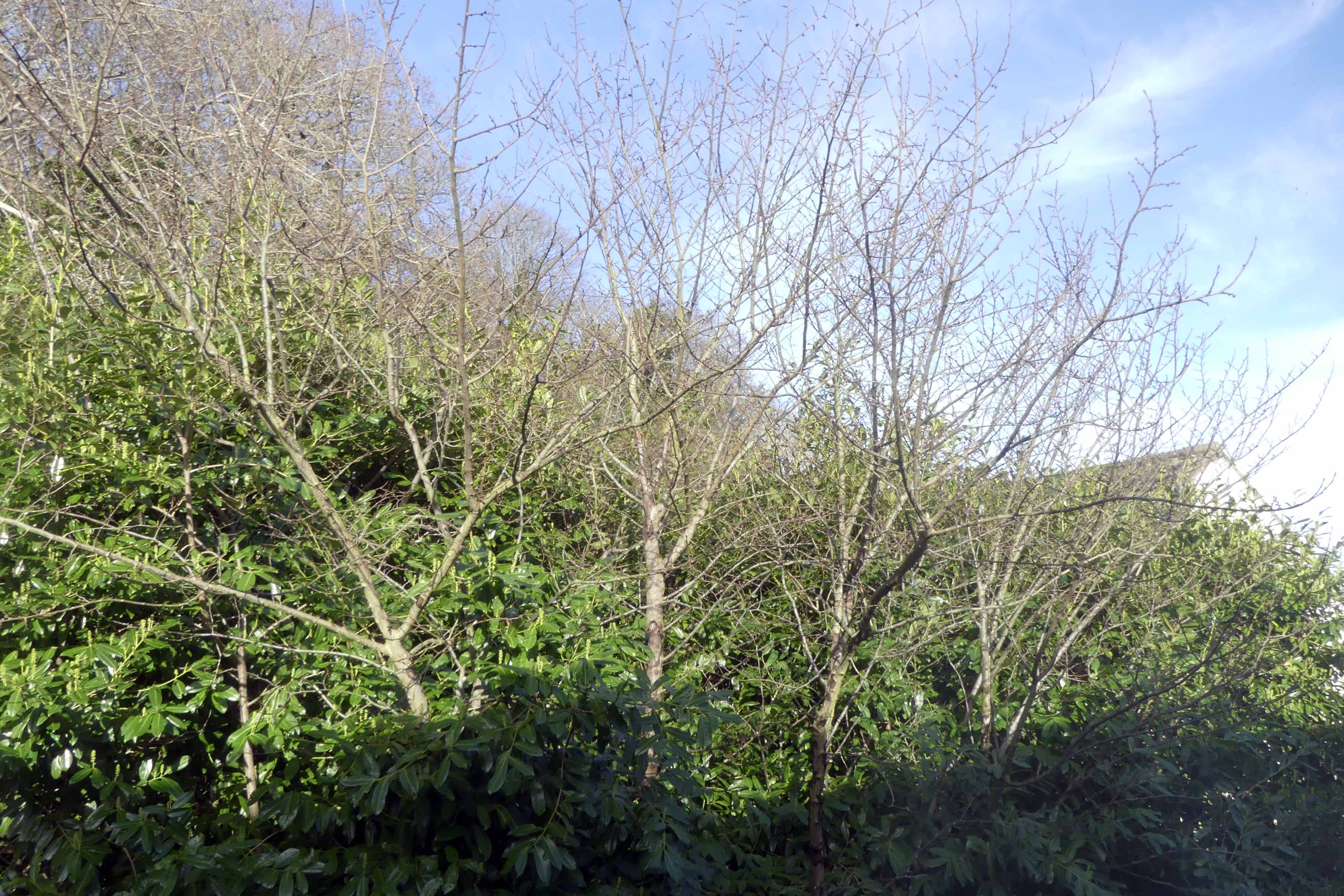
The laurel hedge in sunshine with young wych elm trees grown up from suckers

He tootled along till he’d almost reached the end of the hedge, then found a cosy spot to settle in. Behind branches of one of the young wych elms, sheltered by laurel leaves but open to the sun, he was well-protected and comfortable enough to perch there for almost twenty minutes.

I do hope he’ll stay around and nest somewhere close by….

Share this:

  • Share on Facebook (Opens in new window) Facebook
  • Share on Pinterest (Opens in new window) Pinterest
  • Share on X (Opens in new window) X
Like Loading...

Everlasting Green

10 Sunday Dec 2017

Posted by theresagreen in bird behaviour, Bryn Euryn Nature Reserve, nature of woodlands, North Wales, plants important to wilflife, woodland birds, woodland walks in Wales

≈ 4 Comments

Tags

blackbird behaviour, Certhia familiaris, evergreen ferns, evergreen trees, garrulus glandarius, goldcrest, holly, holly berries, Jay, long-tailed tit, Regulus regulus, sweet chestnut, the importance of ivy, treecreeper, turdus merula

December 3rd-Woodland Path, Bryn Euryn

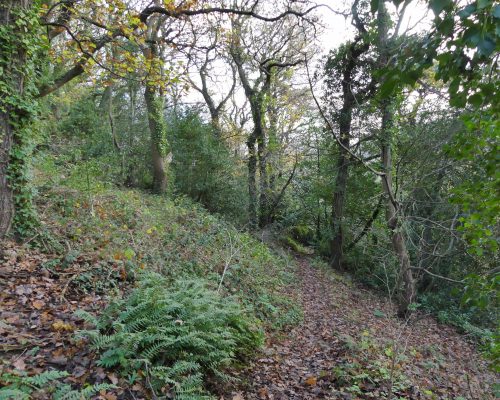
The deciduous trees of the woodland have for the most part shed their leaves now and they cover the ground in a thick damp carpet, exuding the evocative earthy aroma that characterises this time of the year. Their falling has opened up the overhead canopy, highlighting the evergreen flora that has merged into the background since the Spring.

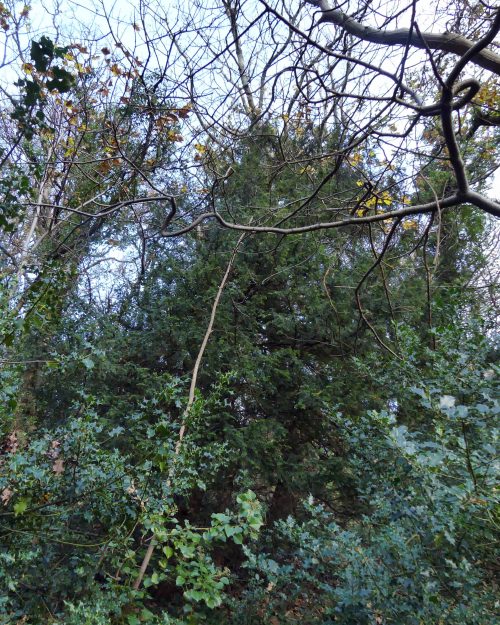
The amount of  permanent greenery always takes me by surprise. Much is in the varying forms of native trees and shrubs; dark dense Yew that fills spaces from the ground upwards, Scot’s Pines with tall trunks and bristly green crowns, glossy spiky Holly, some sprinkled with shiny green berries and of course Ivy, masses of it. There are other non-native residents too, sprawling Laurel being the most evident.

Laurel at the junction of woodland paths

Fallen leaves of sycamore and oak

Ivy is a much-maligned native evergreen that was thought to strangle trees as well as spoil their appearance. In the days when this woodland would have been strictly managed it would probably have been regularly stripped away. Now left to its own devices it is without doubt the most dominant of the native evergreens here; scrambling to the tops of even the tallest of trees in its search for light and covering large areas of the understorey too. The benefits of ivy to wildlife are enormous; both its pollen and berries can be an essential source of food for many insects and birds and it provides shelter for invertebrates, birds, small mammals and bats. At this time of year it also gives cover to foraging parties of small birds such as tits and treecreepers whilst they search amongst its stems and leaves for hibernating insects and spiders.

Ivy clambers up almost every tree

There’s green at ground level too; Polypody and Hart’s Toungue ferns are both evergreen. There are bright green patches of mosses and grey-green lichen is dusted in varying amounts onto most tree trunks and branches.

I love the little ‘scenes’ I find at this time of the year, full of interesting textures,  shapes and forms and coloured in earthy shades of green and brown.  Here the base of an oak tree has bright green moss and grey-green lichen growing on its fissured bark and tendrils of ivy are beginning their climb up. A polypody fern has found a sheltered spot, there’s a tiny new holly plant and the beginnings of a bramble.  

Nearby the fresh green leaves of Alexanders are already showing through the leaf litter.

Without the dressing of leaves the architecture of individual trees is revealed. I must have passed this tree dozens of times as I’ve walked this path but today it caught my attention as the sunlight turned its remaining dried out leaves to coppery gold.

I was unsure of the species of tree; looking upwards I saw it was tall, and also that its trunk and twisted branches appear bleached and much of its covering of bark is missing. Not helpful, but looking properly at the size and shape of the leaves I’m leaning towards Sweet Chestnut, another popularly planted non-native. There’s been no evidence of the prickly chestnuts though, so I’ll have to check to see if it produces flowers next Spring.

Ivy is creeping up the trunk of the tree and it has a backdrop of dense dark green Yew and shiny Holly.

Holly, ivy and yew

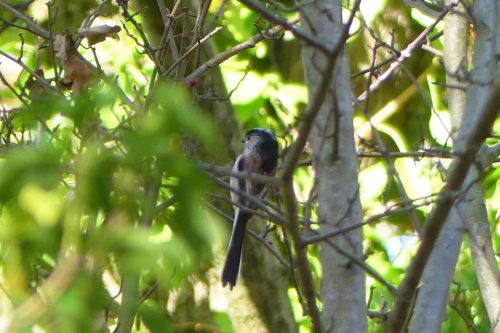
Long-tailed tit

I hear the contact calls of Tits and stand still hoping it means a feeding party are heading my way. It did indeed and now I don’t know where to look first as Long-tailed, Blue and Great Tits swoop and dart around the branches of the nearby trees. Some venture lower down giving me eye-level views. There were less birds in the party than those I saw a few weeks ago, so maybe they’ve split into smaller numbers as the availability of food has diminished. They seem to be travelling faster too, not lingering for long in one spot.

Blue tit

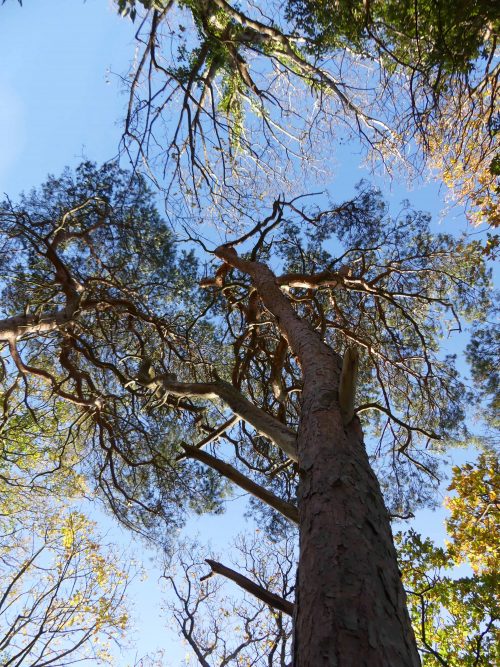
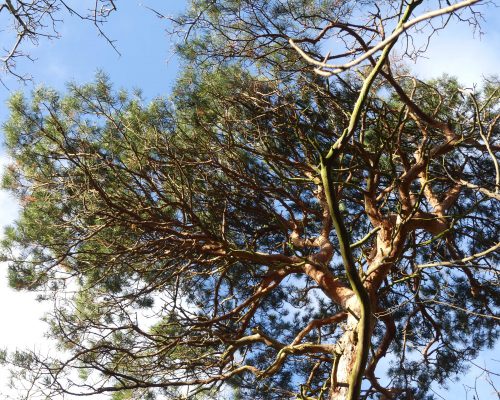
I wasn’t too far from where the Scots pines are gathered. Popular trees with the Tits I wondered if that was where they were headed. The trees are tall and positioned on the edge of the woodland; many have been distorted by exposure to winds and the search for light. With no low branches, their foliage is all on their crowns, so sighting anything as small as a tit is tricky, especially in sunshine. The light is beautiful up there though; I love these upward views of the tree canopy, especially on blue sky days. I’m thinking I would like to see a Coal tit though, haven’t seen one for ages.

Scots pine

A gathering of Scot’s Pines

I always stop here and look over the wire fence that marks the boundary of the private woodland and a small field. Trees on its edge although leafless are greened with ivy and gorse, which may well have once been planted as a hedge to contain livestock, has some golden blossom.

The views across the landscape to the Carneddau Mountains on the edge of Snowdonia are ever-changing with the light and the seasons and are always breathtaking.

Woodland Trail

I reach the top of the Woodland Path, and as always take note of the oak tree here at the junction with the Woodland Trail that marks the boundary of the Bryn Euryn Nature Reserve. It still has some leaves clinging on but they are fewer and browner now than a couple of weeks ago.

Oak tree on November 19th
Oak tree on December 3rd

I turn right, then a few metres on turn left onto the narrow unmarked track that leads upwards through the woodland.

I spot a large holly bush endowed with a generous crop of berries.

Walking towards it I disturb several Blackbirds from their feasting on the berries on its far side. Confident the hungry birds would come back once they thought the coast was clear, I stopped to wait a short way away, lurking behind a nearby tree.

If you’re looking out for birds, staying still in a likely spot is often more rewarding than any amount of walking and the next few moments bore this out. This part of the wood is favoured by Jays and I heard some screeching to to one another close by. At first I couldn’t locate them, but then saw one progress its way down from a tree to some low vegetation then onto the ground where it began searching for its stash of buried acorns. The green plant in the picture is newly-sprung Dog Mercury.

Brilliant to have such great views of two of these gorgeous and notoriously wary birds. I noticed one of them had what appeared to be an injury to its left side where feathers had been lost; maybe it was from the beak of another bird competing for buried treasure. It seemed OK though and was behaving perfectly normally. Then another treat. The little feeding party I’d seen earlier passed overhead and around me, Long-tailed and Blue tits in tree branches above, then flickering movements in the Holly bush alerted me to the presence of a tiny Goldcrest.

The Goldcrest is Britain’s smallest bird

These tiny jewels of birds, (Britain’s smallest), when on the hunt for insects are constantly moving, flitting deftly through dense foliage, hanging upside down effortlessly and even fluttering frantically to hover like a hummingbird, which must use up a lot of energy. They are delightful and fascinating to watch, but tricky to keep in focus and even trickier to photograph.

A Goldcrest can hover like a hummingbird

Holly is dimorphic, which means it has separate male and female plants, and only female trees bear berries. Traditional country wisdom has it that bountiful crops of berries are a sign of a hard winter to come. More scientific modern reckoning is that it is sign of a good summer past; we certainly had plenty of rain to swell berries this year.  I was surprised that the berries were being taken so early in the season though, I hope it doesn’t mean there’s already a shortage of other food available.

Most of the birds I saw appeared to be juveniles and they do seem to have been taking the fully-ripe berries.

Blackbird-Turdus merula

I was also surprised to find flowers on several bushes. They usually come forth around May when they stand a better chance of getting pollinated.

The low sun shines brightly through the trees spotlighting a small spindly tree with golden leaves. Once again I don’t know what species it is but from the size, shape and beautiful colouration of its leaves think it’s fairly safe to say it’s a maple.

“The Holly and the Ivy, Now they are both full grown” …….

Ivy completely covers a tall tree, Holly in front and a still-green Male fern on the ground

Another interesting little ‘scene’ catches my attention…

I’m never sure about the placement of this commemorative bench. It is weathered, covered with lichen and appears to have been there for decades, but the plaque gives a much more recent date. A reminder how nature is quick to move in given the chance.
It’s a shame the bench doesn’t face the other way as there’s a lovely display of ferns behind it; Hart’s Tongue, Polypody and Male Ferns are there and there’s pretty ferny moss too.

Past the bench the path continues through what I think of as ‘the Dark Wood’. Here the hillside rises steeply upwards on one side and almost as steeply downwards on the other. On the north/north-west side of the Bryn not much sunlight reaches here and there’s a density of Yew trees that also make it seem darker.

A spreading Yew

There are a lot of Silver Birches here too, which you would think would lighten the place up, but at their lower level trunks have darkened and on a few the bark has become strangely thickened and fissured.

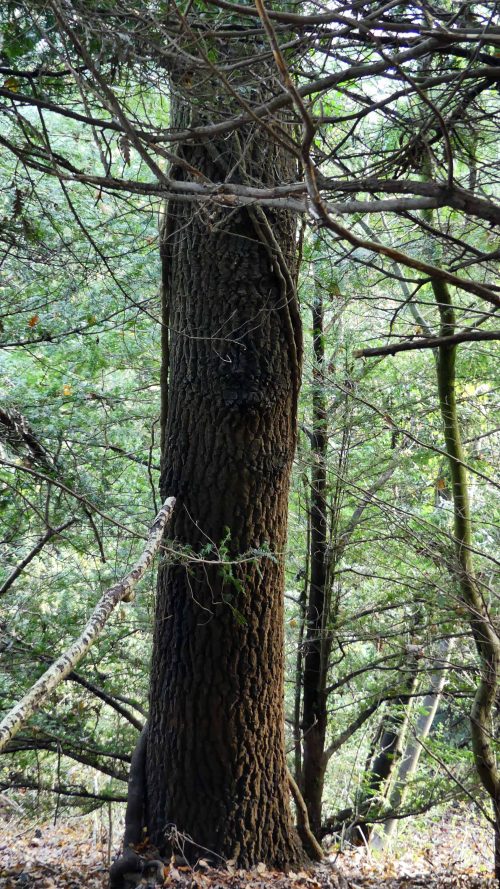
From the lower downward slope a mighty tree trunk rises, by far the biggest tree here and that I’ve always assumed was a mighty pine, a Redwood or Sequoia or such-like.

But today I noticed some large fallen leaves that could only have come from it. It would seem then that it’s another Sweet Chestnut, but here a properly magnificent specimen. What a shame to have only restricted views.

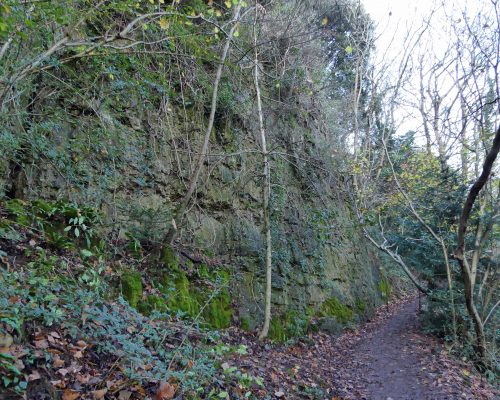
On the opposite side of the path a sheer cliff of exposed limestone towers and adds to the atmosphere. I wonder if it was once part of the defences of the ancient hill-fort that was located on the summit.

Water often leaks from fissures in the porous rock and moss thrives on its shaded damp surface.

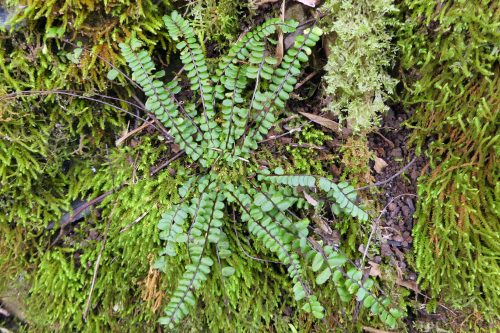
Having a closer look at the moss I found another fern amongst it, a tiny delicate one I’ve not noticed here before; a Maidenhair Spleenwort.

(I’m working on identifying mosses!)


Maidenhair spleenwort-Asplenium trichomanes

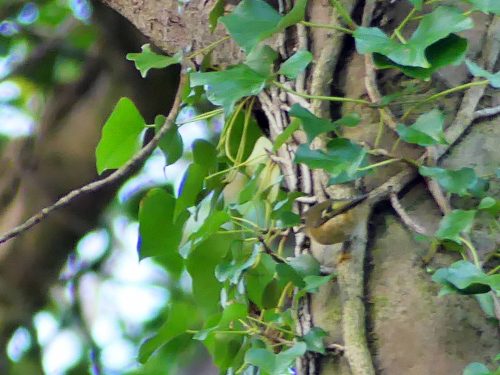
Past here there are more darkly-ivied trees. Today a movement caught my eye – another sighting of a foraging Goldcrest!

I watched it for what seemed like ages trying to keep it in sight as it flitted from branch-to-trunk-to-branch, in and out of the ivy, now doing its hummingbird impression – and then demonstrating a behaviour I’d read about but never seen; it climbed up the thick ivy stems like a tiny treecreeper. What brilliant little birds they are. I wish I’d had better light for better photographs.

A short way further on you are back out onto the wider brighter more open Woodland Trail.  Going down the wooden steps takes you to the car park, or as I opted, to loop around onto the lower part of the trail to get back to where I started.

As I stood deciding which way to go, one more treat, a Treecreeper making its way up another ivy-clad tree close to the path.

Treecreeper-Certhia familiaris


Share this:

  • Share on Facebook (Opens in new window) Facebook
  • Share on Pinterest (Opens in new window) Pinterest
  • Share on X (Opens in new window) X
Like Loading...

Wintergreens and Birds in the Woods

06 Friday Jan 2017

Posted by theresagreen in bird behaviour, birds of Wales, Bryn Euryn Nature Reserve, woodland birds

≈ 11 Comments

Tags

bird migration, Blue tit, coal tit, ferns that stay green in winter, goldcrest, Great Tit, long-tailed tit, redwing, the importance of ivy, treecreeper, wintergreens

January 2nd – Bryn Euryn 

Clear blue skies and frosted grass sparkling in brilliant sunshine were too much to resist, this had to be the perfect day for my first long walk of the New Year. Less than five minutes along my path into the woods I knew this was set to be a slow walk when I stopped to photograph berries on a holly tree. I was surprised to find so many remaining uneaten and noted ripe ones fallen and peppering the ground beneath. If not for that I may well have missed the flock of beautiful redwings that burst from the trees on the steep lower slope of the Bryn, exploding from their cover and rapidly scattering like shot from a gun, targeting branches of trees close by. There were a number of them, but impossible to count as once landed they are really difficult to spot. I was thrilled to see them and to be able to watch them and delighted that I got any photographs at all, so of two, this was the best.

170102-berc-4-redwing

Redwing – Turdus iliacus

I knew there were redwings around as I’d been fortunate enough to see some from my kitchen window on the morning of New Year’s Eve and one a couple  of days before that, but I had no idea whether they were just passing through or were here to stay. I’m not certain, but I think they were searching through ivy for ripe berries. Now I am hopeful they will stay for a while, at least while they are finding food.

Ivy berries are in varying stages of ripeness

Ivy berries are in varying stages of ripeness

170102-berc-3a-polypody-fern

Polypody fern

The majority of deciduous trees are bare now, but there is much that is green. Here we have our native holly, copious amounts of ivy, yew, a few Scots pines that are a native but that were most probably introduced, and rather a lot of laurel, once much beloved by Victorian gardeners.

170102-berc-6-scots-pine

At ground level there are ferns, the polypody in the photograph above, and also hart’s tongue and male ferns.

170102-berc-58-harts-tongue-male-ferns

Hart’s tongue & a small male fern

And there’s lots of moss.

170102-berc-22-mossy-stones

Then my reward for wandering slowly and numb fingers on my gloveless right hand, left free to focus and press the shutter button on the camera; suddenly I was surrounded by the joyous energy and excited sounds of a number of small birds. A feeding party, a collective of a variety of species of small woodland birds united in the eternal search for food.

It’s impossible to say who arrived first, I didn’t sense that there were leaders and followers, more that the flock was operating as a single entity arriving at a pre-determined spot with potential for all members. Of course there were blue tits, also great tits and a couple of coal tits.

170102-berc-7-blue-tit

Blue tit

An encounter with a feeding party of birds is a magical, uplifting and energising experience. The birds themselves exude excitement and energy, seeming to delight in the thrill of being part of a gang.

170102-berc-18-great-tit-or-coal-tit

Coal tit

The enchanting long-tailed tits were there too.

170102-berc-17-long-tailed-tit

Long-tailed tit

Once arrived they quickly settled to foraging amongst the trees and shrubbery, splitting back into their families or species groups. I would have been happy with the company of just the exuberant tits, but have to admit my attention was stolen from them when I noticed the treecreepers. Often included as members of a feeding party, there were two on a tree in front of me and then another two, closer to the side. What a treat to have that many of these gorgeous little birds so close and not only in range of the camera but with the added bonus of bright sunlight too.

170102-berc-13-treecreeper

Treecreeper

170102-berc-9-treecreeper

170102-berc-11-treecreeper

I lost track of time watching the birds, but they gradually moved away and passing people walking a dog and chatting  broke the spell and I too turned to continue my walk. But there was one more little treat to come – two tiny goldcrests, that may or may not have been with the feeding party, were working their way through a small holly bush nearby. I watched them for a good while, but they eluded capture by my camera, they are much too quick especially when trying to contend with foreground vegetation. The shot below was the best one I got!

170102-berc-5-goldcrest

Goldcrest

Before heading on to the trail around the Bryn I had a look at the view over the boundary fence. The higher peaks of the Carneddau mountains have snow with clouds above them that look to be holding more. The warming sunshine had them shrouded in a light veil of mist, with more rising from the Conwy river in the valley below.

170102-berc-19-snow-on-the-mountains

Share this:

  • Share on Facebook (Opens in new window) Facebook
  • Share on Pinterest (Opens in new window) Pinterest
  • Share on X (Opens in new window) X
Like Loading...
Follow everyday nature trails on WordPress.com

Enter your email address to follow this blog and receive notifications of new posts by email.

‘But it is the common species that keep the living world ticking over and provide most of our experiences of wildlife, and I would argue that maintaining the abundance of these is as important a conservation priority as maintaining the existence of rarities’. Richard Mabey

MOST RECENT POSTS

  • A Glimpse of Spring to Come January 22, 2025
  • Hunting the Wren December 28, 2024
  • Oh, Christmas Tree December 18, 2024
  • In and Out of the Ivy February 15, 2024
  • Nature’s Fireworks November 30, 2023
  • Wild Autumn along the Coast Path November 3, 2023

OLDER POSTS

LOOKING FOR SOMETHING IN PARTICULAR?

  • Things Bright and Beautiful
    Things Bright and Beautiful
  • Sights and Sounds from the Little Orme 1
    Sights and Sounds from the Little Orme 1
  • Catchers, a Duck and Divers
    Catchers, a Duck and Divers
  • May Bee Appearing on Ivy near You
    May Bee Appearing on Ivy near You
  • Following a river to a Fairy Glen
    Following a river to a Fairy Glen
  • Shades, Sounds and Scents of the Woods
    Shades, Sounds and Scents of the Woods
  • Fine Dining for Crows
    Fine Dining for Crows
  • A Windy Wildflower Trail
    A Windy Wildflower Trail
  • The Windhover
    The Windhover
  • A Window on the Woods-Winter 1
    A Window on the Woods-Winter 1

nightingale trails

The Walk of the Monarch Butterfly-Sendero de la Mariposa Monarca

The Walk of the Monarch Butterfly-Sendero de la Mariposa Monarca

MY WILDFLOWER BLOG: where the wildflowers are

Snowdrop

Snowdrop

most recent posts

Follow everyday nature trails on WordPress.com

Social

  • View teresamaygreen’s profile on Twitter

Enter your email address to follow this blog and receive notifications of new posts by email.

Website Built with WordPress.com.

  • Subscribe Subscribed
    • everyday nature trails
    • Join 359 other subscribers
    • Already have a WordPress.com account? Log in now.
    • everyday nature trails
    • Subscribe Subscribed
    • Sign up
    • Log in
    • Report this content
    • View site in Reader
    • Manage subscriptions
    • Collapse this bar
 

Loading Comments...
 

    %d