• Home
  • about
  • about the photographs
  • Local Nature Reserves
    • Bryn Euryn Local Nature Reserve
    • Mynydd Marian
  • Wales Coast Path
    • Grey Seals in North Wales
    • St.Trillo’s Chapel
    • Wildflowers of North Wales Coastal Paths, Cliffs and Dunes

everyday nature trails

everyday nature trails

Tag Archives: Old Colwyn

On a Cool, Damp Day in Early Spring…

16 Sunday Apr 2023

Posted by theresagreen in Nature of Wales, Nature Walks, North Wales

≈ 3 Comments

Tags

April, Birds, early spring, Fairy Glen, grey wagtail, Old Colwyn, river Colwyn, wildflowers, woodland

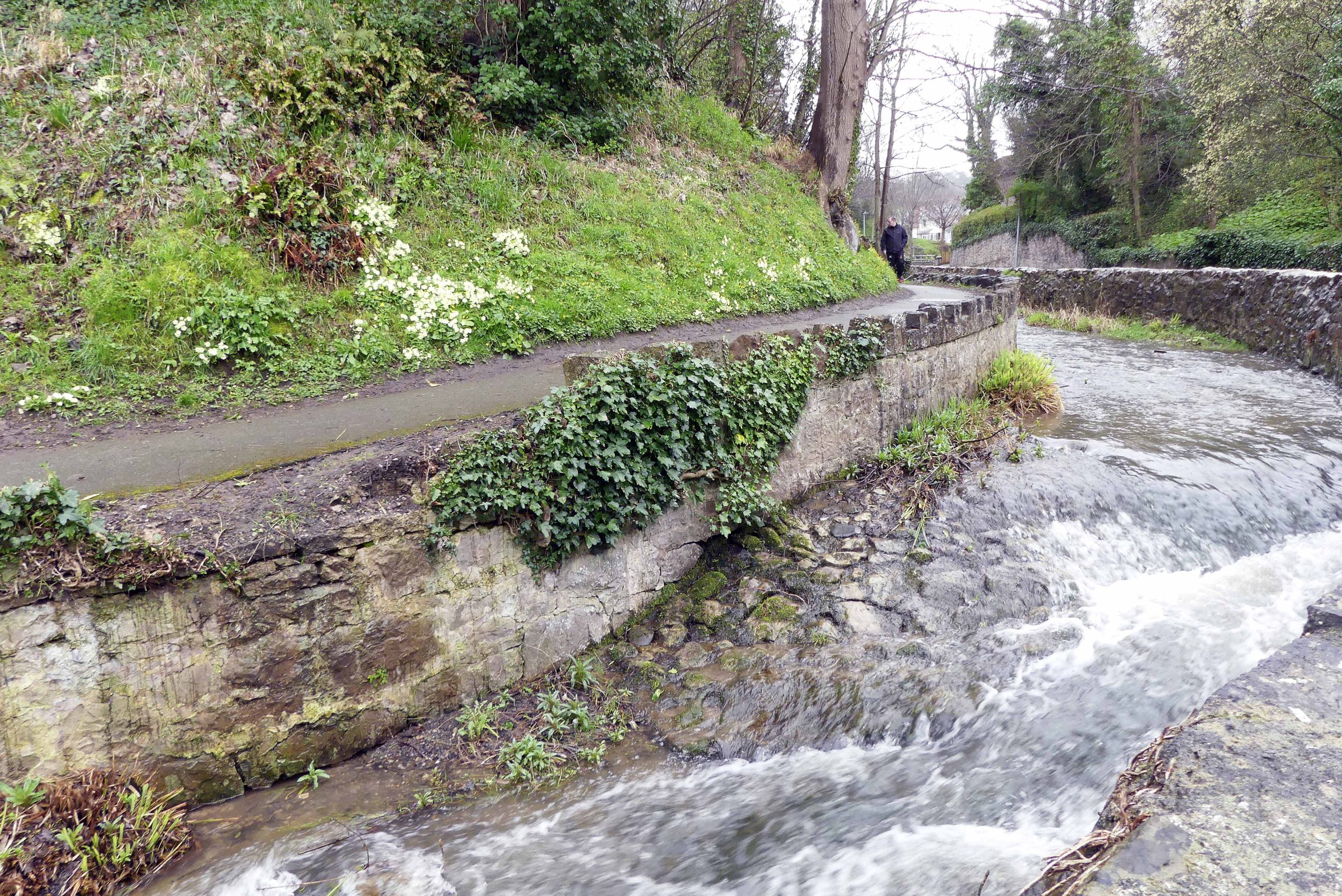
Slow to get going, this early Spring has been a bit of a roller-coaster weather-wise, with temperatures yo-yoing up and down almost on a daily basis. On occasional days the sun has been hot enough to burn, but most have been cloudy cool and at best damp from frequent rain showers. But the progress of Spring carries on apace and I don’t want to miss it, so I remind myself that cool, damp, cloudy days can be just as  rewarding as warm sunny ones, especially if you’re out between showers or soon after rain has stopped. On such a day I headed for one of my favourite places to meander – alongside the little River Colwyn where it runs through Old Colwyn and completes its journey to the sea. 
On damp grassy banks the flowers of celandines and daisies are closed against the damp and lack of sunshine.
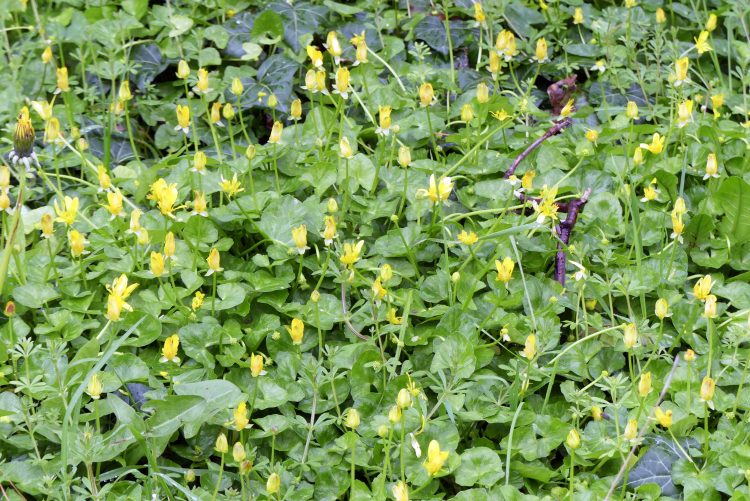
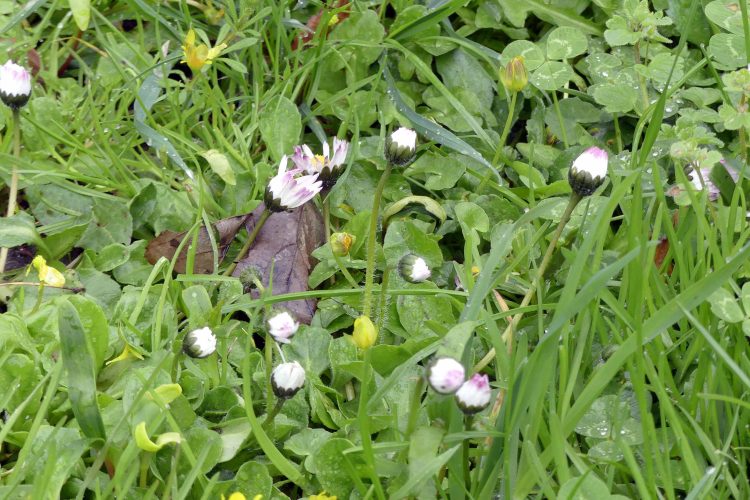
lesser celandines
common daisies

The river is rarely deep, but today it was full enough to cover most of its rocky bed, shallow enough to create falls and white water where levels drop down, and running fast enough to make itself heard as it raced towards the sea.

The limestone wall that keeps it within bounds, damp from recent rain is decorated on the road side with opportunistic little plants; prettiest now were ivy-leaved toadflax with its little lilac-mauve flowers and the succulent grey-green leaves of a stonecrop.
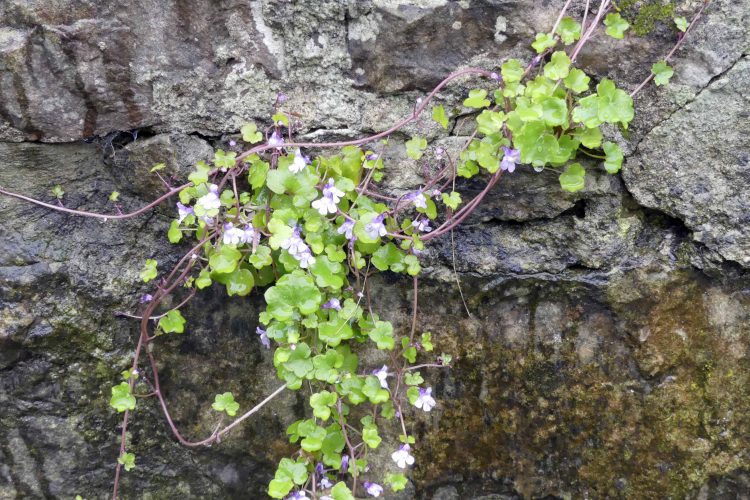
ivy-leaved toadflax
stonecrop

Coed Myn y Don Woodland

The board illustrating some of the variety of trees that grow in this remnant of woodland is slowly being integrated into its surroundings, but is just about legible. Part natural woodland and part garden, there’s an interesting mix of flora here, trees, native wildflowers and cultivated ones blend well, and together with the river they help make this a valuable haven for some of our local wildlife. In places though, wildflowers are in danger of becoming overwhelmed by rapidly-spreading winter heliotrope, as I’m finding increasingly in other local spots I visit.
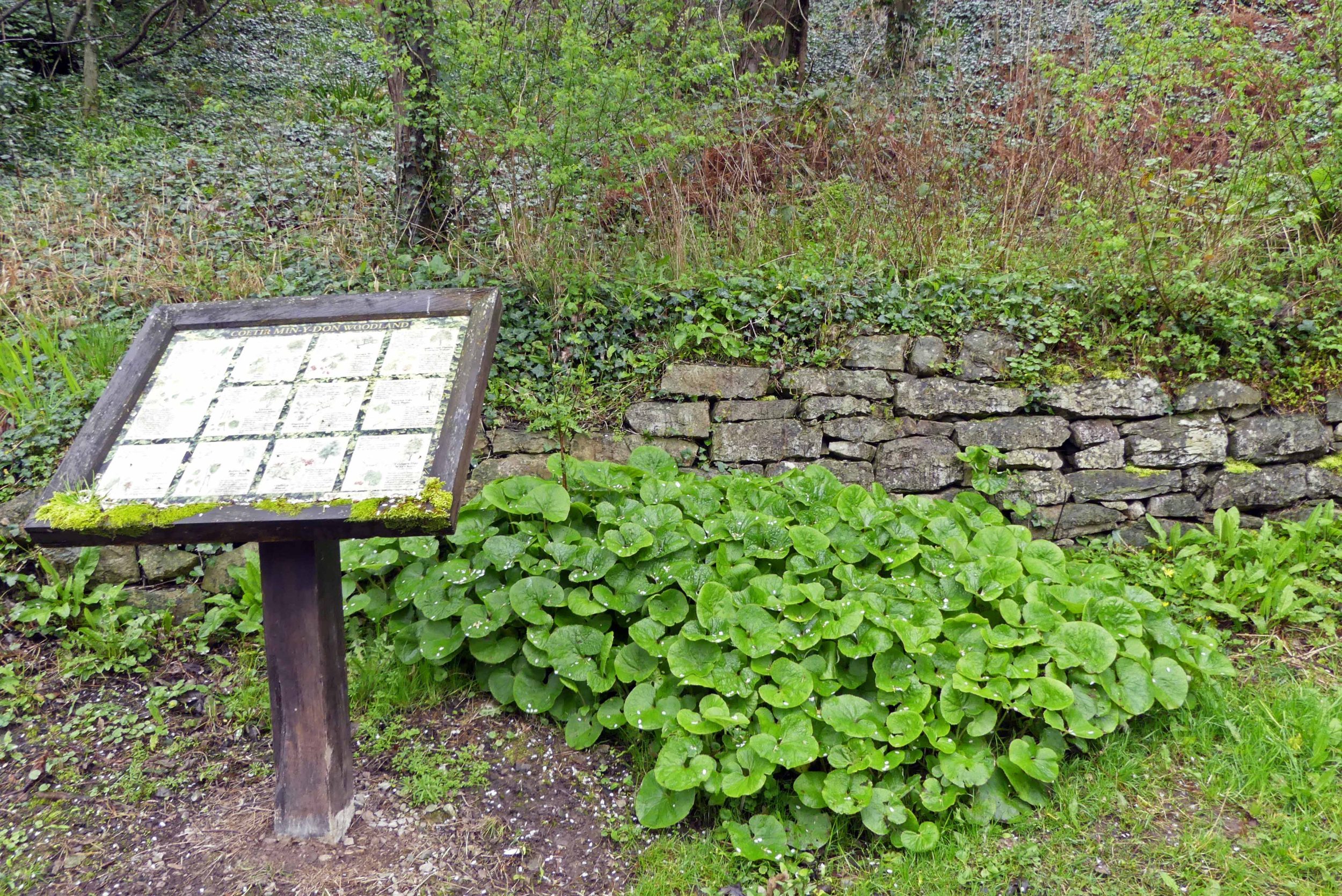
Winter heliotrope spreading beneath the info board

The golden flowers of a plant I hadn’t noticed here before caught my eye. Growing through grass and other plants, a small patch of the rather inelegantly named opposite-leaved golden saxifrage, which favours growing in damp, even boggy shady woodland places.

opposite-leaved golden saxifrage flowers
opposite-leaved golden saxifrage flowers & leaves

On the sloping bank that follows the curve of the river are primroses, which smelt delicious, common dog violets, wood anemone, whose flowers were closed and dog’s mercury.

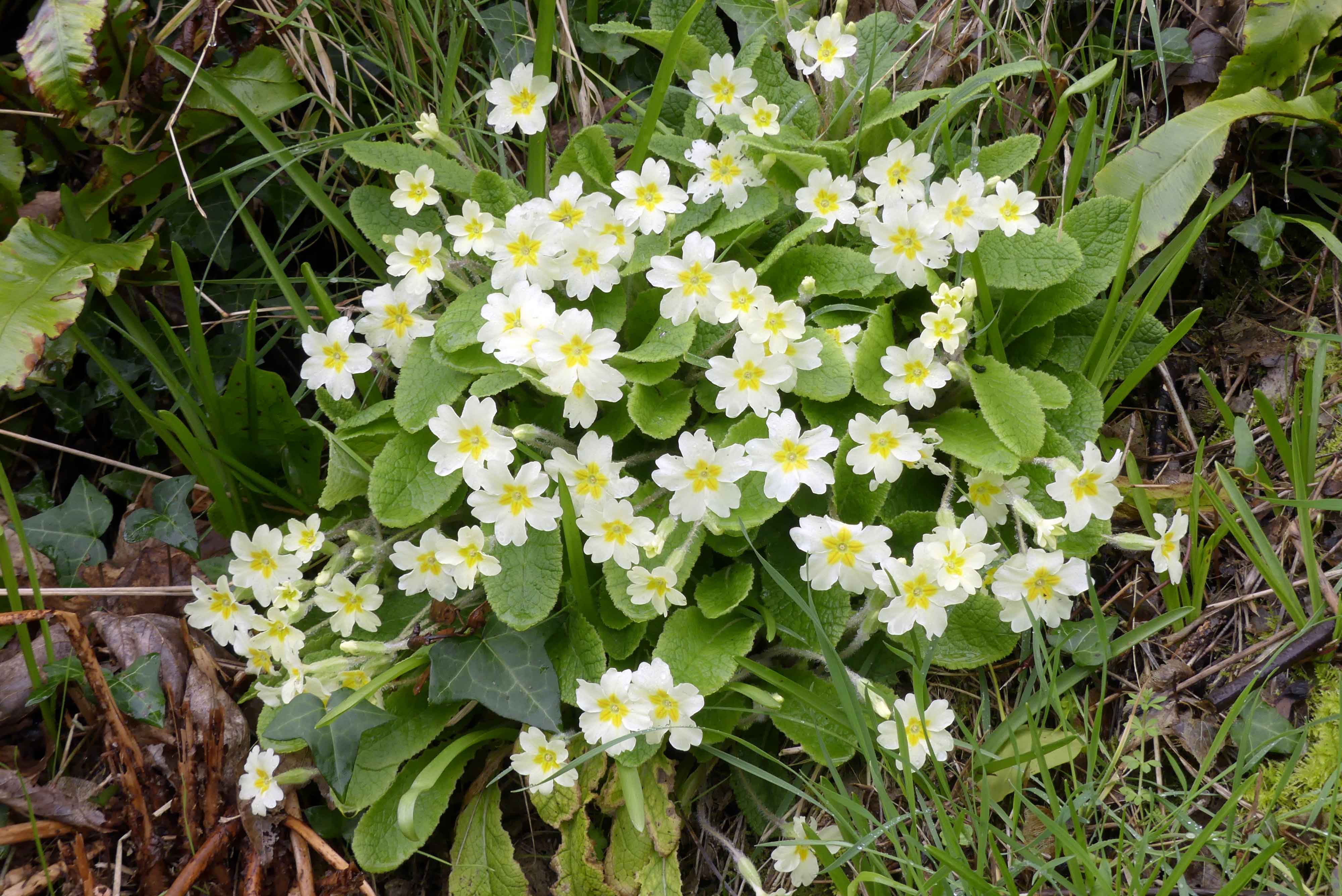
common dog violets
primroses

Over the years, this has consistently been one of the very best places I know for hearing and seeing birds, and I wasn’t to be disappointed today. A chorus of birdsong accompanied the sound of the water; I stop to listen and although the songsters are hidden from sight, I heard a melodious blackbird, a robin, a few notes from a wren as it broke from cover and a taunting chiffchaff, one of my ‘targets’ for today, which frustratingly I couldn’t locate.

Tan y Bryn Gardens
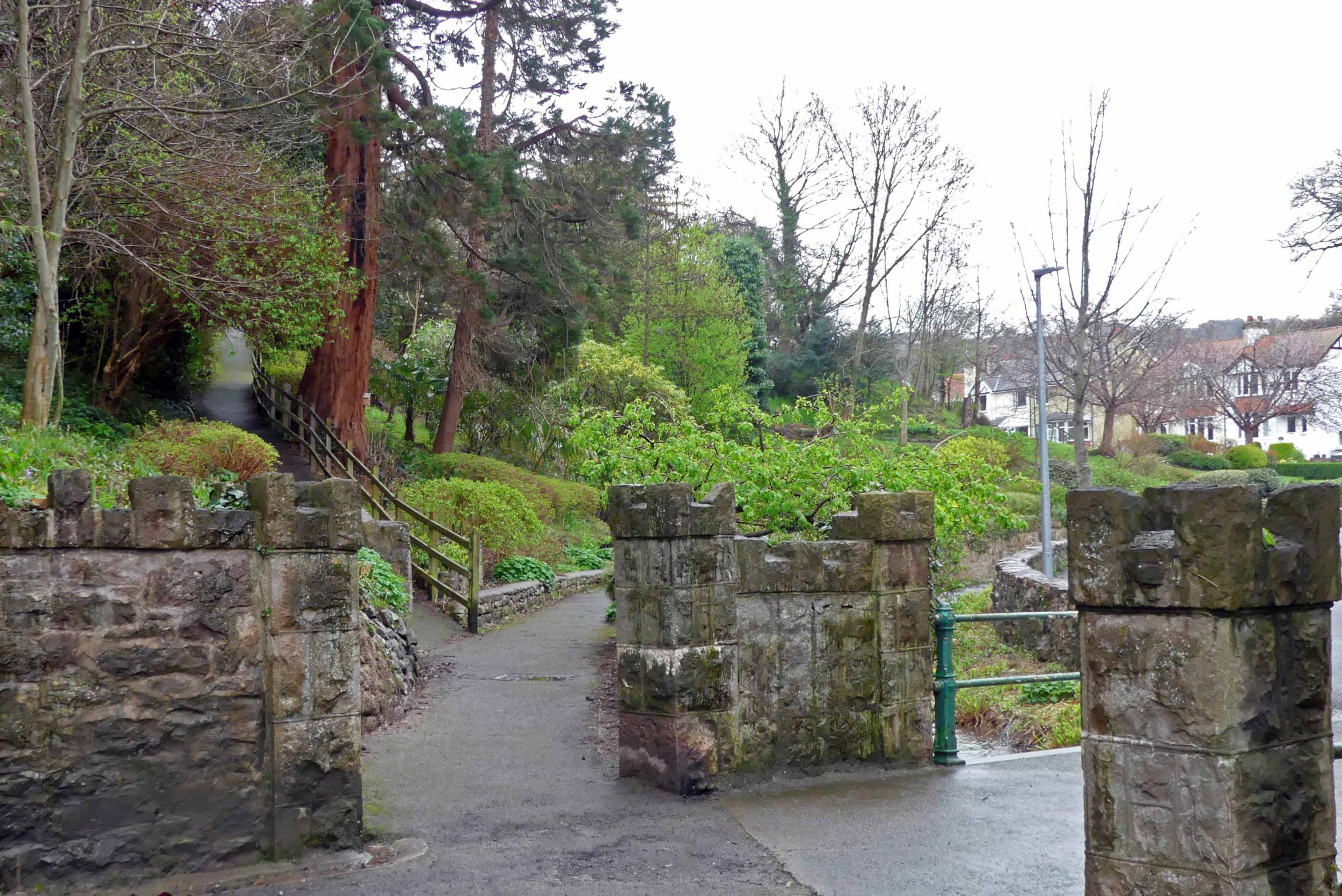
On the bank just inside the entrance to the gardens the strange other-worldly shoots of one of our most ancient wild plants, horsetail, are already grown quite tall. A notoriously stubborn garden invader, I wonder if some of the plants are deliberately left, or whether they just refuse to be banished. A little further on, where water pools at the bottom of the slope, another alien-looking bud, this one enormous and belonging to the giant gunnera (aka giant rhubarb) with its correspondingly enormous leaves.
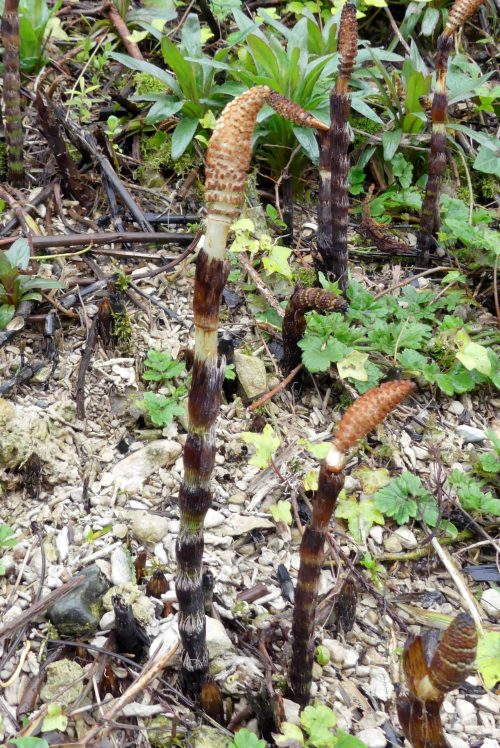
horsetail buds
flower bud of giant gunnera

I stopped to listen to a song thrush. Perched in the shade on a branch of a tree close to the path he was singing enthusiastically, as song-thrushes do, then every so often pausing. In those intervals I could hear another song thrush singing from some distance away, in the woodland that continues on the other side of the road. They were clearly communicating, perhaps confirming their territorial claims, or maybe just having a conversation, discussing the sorry mess their human neighbours are making of things.
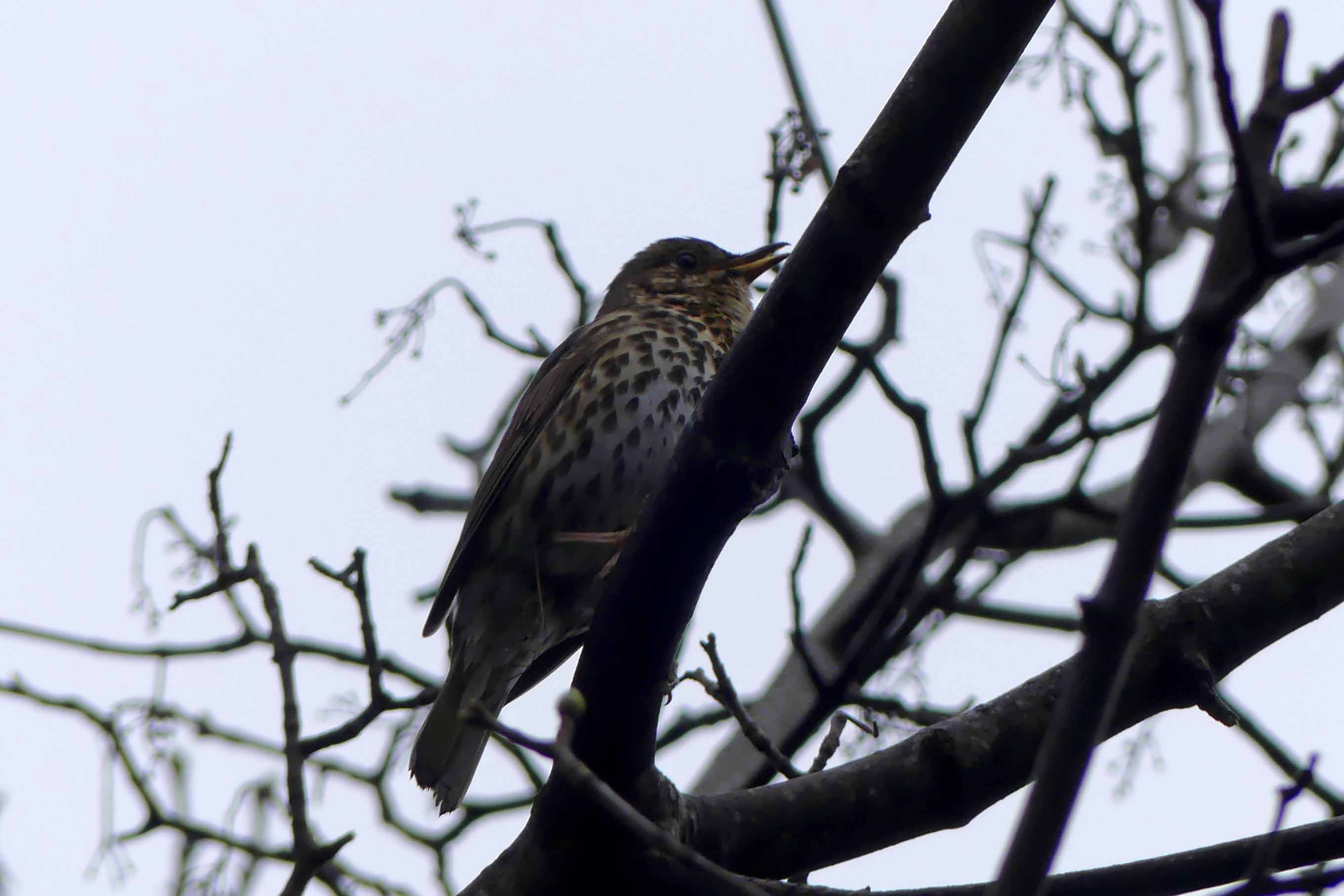
song thrush singing

As I stood listening to the thrushes, a robin, rapidly followed by another flew right in front of me, so close I’m amazed they missed me. They headed straight into a shrub, routing out a third robin, which flew out at speed and dived into a tree. The other two, most likely a pair, were right on its tail and the three of them chased across the road, where the ‘invader’ departed, leaving the others to regain their composure on a garden wall.

They weren’t the only ones chasing about; just seconds later two dunnocks raced past me. One disappeared from sight while another landed quite prettily in the middle of a flowering shrub.

dunnock

Moving on, I was keeping an eye on the river and also scanning the rooftops of houses opposite, hoping to catch sight of a grey wagtail, always one of the special birds I hope to see here.

The damp short turf alongside this stretch of path is a favourite spot for foraging blackbirds and I’ve also seen both song and mistle thrushes here on occasions. Today it was left to a single pair of blackbirds out hunting together, which probably means they have young, hungry offspring to feed.
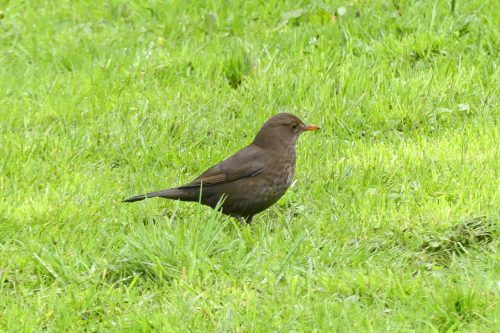
female blackbird
male blackbird

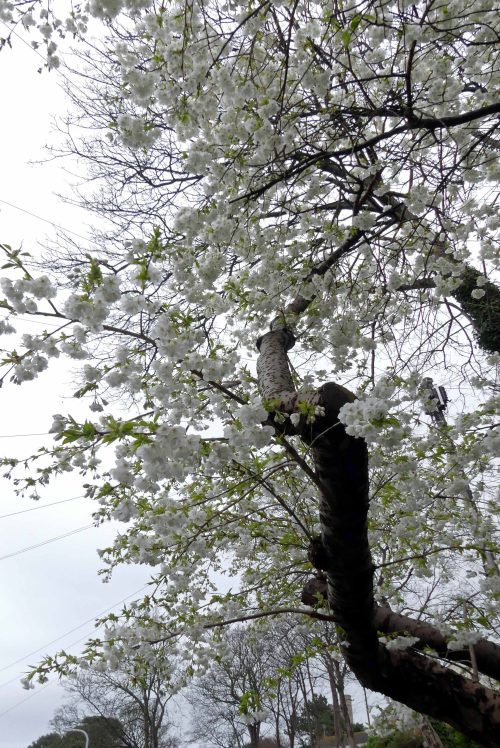
Nearing the top end of the gardens, one of my favourite local trees overhangs the path. A Japanese cherry, this beautiful tree is one of the highlights of a walk here at this time of year and is a total treat for the senses. Its snowy white blossom, which usually appears before the leaves, looks beautiful and has the most delicious rich honey-almond-y fragrance, which on a warmer, sunnier day might have been visited by bees. I’m not entirely certain, but I think it’s a Mount Fuji Cherry, named for the holy Japanese mountain covered with eternal snow

Following on from the sublime beauty of the tree, the next part of the path, which together with the river, passes under buildings and the main road through the village, has less appeal. Sadly, this lovely little river is prone to having rubbish thrown into it, most frequently glass and plastic bottles and drinks’ cans etc., but also random bigger items. Today’s photograph contains the frame of a pushchair.

Nearing the underpasses, I was distracted from thoughts of littering and fly-tipping by a flash of yellow and the flickering movements of a bird amongst the thicket of old ivy that covers the wall to the right of where the river flows through. There, inspecting the dried materials amongst the twining stems, a female grey wagtail was taking her time searching for pleasing pieces, which I think it’s safe to assume, would contribute to the construction of a nest.

grey wagtail pair

She was joined by a slightly brighter, more colourful male, who made several attempts to get closer to her, but definitely wasn’t interested in helping to collect nesting material. I watched them for quite a few minutes – she picking out bits and dropping them when she found something better; he flying off and coming back several times until they finally flew off together, up and over the wall and away over the houses on the far side of the road. Not the direction I’d expected, but maybe they were making a distracting detour to their nest site.
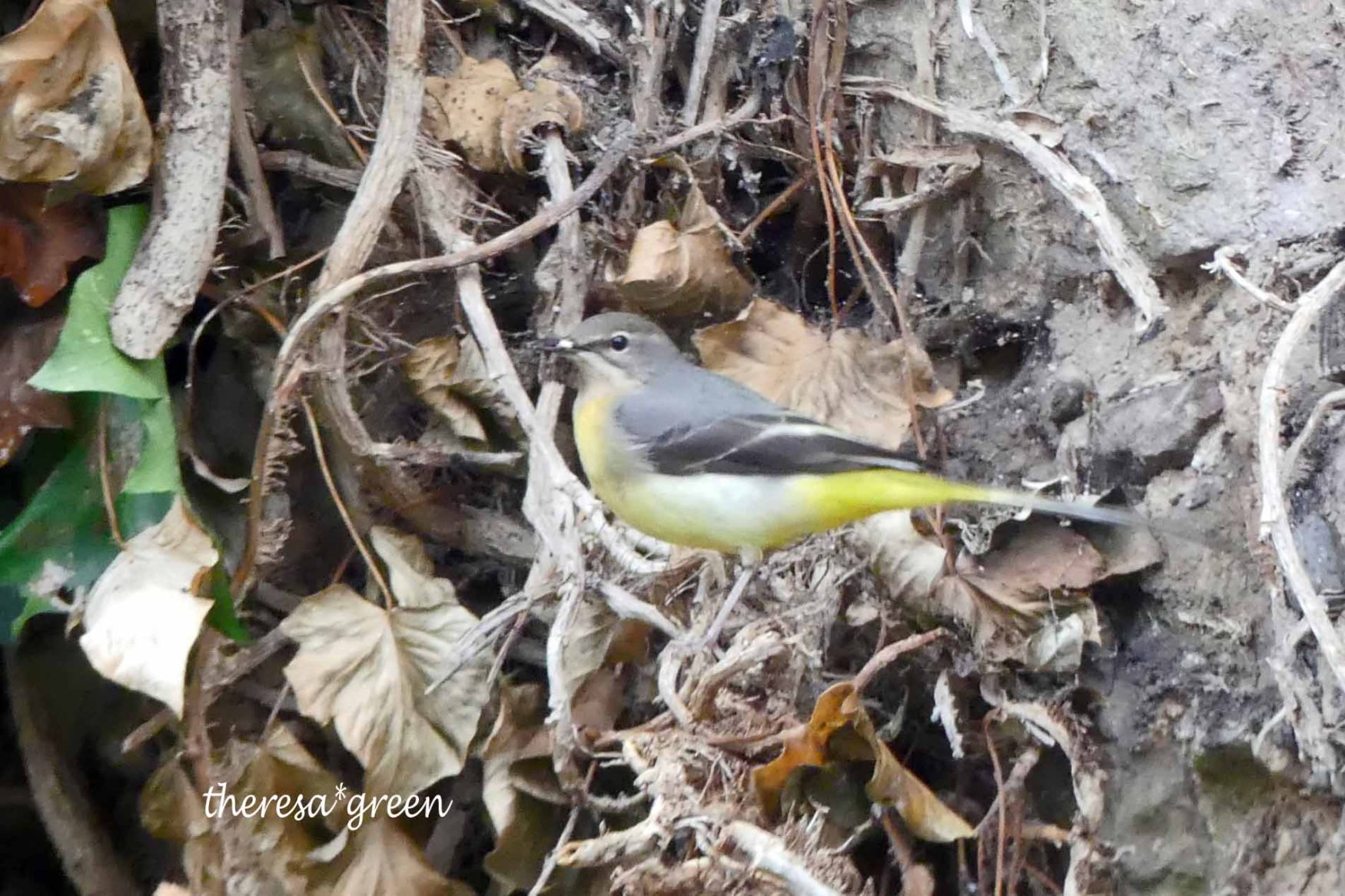
female grey wagtail

Some of the lack of beauty of the pedestrian underpass has been made up for by some colourful, well-painted graffiti on the outside entrance and along the inside walls of its length. At the moment it’s further enhanced by one of the biggest patches of ivy-leaved toadflax I think I’ve ever seen.

Inside, my favourite piece of graffiti art cleverly depicts the part of Abergele Road, which is immediately above, but as it may have looked when the tram ran through it, and also the viaduct which spans the bottom of the road where I began my walk.
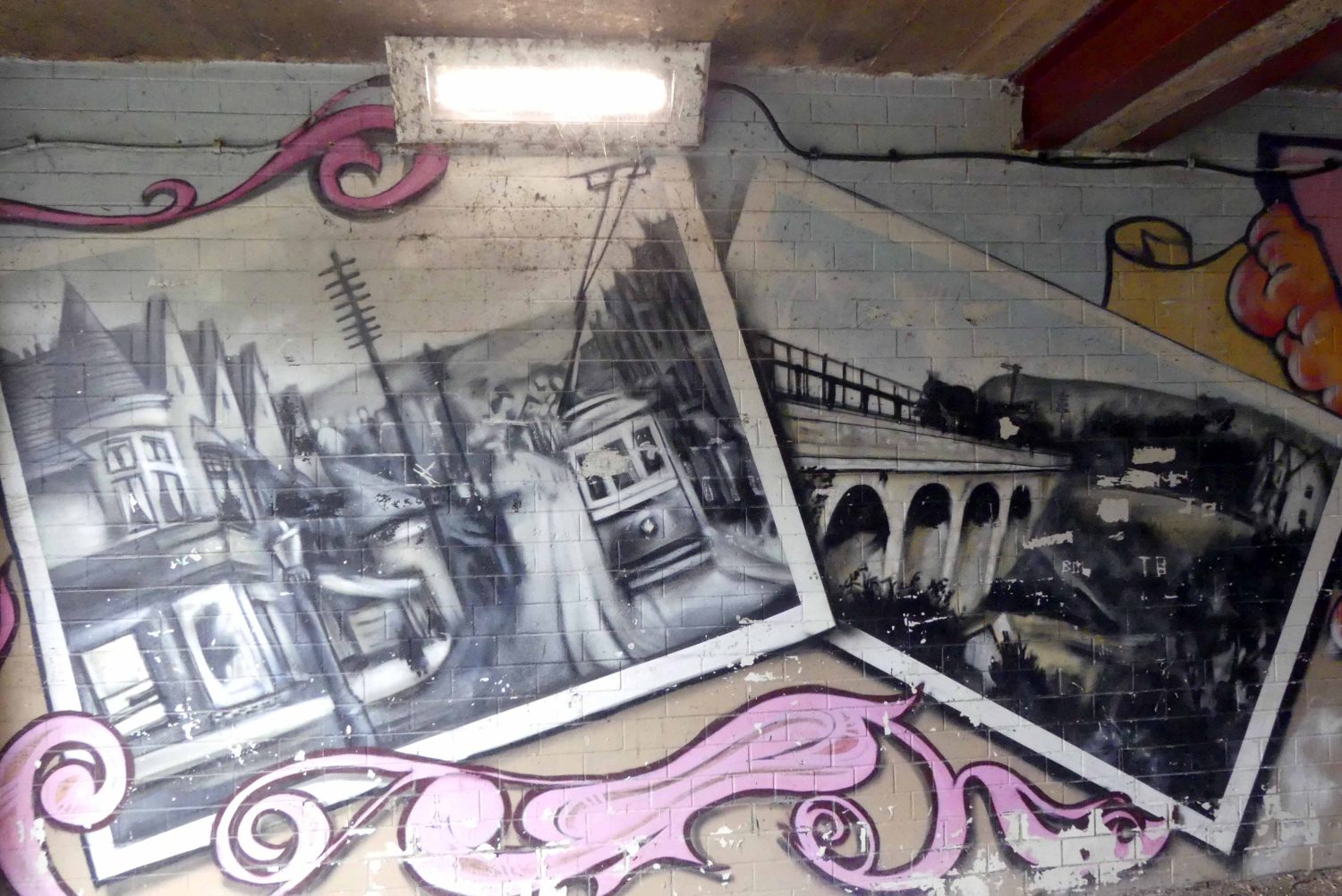
Llawr Pentre

The underpass leads through to the part of the village known as Llawr Pentre. Down below the level of today’s village, this was where Old Colwyn originated and was where the ford across the river was located. Here too were a flour mill, dating back to pre-1750, a farm, a slaughter house, a wheelwright, a saddlery, and a butcher’s shop. Now it is purely residential and the access road lined with parked cars. Maybe not the most attractive part of the river’s journey, but it runs through regardless, and perhaps surprisingly, it is often a part visited by grey wagtails, so always worth a look. And lo and behold, as I was lingering noting wildflowers on the river edge, in flew this beautiful male who landed first on an overhead cable, then flew down onto a ‘for sale’ board. First thoughts were this was the male I’d seen on the other side of the underpass, but he had the black throat and bib of his breeding plumage, while this one didn’t.

The path loses the river for a while as you have to divert around private grounds. Steep steps lead up to a lane which you then follow towards the woodland dell of Fairy Glen. At the top of the steps a female house sparrow was feeding on seeds of a sowthistle. She is doubtless one of the members of the flock that inhabit the thick mixed hedge that borders one side of the lane. Hearing the lively cheeps chirps & squabbles of the house sparrow couples hidden from view inside there always make me smile when I pass by here.
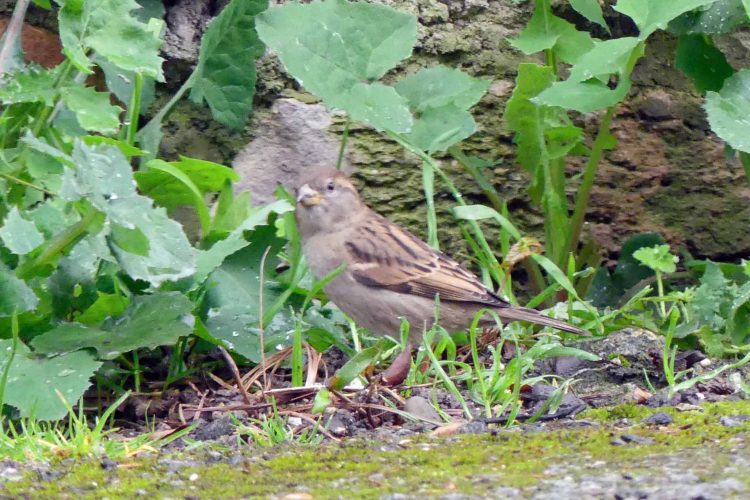
female house sparrow
sparrow hedge

The row of cottages along the lane are a draw for a variety of bigger birds and most of the roofs, chimney pots and aerials have been claimed as perches, roosts or nest sites. Todays there were pairs of herring gull, wood pigeon, collared dove & jackdaw, all looking a bit ruffled and fed up with the weather.
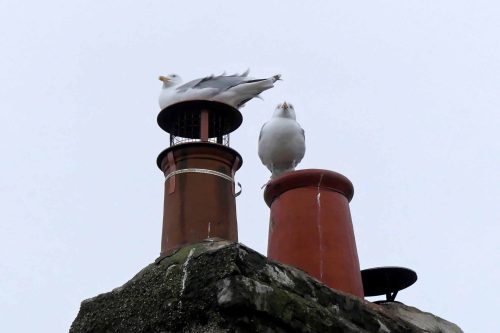
herring gull pair
collared doves
wood pigeons

Fairy Glen

The river is visible once more, and down below at the bottom of the dell its sound is amplified by the steep banks that bound it. Birdsong adds to the music of the water, I pick out blackbirds, robins and great tit, then chiffchaff and blue tit. More raucously there’s the cooing of wood pigeons and the cawing of crows which remind of the closeness of houses.

The trees are still mostly leafless, but the steep sides of the dell and lack of bright sunlight keep it shady. At ground level there’s plenty of greenery from abundant ivy, lush ferns and patches of celandines. In places the well-trodden path is wet and muddy.

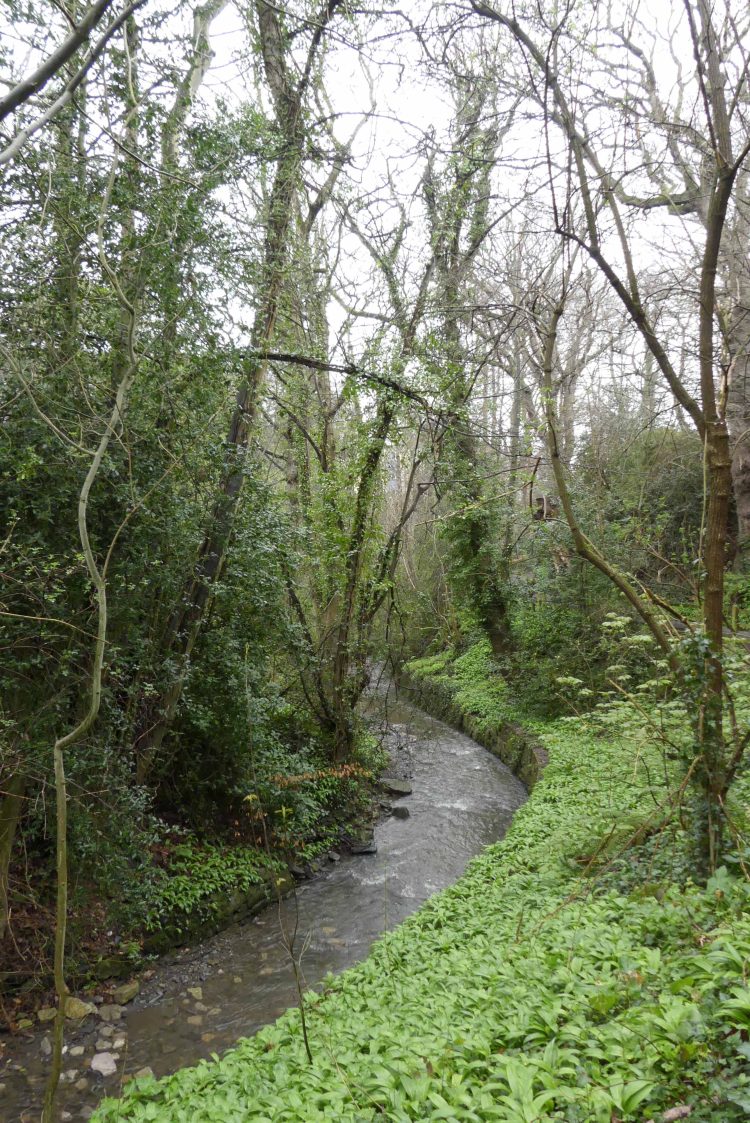
Great swathes of wild garlic cover much of the woodland floor and their pungent aroma fills the cool, damp air. It’s not flowering fully yet, but there are plenty of budding stems, so it won’t be long.
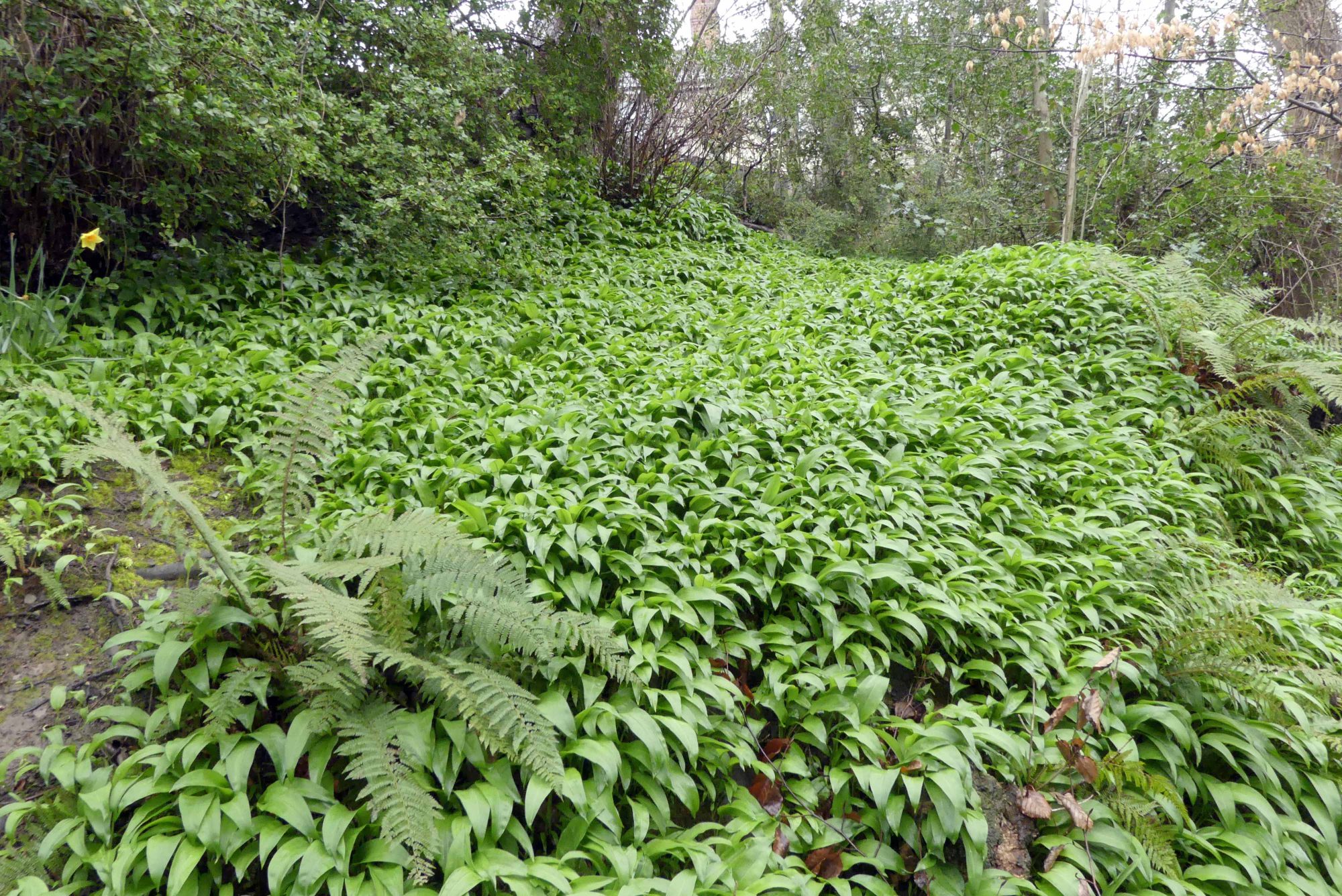
Someone’s been busy digging out a new pond

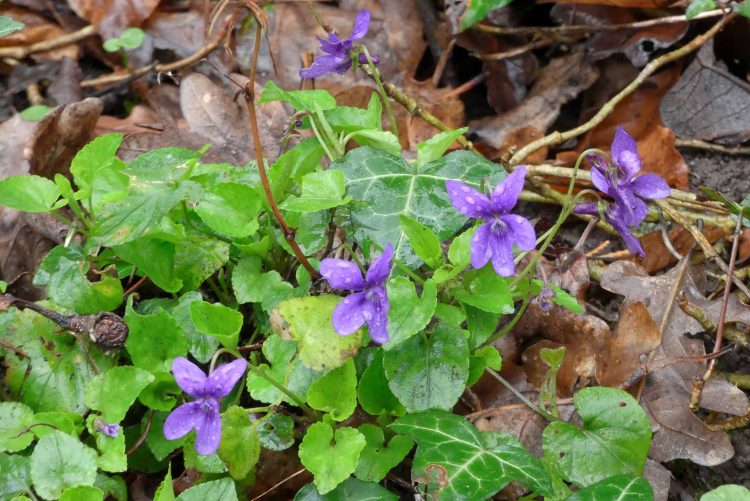
Here and there are little patches of early dog violets
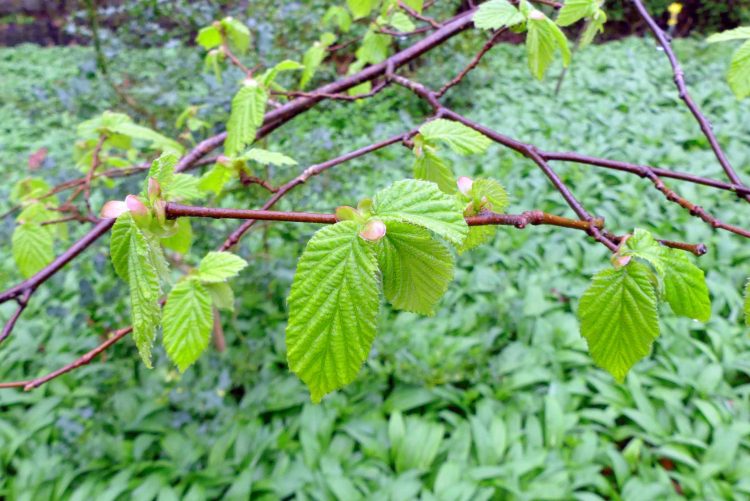
and bright fresh green leaves of hazel
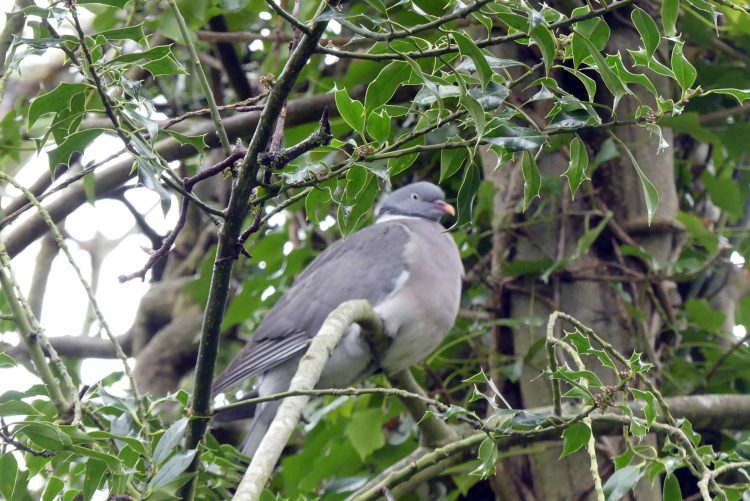
Although there are plenty of birds to be heard, I only had glimpses of foraging blue tits and robins that fly up from where they were singing as I got too close. I heard a nuthatch calling but couldn’t see him. Chiffchaffs continued to elude me. The only photograph I managed was of a wood pigeon keeping a beady eye on me from where it was tucked into a tall holly tree
Perhaps the birds sensed it was about to begin raining before I felt it. Time to turn around and head back.

Retracing my steps, still enjoying the sound of the river and birds singing despite the rain, I realised that I hadn’t met a single other person whilst I’d been here and had had all of this to myself.
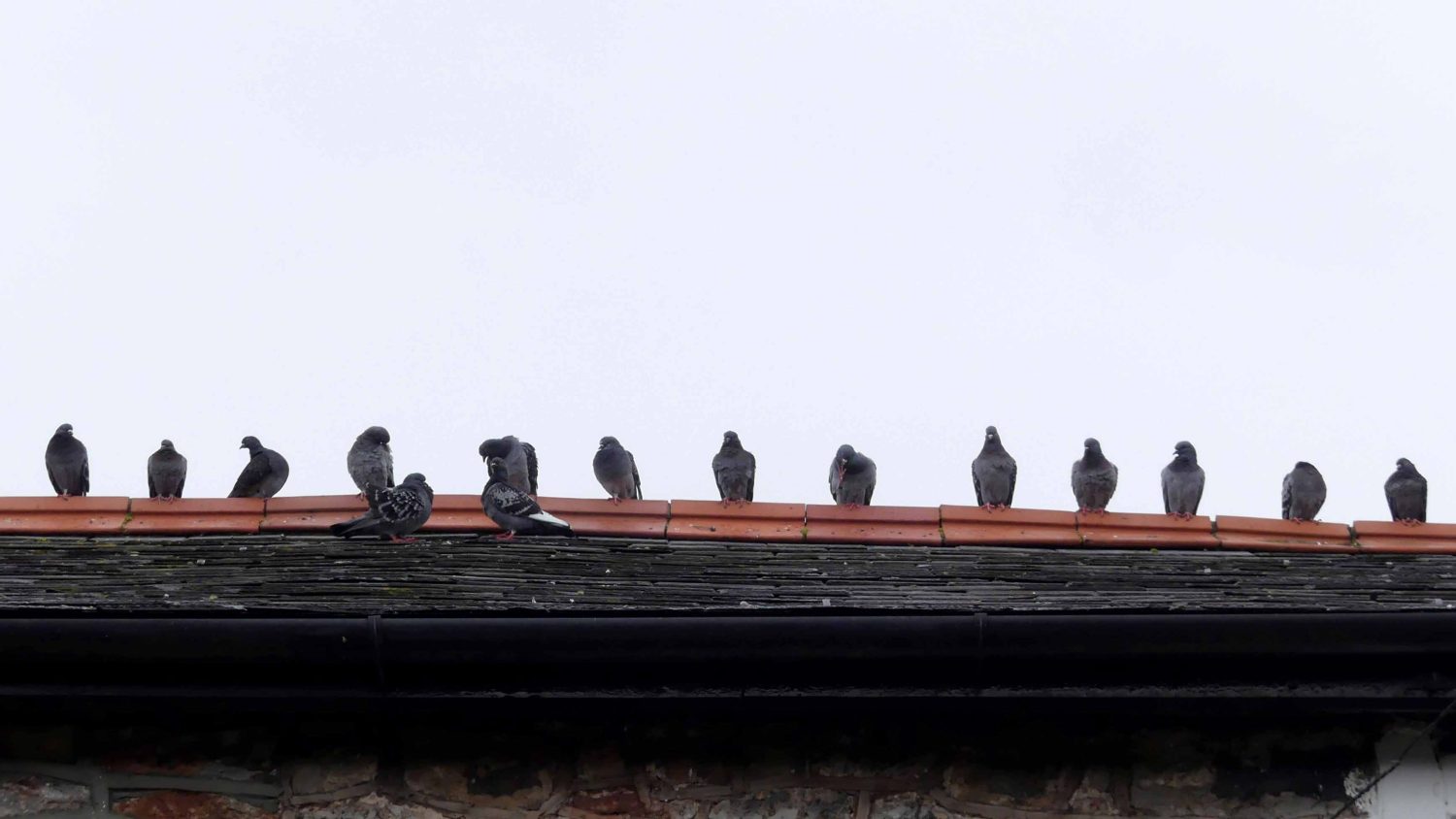
Back out onto the lane, I met a man that lives in one of the cottages as he was putting out seed for the birds. He told me he does that twice a day and has his ‘morning birds’ and his ‘afternoon birds’. That probably accounts for the line of feral pigeons on his roof.
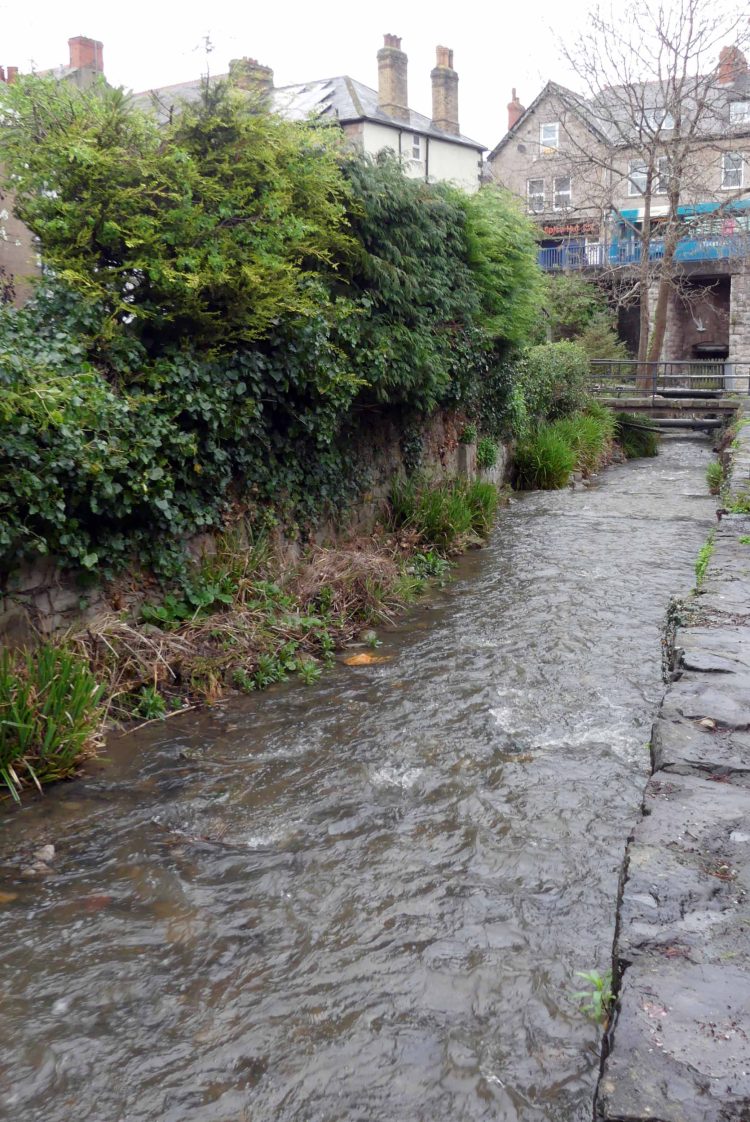
Re-joining the river in Llawr Pentre, I took this picture to show where it passes under the road and buildings, cropping out the cars that are always parked in a line close to the river’s edge.
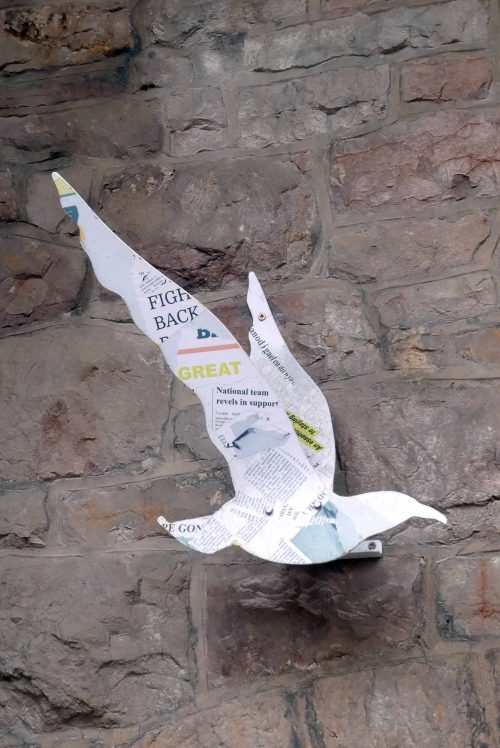
Above the entrance to the underpass, watch out for the herring gull! This is one of several 2-dimensional images of our iconic irrepressible gulls that can be found located around Colwyn Bay.
Heading back through the gardens gives another chance to enjoy the glorious cherry blossom

The indignant blackbird in a the tree below had just chased off another male.

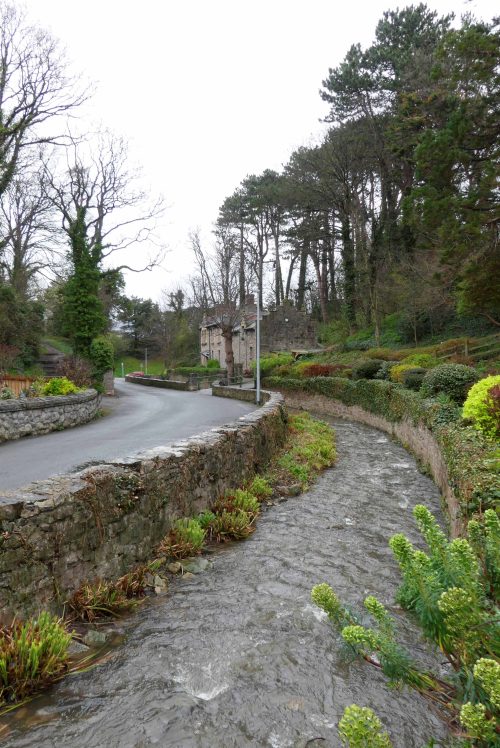
Curving back through the gardens this is perhaps the best view of the river.
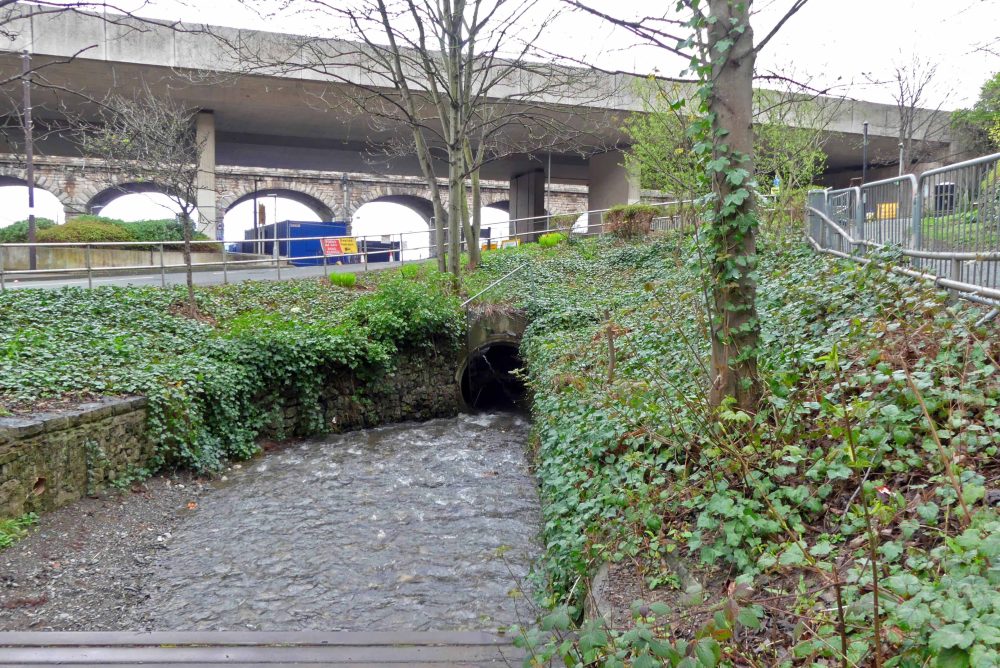
The final view of it is as it disappears into the culvert taking it beneath the road, the Expressway bridge and the viaduct where it has quite a sad end, emptying into Colwyn Bay as what is called an outfall.
Share this:

  • Click to share on Facebook (Opens in new window) Facebook
  • Click to share on Pinterest (Opens in new window) Pinterest
  • Click to share on X (Opens in new window) X
Like Loading...

Wales Coast Path-Colwyn Bay to Pensarn

05 Tuesday May 2015

Posted by theresagreen in Nature of Wales, North Wales, Wales Coast Path

≈ 8 Comments

Tags

colwyn bay pier, goldcrest, grey wagtail, herring gull, Llanddulas Point, Old Colwyn, sea holly, sea mayweed, seashore walks, yellow horned poppy

One of my ambitions for this year is to walk more of the North Wales section of the  Wales Coast Path, which begins, or ends depending on which way you’re walking at Chester and continues around to Caernarfon. Some of the walks I do fairly regularly are part of the Coast Path, and there are other bits within reasonable striking distance that I could do fairly easily and I am keen to see more of the wildlife found along this amazing and varied coastline. On a sunny day back in the middle of March I set off in the opposite direction to that of my usual routes planning to walk the section from Colwyn Bay to Pensarn, the seaside part of Abergele. I cheated a bit as I have done the Colwyn Bay part so many times before, and drove to the pier to take some updated photos of the route along the promenade.

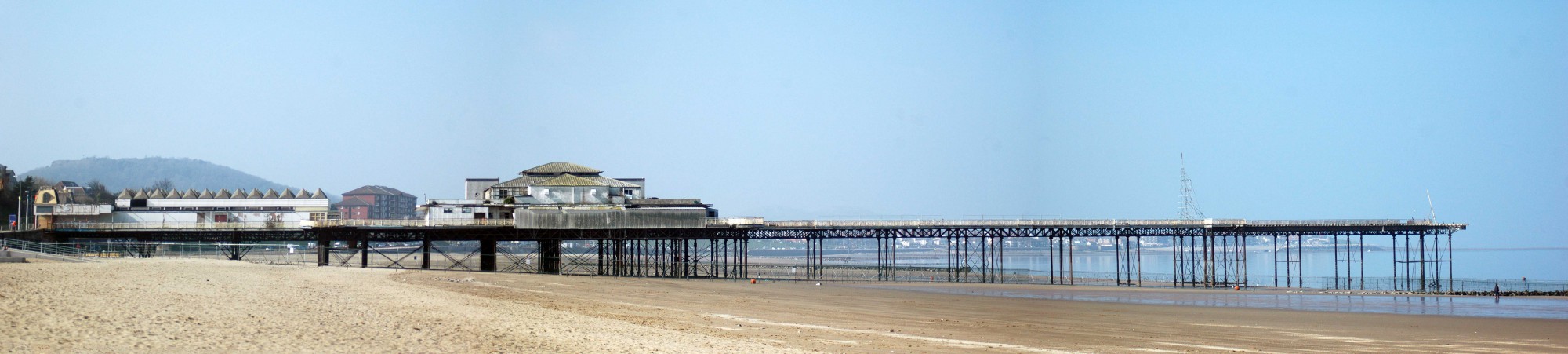
Colwyn Bay Pier, in a sad and dilapidated state

Colwyn Bay’s Victoria Pier, in a sad and dilapidated state

As a result of a long drawn-out dispute over its ownership, the pier is in a sad state of disrepair and dilapidation but there is much ongoing effort locally to save and restore it. It must be a bit of an embarrassment to the local council, particularly as a lot of money has been invested in providing a new sandy beach and in the building of the new water sports centre, known as Porth Eirias, just a stone’s throw away.

The water sports centre at Porth Eirias is finished but not yet occupied..

The water sports centre at Porth Eirias is finished but not yet occupied..it’s meant to look like a ship

From Porth Eirias the path continues as a promenade and cycle path and is my favourite stretch, particularly in the winter when stormy seas send waves crashing into and over the sea wall and flood the road, which may be closed off on exceptionally wild days. On the opposite side of the road the railway track runs parallel atop a high embankment, which provides habitat for an interesting array of wildflowers. There are great views from the trains too.

The view from Porth Eirias that shows the route of the Coast Path  towards Llandulas

The view from Porth Eirias that shows the route of the Coast Path towards Llanddulas

At the end of the promenade is a small parking area from where the path and cycle track continue towards Llanddulas. I had intended to park here and walk, but it was full of works vehicles as yet more work was being carried out on reinforcing the sea defences. Instead I crossed over the road and turned in towards Old Colwyn and stopped by the river at Min-y-Don.

Celandines

Celandines

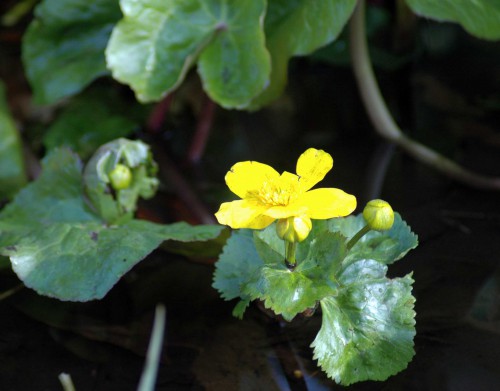
Celandines smothered the grassy bank on the sunny side of the road and King Cups lit up the shadier side of the path along the river.

The river was running fast and at a fairly decent level, although nowhere near full.

150318TG-Old Colwyn- King cup

Golden yellow King Cups

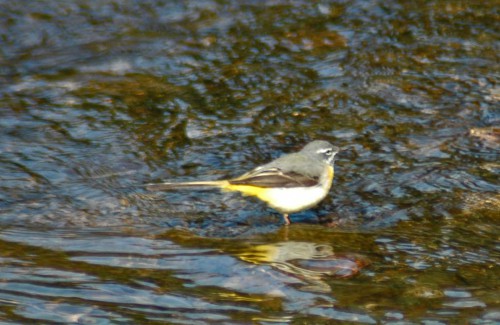
This is a favourite spot for Grey Wagtails and I had timed my visit perfectly as a pair of them flew down from upstream to land almost right in front of me. I watched them for a good while, darting after flies from stones in the water and running along the stone wall.
Grey Wagtail - the female of a pair

Grey Wagtail on the river Colwyn- the female of a pair

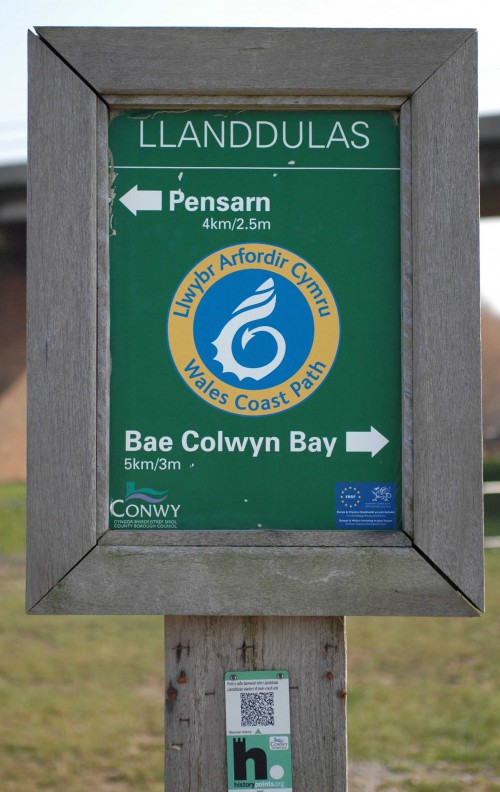
150318TG-Wales Coastal Path-Llanddulas- Sign board

I drove on to Llanddulas Point and parked facing out across the flat rocky shore to the sea. The views from here are expansive to say the least, and if you were walking the Coast Path seriously I can imagine it may be rather daunting to be able to see where you are heading and will arrive at in a few hours time.On a sunny and warmish day like today it is pleasant enough and as the land is almost pancake flat, easy walking. I’m not sure if I’d fancy it on a wet day when the wind was blasting you in the face.

Leaving the car park and crossing a small bridge, the path follows the lower stretch of the River Dulas for a short distance until it reaches its end and flows towards the sea.

Path alongside the river

Path alongside the River Dulas

The coast here may appear to stark and empty, but it provides important habitat for a good range of marine plants and the eastern end of Llanddulas beach is designated as a SSI as locally rare plants such as sea kale and yellow horned poppy grow there. It was too early in the season for plants to be flowering, but there are new leaves pushing up through the shale.

New leaves of Sea Holly

New leaves of Sea Holly

New leaves of Yellow Horned Poppy

New leaves of Yellow Horned Poppy

New leaves of Sea Mayweed

New leaves of Sea Mayweed

As I neared the last stretch of the river I heard, then spotted more Grey Wagtails, another pair I’m sure, that were hunting flies from stones near the banks, flitting low across the water from one side to the other. As you round the bend in the path where the river ends the narrow ribbon of trees that follow the line of the cliff reaches the path edge. As I got close to this point a wren flew from the tree cover across to a rock and belted out his song.

Red-brown lichen

Red-brown lichen

I attempted to get a bit closer to him and he moved off, but I was soon distracted by a rock face smothered in a red-brown coloured lichen, I have no idea what it is, and another rock with some sort of quartz trapped in it.

Quartz in limestone

Quartz in limestone

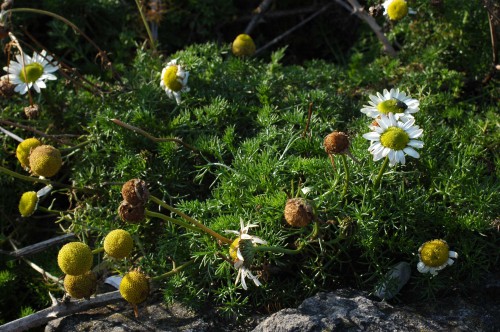
Sheltered on this side of the rocks there was a clump of sea mayweed that appeared to have been blooming for some time as many of the flowers were already beginning to go to seed.

Clump of flowering Sea Mayweed

Clump of flowering Sea Mayweed

A green-bottle fly on Sea Mayweed flower

A green-bottle fly on Sea Mayweed flower

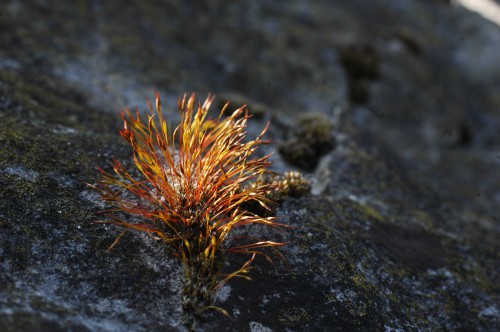
Highlighted by the sun there was a pretty little clump of moss or with seed-heads on a nearby rock too.

Moss or lichen with seedheads

Moss with seedheads

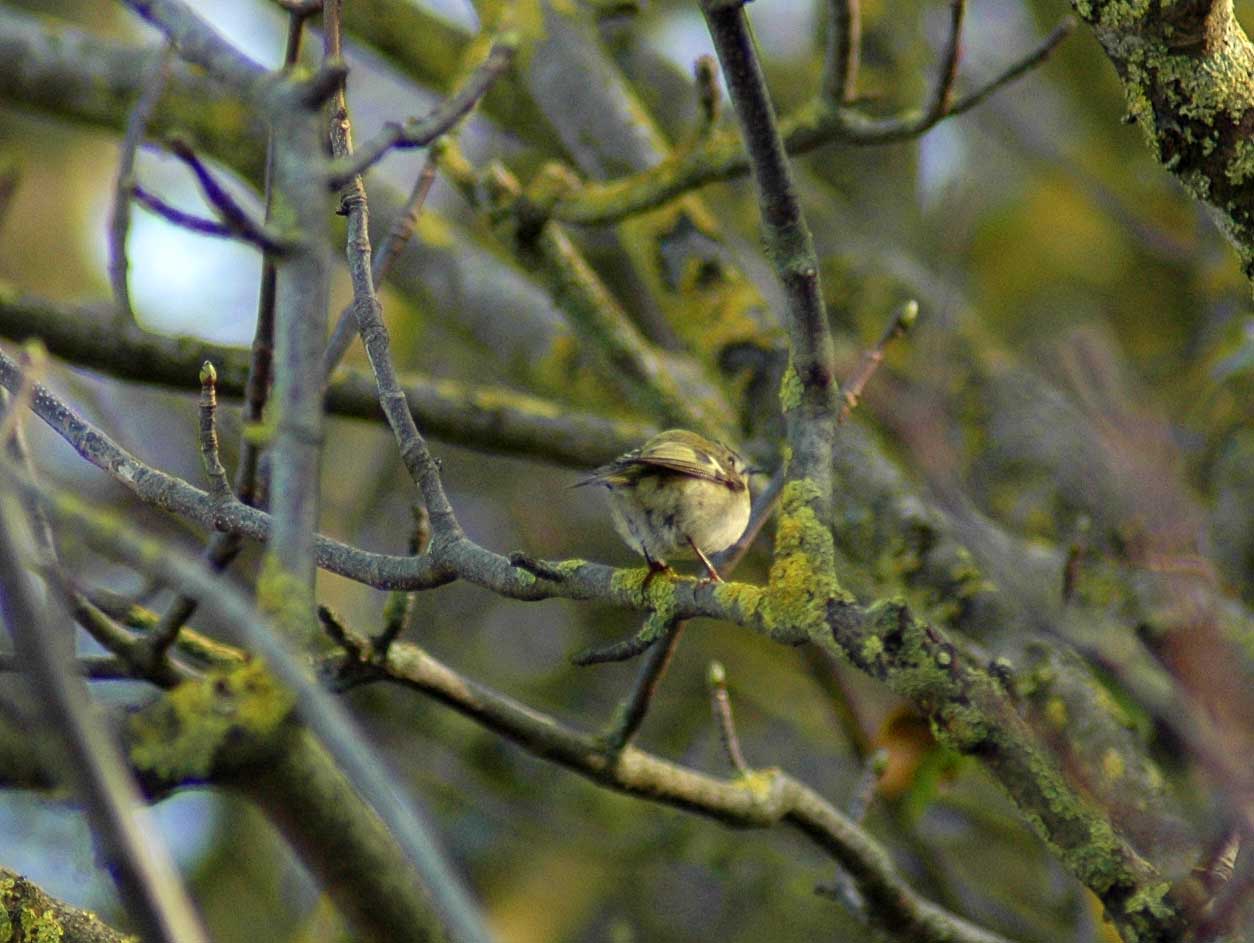
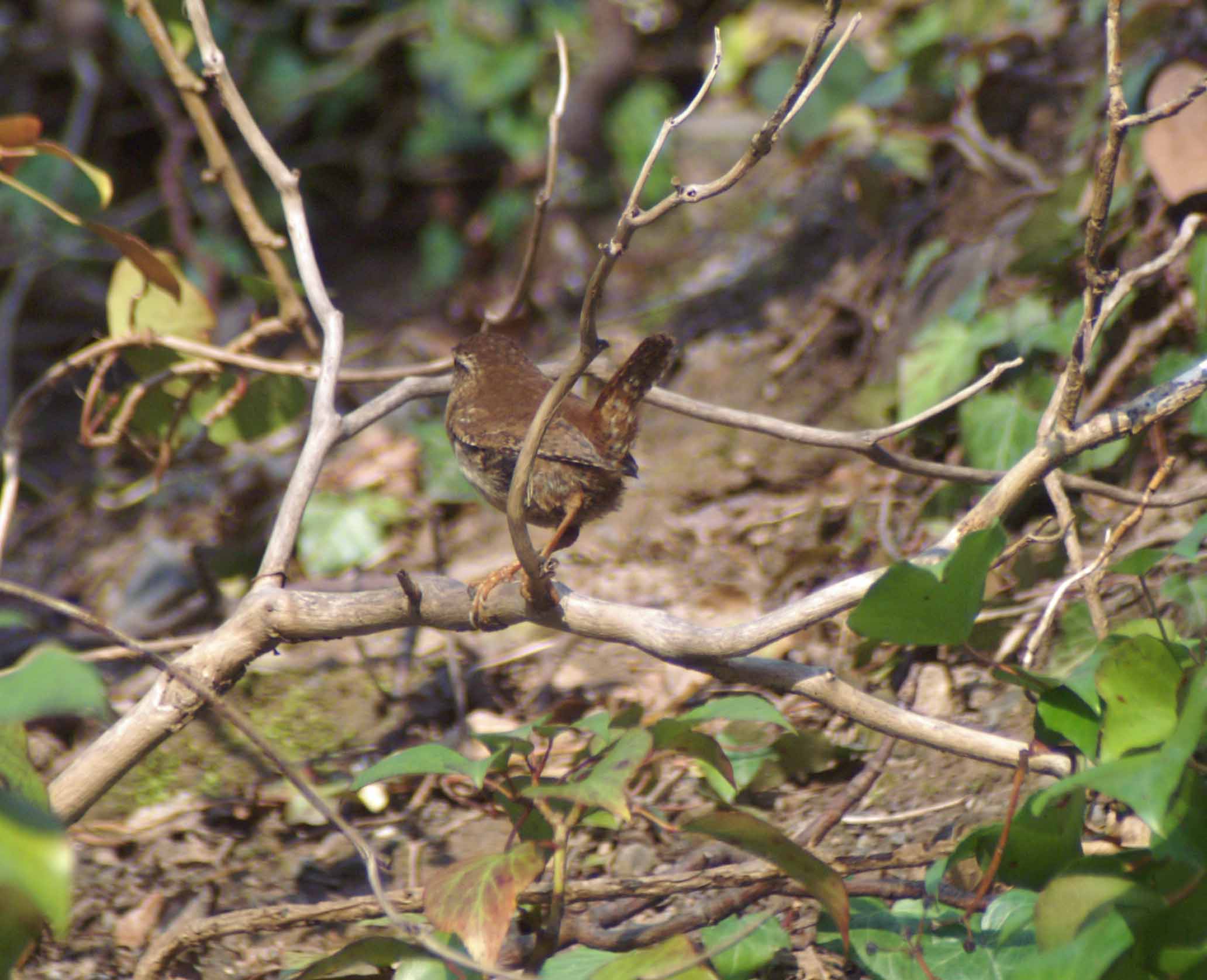
Moving back to the path I spotted two tiny birds flitting about amongst the twiggy tree branches. I thought at first they were wrens, but then excitedly realised they were too small and were actually goldcrests, a definite pair. I watched them for a good while as they continued to forage amongst the lichen-covered twigs, but didn’t have much luck getting a clear enough view for long enough to get a good photograph. The one below is the best I could do but it does confirm the sighting!

A rear view of one of a pair of goldcrest

A rear view of one of a pair of goldcrest

I would never have imagined seeing these delightful little birds here within a metre or two of a busy walkway, but there they were and no-one else seemed to notice them at all. These trees are mostly ash that have been regularly pollarded to prevent them growing high enough to block the view from the wooden chalets that line the clifftop above them and appear to be a popular spot with a variety of other species of birds too. In the short while I was there I saw blackbirds, dunnocks, robin, the wren I already mentioned and blue tits and great tits.

A view of the shore lined with herring gulls

A view of the shore in the direction of Abergele then on to Prestatyn and Rhyl

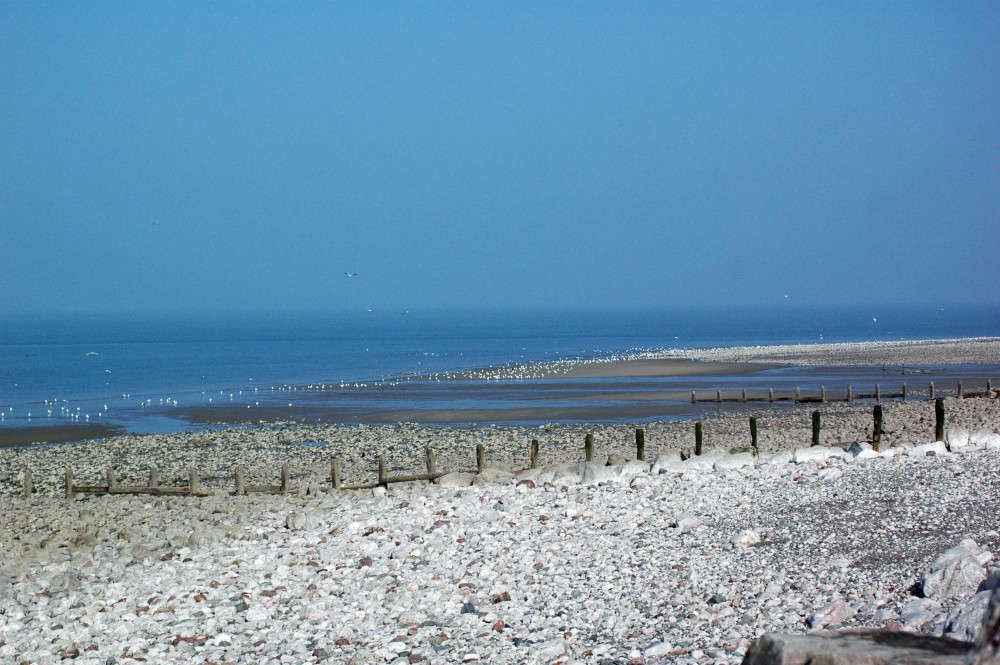
A few metres away the shoreline was lined with huge numbers of herring gulls. During the winter months, there are oystercatcher, curlew, redshank and turnstone feeding here and some years there are snow buntings.

The shoreline stretches on to Pensarn then on to Prestatyn and Rhyl

The shoreline stretches on to Pensarn then on to Prestatyn and Rhyl

I was surprised to find some little yellow coltsfoot flowers pushing up through the stony ground next to the path here.

Coltsfoot

Coltsfoot

Wooden chalets line the path for a good distance along this section of the path and there were a growing number of people out walking dogs, so I turned round and walked back the way I had come.

Limestone quarry

Limestone quarry

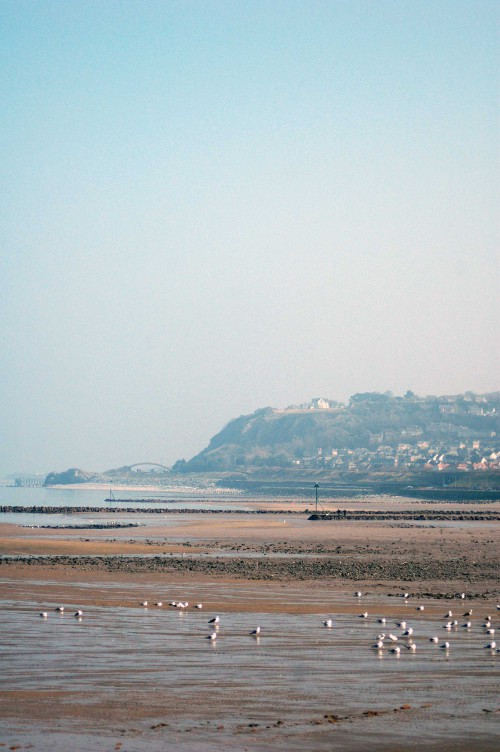
Mist obscured much of the distant views today, but it was still possible to make out the outline of the old limestone quarry which rises up behind the shore, separated from it by the A55 Expressway. For 300 years quarrying was a major occupation in this area, second only to farming and lime kilns dominated the skyline from 1890 to 1940. There is a working quarry operational today and between Llanddulas and Colwyn Bay the path passes a jetty that serves it. There used to be another jetty, closer to Llanddulas where during stormy weather in April 2012 a cargo ship that was loading there was forced on to the rocks and had to be dismantled.This event made the national news and I recall it causing chaos on the A55 as people stopped their cars and got out to have a look or to take photographs.

Linnets on the raised stony sea bank

Linnets on the raised stony sea bank

Final treats were the sight of a small flock of linnets that flew on to the raised stony sea bank to feed on seeds and a lovely pair of mallard by the footbridge.

Mallard pair

Mallard pair


Share this:

  • Click to share on Facebook (Opens in new window) Facebook
  • Click to share on Pinterest (Opens in new window) Pinterest
  • Click to share on X (Opens in new window) X
Like Loading...

Fairy Glen

04 Sunday Mar 2012

Posted by theresagreen in Local Nature Reserves, Nature, nature of woodlands, nature photography, woodland birds

≈ 2 Comments

Tags

blackbird eating berries, Blue tit, coal tit, Fairy Glen, Old Colwyn, Wren

I am currently working in Old Colwyn and as it would have been a pity not to take advantage of some of last week’s sunny spring-like weather, so I ventured out during my lunch breaks to explore some  of the locality. In a recent blog – What a beautiful day- I featured photographs that I had taken in the small area of woodland alongside the final stretch of the river Colwyn. This is called Min-y-Don woodland and is a remnant of an ancient woodland that would once have covered the whole valley. From there it is possible to walk along a footpath leading up to the village that follows the course of the river. At the top, if you cross the Abergele Road and follow the signs to ‘Fairy Glen’, you reach a narrow wooded dell that the river runs through, bounded by roads and houses.

In present day Old Colwyn, much of which sadly has seen better days, Fairy Glen seems an incongruous name for a part of it, but it harks back to when this whole area was wealthier and hugely popular with well-to-do Victorian holidaymakers. This area of woodland was said to contain many different spirits including fairies, hence its name, which dates from the Victorian era and is a common name from that period (another local one being the “Fairy Glen” in Penmaenmawr).

The wooden road sign for Fairy Glen

Fairy Glen has recently been designated as a Local Nature Reserve and has undergone  regeneration with funding from the local council and it is now possible to walk through it easily. Presently the Fairy Glen is subject to an ownership dispute between Conwy County Borough Counciland the water company, Dŵr Cymru, each claiming that the maintenance of the area is the responsibility of the other. The trail was funded by Cydcoed Forestry Commission Wales.

“A path broadly follows the Afon Conwy which, with the Fairy Glen (then known as Y Nant), was mentioned by the traveller Edward Llwyd in 1699. He described the area as having seven wells and being completely wooded. There are, in fact, remaining indicators in Fairy Glen which identify it as an ancient woodland.”

I doubt that today’s Fairy Glen would have suited the Victorian visitors romantic aesthetic, but it is a pleasant enough place to spend half an hour. It is barely a five minute walk from work and I headed there for my first ‘reccie’ last Friday afternoon; I was very pleasantly surprised by the sightings I had there.

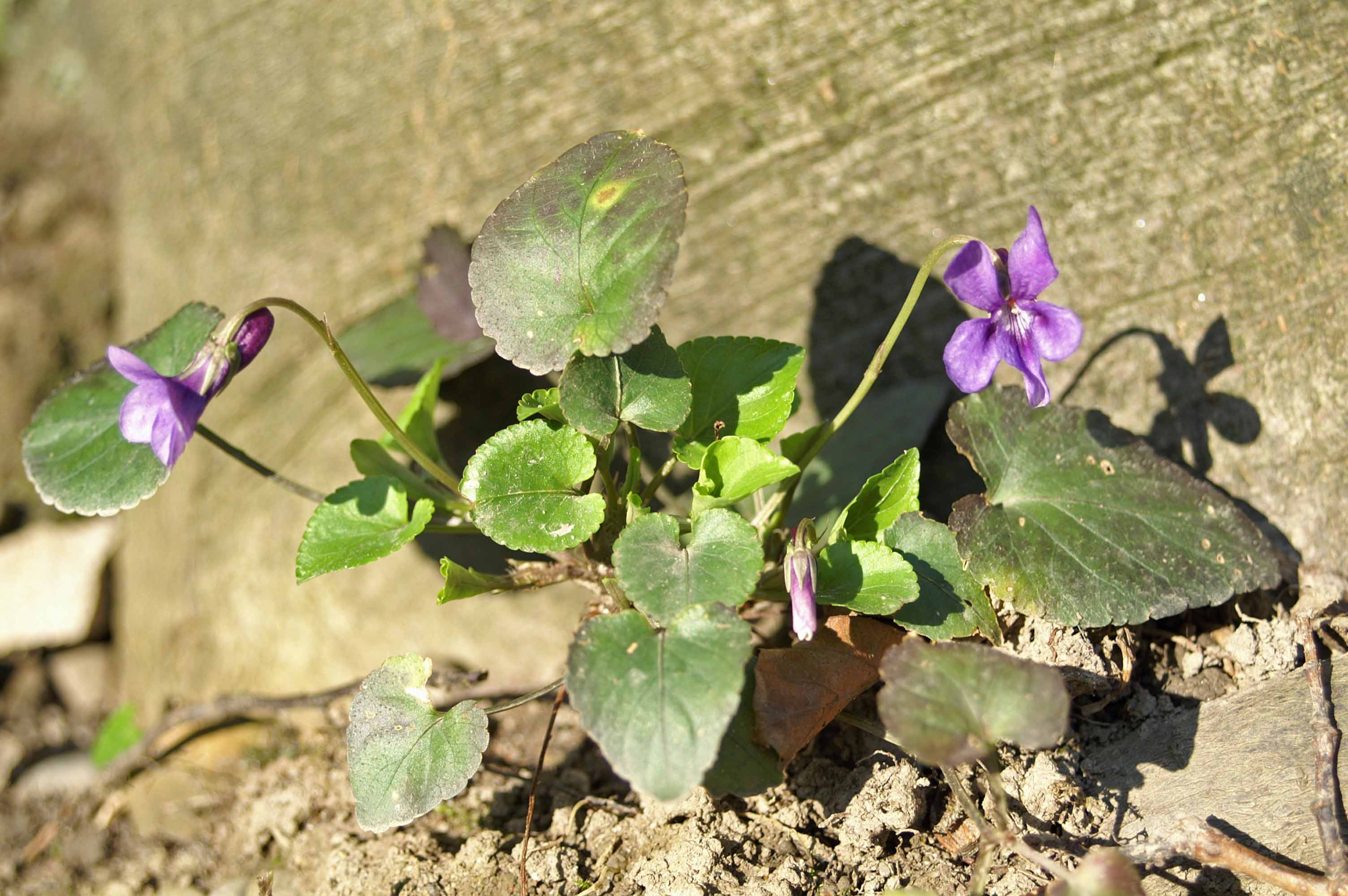
My first surprise was finding this violet plant flowering at the base of a large tree

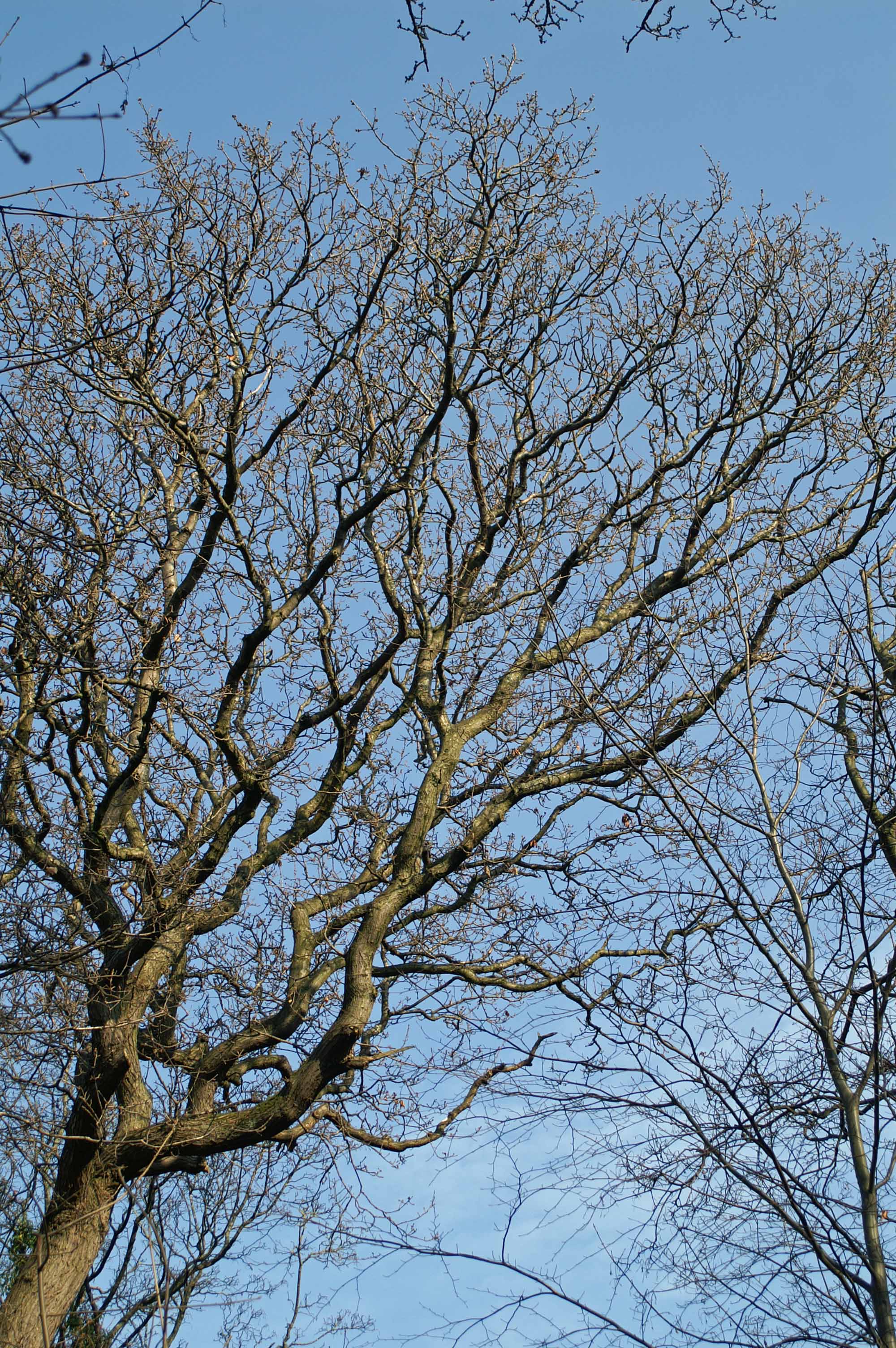
A tracery of bare twigs and branches against a perfectly blue cloudless sky

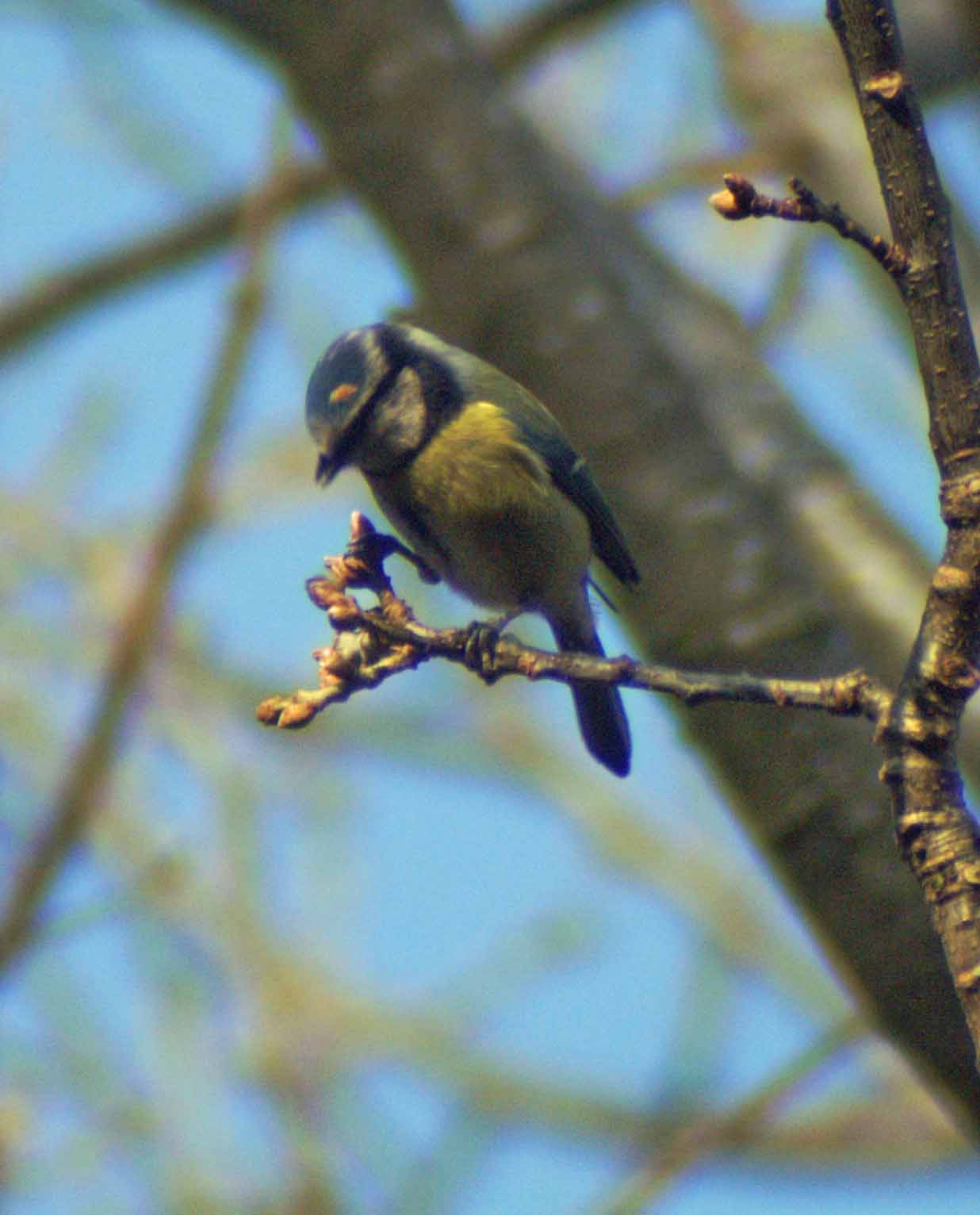
Blue Tits seemed to be everywhere

Blue Tit picking delicately around the sticky leaf buds

Hazel catkins

A grey squirrel sat on a tree branch eating something held in its paws, possibly an acorn it had buried back in the autumn

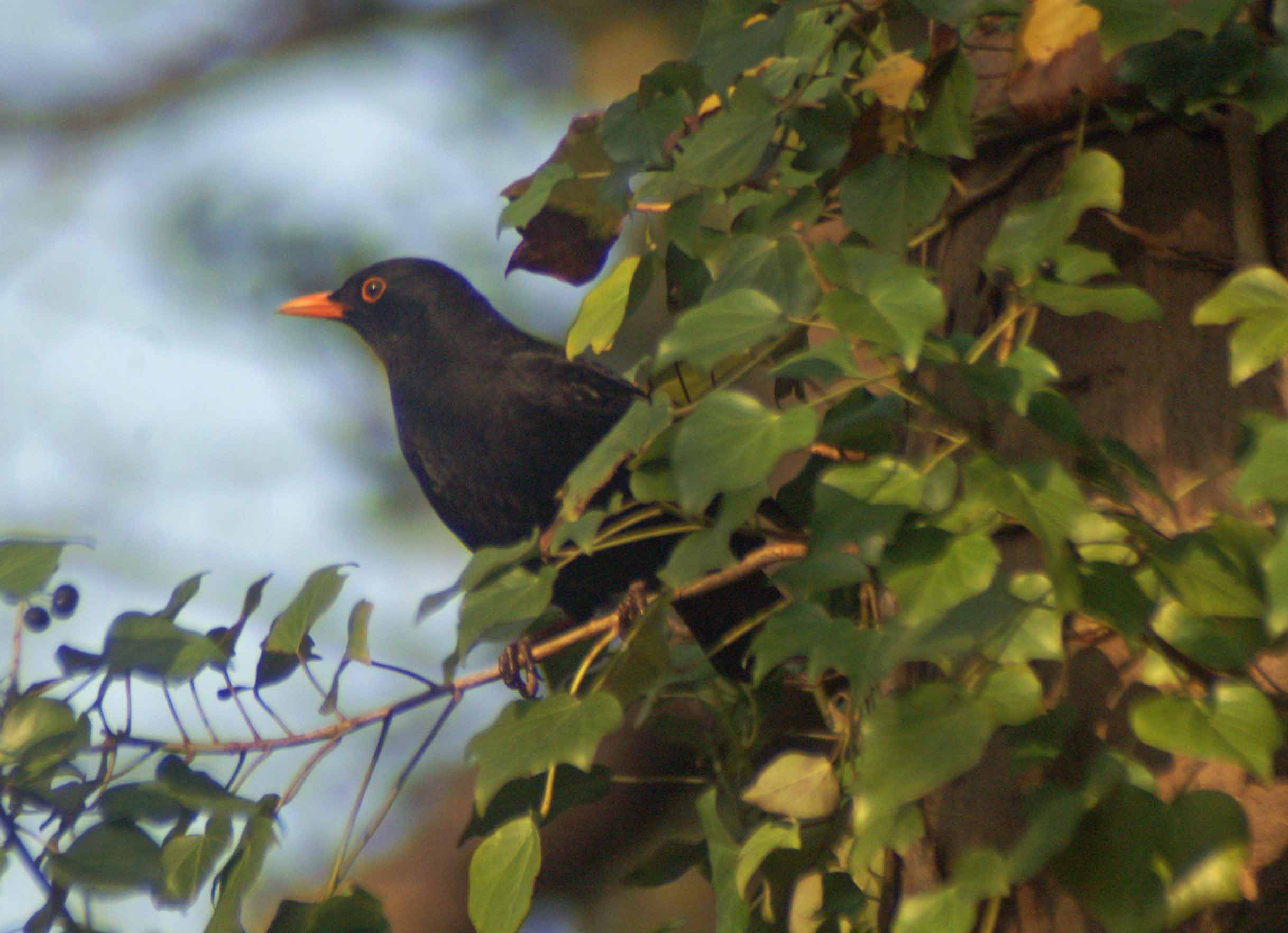
A beautiful male blackbird was picking off ripe ivy berries

The blackbird contorted himself to reach a berry

The blackbird with a berry in his beak

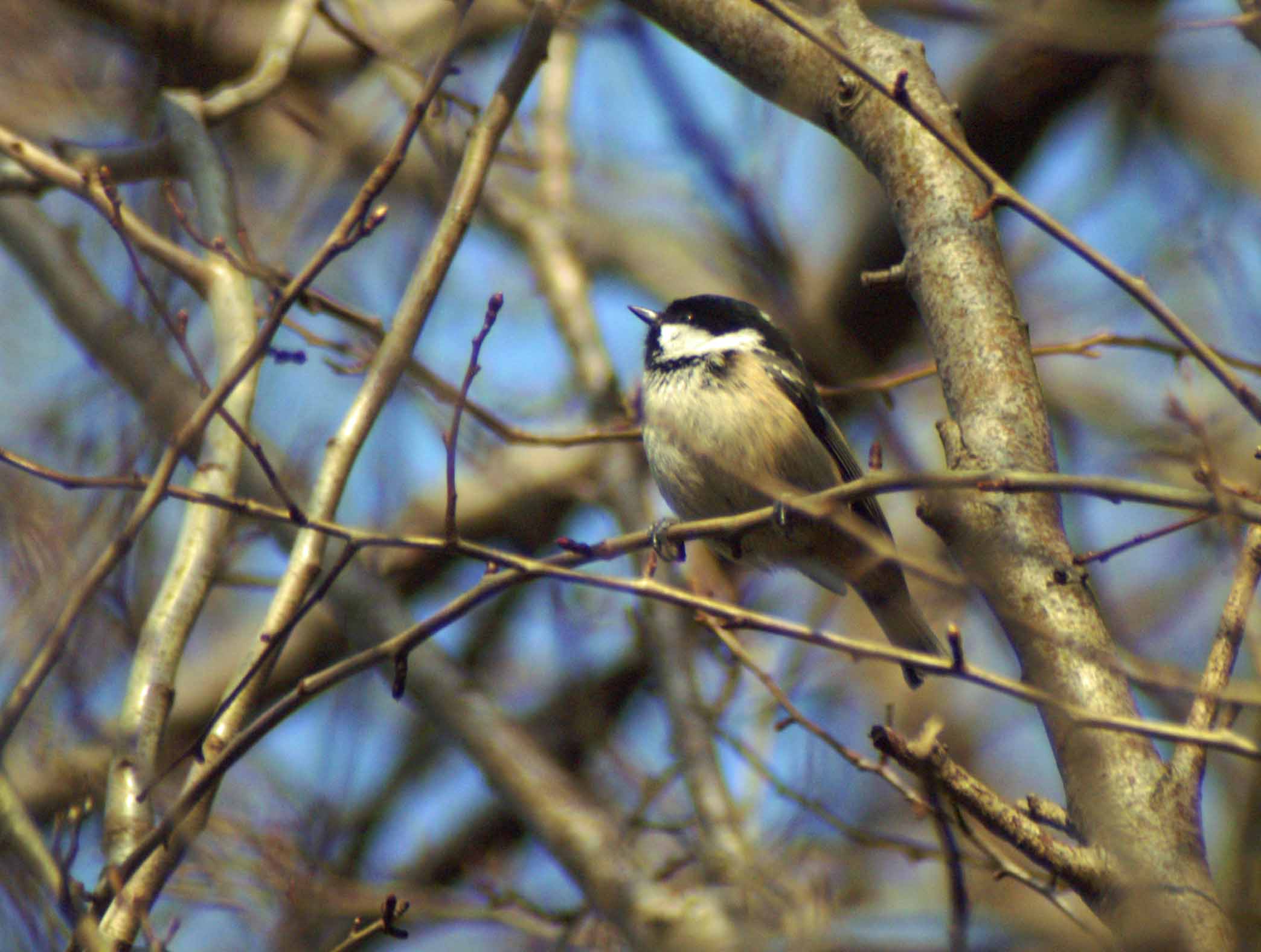
A big surprise was the sighting of this lovely coal tit

A wren singing from a low branch

Another wren flew across the path and perched on the fence. It looked a little odd, but it took a few seconds to realise it was because he was missing his characteristic upturned tail

The missing tail did not seem to be inhibiting the little bird too much – he was bright eyed and flitting around singing enthusiastically

A robin singing beautifully, but in the shade

A pair of nike trainers thrown up into a tree. A reminder that this is a just an oasis in a small urban jungle

Share this:

  • Click to share on Facebook (Opens in new window) Facebook
  • Click to share on Pinterest (Opens in new window) Pinterest
  • Click to share on X (Opens in new window) X
Like Loading...
Follow everyday nature trails on WordPress.com

Enter your email address to follow this blog and receive notifications of new posts by email.

‘But it is the common species that keep the living world ticking over and provide most of our experiences of wildlife, and I would argue that maintaining the abundance of these is as important a conservation priority as maintaining the existence of rarities’. Richard Mabey
MOST RECENT POSTS

  • A Glimpse of Spring to Come January 22, 2025
  • Hunting the Wren December 28, 2024
  • Oh, Christmas Tree December 18, 2024
  • In and Out of the Ivy February 15, 2024
  • Nature’s Fireworks November 30, 2023
  • Wild Autumn along the Coast Path November 3, 2023

OLDER POSTS

LOOKING FOR SOMETHING IN PARTICULAR?

  • Pretty prickly Thistles
    Pretty prickly Thistles
  • The Foxglove - of Fairytales, Myths & Medicine
    The Foxglove - of Fairytales, Myths & Medicine
  • Fine Dining for Crows
    Fine Dining for Crows
  • Pines and Primroses
    Pines and Primroses
  • Bryn Euryn - a walk of several parts. Part 1
    Bryn Euryn - a walk of several parts. Part 1
  • A Blackthorn Winter
    A Blackthorn Winter
  • Birds and the art of fly catching
    Birds and the art of fly catching
  • Grey Seals on the rocks
    Grey Seals on the rocks
  • What a beautiful day
    What a beautiful day
  • Everyday Birds - The Blue Tit
    Everyday Birds - The Blue Tit

nightingale trails

The Walk of the Monarch Butterfly-Sendero de la Mariposa Monarca

The Walk of the Monarch Butterfly-Sendero de la Mariposa Monarca

MY WILDFLOWER BLOG: where the wildflowers are

Snowdrop

Snowdrop

most recent posts

Follow everyday nature trails on WordPress.com

Social

  • View teresamaygreen’s profile on Twitter

Enter your email address to follow this blog and receive notifications of new posts by email.

Website Built with WordPress.com.

  • Subscribe Subscribed
    • everyday nature trails
    • Join 359 other subscribers
    • Already have a WordPress.com account? Log in now.
    • everyday nature trails
    • Subscribe Subscribed
    • Sign up
    • Log in
    • Report this content
    • View site in Reader
    • Manage subscriptions
    • Collapse this bar
 

Loading Comments...
 

    %d