• Home
  • about
  • about the photographs
  • Local Nature Reserves
    • Bryn Euryn Local Nature Reserve
    • Mynydd Marian
  • Wales Coast Path
    • Grey Seals in North Wales
    • St.Trillo’s Chapel
    • Wildflowers of North Wales Coastal Paths, Cliffs and Dunes

everyday nature trails

everyday nature trails

Tag Archives: nature

Hunting the Wren

28 Saturday Dec 2024

Posted by theresagreen in Birds, CUSTOMS & TRADITIONS

≈ 3 Comments

Tags

Birds, Boxing Day, Christmas, customs, Ireland, Isle of Man, mythology, nature, St Stephen's Day, traditions, Wales, Wren

For reasons lost in the mists of time, the tiny wren has featured largely in the folklore, mythology and traditions of many European countries. In the UK, perhaps the most extraordinary and in the past, cruel custom, must be the one that traditionally took place each December 26th. To many of us this is Boxing Day or St Stephen’s Day, but in some parts of Great Britain it was also known as Hunt the Wren Day or just Wren Day, depending in which part of Great Britain the ritual was enacted.

There are several variations as to how the ceremony, or ritual was played out, but essentially it involved boys and sometimes young men who joined together, often dressing in curious costumes, such as straw masks, greenery and a motley assortment of colourful clothing, who for the duration of the ritual were known as ‘Wren Boys’. Their mission was to hunt around the hedgerows for a wren, which was sometimes kept alive, sometimes not. Once caught, the bird was then put in a small box or ‘Wren House’, which was decorated with holly, ivy and ribbons, placed on top of a staff or long pole and displayed around the neighbourhood. The boys sang songs and played music in exchange for donations.

Typically Wren Hunts took place in Ireland, The Isle of Man, Wales and France; all areas where Celtic traditions are more firmly entrenched. Times, sensibilities and laws have thankfully changed in modern times, but in a few places Wren Day has survived, or been revived, suitably modified but keeping the tradition alive and raising money for charity.

Ireland

In Ireland the day is known in Irish Lá an Dreolin, or Hunt the Wren Day and takes place on 26th September, St Stephens Day. Here the Wren Boys beat the bushes and hedges with sticks, and when a wren flew out they tried to bring the bird down by throwing sticks, stones and any other objects that came to hand. Whoever killed the wren, or wran as the bird is also known, was believed to have good luck for a year. The dead bird was placed atop of a long pole, then travelling from house to house they sang songs accompanied by drums and pipes, they collected money for food and drink. One version of the song is this:

“The wren the wren the king of all birds,

St Stephen’s Day was caught in the furze

Her clothes were all torn – her shoes were all worn

Up with the kettle and down with the pan

Give us a penny to bury the wran

If you haven’t a penny, a ha’penny will do

If you haven’t a ha’penny, God bless you!”

Today the Wren Hunt no longer takes place, but Wren Day has survived, or been revived in a few towns and villages. Groups of Wren Boys hold small parades and carry around a stuffed or fake wren and usually collect money for charity or to host a dance or ‘Wren Ball’ for the town.

Wales
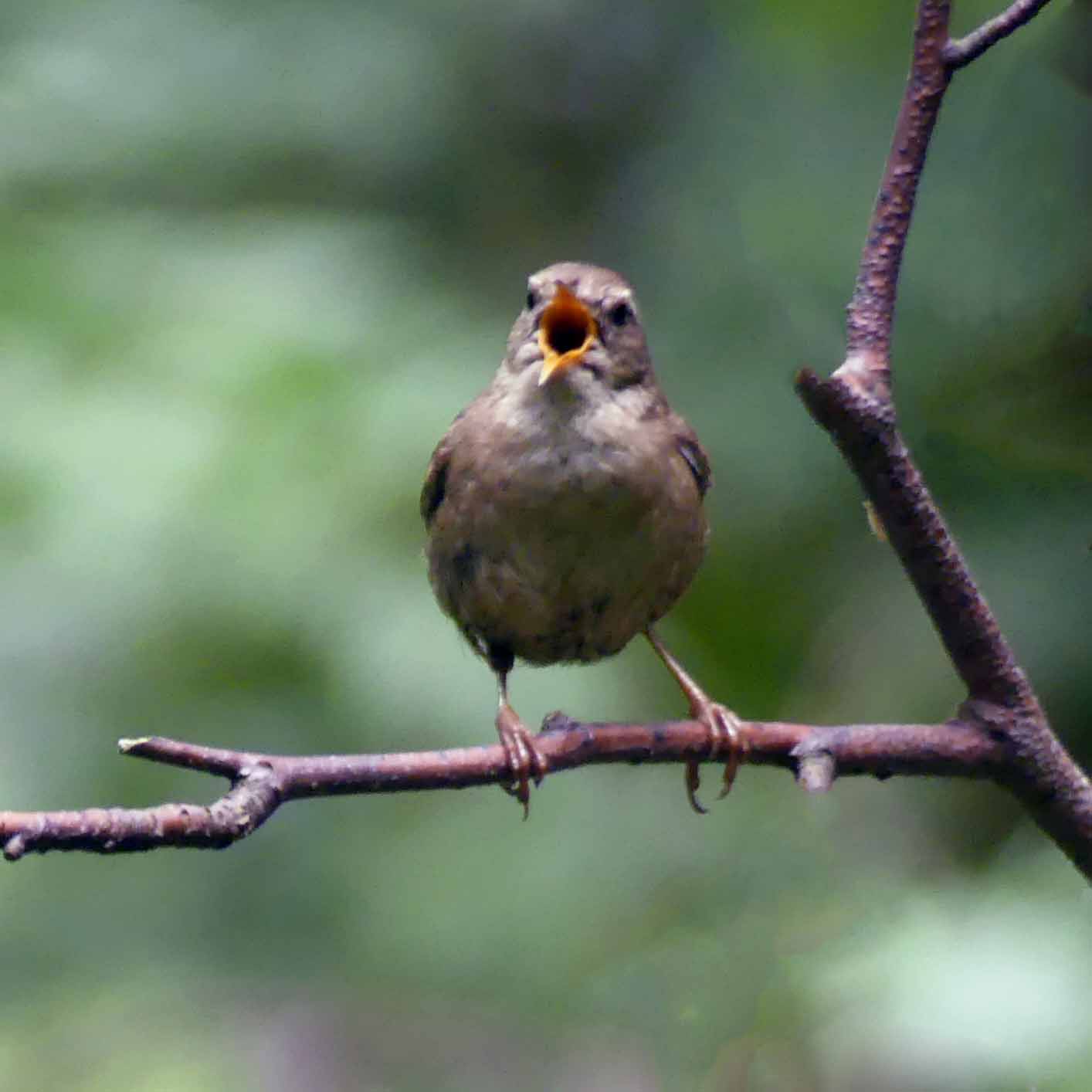
In Wales the tradition of Hunting the Wren, in Welsh, Hela’r Dryw, took place on the Twelfth Day of Christmas, January 5th, and the practice continued in Pembrokeshire until the beginning of the 20th century. Similarly to the traditions of The Isle of Man, a dead wren placed in a ‘Wren House’, a small decorated wooden box with windows, which was carried around the village by ‘Wren Bearers’. Sometimes, the Wren Boys caught a live wren, placed it in the Wren House and called upon folk to make offerings to the ‘Little King’, then set the bird free at the end of the day.

England

The tradition was followed in parts of England, but it gradually died out or was banned by the authorities by the mid 19th century. In the late 20th century the tradition of the Wren Hunt was revived in Suffolk and it has been performed in the town of Middleton on every Boxing Day since 1994.

Isle of Man

Legend

Although the origins of the wren hunting ritual is obscure in most cases, in the Isle of Man it is said to be associated with an enchantress, a fairy queen or a goddess named Tehi Tegi, which translated means something like ‘beautiful gatherer’. The legend says that Tehi Tegi was so beautiful that all the men of the Island followed her around, neglecting their homes and fields, in the hope of being chosen to marry her. But Tehi Tegi led her potential suitors to the river and drowned them and when confronted she escaped by transforming into a wren and flew away. She was banished from the Island, but returns once a year, when she is hunted.

Hunt the Wren was first recorded on the island in the 1720s, though even then was said “to have been practised since time immemorial”, then during what is known as the Manx cultural revival of the 1970s and 80s, *Culture Vannin said Hunt the Wren had become “revitalised with a new focus on the dance”.

December 26th 2024

One of the unique Manx festive traditions took place on St Stephen’s Day as Hunt the Wren was marked with singing and dancing across the island’s communities. Culture Vannin said the practice dates back to pre-Christian times, and was centred around a wren, described as “the king of all birds” in legend. In modern times, an artificial wren is used which is “hunted” and danced through the streets on top of a wren pole.

extract from https://www.bbc.co.uk/news/articles/cx2np73nx1ro

* Culture Vannin is an organisation that promotes and supports the culture, heritage and language of the Isle of Man established in 1982 by the Isle of Man Government as the Manx Heritage Foundation. In 2014, it was rebranded as Culture Vannin to reflect its progressive approach to Manx culture. 

Share this:

  • Click to share on Facebook (Opens in new window) Facebook
  • Click to share on Pinterest (Opens in new window) Pinterest
  • Click to share on X (Opens in new window) X
Like Loading...

Bird study: Blackcap

14 Monday May 2012

Posted by theresagreen in bird behaviour, Nature, nature of woodlands, nature photography, woodland birds

≈ 14 Comments

Tags

Blackcap, breeding warblers, Gibraltar, migrant birds, nature, sylvia atricapella, woodland birds

As soon as I heard the notes of its lovely melodious song, I knew I was looking out for a  blackcap amongst the trees growing by the river in Fairy Glen. Often singing from a perch in deep cover, I was quite surprised to find him quickly and easily, openly warbling from a branch in a smallish sycamore.

A blackcap singing beautifully from a tree next to the river, Fairy Glen

Blackcap– Sylvia atricapilla. The majority of  Northern European breeders winter in southern Europe and north Africa, where the local populations are resident. I enjoy the close company of these birds all round when in Spain as once established in a territory they tend to stay within it to live and breed.

This must be one of the easiest species of British breeding warblers to identify due to their distinctive caps; this is glossy black in the male but rusty red-brown in the female, so as usual the male gets precedence in the naming; even the latin ‘atricapilla‘ translates as black-haired. The birds’ upper parts are grey-olive brown and the underparts are a paler grey-buff. The other main distinguishing feature is its lovely clear melodious song which brought about its reputation in Britain as the ‘northern nightingale’.

The majority of  blackcaps we hear and see in Britain are summer visitors that arrive during April to breed in most parts of England and Wales, with sparser numbers venturing into Scotland and Ireland, then leaving again in October. (Although it has been recorded that blackcaps from Germany and north-east Europe are increasingly spending the winter in the UK, mainly in England.)

In common with other warbler species, other than when the male is singing, they may be difficult to spot as in general they spend much of their time hidden amongst shrubs and bushes within which they forage for food. When changing location they emerge abruptly from the cover of one bush and make a short, low jerky flight to another. Their presence is often given away by their call-notes, a rather harsh ‘churr’, also used as a contact call between a pair or parent and young and an excited ‘tac-tac’ rapidly repeated if the bird is alarmed.

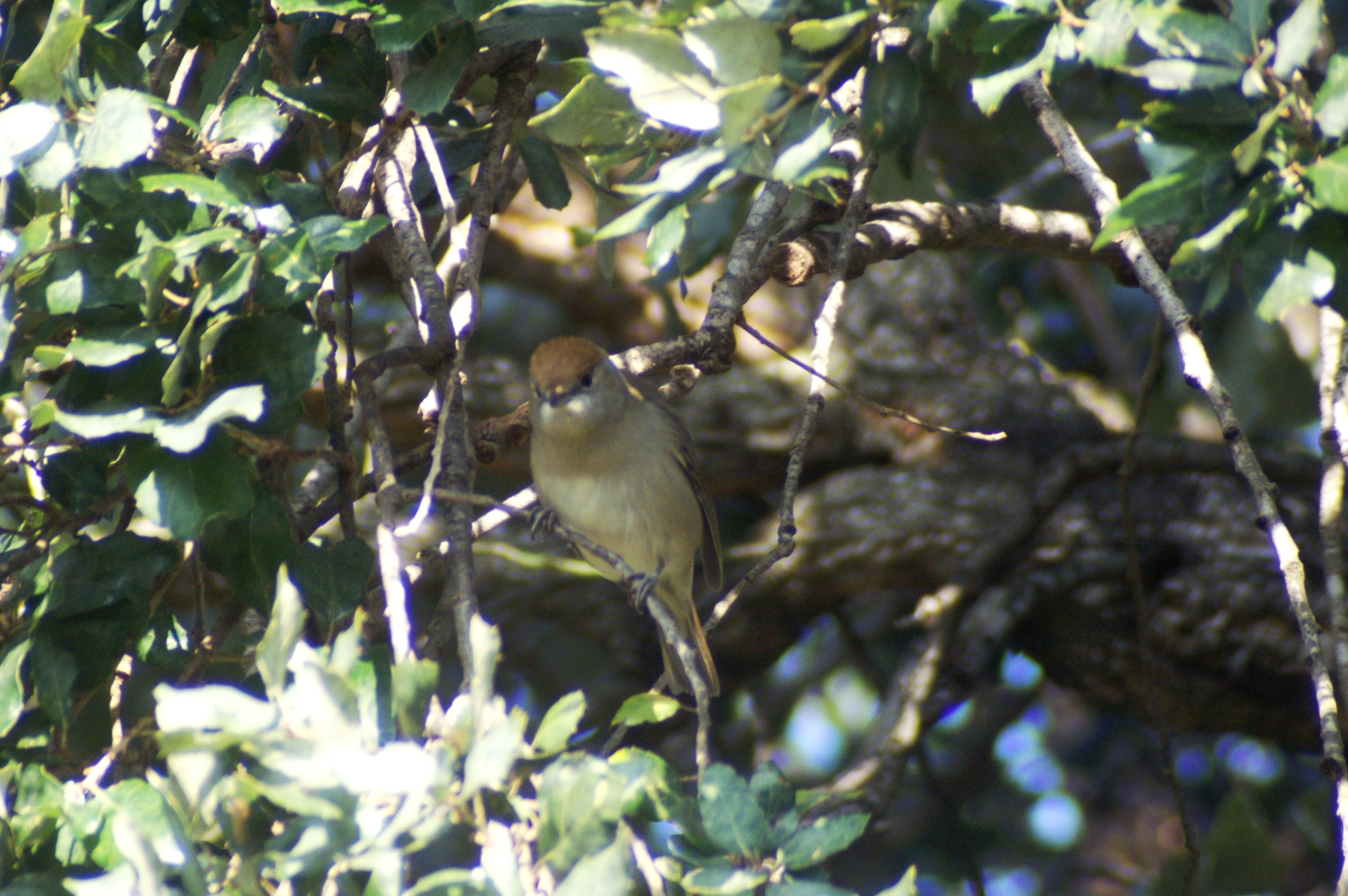
A female in a cork oak tree in the garden in Sotogrande,Spain

Blackcaps nest in woods, on heaths and sometimes gardens where there is a good density of undergrowth or coarse vegetation within which to build their nest and to ensure a reliable supply of food. The nest is a surprisingly frail construction for such a sturdy bird; built mainly by the hen of dried grass and lined with hair and other fine material, it is attached to the surrounding vegetation with ‘basket handles’. Both parents  will incubate the eggs and both will also feed the nestlings.

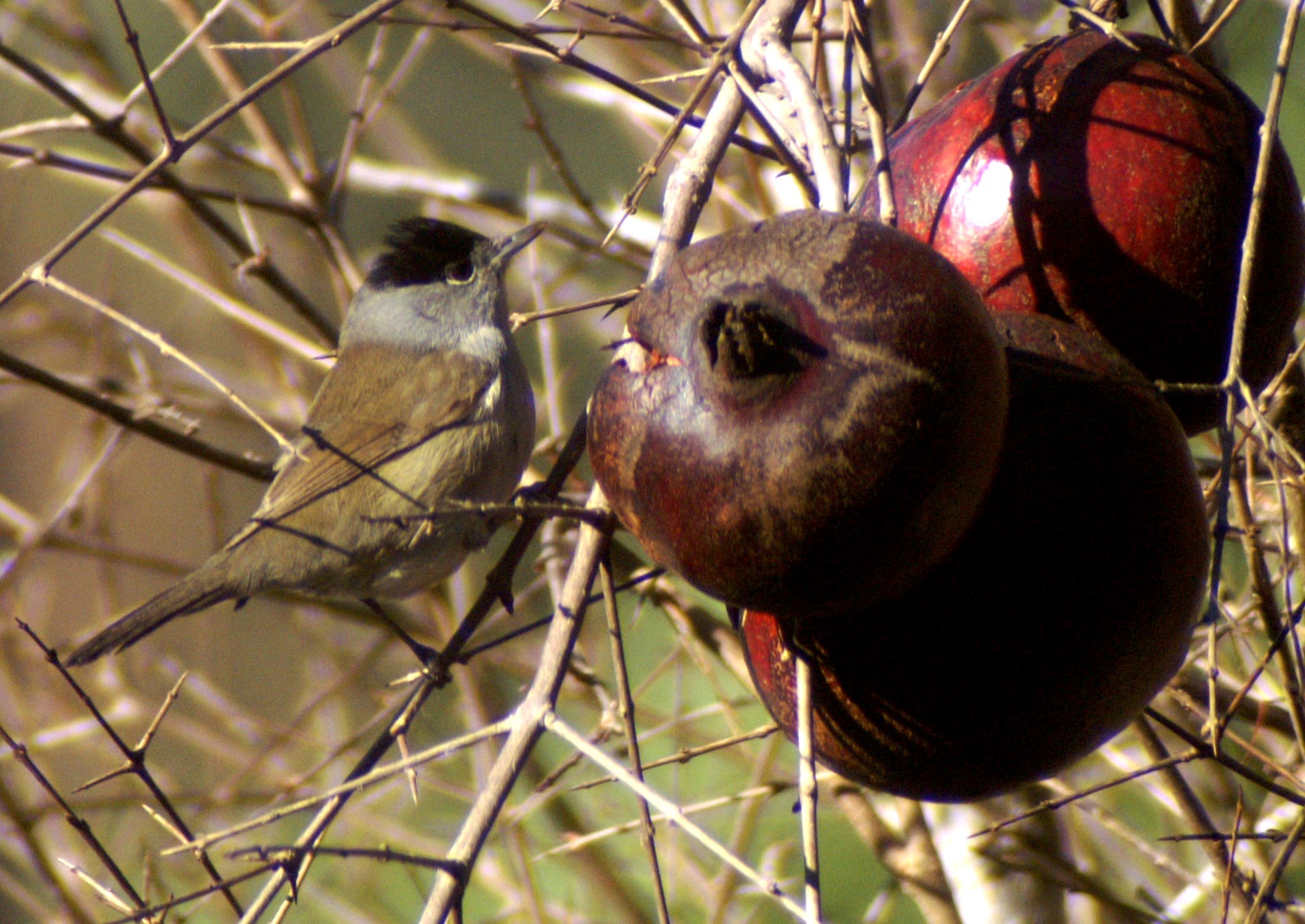
Caps of young birds begin brown as those of the female, males gradually turn black. Plant is American poke-weed, blackcaps love feasting on its ripe berries. Sotogrande, Spain.

The Blackcap is hardier than most other warblers, partly because of its adaptation to a more variable diet. Food is mostly flies, caterpillars and other insects, but they also avidly consume a wide variety of  fruit and berries as and when it beomes available.

The blackcaps wait for the pomegranate fruit to ripen and split then gorge themselves on the fleshy seeds until all that remains is the husk. Sotogrande, Spain

20/2/10-Feasting on nectar from aloes growing in the garden, Sotogrande, Spain

The Blackcap in other countries

Gibraltar – where they count and ring them on migration…

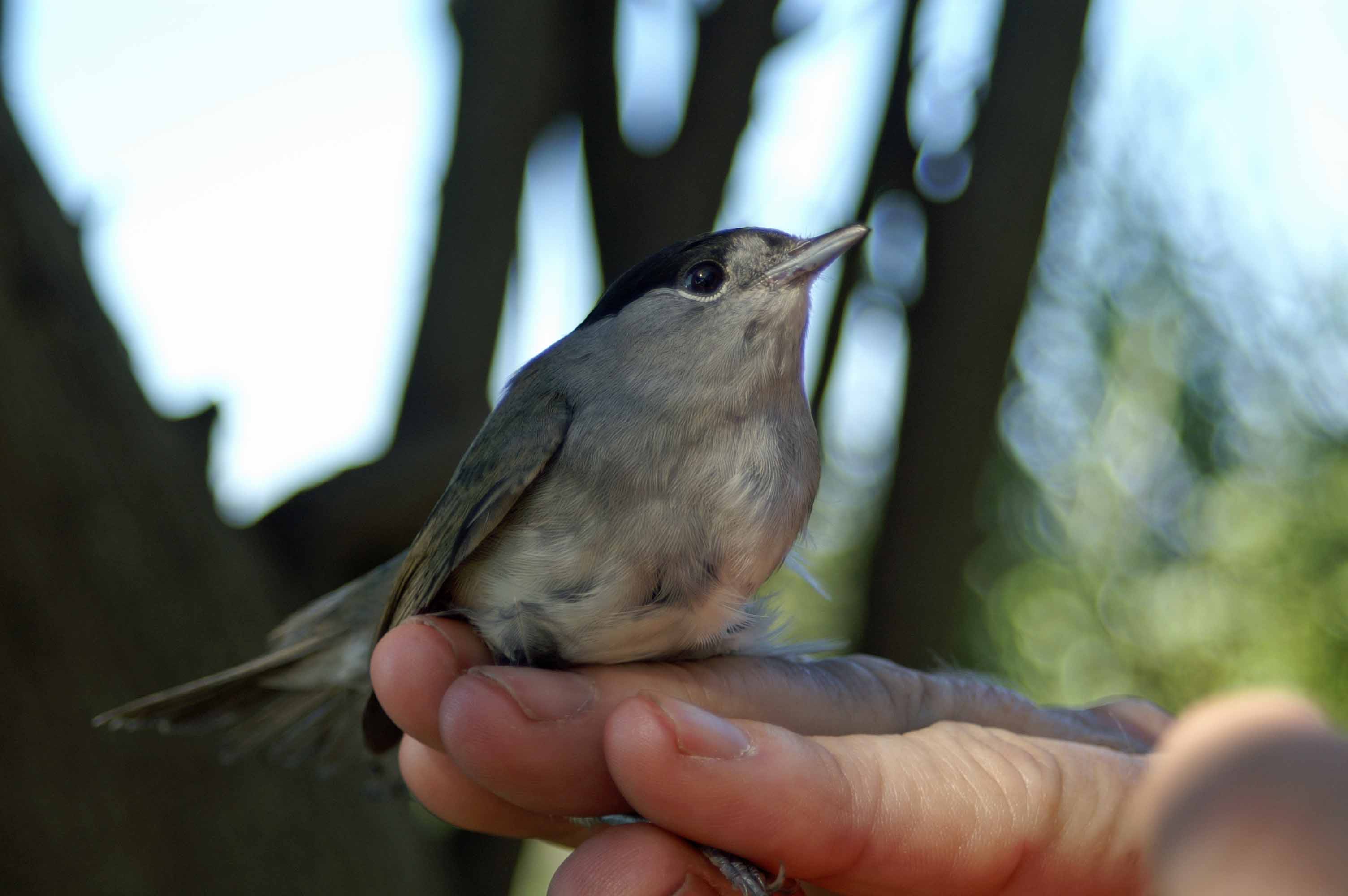
21/10/11-A very healthy blackcap enroute to Africa, ringed, weighed and measured and about to be released

Cyprus – where they eat them ….

The blackcap has been considered a culinary delicacy from the Middle Ages and to this date thousands of them fall victim to the lime-sticks set out by the villagers. John Locke, an Englishman who visited the island in 1553, makes the first reference to the trade in pickled or marinated “Becaficoes”, which was well established even in those days; he adds that “they annually send almost 1200 jarres of pots to Venice”. Many subsequent writers refer to this article of diet, still a favorite dainty. In 1576, the well educated traveller Porcacchi notes:… “there are birds of all kinds: in most esteem are those found nowhere else as certain little birds called vine-birds”. Keeping an itinerary of his visit to Cyprus between September 1598 and March 1599, Ioannes Cotovicus, a Professor at the University of Utrecht writes about the famous birds: “Infinite numbers of them are preserved in jars with vinegar and savory herbs and sent for (950 725 B.C.) Cyprus Museum sale to Venice, making a dainty dish greatly in request with princes and lords throughout Italy”. Later on, Pietro Della Valle recording his visit to Ayia Napa in September 1625 writes: “We found and ate in this place a large quantity of beccafichi, called by the Greeks sykalidia which at this season are caught in such abundance that besides the numbers that are consumed in the island itself, thousands are exported in vinegar to Venice and elsewhere” (Excerpta Cypria, pages 72, 166, 200, 213).

Over the last years the number of blackcaps has dropped dramatically, as they keep falling prey of lime-sticks or nets.

http://www.kypros.org/Cyprus/cap.html

Finland – where they are celebrated in poetry ….

The official song: Sylvia´s song

Once upon a time, a poet spent his summer at the beautiful Franssila manor in Kangasala, Finland. Sitting on the veranda, he heard a small bird sing. It was the blackcap (Sylvia atricapilla) that inspired Zachary Tope-lius, the poet and writer of children´s fiction, to write the poem “Sylvia´s son”, known today as “A Summer´s Day in Kangasala”. Put to music, the poem became Finland´s best-loved song and choral work and the official song of the Tampere Region. The “Harjula Ridge” of the song is today´s Haralanharju, a place of pilgrimage for every lover of scenic beauty. http://www.pirkanmaa.fi/en/tampere-region/emblems-tampere-region

Share this:

  • Click to share on Facebook (Opens in new window) Facebook
  • Click to share on Pinterest (Opens in new window) Pinterest
  • Click to share on X (Opens in new window) X
Like Loading...
Follow everyday nature trails on WordPress.com

Enter your email address to follow this blog and receive notifications of new posts by email.

‘But it is the common species that keep the living world ticking over and provide most of our experiences of wildlife, and I would argue that maintaining the abundance of these is as important a conservation priority as maintaining the existence of rarities’. Richard Mabey

MOST RECENT POSTS

  • A Glimpse of Spring to Come January 22, 2025
  • Hunting the Wren December 28, 2024
  • Oh, Christmas Tree December 18, 2024
  • In and Out of the Ivy February 15, 2024
  • Nature’s Fireworks November 30, 2023
  • Wild Autumn along the Coast Path November 3, 2023

OLDER POSTS

LOOKING FOR SOMETHING IN PARTICULAR?

  • The Foxglove - of Fairytales, Myths & Medicine
    The Foxglove - of Fairytales, Myths & Medicine
  • Pretty prickly Thistles
    Pretty prickly Thistles
  • Willsbridge Mill, Bristol
    Willsbridge Mill, Bristol
  • Following a river to a Fairy Glen
    Following a river to a Fairy Glen
  • Fine Dining for Crows
    Fine Dining for Crows
  • Catchers, a Duck and Divers
    Catchers, a Duck and Divers
  • Everyday Birds - The Blue Tit
    Everyday Birds - The Blue Tit
  • Wild and Windy on West Shore
    Wild and Windy on West Shore
  • Of Gorse, Furze or Whin
    Of Gorse, Furze or Whin
  • Wildflowers of North Wales Coastal Paths, Cliffs and Dunes
    Wildflowers of North Wales Coastal Paths, Cliffs and Dunes

nightingale trails

The Walk of the Monarch Butterfly-Sendero de la Mariposa Monarca

The Walk of the Monarch Butterfly-Sendero de la Mariposa Monarca

MY WILDFLOWER BLOG: where the wildflowers are

Snowdrop

Snowdrop

most recent posts

Follow everyday nature trails on WordPress.com

Social

  • View teresamaygreen’s profile on Twitter

Enter your email address to follow this blog and receive notifications of new posts by email.

Website Built with WordPress.com.

  • Subscribe Subscribed
    • everyday nature trails
    • Join 359 other subscribers
    • Already have a WordPress.com account? Log in now.
    • everyday nature trails
    • Subscribe Subscribed
    • Sign up
    • Log in
    • Report this content
    • View site in Reader
    • Manage subscriptions
    • Collapse this bar
 

Loading Comments...
 

    %d