Tags
Crow dropping shellfish onto rocks, Curlew, curlew on seashore, intelligent behaviour of crow, migrant hoverfly, rhos-on-sea
Walk from Penrhyn Bay to Abbey Road, Rhos-on-Sea
The beach of Penrhyn Bay is mostly made up of shingle, a hostile environment for plants, but some tough species have gained a hold there, spreading forward from the base of the sea wall.
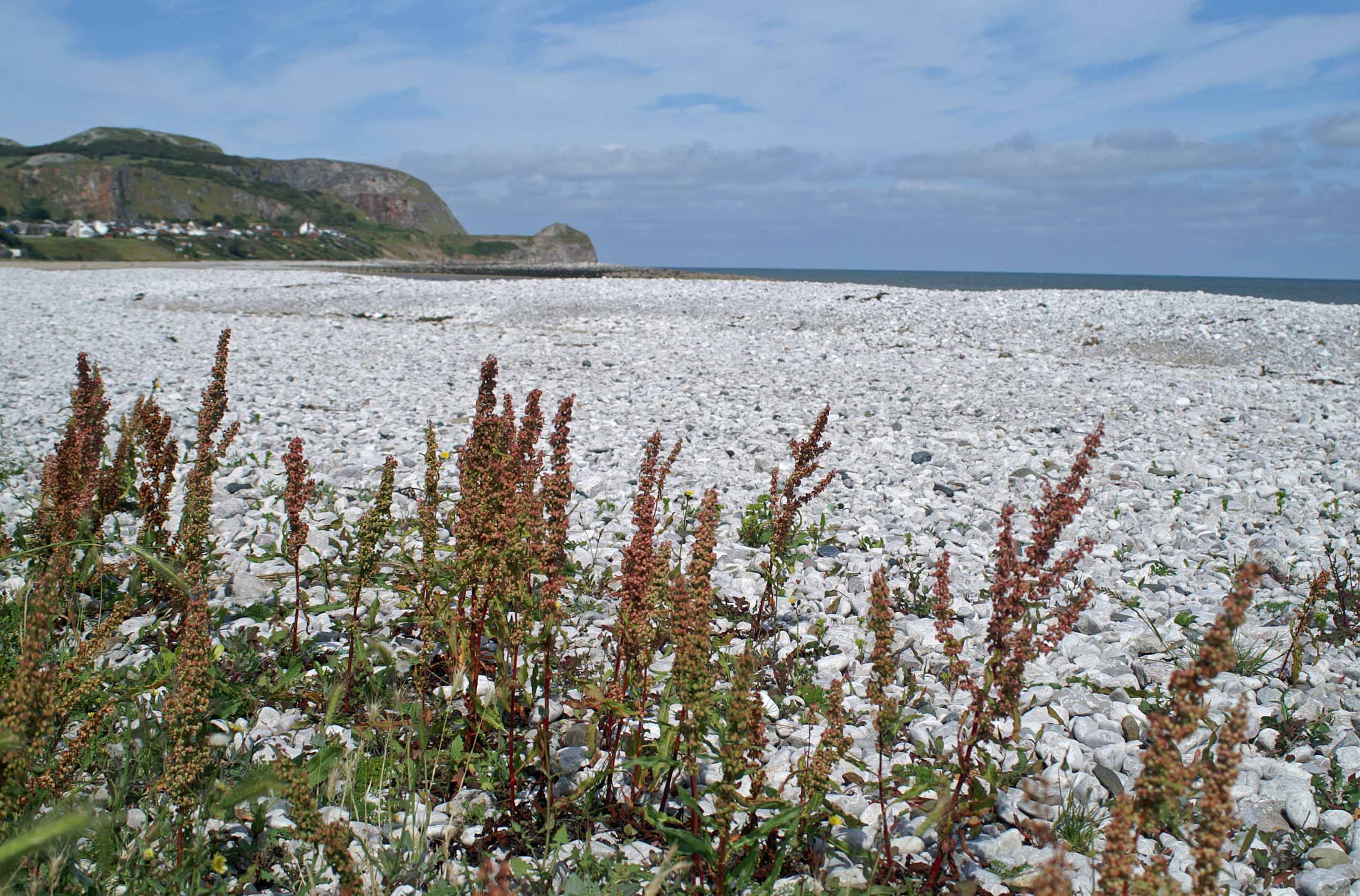
24/7/11-Dock plants growing on the seashore with the Little Orme in the background
Shingle as a habitat
Shingle plants will begin to colonise above the high tide mark. Below this the moving pebbles will prevent any seedlings getting a stable hold. The plants that grow on the shingle usually have long and tough roots able to withstand the friction of the pebbles that will be disturbed by storms. Often referred to as a desert-like environment, plants like dock have water-retaining leaves that enable them to be one of the larger colonisers of this unique habitat, while smaller plants may be able to harness the water that collects on the surface of the pebbles.

- 24/7/11-Penrhyn Bay beach-Common Mallow growing on the shingle was attracting insects


- 24/7/11-Penrhyn Bay beach -a Migrant Hoverfly resting on a mallow leaf

I left the beach where the shingle gives way to the rocky shore of Rhos-on-Sea, keeping an eye on the beach from the promenade. A Black-headed Gull caught my attention and I stopped to have a closer look. The gull was standing on a patch of muddy sand and I was intrigued to see the tops of car tyres protruding above the sand behind it. The way they were placed seemed to be deliberate, so I wondered if they are being used to reinforce the sea-break or stabilise the sand? They must have been there for a good while as some have seaweed growing over them.

- 24/7/11-Black-headed Gull with tyres bedded in the sand behind it

Focusing my attention on the gull and the tyres, I had half-noticed a brownish coloured bird against the rocks behind them that I thought was a young Herring Gull. When I gave it proper attention I had a pleasant surprise; it was actually a wader, either a Whimbrel or a Curlew, that was foraging around the rocks, probing its long curved beak into the the muddy sand.It was so well camouflaged against the rocks it was difficult to keep track of it, but I got a better view when it spent a couple of minutes in a more open pool of water.

- 24/7/11-Curlew on the sea shore


- 27/7/11-The Curlew blended perfectly into its surroundings

The wader disappeared from sight amongst the rocks and I carried on with my walk. I didn’t get far before I stopped again to watch a Crow that was acting strangely, flying up into the air then diving down again. It took a few minutes to realise that what it was doing: it was searching for a shellfish, picking it up in its beak, flying up then dropping it onto the rocks hoping to break it and diving down after it.

- 24/7/11-The shellfish does not drop straight down, so the crow has to follow it quickly or lose sight of it.


- 24/7/11-The crow is surprisingly agile and turns quickly to make a steep dive


- 24/7/11-Diving Crow keeping its eyes on the landing position of its snack

There was quite a gap between each performance which I thought may have been either because the shellfish needed to be a particular size or species, or perhaps needed to be partially open, or simply that each mouthful obtained this way required so much effort – it may well take more than one drop to smash a shell. I was fascinated by their behaviour and very impressed with their ingenuity; clever things.
There were quite a few gulls about; Lesser Black-backed gulls, Herring gull adults and juveniles and a few more Black-headed gulls. Herring gulls frequently chase other birds they see flying with food in their bills, hoping to steal it if possible. During an interlude in the Crow entertainment I spotted a mottled brown and white bird that I took to be a juvenile Herring gull being chased by an adult; as it broke away and flew towards me I was surprised again to see that it was another Curlew carrying something quite large in its bill; a crab I think.

- 24/7/11-Curlew flying with food

The Curlew flew back along the sea edge towards Penrhyn Bay, landing a short distance away from me amongst a cluster of rocks. Watching it closely I could see other Curlews gathered there, difficult to count as they are very hard to see, but at least another three.
It’s amazing what you see sometimes when you don’t set out to look!
 everyday nature trails