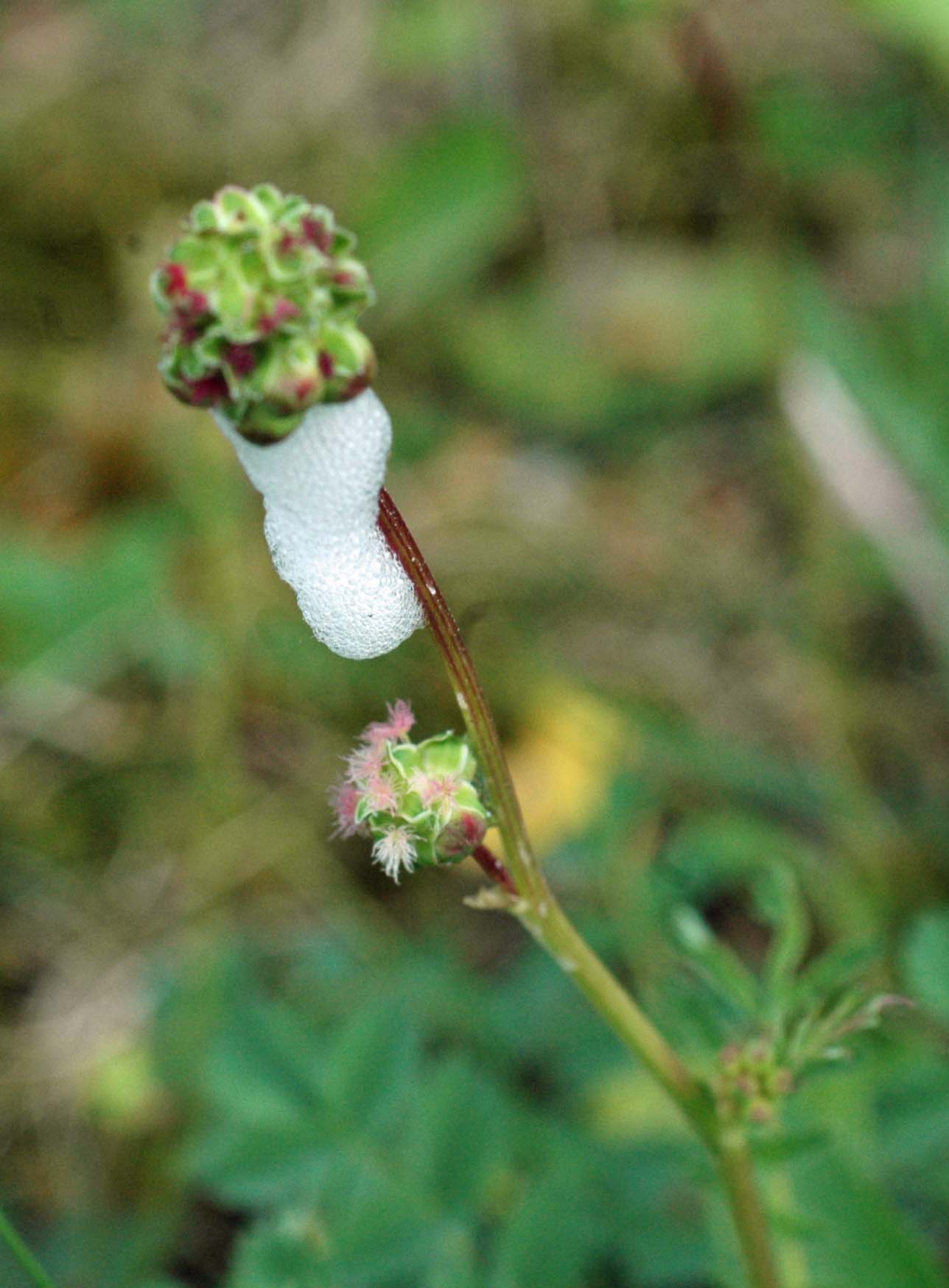
15/6/13-Cuckoo-spit on Salad Burnet
As I’ve been getting up close and personal with wildflowers this spring I have noticed what seems to be an unusual amount of the bubbly frothy white deposits we fondly call “Cuckoo-spit”. Now I have been aware of the stuff since I was a child picking wildflowers, way back in the day when there were still plenty of them, and was aware that my step-father used to wash it off plants he grew in the garden. I knew it housed some kind of bug, but not what exactly, and ignored it in my own garden as I soon realised that no harm seemed to befall the plants it appeared on, so why kill something for the sake of it? Now I know more about the amazing little bugs whose larvae hide away beneath the sticky frothy stuff I am so glad I let them be. (On a commercial scale the insect is regarded as a pest because they carry harmful viruses.)
The name

Cuckoo-spit low down amongst Bird’s-foot Trefoil
It is supposed that the name Cuckoo-spit arose because sightings of the spittle often coincided with hearing the first calls of Cuckoos in the Spring. It may also be linked with a delightful(!) old superstition that required one to spit whenever a Cuckoo was heard, to ward off bad luck. This is reiterated in Cuckoo-spit being an important ingredient in witches’ brew (as in Macbeth). I have read that in Scandinavian countries the froth is known as ‘witches’ spit’ and in the United States it is frog-spit, toad-spit or snake-spit. I’d appreciate confirmation from fellow-bloggers on those colloquial names being correct and would love to hear of any others.
What it is and the insect that produces it
The substance is produced by the larvae of a froghopper, or ‘cuckoo-spit insect’ which is also sometimes called the ‘spittle-bug’. In the late summer, adult females lay up to 100 eggs into an incision made into the tissues of a host plant. The eggs are laid on a variety of plants including nettles and grasses as well as the tender young shoots of willow, cherry and apple. The eggs hatch into nymphs the following spring.
Aside: I wonder what happens to most of the eggs? There is rarely more than one blob of spit on an individual plant stem. Perhaps they get eaten by other insects or don’t survive the winter? Or do the young larvae migrate to other plants?

Froghopper larva exposed from beneath its frothy blanket on a Cat’s-ear flower stem
The nymph is the sexually immature stage. It resembles the adult in shape but has no wings and only rudimentary legs and eyes. At this stage its exoskeleton (outer body layer) is very thin so it needs to protect itself from desiccation; hence the soapy bubbles. The froth also serves to protect the developing nymph from predators by hiding it and by the fact that it tastes horrible. Enclosed within its frothy tent, the nymph moults several times before emerging as an adult in early summer.
How the ‘spit’ is produced
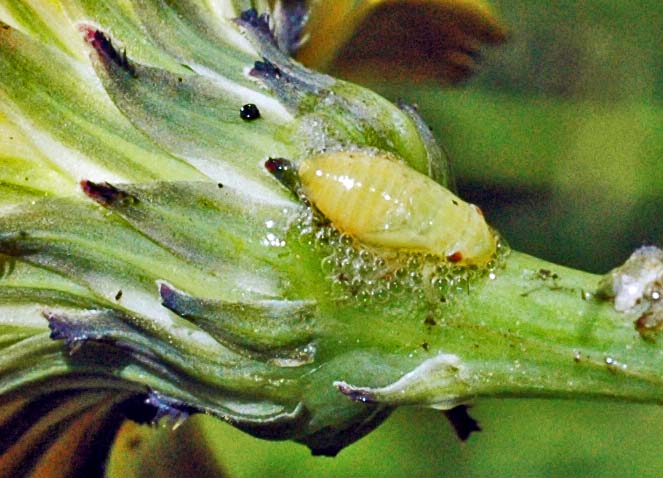
An enlarged (photographically) froghopper larva
The nymph feeds head downwards with its syringe-like mouthparts embedded in the tissue of the plant. The froth is created by the insect excreting a fluid, the result of excess undigested plant sap, exuding through the anus. This sap, as it is excreted, mixes with a secretion from the abdominal glands. Air bubbles are introduced through a special valve on the abdomen which acts like a bellows, and contact with the air causes the liquid to ferment, forming the froth (or spittle).
I have to say that seeing it this size and knowing how it feeds put me in mind of ticks, which are one insect species I could happily see become extinct.
The adult froghopper
The froghopper is a member of the order Homoptera; thus related to both cicadas and aphids. The Common Froghopper (Philaenus spumarius) is the most widespread example in the UK, although related species are found worldwide. Typically the adult froghopper is between 4mm and 7mm long. They are called froghoppers because from above they appear frog-like, and they are able to hop significant distances when disturbed.

An adult froghopper, much enlarged. Photograph from BBC archives
Habitat
In nature, the habitats froghoppers are most often found in are woodland edges and grassland. However, they are also a pest known particularly to fruit-growers. They feed on plant sap which they extract from the leaves and stems of plants. This causes minor damage in itself, but the insects carry viruses which can cause serious harm to crops. In gardens they are frequently encountered on such plants as chrysanthemum, dahlia, fuchsia, lavender, rosemary and rose – all of which produce strong aromatic oils.
Why the froghopper is amazing
It has been discovered that the froghopper is the champion jumper of the insect world, a title previously attributed to fleas. The froghopper, which is only 6mm long can spring to heights of 70cm and although the flea can match that, the froghopper is some 60 times heavier.
Read more in this fascinating article (from which I copied the photograph of the adult froghopper):
http://news.bbc.co.uk/1/hi/sci/tech/3110719.stm
I would like to add that no froghoppers were deliberately harmed in the taking of my photographs, I did my best to cover him back up with more froth – (yuk!-sticky stuff!) And I will be keeping an eye out for adult froghoppers to try for my own photographs.
 everyday nature trails