For a few magical days earlier this month I enjoyed the privilege of close sightings of Redwings as they travelled around our local woodland foraging for food. Special sightings indeed, and better still I didn’t even need to leave my flat: all but one of the following photographs were taken from my kitchen window.
December 31st 2016
09:10 Thrilled to see Redwings this morning – several flew through the cover of the trees and shrubbery behind the building, with one pausing briefly in view of the kitchen window. There was a flurry of bird activity around that time; they were preceded by a mixed group of small birds, including Long-tailed, Great & Blue tits and seemed to have a variety of blackbirds travelling with them, so may have been a thrush feeding party following a tit feeding. The light was poor and I only managed to get one not-so-good photograph, but at least it is a record of the sighting.

English name: Redwing Scientific name: Turdus ileacus Welsh: Coch Dan-aden Status in the UK: RED Redwings are red-listed in the UK as although the majority are autumn-winter residents, we have a very small breeding population, restricted in range to the northern third of Scotland.
Other local names: Swinepipe, Wind Thrush Scientific name from: Latin: turdus=a thrush and Latin: iliacus=of the flanks (from ile=flank)
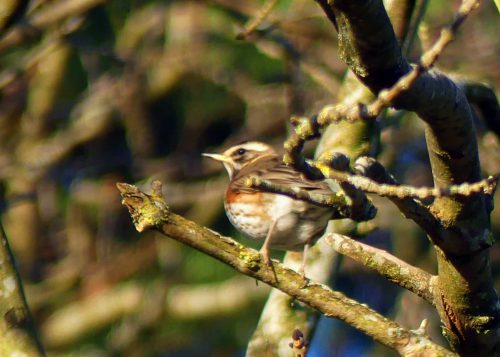
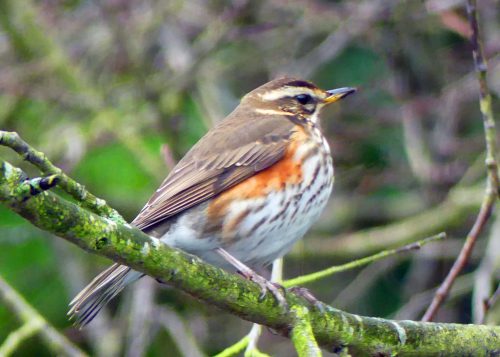
Redwings are Autumn-Winter residents of the UK and the smallest and daintiest of our thrushes. Smaller than the Song thrush, they are often shy, but a close view reveals a prominent whitish supercilium (eye stripe), warm rust red patches on the flanks and under the wings and cool grey-brown upperparts. Males and females are alike.
January 2nd
This was the day of my encounter with the flock during my walk in the woods, already described in the previous post. There were blackbirds with them then too and I went on to see the mixed small-bird feeding party just minutes later.

The Redwing’s diet is mainly composed of invertebrates, supplemented with berries in autumn and winter. Wintering Redwings may be seen together with Fieldfares foraging in open fields, but they also feed with other thrushes in grassy paddocks or in woodland. Visits to gardens may be brief and are usually prompted by harsh weather.
January 5th
A frost last night left the ground hard and sparkling white this morning, and it remained cold for much of the day despite the bright sunshine. The hard ground may have driven the Redwings to seek easier food sources. This was brilliant for me as from early morning a small flock of them arrived intermittently throughout the day to pick at ripening ivy berries. So once again from my window I had a succession of fairly close-up views of them, although most of the time they were at least partially hidden behind tree twigs or within ivy foliage.

The majority of Redwings arrive into the UK during September and October as birds cross the North Sea from Scandinavia and Russia. Those arriving into Wales and other western areas are most probably Icelandic birds. Redwings are night-time migrants, and if you are lucky and listen out on dark clear autumn and early winter nights, particularly in the east of the country, you may hear the thin ‘tseep‘ of a flock overhead. As winter arrives Redwings will have largely finished their journeys, settling in the warmer and relatively frost-free areas away from the east coast. They stay with us till March, although hard weather may force them to migrate further, with Scandinavian/Russian birds (the iliacus race) continuing westwards to Ireland or southwards into southern Europe.
Taking a few minutes to rest in the warm sunshine:

“Any attempt to estimate the size of the wintering population of Redwings in Britain and Ireland meets with the same problem as for the Fieldfare: the numbers vary from year to year, and also in the course of a single winter, and major shifts of population may take place in response to weather and feeding conditions. “
( David Snow 1987 – The Atlas of Wintering Birds in Britain and Ireland, edited by Peter Lack)



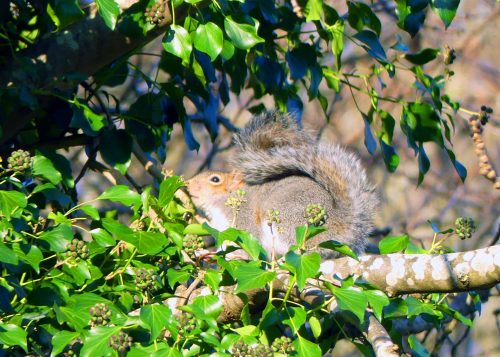
Another interesting observation I made today was of a Grey squirrel that seemed to be ‘guarding’ the ivy berries. I watched it chase away another squirrel several times, but also noticed it was chasing the Redwings away too, charging at them by running along branches towards them at speed, tail all fluffed out!

January 6th
Milder temperatures may have allowed the Redwings to move on in their constant search for food and today I saw just one bird from my window. It wasn’t in the usual hurry and lingered for a few moments, not moving far and presenting itself to me from various angles so I got some lovely views of different aspects of its plumage and general ‘giz’. They really are beautiful birds.

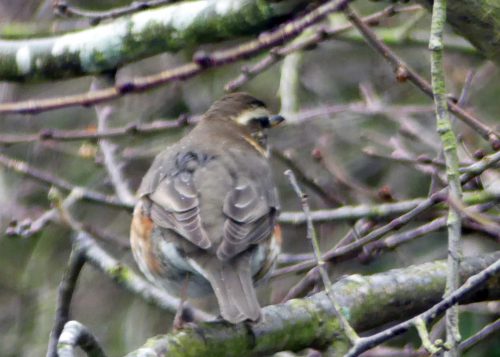
I saved the best for last.
 everyday nature trails