Last week we were blessed with a few days of beautiful calm bright sunny spring-like days, which came as a welcome break between the post-Christmas freeze and the forecasted return to colder, more seasonal weather to come. Warm enough to get out to enjoy a walk at my preferred ambling pace, with plenty of moments to just stand and look around me without freezing to the spot, and the freedom to take photographs without fumbling with gloves, could not be passed up.
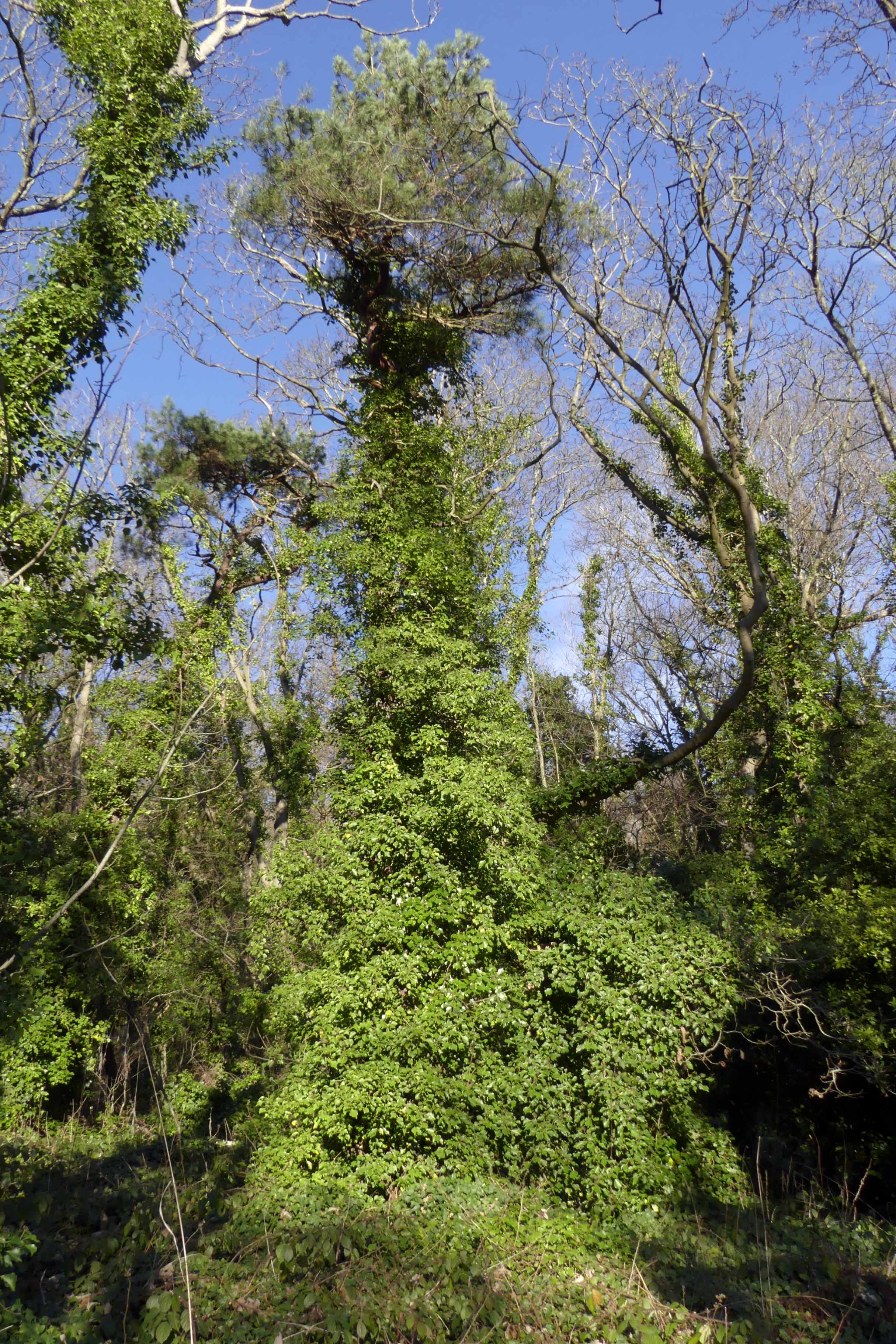
At both ground and eye level my local woods remain surprisingly green throughout the winter; sprawling ivy blankets much of the woodland floor and at every opportunity clambers high up the trunks of many trees. There are plenty of other evergreens too, dark yews, scots pines and the somewhat controversial holm oak all abound.
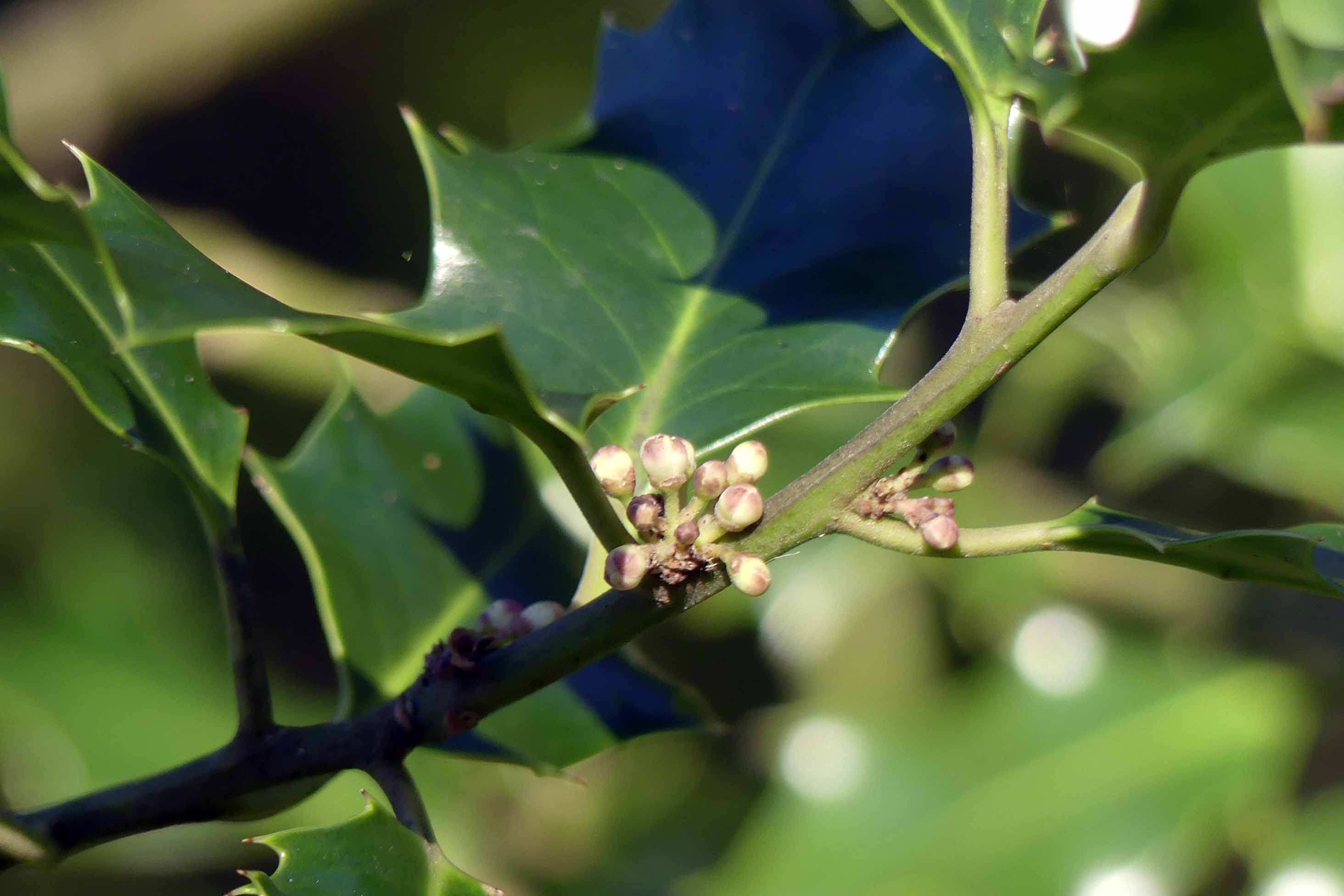
There are copious amounts of shining holly too, taking many forms from small trees to thick spreading bushes, dependent upon where they find themselves and the availability of space and light. One of my ‘targets’ for today was to look for the first signs of flowers on holly; some plants begin flowering early in the year while others wait for the spring or even early summer. I managed to find a few flower buds, but not yet open I couldn’t tell if they were male or female (holly plants may be either male or female, with females being the ones that produces berries), but male flowers most often appear first. Here and there a few berries remain.
Flower buds on hollyA few berries left
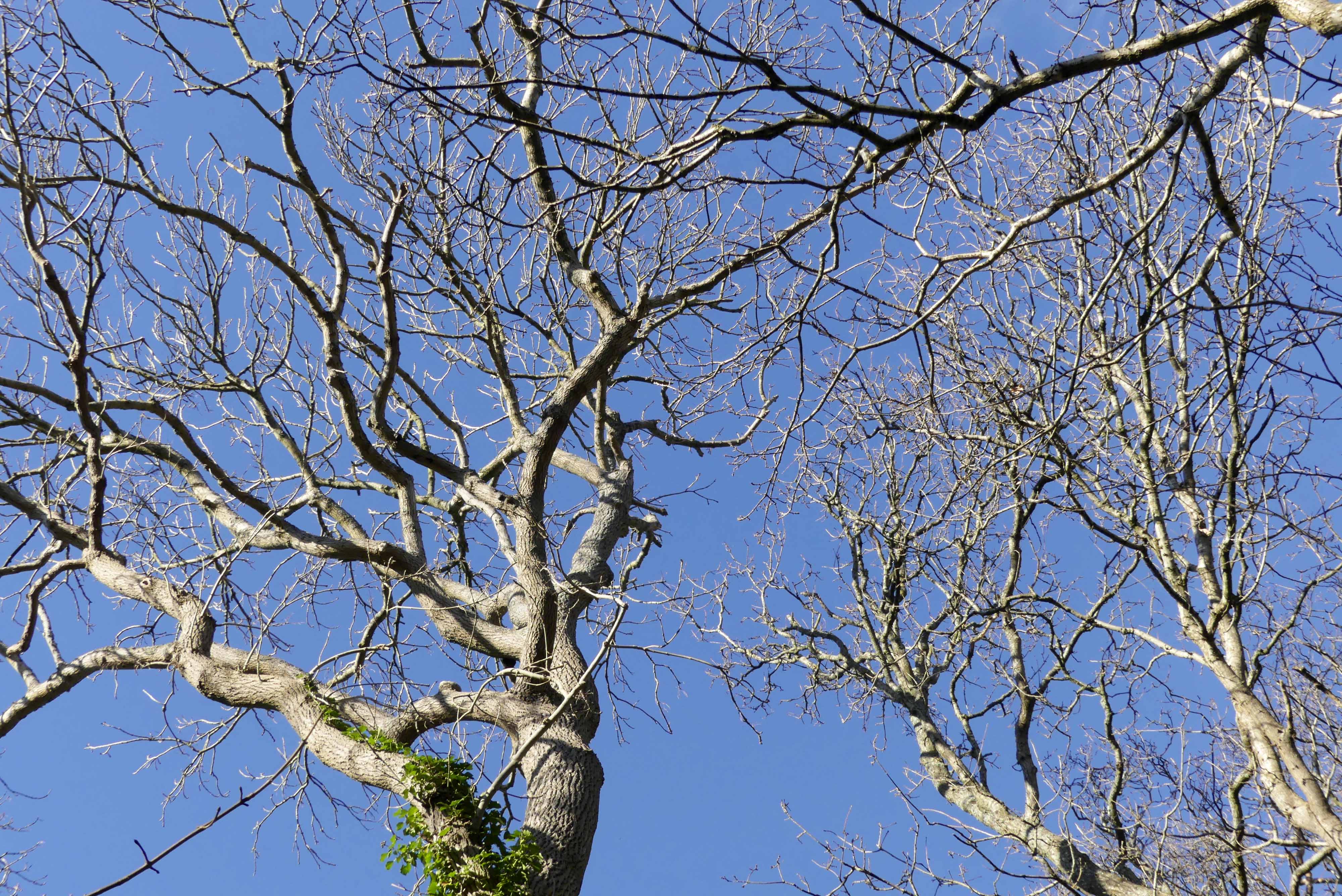
Looking up adds another dimension to the scene; a cloudless deep blue sky provides a perfect background highlighting the fascinating network of branches and twigs of the leafless trees reminding there is more winter to come.
As I meandered along I kept an eye on the surrounding trees; on days like this in the winter when trees are still bare of leaves there’s always a chance of spotting a foraging treecreeper quietly spiralling its way around trunks and branches; not today though.
The distinctive call of a nuthatch helped to locate it as it travelled up and down the branches of an oak tree. It paused every now and then to probe a likely spot for insects, but was way too busy to stop and pose for a photograph.
Female great spotted woodpecker
I had better luck with a pair of spotted woodpeckers that were travelling high up through the treetops. Stopping momentarily to investigate the trunk of a likely tree; the male quickly flew off but I managed a quick snap of the female who lingered a few seconds before she also took off to follow him.
Leaving the narrow earth paths of the woodland and joining the Woodland Trail of the Reserve, which is higher up the hill, I hoped to catch sight of a few more birds as there are good views down through the trees from there. As always, numerous wood pigeons and blackbirds vied for the ripest of the ivy berries. There were glimpses of blue tits, numbers of them travelling around together, keeping up an almost constant chorus of chirpy contact calls as they travelled between the ivy-clad trees. A fewer number of great tits accompanied them, and one sounded out a few notes of his ‘teacher-teacher‘ song, a first ‘hearing’ of that this year.
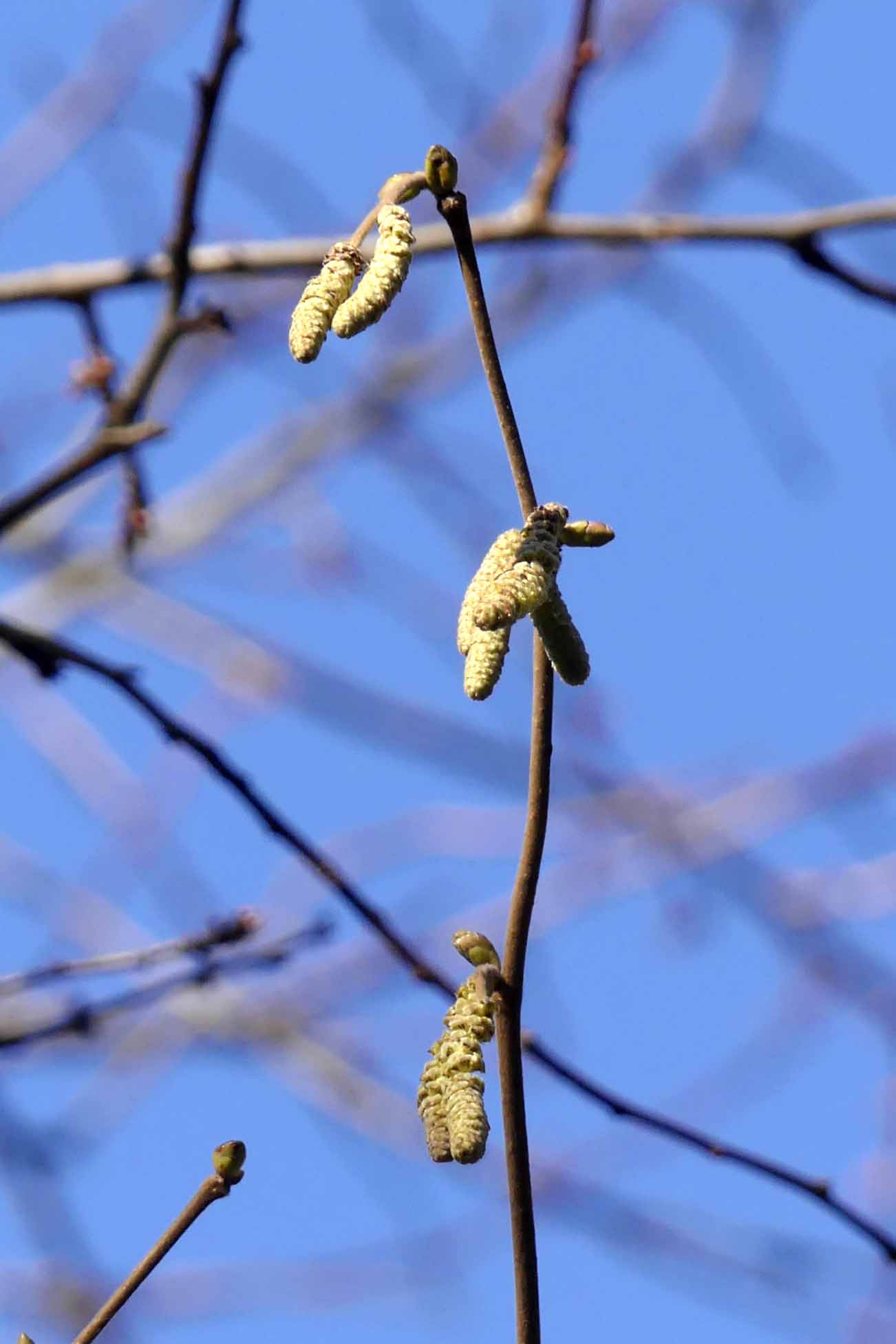
Male hazel catkins are beginning to show
Robins have been singing for a few weeks now, but today they were out in force each one either declaring territory, or perhaps calling out for a mate, at frequent intervals. Most were singing from cover, but one or two were bolder and sang confidently in the open. It’s not possible to tell whether you’re seeing or hearing a male or a female robin as both hold territories and both sing.
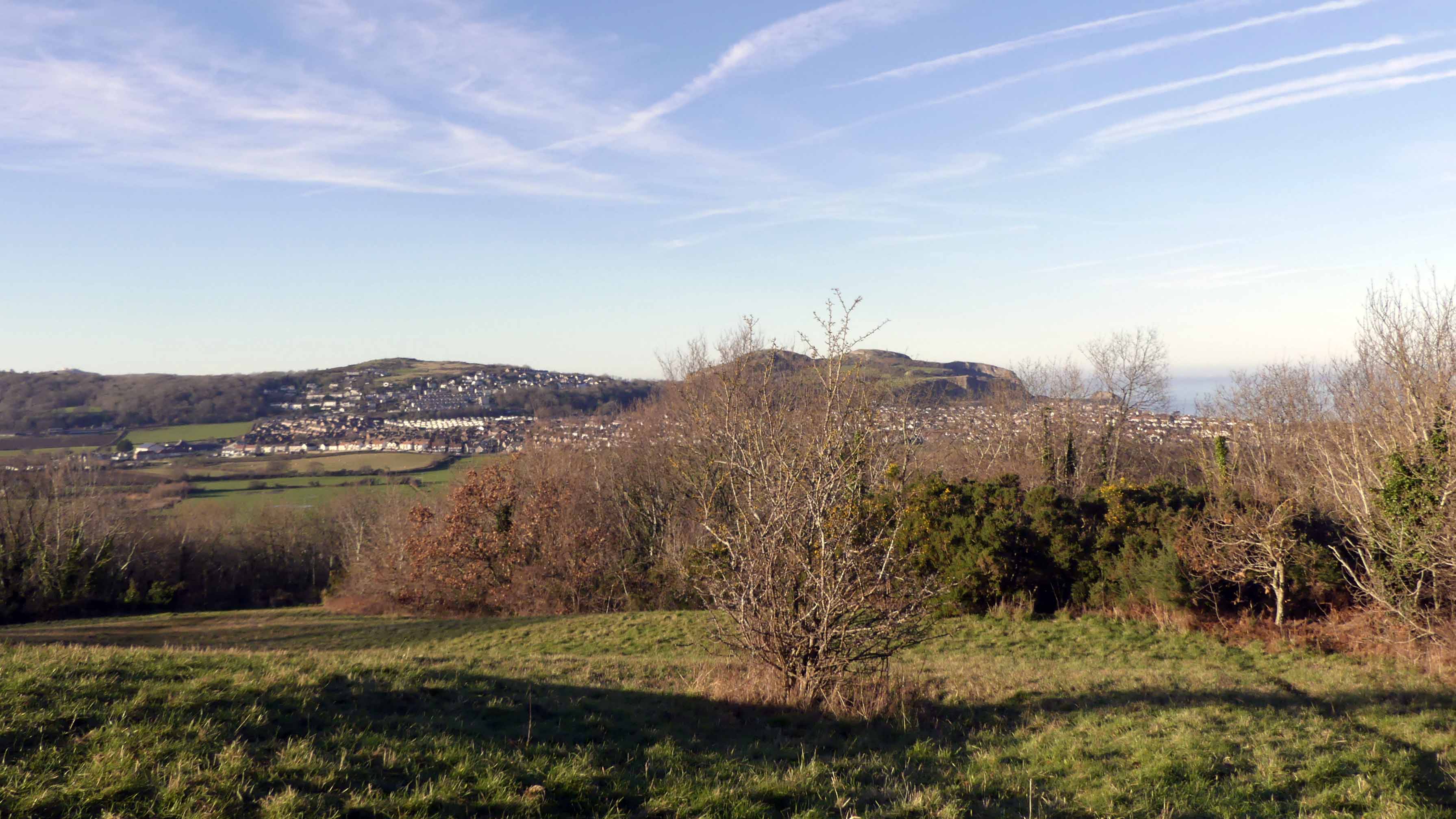
View from the top of the field on the slope of Bryn Euryn across to Penrhyn Bay and the Little Orme:
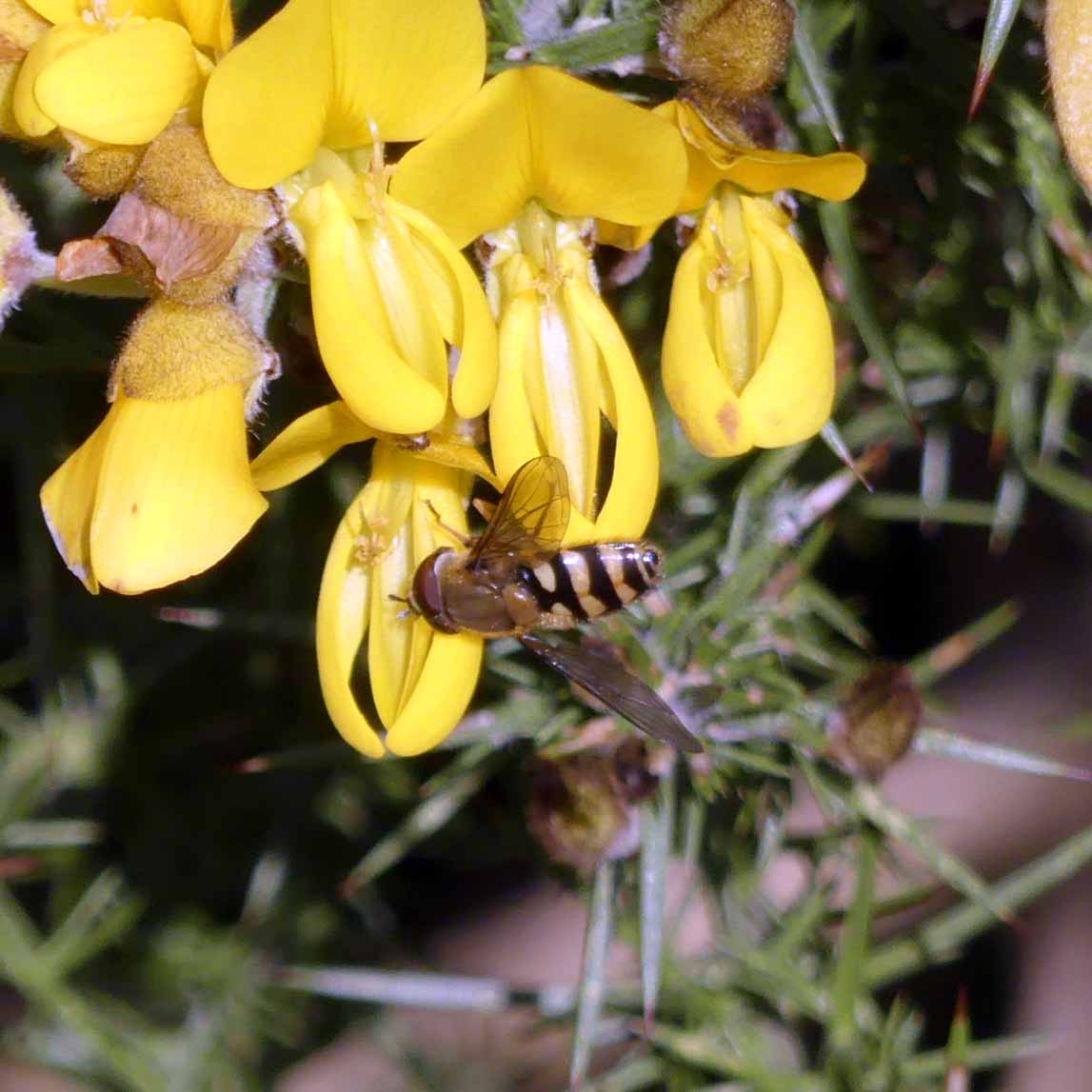
Meliscaeva auricollis (f)
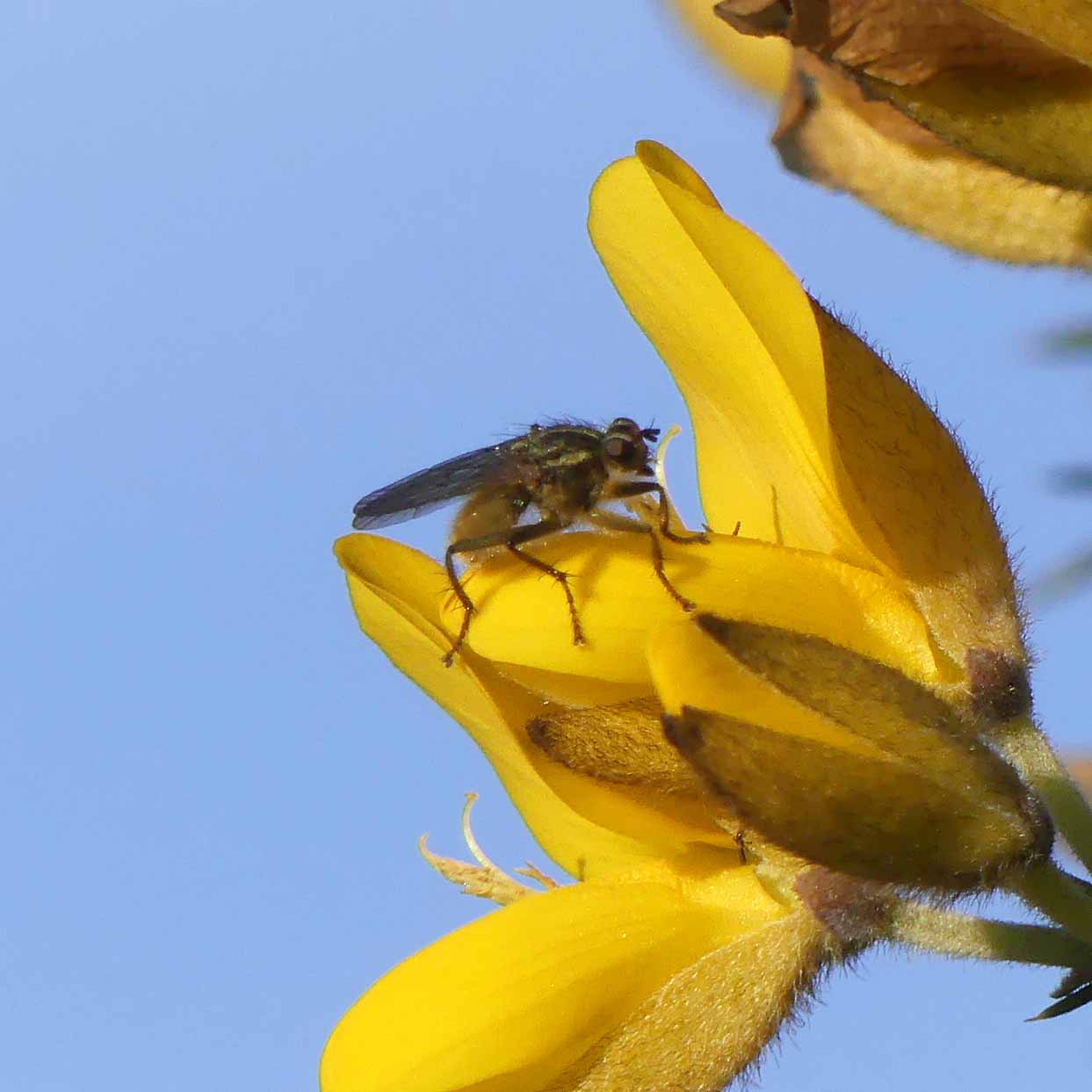
Reaching the open field I started on my usual route around its edges, looking carefully at the vegetation for any insects that might be out on show whilst taking the opportunity to bask in the sunshine and/or seeking a welcome mid-winter top-up of nectar or pollen energy. I was in luck! Some of the gorse bushes are in flower to vary degrees and some of those in the most sheltered and sunniest spots had visitors. Firstly a single hoverfly had a small bush at the bottom end of the field to itself. Not a species I recognised, it was later identified for me as a female Meliscaeva auricollis, a double first sighting – first hoverfly of this year and a first of the species.
“When gorse is not in flower, kissing is out of season“
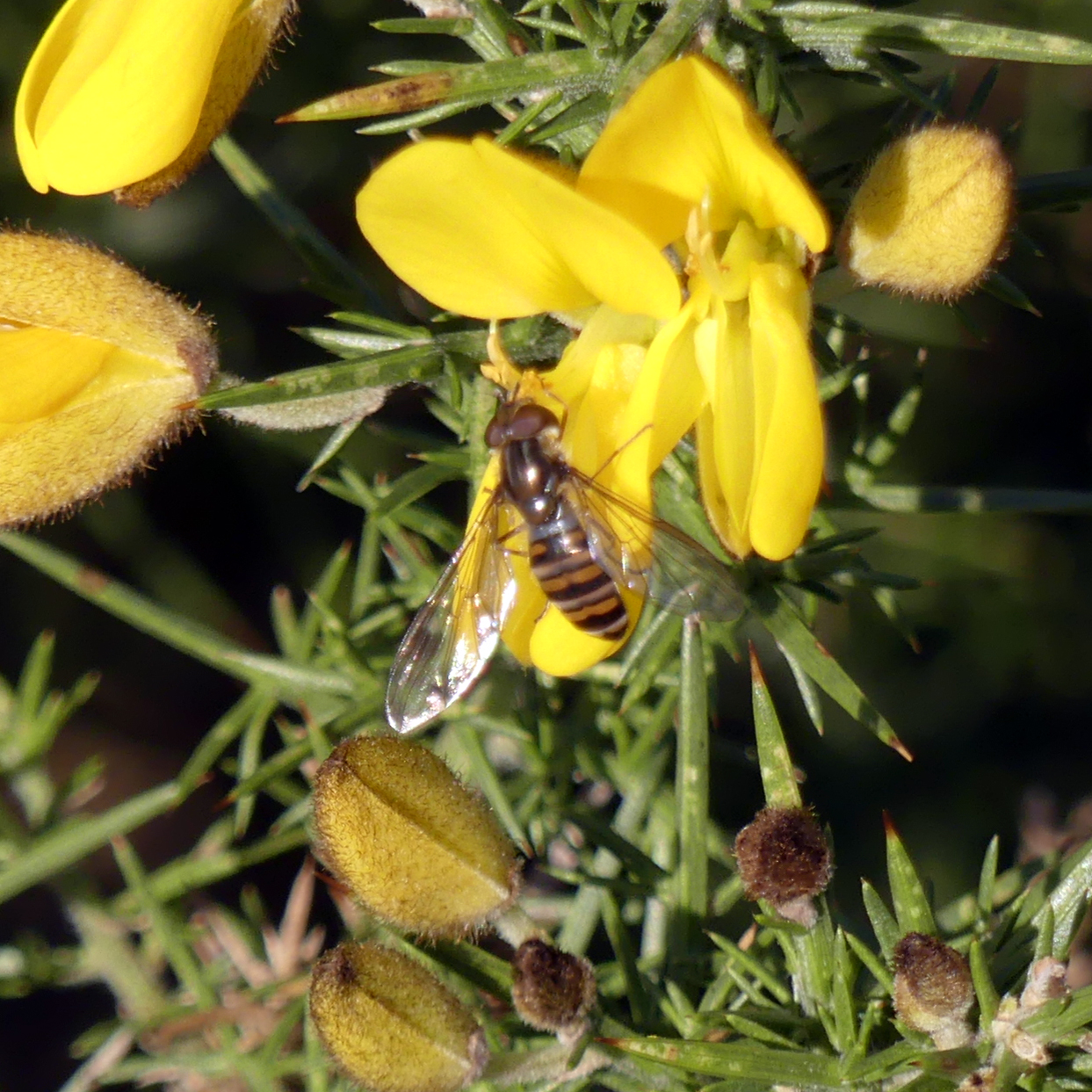
At the top corner of the field there are several big old gorse bushes, one of which is in more or less full bloom and emitting its glorious warm coconut-vanilla perfume. Here there were a surprising number of insects vying for the best blossoms. There were more hoverflies, two black and yellow Syrphus males (not able to specify species) and a single little female Marmalade fly Episyrphus balteatus.
There were also several honeybees and a single individual of one of my favourite species, a female yellow dungfly.
HoneybeeYellow dungfly (female)
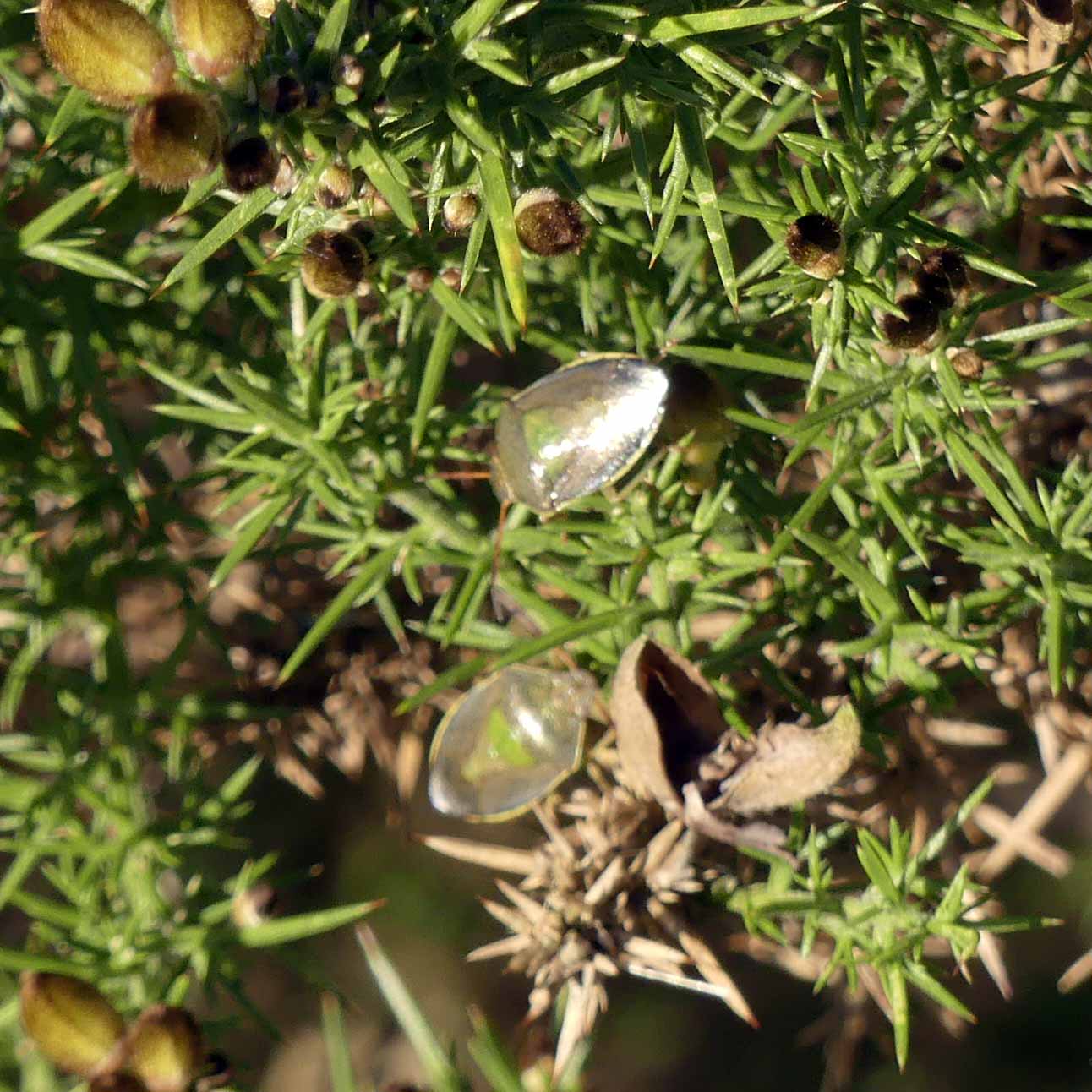
All of the above were wonderful to see, especially so early in the year, but the outstanding treat for me was to see gorse shieldbugs in a greater number than I’ve ever seen in one place at the same time ever. As usual it took a minute or two to get my eye in to spot them, but once I did I discovered them singly and often in twos both basking in the sun and moving around, and stopped trying to count when I reached 20 individuals. A perfect sight to finish on.
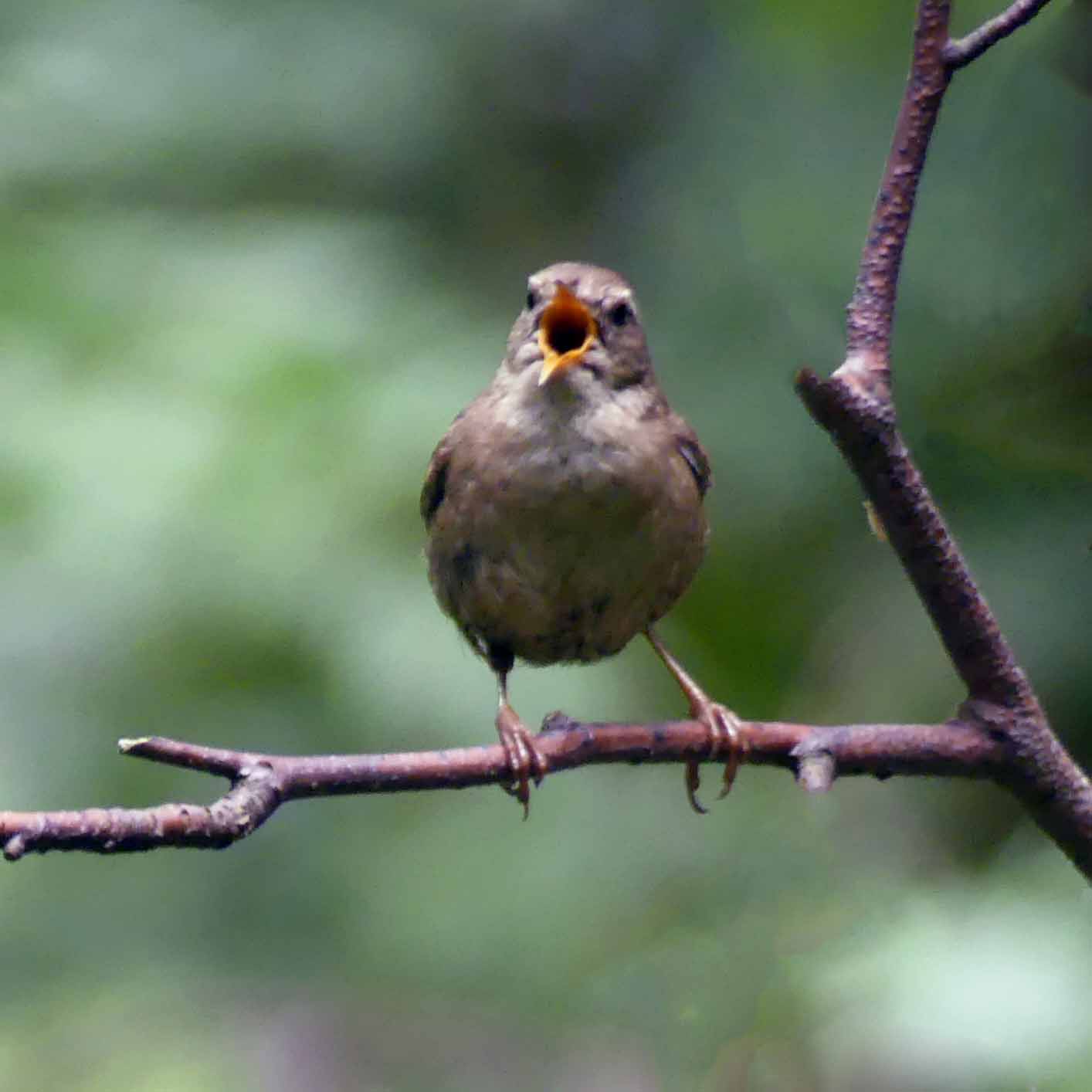
For reasons lost in the mists of time, the tiny wren has featured largely in the folklore, mythology and traditions of many European countries. In the UK, perhaps the most extraordinary and in the past, cruel custom, must be the one that traditionally took place each December 26th. To many of us this is Boxing Day or St Stephen’s Day, but in some parts of Great Britain it was also known as Hunt the Wren Day or just Wren Day, depending in which part of Great Britain the ritual was enacted.
There are several variations as to how the ceremony, or ritual was played out, but essentially it involved boys and sometimes young men who joined together, often dressing in curious costumes, such as straw masks, greenery and a motley assortment of colourful clothing, who for the duration of the ritual were known as ‘Wren Boys’. Their mission was to hunt around the hedgerows for a wren, which was sometimes kept alive, sometimes not. Once caught, the bird was then put in a small box or ‘Wren House’, which was decorated with holly, ivy and ribbons, placed on top of a staff or long pole and displayed around the neighbourhood. The boys sang songs and played music in exchange for donations.
Typically Wren Hunts took place in Ireland, The Isle of Man, Wales and France; all areas where Celtic traditions are more firmly entrenched. Times, sensibilities and laws have thankfully changed in modern times, but in a few places Wren Day has survived, or been revived, suitably modified but keeping the tradition alive and raising money for charity.
Ireland
In Ireland the day is known in Irish Lá an Dreolin, or Hunt the Wren Day and takes place on 26th September, St Stephens Day. Here the Wren Boys beat the bushes and hedges with sticks, and when a wren flew out they tried to bring the bird down by throwing sticks, stones and any other objects that came to hand. Whoever killed the wren, or wran as the bird is also known, was believed to have good luck for a year. The dead bird was placed atop of a long pole, then travelling from house to house they sang songs accompanied by drums and pipes, they collected money for food and drink. One version of the song is this:
“The wren the wren the king of all birds,
St Stephen’s Day was caught in the furze
Her clothes were all torn – her shoes were all worn
Up with the kettle and down with the pan
Give us a penny to bury the wran
If you haven’t a penny, a ha’penny will do
If you haven’t a ha’penny, God bless you!”
Today the Wren Hunt no longer takes place, but Wren Day has survived, or been revived in a few towns and villages. Groups of Wren Boys hold small parades and carry around a stuffed or fake wren and usually collect money for charity or to host a dance or ‘Wren Ball’ for the town.
Wales
In Wales the tradition of Hunting the Wren, in Welsh, Hela’r Dryw, took place on the Twelfth Day of Christmas, January 5th, and the practice continued in Pembrokeshire until the beginning of the 20th century. Similarly to the traditions of The Isle of Man, a dead wren placed in a ‘Wren House’, a small decorated wooden box with windows, which was carried around the village by ‘Wren Bearers’. Sometimes, the Wren Boys caught a live wren, placed it in the Wren House and called upon folk to make offerings to the ‘Little King’, then set the bird free at the end of the day.
England
The tradition was followed in parts of England, but it gradually died out or was banned by the authorities by the mid 19th century. In the late 20th century the tradition of the Wren Hunt was revived in Suffolk and it has been performed in the town of Middleton on every Boxing Day since 1994.
Isle of Man
Legend
Although the origins of the wren hunting ritual is obscure in most cases, in the Isle of Man it is said to be associated with an enchantress, a fairy queen or a goddess named Tehi Tegi, which translated means something like ‘beautiful gatherer’. The legend says that Tehi Tegi was so beautiful that all the men of the Island followed her around, neglecting their homes and fields, in the hope of being chosen to marry her. But Tehi Tegi led her potential suitors to the river and drowned them and when confronted she escaped by transforming into a wren and flew away. She was banished from the Island, but returns once a year, when she is hunted.
Hunt the Wren was first recorded on the island in the 1720s, though even then was said “to have been practised since time immemorial”, then during what is known as the Manx cultural revival of the 1970s and 80s, *Culture Vannin said Hunt the Wren had become “revitalised with a new focus on the dance”.
December 26th 2024
One of the unique Manx festive traditions took place on St Stephen’s Day as Hunt the Wren was marked with singing and dancing across the island’s communities. Culture Vannin said the practice dates back to pre-Christian times, and was centred around a wren, described as “the king of all birds” in legend. In modern times, an artificial wren is used which is “hunted” and danced through the streets on top of a wren pole.
* Culture Vannin is an organisation that promotes and supports the culture, heritage and language of the Isle of Man established in 1982 by the Isle of Man Government as the Manx Heritage Foundation. In 2014, it was rebranded as Culture Vannin to reflect its progressive approach to Manx culture.
Slow to get going, this early Spring has been a bit of a roller-coaster weather-wise, with temperatures yo-yoing up and down almost on a daily basis. On occasional days the sun has been hot enough to burn, but most have been cloudy cool and at best damp from frequent rain showers. But the progress of Spring carries on apace and I don’t want to miss it, so I remind myself that cool, damp, cloudy days can be just as rewarding as warm sunny ones, especially if you’re out between showers or soon after rain has stopped. On such a day I headed for one of my favourite places to meander – alongside the little River Colwyn where it runs through Old Colwyn and completes its journey to the sea.
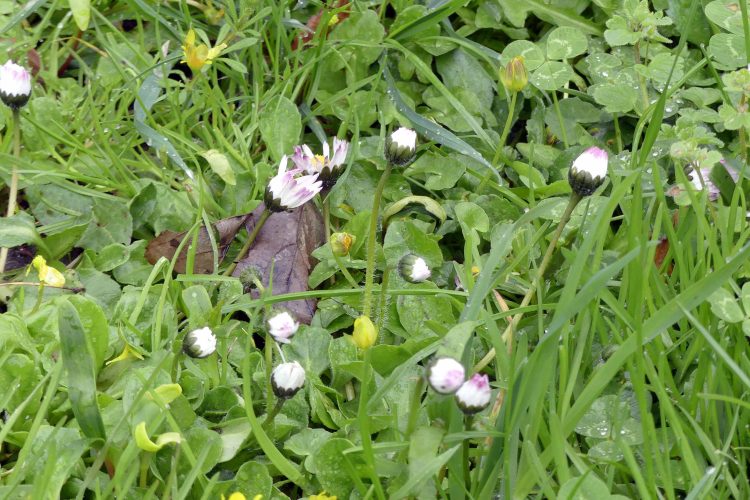
On damp grassy banks the flowers of celandines and daisies are closed against the damp and lack of sunshine.
lesser celandinescommon daisies
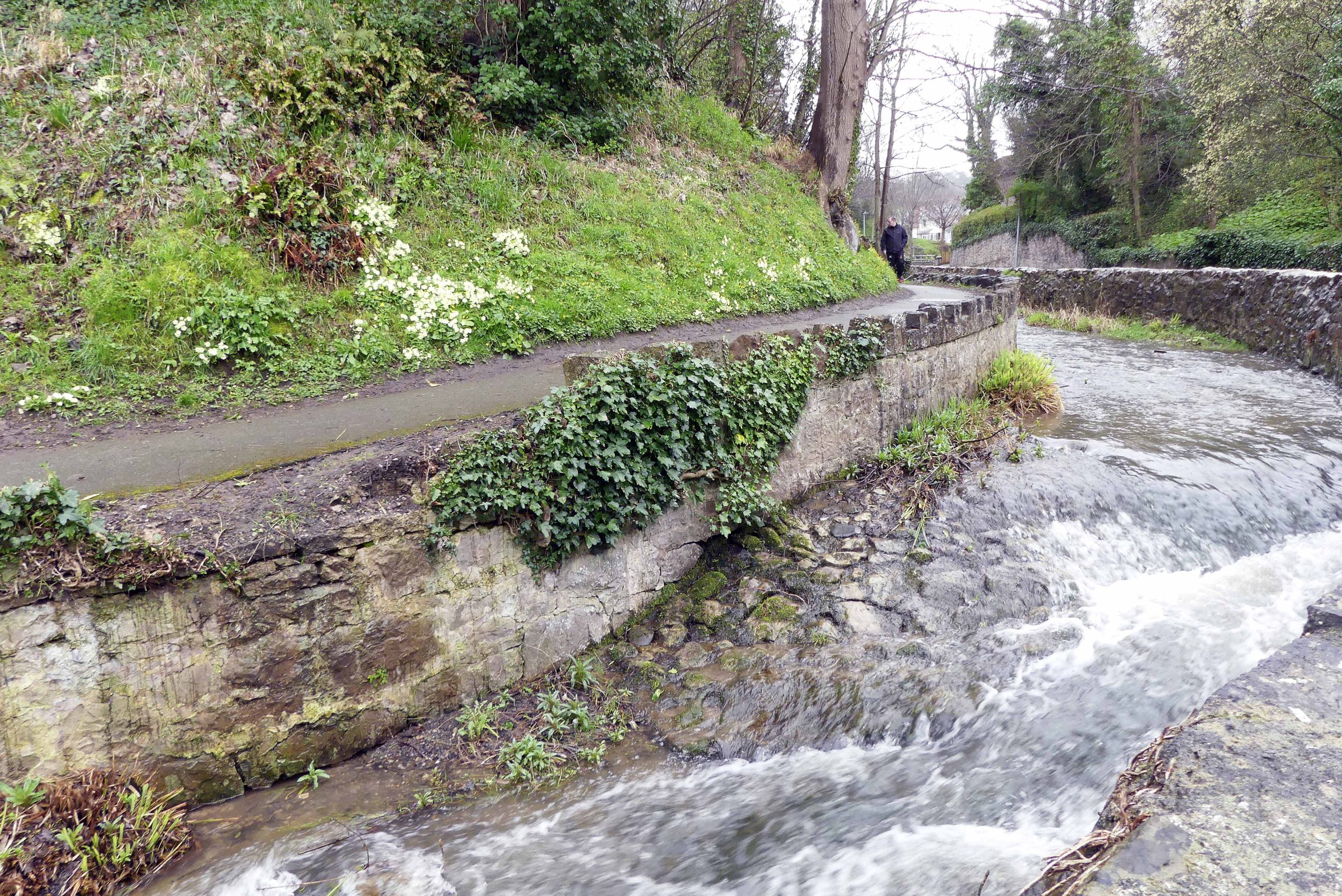
The river is rarely deep, but today it was full enough to cover most of its rocky bed, shallow enough to create falls and white water where levels drop down, and running fast enough to make itself heard as it raced towards the sea.
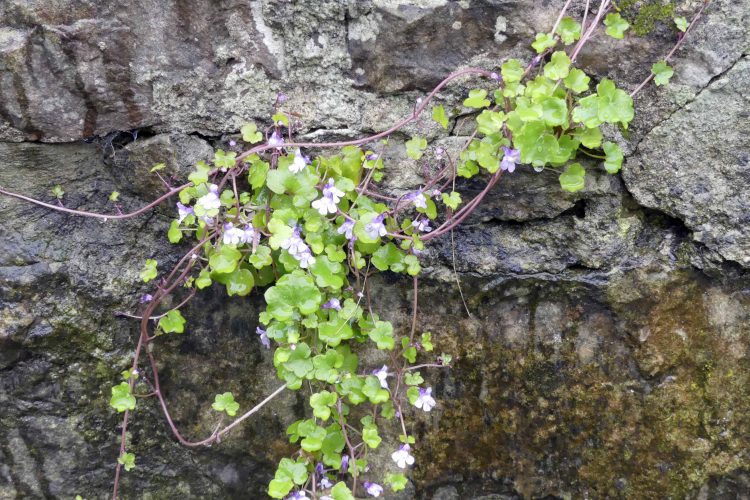
The limestone wall that keeps it within bounds, damp from recent rain is decorated on the road side with opportunistic little plants; prettiest now were ivy-leaved toadflax with its little lilac-mauve flowers and the succulent grey-green leaves of a stonecrop.
ivy-leaved toadflaxstonecrop
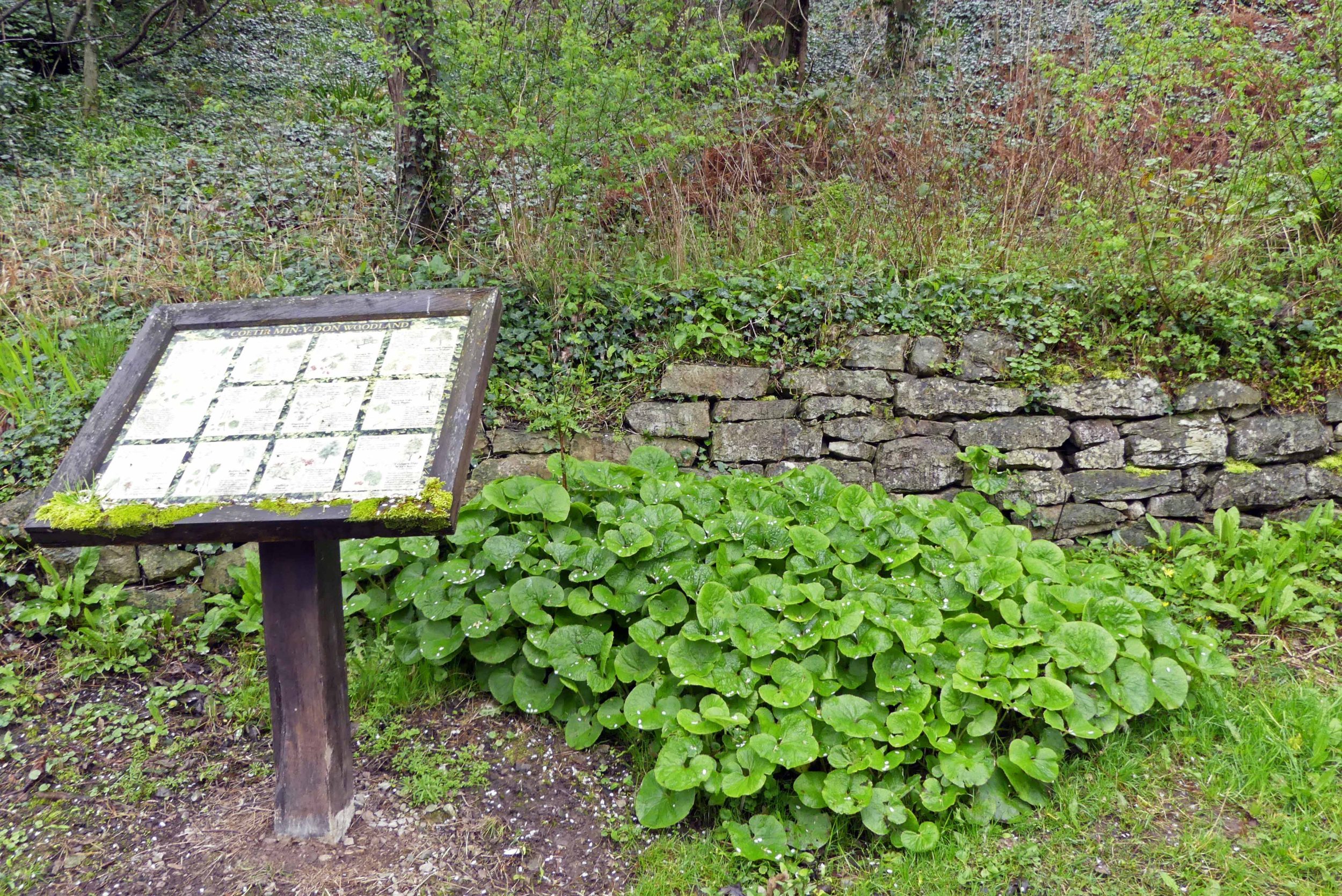
Coed Myn y Don Woodland
The board illustrating some of the variety of trees that grow in this remnant of woodland is slowly being integrated into its surroundings, but is just about legible. Part natural woodland and part garden, there’s an interesting mix of flora here, trees, native wildflowers and cultivated ones blend well, and together with the river they help make this a valuable haven for some of our local wildlife. In places though, wildflowers are in danger of becoming overwhelmed by rapidly-spreading winter heliotrope, as I’m finding increasingly in other local spots I visit.
Winter heliotrope spreading beneath the info board
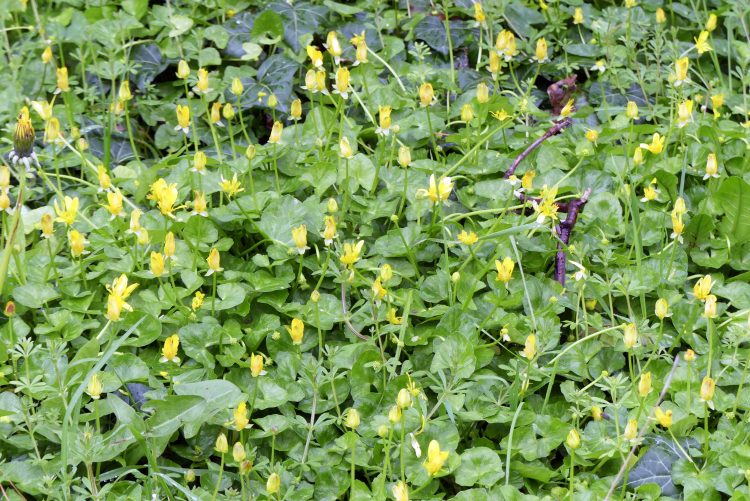
The golden flowers of a plant I hadn’t noticed here before caught my eye. Growing through grass and other plants, a small patch of the rather inelegantly named opposite-leaved golden saxifrage, which favours growing in damp, even boggy shady woodland places.
opposite-leaved golden saxifrage flowersopposite-leaved golden saxifrage flowers & leaves
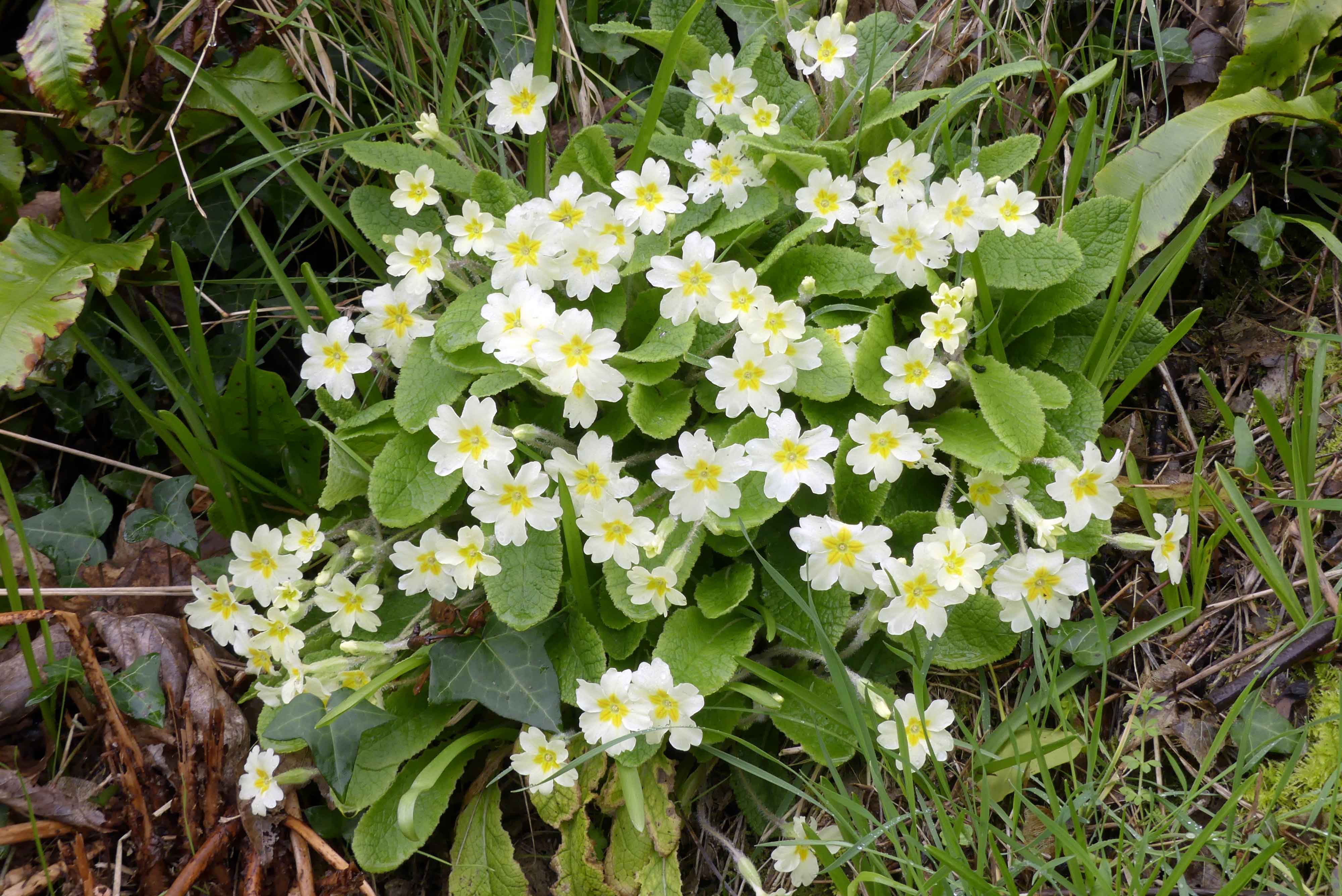
On the sloping bank that follows the curve of the river are primroses, which smelt delicious, common dog violets, wood anemone, whose flowers were closed and dog’s mercury.
common dog violetsprimroses
Over the years, this has consistently been one of the very best places I know for hearing and seeing birds, and I wasn’t to be disappointed today. A chorus of birdsong accompanied the sound of the water; I stop to listen and although the songsters are hidden from sight, I heard a melodious blackbird, a robin, a few notes from a wren as it broke from cover and a taunting chiffchaff, one of my ‘targets’ for today, which frustratingly I couldn’t locate.
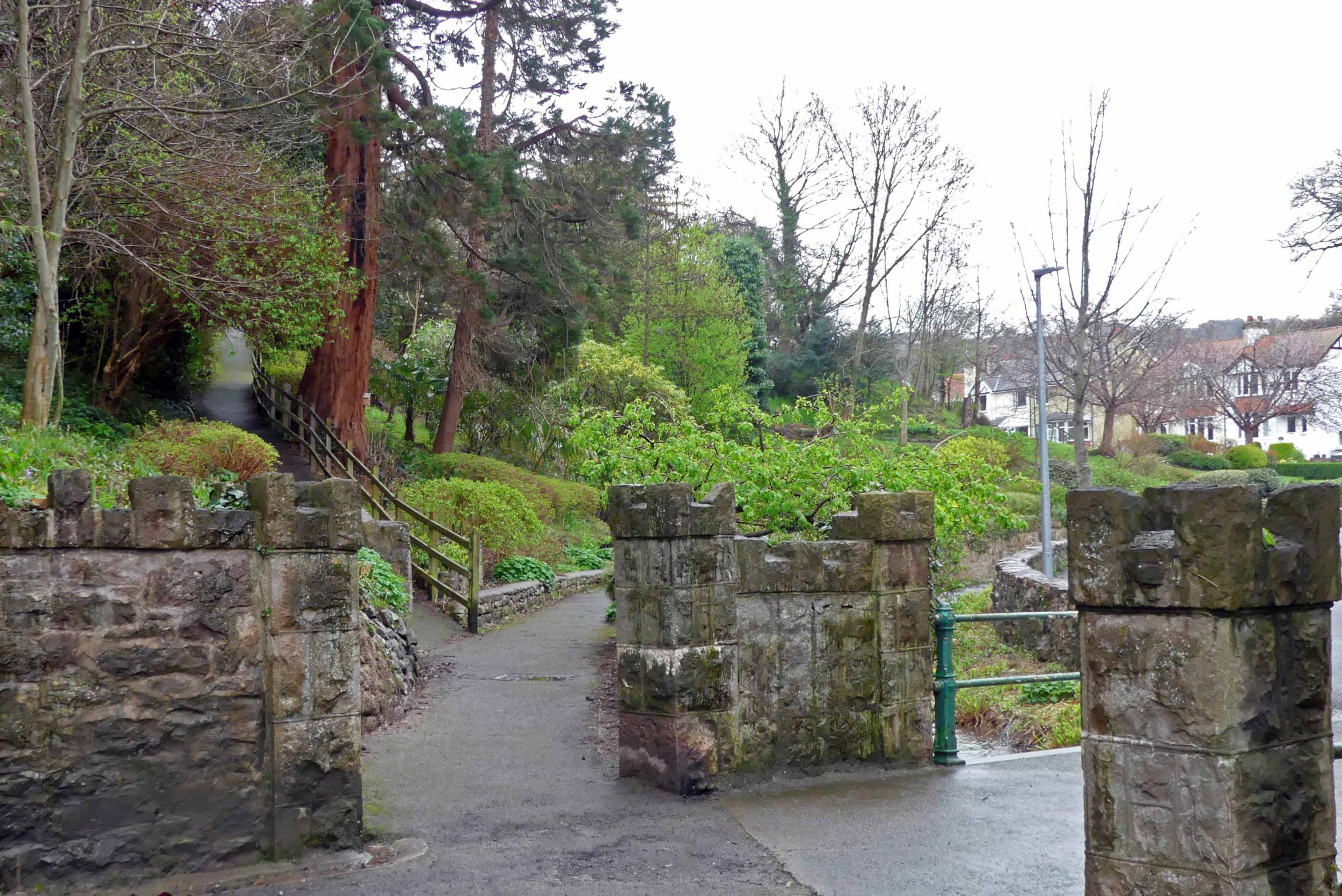
Tan y Bryn Gardens
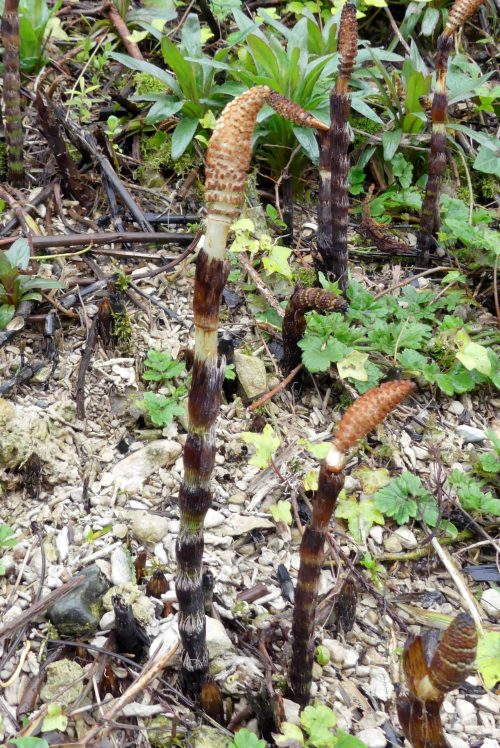
On the bank just inside the entrance to the gardens the strange other-worldly shoots of one of our most ancient wild plants, horsetail, are already grown quite tall. A notoriously stubborn garden invader, I wonder if some of the plants are deliberately left, or whether they just refuse to be banished. A little further on, where water pools at the bottom of the slope, another alien-looking bud, this one enormous and belonging to the giant gunnera (aka giant rhubarb) with its correspondingly enormous leaves.
horsetail budsflower bud of giant gunnera
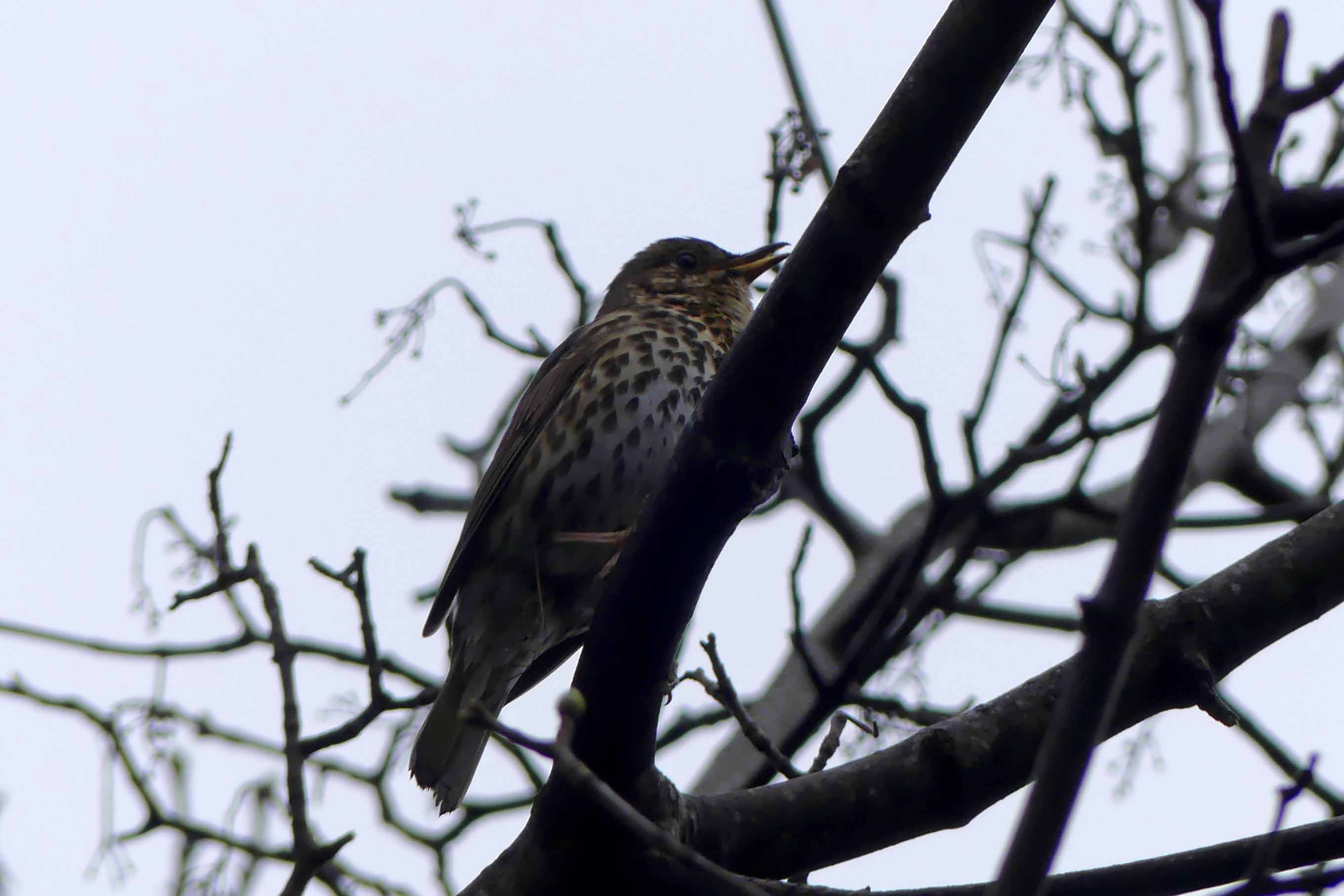
I stopped to listen to a song thrush. Perched in the shade on a branch of a tree close to the path he was singing enthusiastically, as song-thrushes do, then every so often pausing. In those intervals I could hear another song thrush singing from some distance away, in the woodland that continues on the other side of the road. They were clearly communicating, perhaps confirming their territorial claims, or maybe just having a conversation, discussing the sorry mess their human neighbours are making of things.
song thrush singing
As I stood listening to the thrushes, a robin, rapidly followed by another flew right in front of me, so close I’m amazed they missed me. They headed straight into a shrub, routing out a third robin, which flew out at speed and dived into a tree. The other two, most likely a pair, were right on its tail and the three of them chased across the road, where the ‘invader’ departed, leaving the others to regain their composure on a garden wall.
They weren’t the only ones chasing about; just seconds later two dunnocks raced past me. One disappeared from sight while another landed quite prettily in the middle of a flowering shrub.
dunnock
Moving on, I was keeping an eye on the river and also scanning the rooftops of houses opposite, hoping to catch sight of a grey wagtail, always one of the special birds I hope to see here.
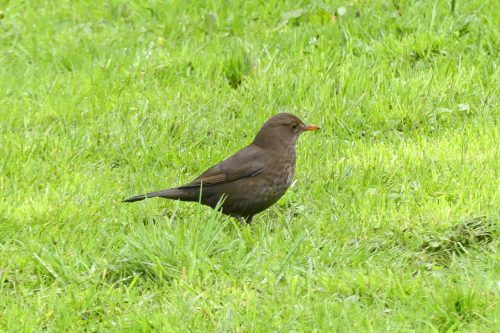
The damp short turf alongside this stretch of path is a favourite spot for foraging blackbirds and I’ve also seen both song and mistle thrushes here on occasions. Today it was left to a single pair of blackbirds out hunting together, which probably means they have young, hungry offspring to feed.
female blackbirdmale blackbird
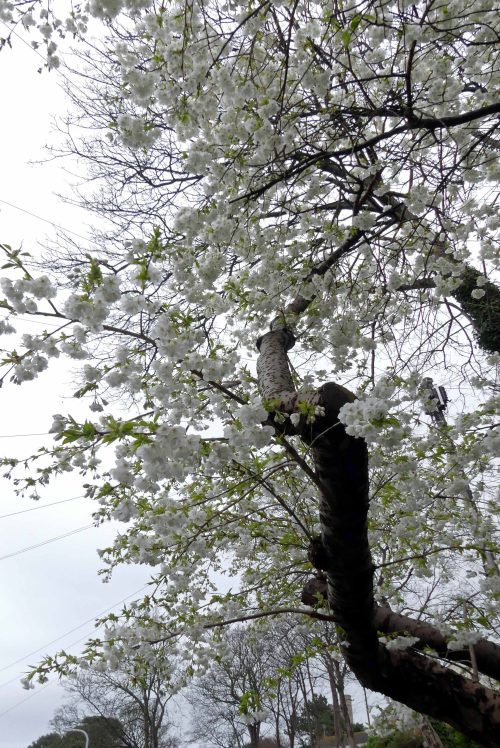
Nearing the top end of the gardens, one of my favourite local trees overhangs the path. A Japanese cherry, this beautiful tree is one of the highlights of a walk here at this time of year and is a total treat for the senses. Its snowy white blossom, which usually appears before the leaves, looks beautiful and has the most delicious rich honey-almond-y fragrance, which on a warmer, sunnier day might have been visited by bees. I’m not entirely certain, but I think it’s a Mount Fuji Cherry, named for the holy Japanese mountain covered with eternal snow
Following on from the sublime beauty of the tree, the next part of the path, which together with the river, passes under buildings and the main road through the village, has less appeal. Sadly, this lovely little river is prone to having rubbish thrown into it, most frequently glass and plastic bottles and drinks’ cans etc., but also random bigger items. Today’s photograph contains the frame of a pushchair.
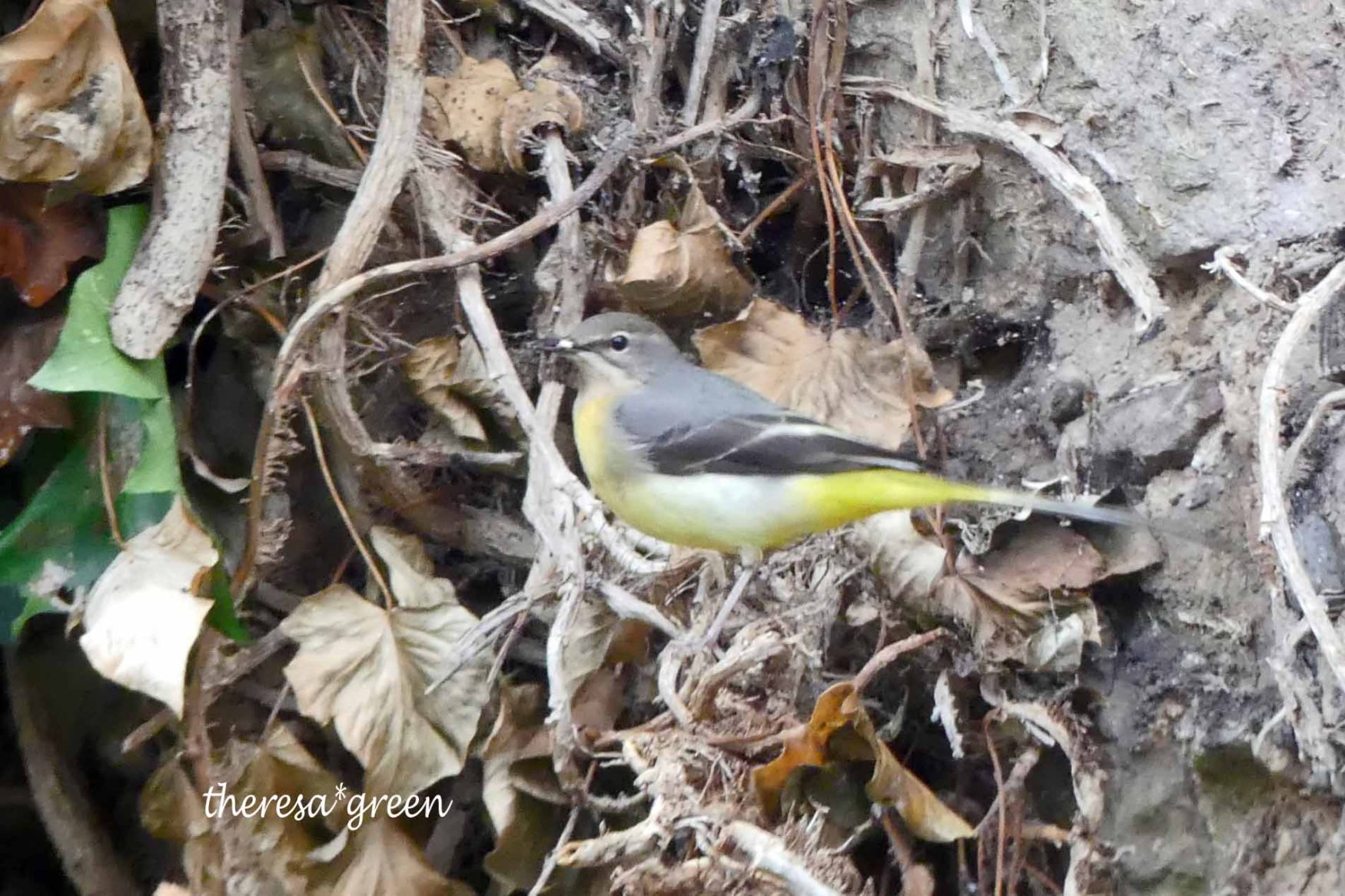
Nearing the underpasses, I was distracted from thoughts of littering and fly-tipping by a flash of yellow and the flickering movements of a bird amongst the thicket of old ivy that covers the wall to the right of where the river flows through. There, inspecting the dried materials amongst the twining stems, a female grey wagtail was taking her time searching for pleasing pieces, which I think it’s safe to assume, would contribute to the construction of a nest.
grey wagtail pair
She was joined by a slightly brighter, more colourful male, who made several attempts to get closer to her, but definitely wasn’t interested in helping to collect nesting material. I watched them for quite a few minutes – she picking out bits and dropping them when she found something better; he flying off and coming back several times until they finally flew off together, up and over the wall and away over the houses on the far side of the road. Not the direction I’d expected, but maybe they were making a distracting detour to their nest site.
female grey wagtail
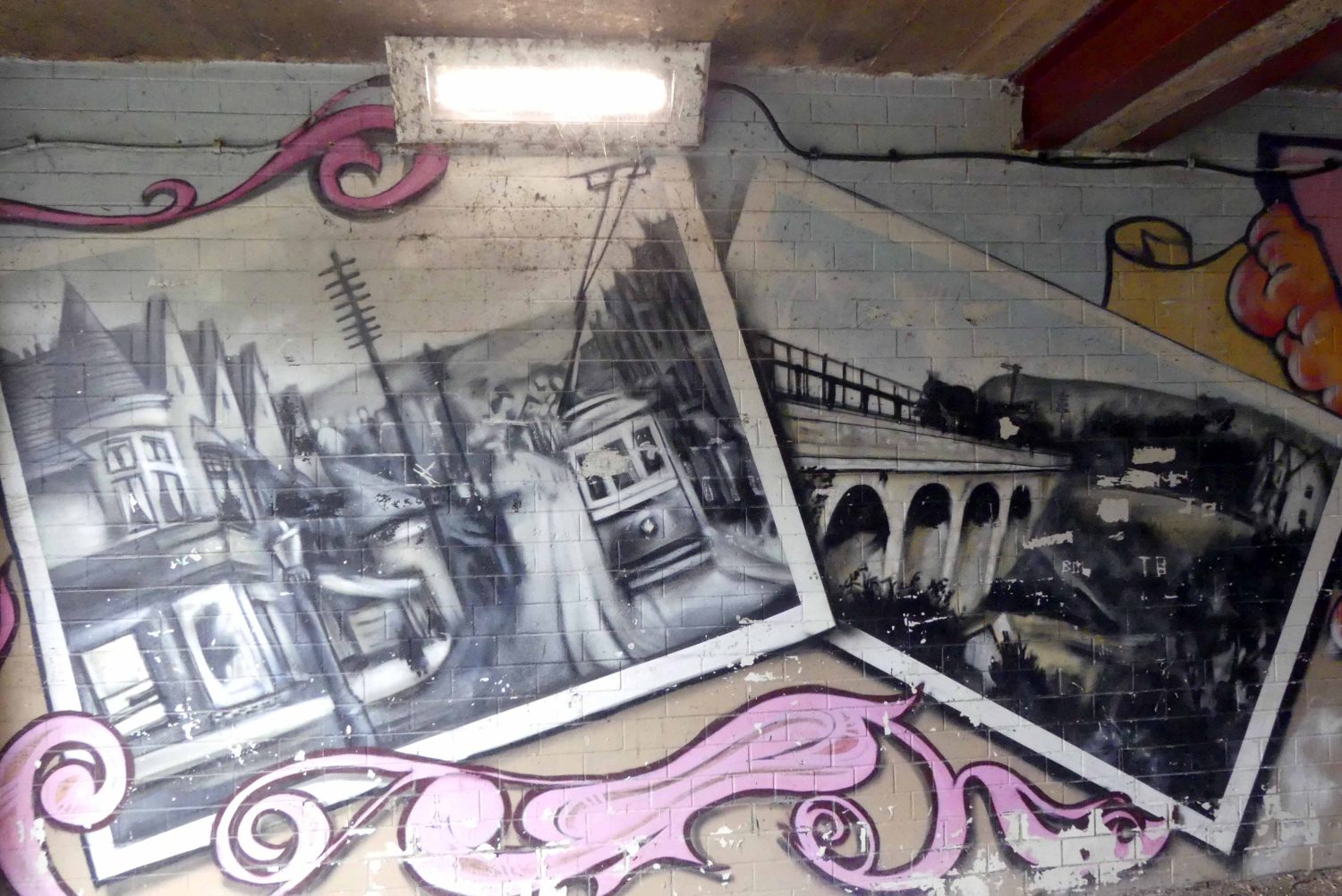
Some of the lack of beauty of the pedestrian underpass has been made up for by some colourful, well-painted graffiti on the outside entrance and along the inside walls of its length. At the moment it’s further enhanced by one of the biggest patches of ivy-leaved toadflax I think I’ve ever seen.
Inside, my favourite piece of graffiti art cleverly depicts the part of Abergele Road, which is immediately above, but as it may have looked when the tram ran through it, and also the viaduct which spans the bottom of the road where I began my walk.
Llawr Pentre
The underpass leads through to the part of the village known as Llawr Pentre. Down below the level of today’s village, this was where Old Colwyn originated and was where the ford across the river was located. Here too were a flour mill, dating back to pre-1750, a farm, a slaughter house, a wheelwright, a saddlery, and a butcher’s shop. Now it is purely residential and the access road lined with parked cars. Maybe not the most attractive part of the river’s journey, but it runs through regardless, and perhaps surprisingly, it is often a part visited by grey wagtails, so always worth a look. And lo and behold, as I was lingering noting wildflowers on the river edge, in flew this beautiful male who landed first on an overhead cable, then flew down onto a ‘for sale’ board. First thoughts were this was the male I’d seen on the other side of the underpass, but he had the black throat and bib of his breeding plumage, while this one didn’t.
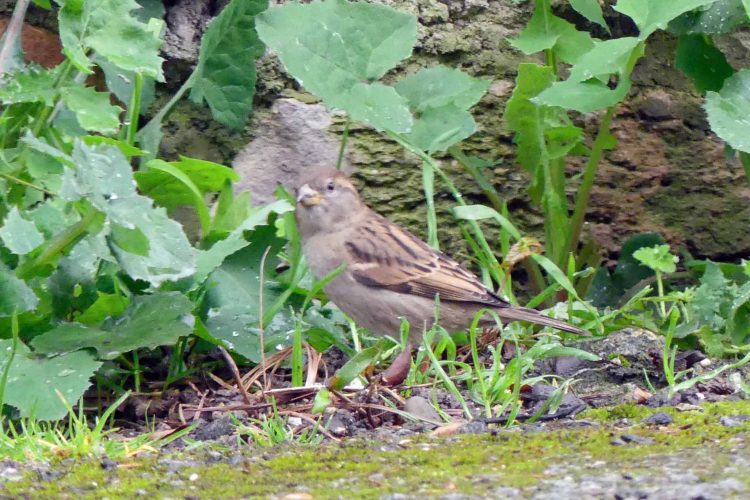
The path loses the river for a while as you have to divert around private grounds. Steep steps lead up to a lane which you then follow towards the woodland dell of Fairy Glen. At the top of the steps a female house sparrow was feeding on seeds of a sowthistle. She is doubtless one of the members of the flock that inhabit the thick mixed hedge that borders one side of the lane. Hearing the lively cheeps chirps & squabbles of the house sparrow couples hidden from view inside there always make me smile when I pass by here.
female house sparrowsparrow hedge
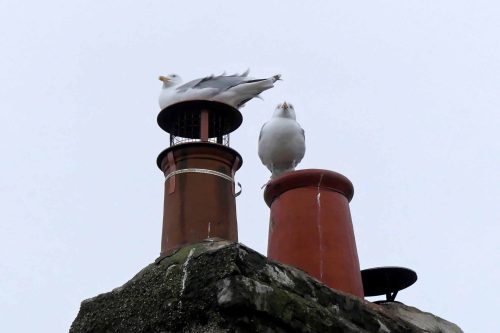
The row of cottages along the lane are a draw for a variety of bigger birds and most of the roofs, chimney pots and aerials have been claimed as perches, roosts or nest sites. Todays there were pairs of herring gull, wood pigeon, collared dove & jackdaw, all looking a bit ruffled and fed up with the weather.
herring gull paircollared doveswood pigeons
Fairy Glen
The river is visible once more, and down below at the bottom of the dell its sound is amplified by the steep banks that bound it. Birdsong adds to the music of the water, I pick out blackbirds, robins and great tit, then chiffchaff and blue tit. More raucously there’s the cooing of wood pigeons and the cawing of crows which remind of the closeness of houses.
The trees are still mostly leafless, but the steep sides of the dell and lack of bright sunlight keep it shady. At ground level there’s plenty of greenery from abundant ivy, lush ferns and patches of celandines. In places the well-trodden path is wet and muddy.
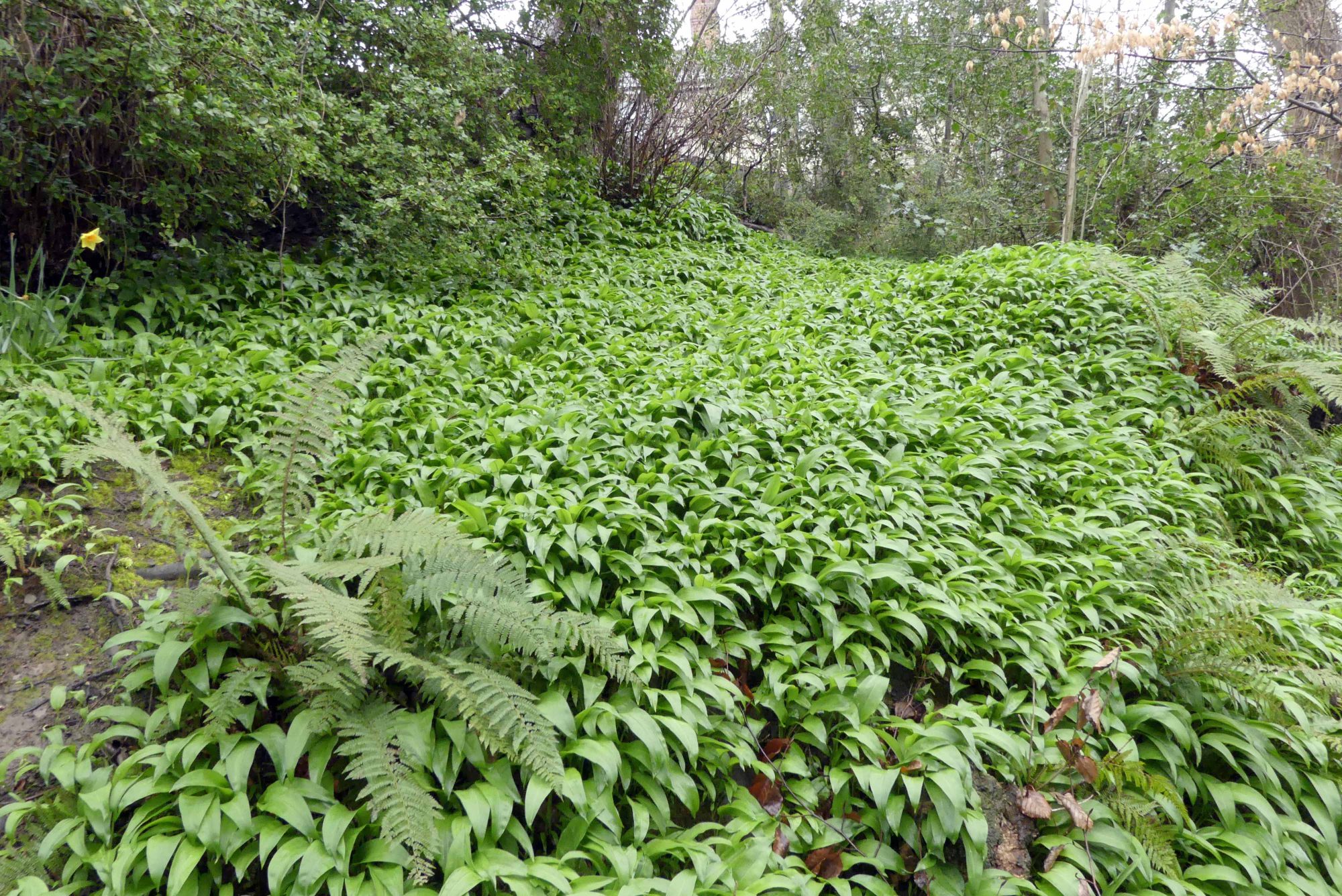
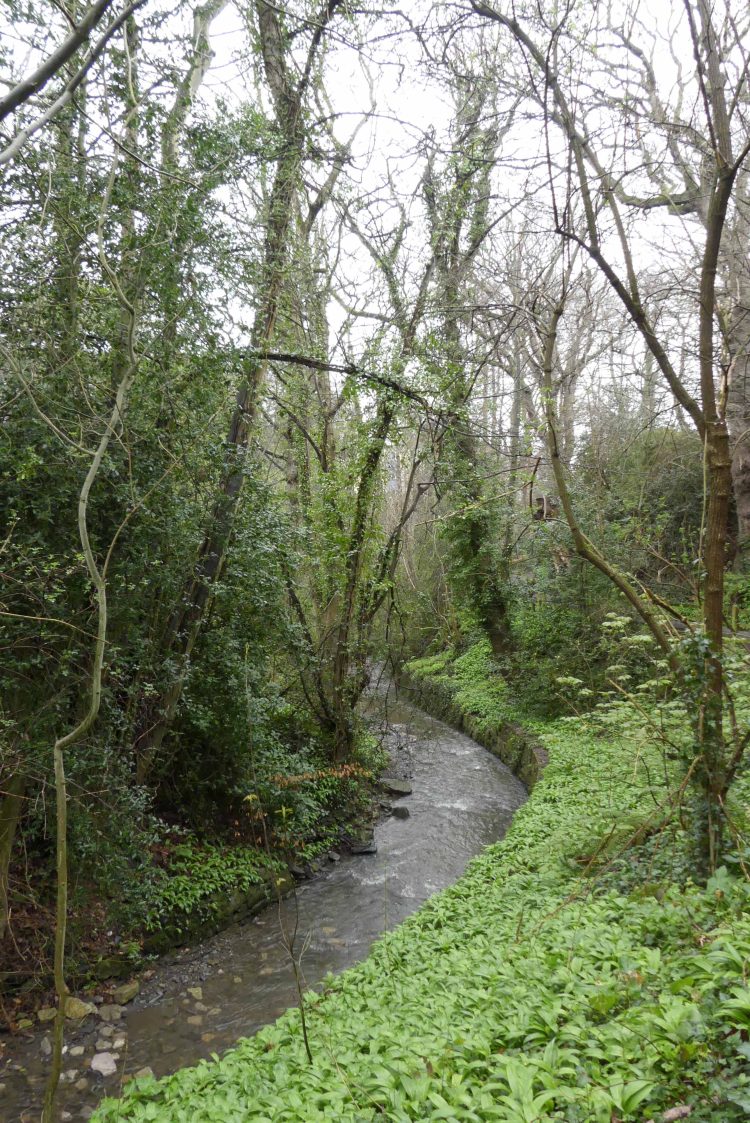
Great swathes of wild garlic cover much of the woodland floor and their pungent aroma fills the cool, damp air. It’s not flowering fully yet, but there are plenty of budding stems, so it won’t be long.
Someone’s been busy digging out a new pond
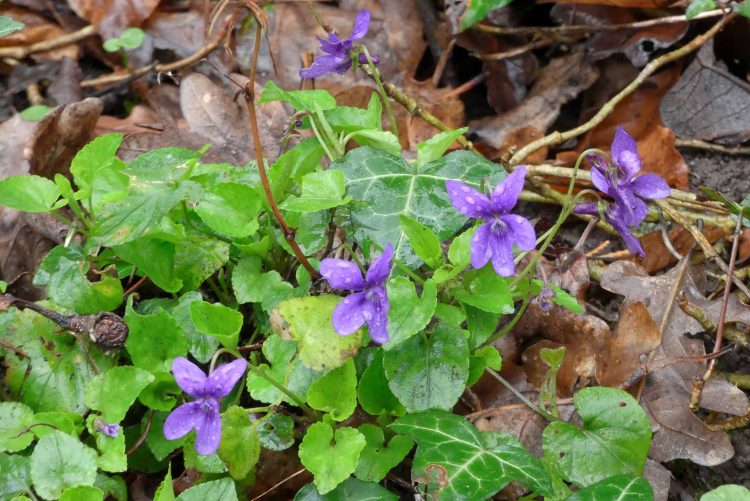
Here and there are little patches of early dog violets
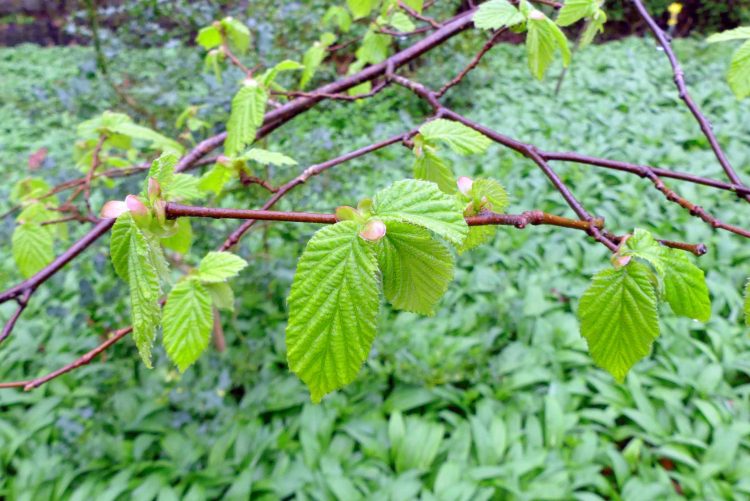
and bright fresh green leaves of hazel
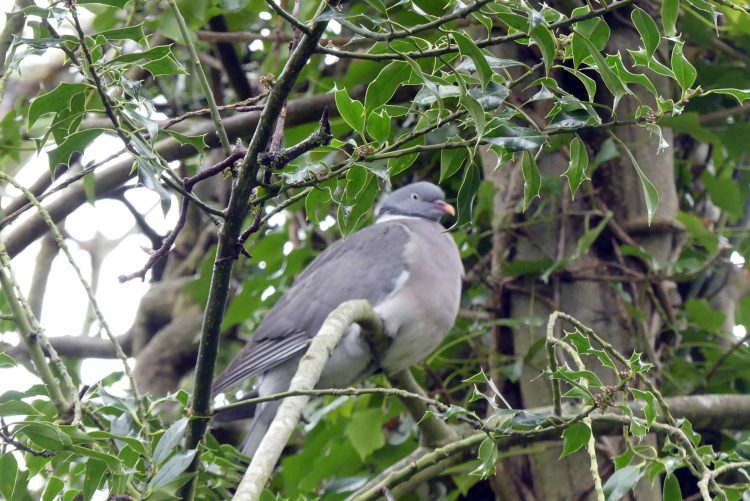
Although there are plenty of birds to be heard, I only had glimpses of foraging blue tits and robins that fly up from where they were singing as I got too close. I heard a nuthatch calling but couldn’t see him. Chiffchaffs continued to elude me. The only photograph I managed was of a wood pigeon keeping a beady eye on me from where it was tucked into a tall holly tree
Perhaps the birds sensed it was about to begin raining before I felt it. Time to turn around and head back.
Retracing my steps, still enjoying the sound of the river and birds singing despite the rain, I realised that I hadn’t met a single other person whilst I’d been here and had had all of this to myself.
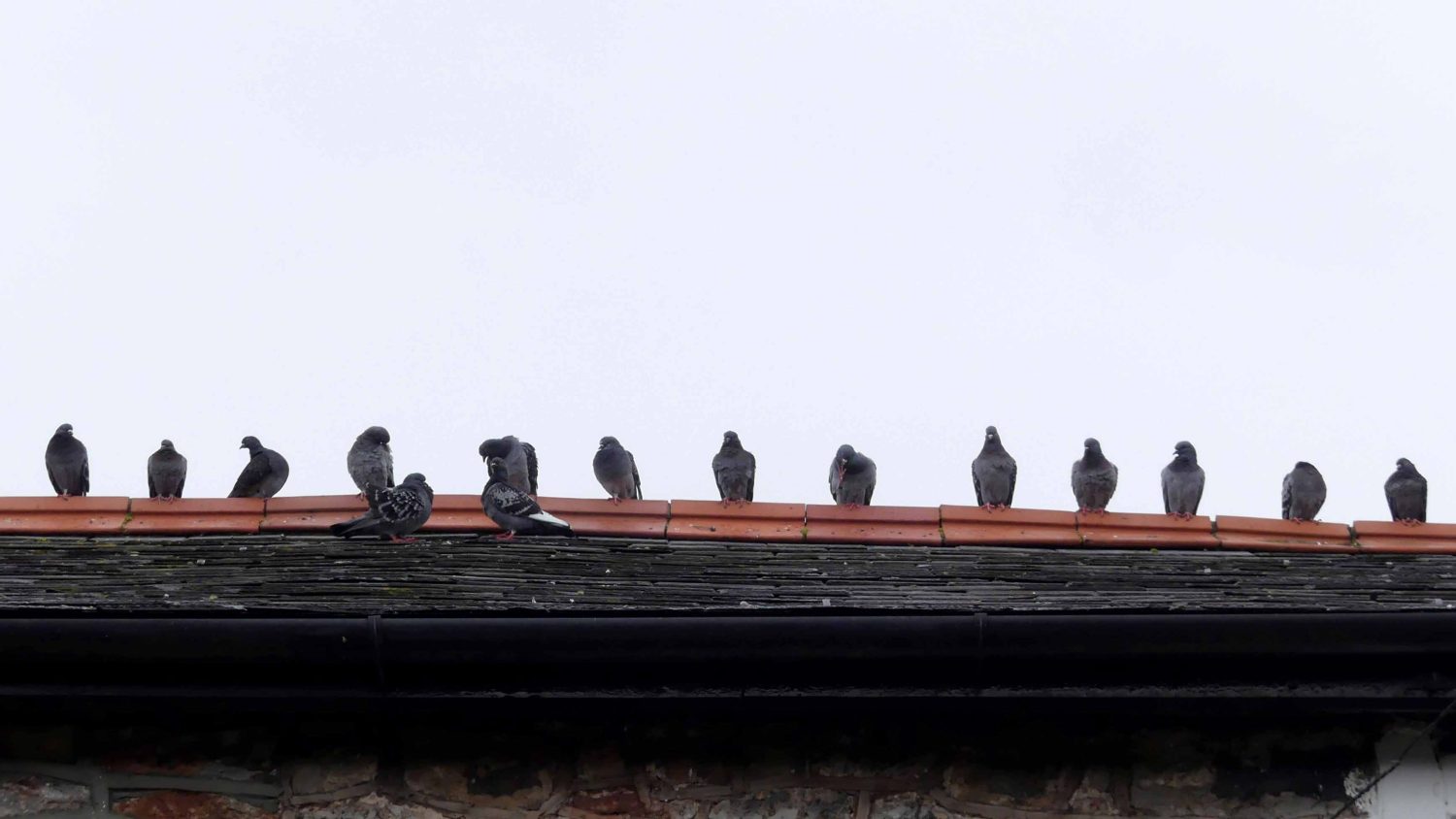
Back out onto the lane, I met a man that lives in one of the cottages as he was putting out seed for the birds. He told me he does that twice a day and has his ‘morning birds’ and his ‘afternoon birds’. That probably accounts for the line of feral pigeons on his roof.
Re-joining the river in Llawr Pentre, I took this picture to show where it passes under the road and buildings, cropping out the cars that are always parked in a line close to the river’s edge.
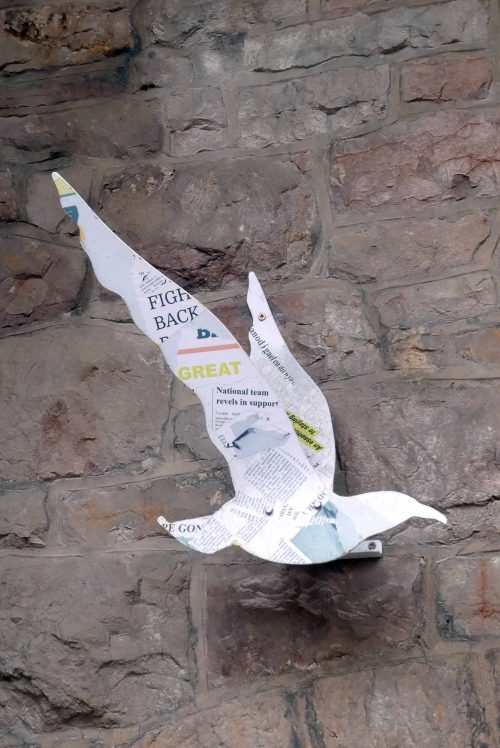
Above the entrance to the underpass, watch out for the herring gull! This is one of several 2-dimensional images of our iconic irrepressible gulls that can be found located around Colwyn Bay.
Heading back through the gardens gives another chance to enjoy the glorious cherry blossom
The indignant blackbird in a the tree below had just chased off another male.
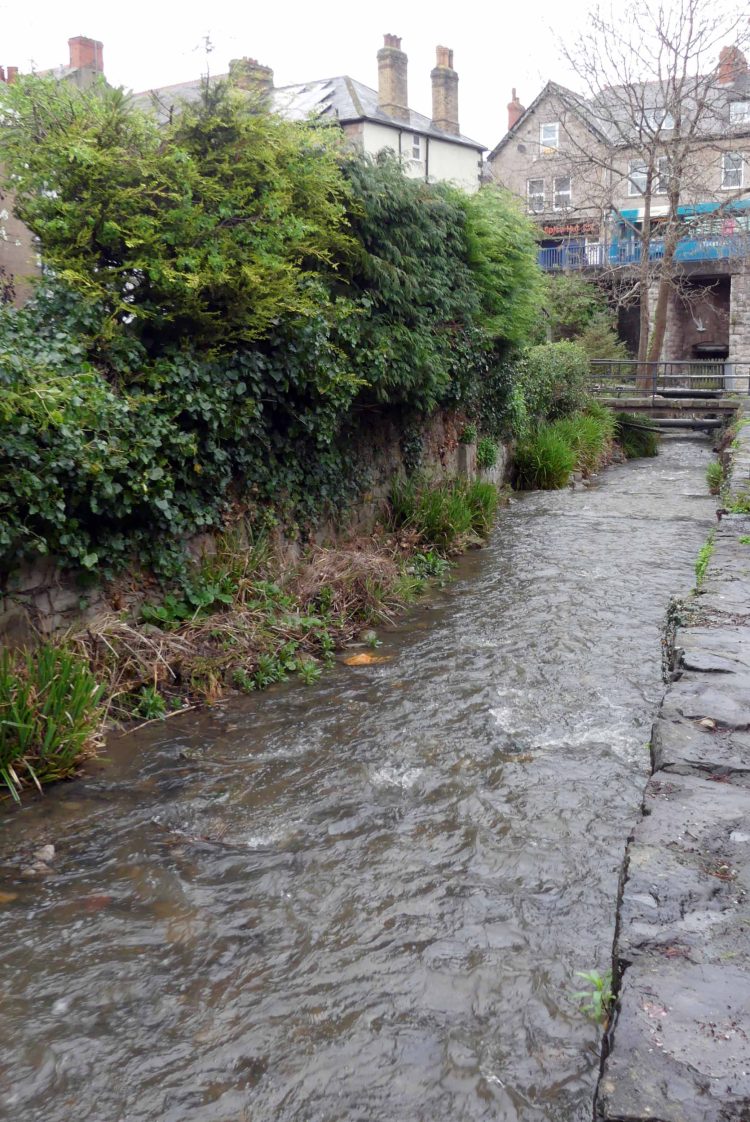
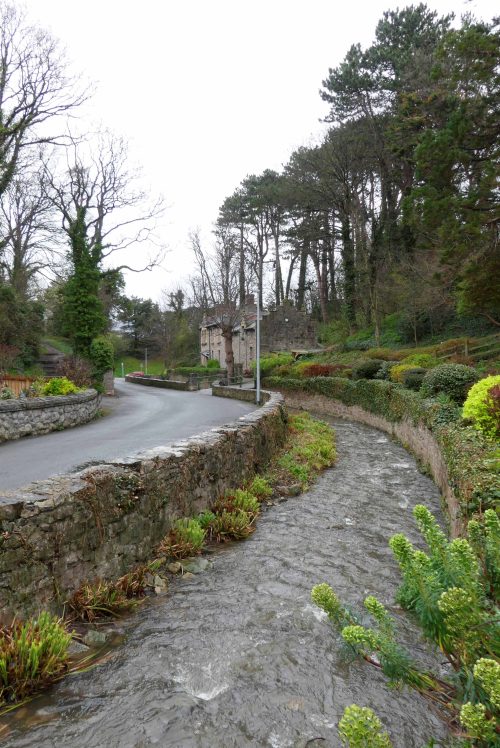
Curving back through the gardens this is perhaps the best view of the river.
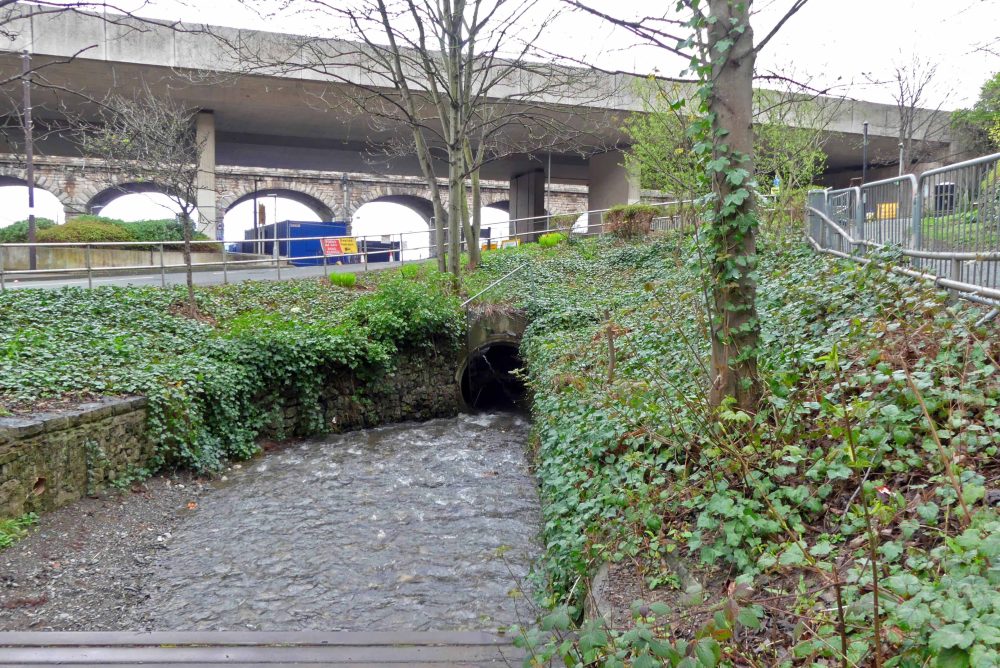
The final view of it is as it disappears into the culvert taking it beneath the road, the Expressway bridge and the viaduct where it has quite a sad end, emptying into Colwyn Bay as what is called an outfall.































 everyday nature trails