• Home
  • about
  • about the photographs
  • Local Nature Reserves
    • Bryn Euryn Local Nature Reserve
    • Mynydd Marian
  • Wales Coast Path
    • Grey Seals in North Wales
    • St.Trillo’s Chapel
    • Wildflowers of North Wales Coastal Paths, Cliffs and Dunes

everyday nature trails

everyday nature trails

Category Archives: woodlands

Willsbridge Mill, Bristol

12 Friday Oct 2012

Posted by theresagreen in Local Nature Reserves, Nature, nature of woodlands, nature photography, woodlands

≈ 4 Comments

Tags

ash keys, catscliffe woods, dark bush cricket, feather moss, haws, red berries, siston brook, spider's webs, willsbridge mill, woodland walks

I am currently staying in Bristol with my son and family, and as they always do when I am here, they make great efforts to take me out to places they know that both I and the children will enjoy.

Avon Wildlife Trust takes responsibility for 35 reserves within the Avon area, with a good few clustered closely around the city.

On Sunday we drove out to Willsbridge Mill, a Local Nature Reserve, which the website describes as  ” Set in a peaceful valley on the edge of Bristol, Willsbridge Mill is an impressively restored 19th Century Corn Mill and Long Barn, located within a stunning 22 acre nature reserve.” It continues ” This green oasis, which was once a bustling industrial site, now supports an amazing array of wildlife habitats – woodland, ponds, meadows, scrub, quarries and a demonstration wildlife garden, running along the fast – flowing Siston Brook. The reserve is home to kingfishers, dippers, owls, foxes, badgers, and bats.”

Dragonfly plaque

After several days of rain and general dampness, the ground in the wildlife garden was soggy and its plants bedraggled, there were a few pond skaters skimming over the surfaces of the ponds and a robin piping a few phrases of song, but apart from that there was little movement.

One of the trails around the reserve is the Sculpture Trail, which features ” striking environmental sculptures made from local materials”. There is also a sequence of attractive brass leaf-shaped plaques bearing different designs, which today were the only indicators of the wildlife that frequents the reserve in spring and summer.

Leaves are beginning to change colour and fall

The Ash tree – Fraxinus excelsior, bears its large single-winged seeds – also commonly known as keys, in large bunches

We followed the pathway to Hawthorns are laden with good crops of haws, but there were no signs of these particular ones being eaten yet.

Haws – the fruits of the Hawthorn

On the wooded side of the pathway, on a bramble leaf in a patch of sunshine a Dark Bush Cricket sat having a meal.

Dark Bush Cricket – Pholidoptera griseoaptera

The Dark Bush cricket is a common animal across the southern half of England, occurring in gardens, hedgerows and on woodland edges, where they can often be seen in quite large numbers sunbathing on bramble patches. Males are very aggressive, fiercely defending their territories against intruders. Females lay their eggs in late summer in rotting wood or bark crevices; the young crickets emerge 18 months later, so odd-year and even-year dark bush-crickets never meet.

Bramble festooned with gauzy spiders’ webs – a classic feature of damp autumn days

The pathway through Catscliffe Woods

Common Feather- moss-Kindbergia praelonga growing on a tree trunk

The stream that flows through the woodland is Siston Brook; it flows fast here and its energy once powered Willsbridge Mill’s water wheel. The stream rises five miles away at St. Anne’s Well, just south of the village of Siston and is a tributary of the River Avon, joining it at Londonderry Wharf, near Keynsham.

A fallen tree spanning the brook

A tree has fallen on one side of the stream bank arcing gracefully over the water to form a natural bridge. It has continued to grow, pushing out branches that now grow vertically from the original trunk; those that touch the ground have probably put down roots and appear to be growing as independent trees.

Steps lead temptingly to a higher woodland trail

Share this:

  • Share on Facebook (Opens in new window) Facebook
  • Share on Pinterest (Opens in new window) Pinterest
  • Share on X (Opens in new window) X
Like Loading...

A hill not too far – part 1

15 Saturday Sep 2012

Posted by theresagreen in Bryn Pydew, fungi, hoverflies, Nature, nature of woodlands, nature photography, woodlands

≈ 6 Comments

Tags

buff-tailed bumblebee, common darter, common green grasshopper, eristalis, hoverflies, inula conyza, leucozona lucorum, ploughman's spikenard, tar spot fungus, traveller's joy

The first day of September was gloriously sunny and warm in the way that only our late summer days can be. In preparation for just such a day I had done a bit of research into other nature reserves that may be nearby and was surprised to discover there is indeed such a one, almost on our doorstep on another landmark hill just beyond Bryn Euryn, called Bryn Pydew. The land is leased and managed by the  North Wales Wildlife Trust (NWWT), and just had to be explored not only because of its proximity, but also because it has within in it an area of Limestone Pavement that I have been keen to add to my round of  habitats to visit.

To quote the Bryn Pydw entry on the First Nature website:

Bryn Pydew SSSI; RIGS site : “This reserve lies on carboniferous limestone and has woodland, grassland, limestone pavement and two disused quarries providing a wide variety of habitats.”

I could hardly believe it was so close by and I had never heard of it, but when I set off to find it, following the directions on the website, I did have some problems finding the ‘entrance’ to the reserve. (I must get myself an ordnance survey map and re-learn to use grid references !)  I knew I was on the Bryn, it’s huge, so hard to miss, and drove up, down around and along a few lanes in the indicated direction, then through the village of Bryn Pydew and back again, finally stopping to ask for directions from a lady carrying a basket heading for the village hall. She didn’t really know either, but suggested it might be the “flat bit further on where they have been digging”. It was clear that there was little room for parking on the lane, so I asked if I should park outside the hall and walk, she said “Oh no, please don’t, we have a fun Dog Show here this afternoon, so we need all the parking space we have for that.” Not wishing to upset anyone or their dog, I drove a bit further and duly came to said ‘flat bit’ at the side of the lane, pulled onto it and got out of the car.

Woodland edge

It seemed likely that the reserve was in the general area as I was now looking at woodland to one side on the lower slope of the hill, then across the lane, a grassy slope with some scrubby vegetation leading to the summit of the Bryn.  Next to where I had parked there was a mound of earth and stones, becoming vegetated with grass, with the addition of  clumps of vervain, verbascum and other wild plants, which made me think this may have been a bit of a dumping ground for the village gardeners. Behind this ‘tump’  there was a ‘path’ cobbled with small pieces of limestone between it and the woodland edge, bordered on either side with wildflowers, predominantly ragwort, but also marsh hemp, cat’s ear, traveller’s joy (wild clematis), hogweed etc.

A beautiful fresh ‘Sun Fly’, also known as ‘The Footballer’ – Helophilus pendulus

The sheltered spot was buzzing with hoverflies, bees and bumblebees and even a few butterflies. Most of the hoverflies were of the larger eristalis species, some of which I have already featured photographs of in recent posts, but there were others too.

Eristalis interruptus on ragwort

Eristalis on Hemp Agrimony

The most familiar of hoverflies, the exquisite little Marmalade Fly – Episyrphus balteatus

I was also an attractive hoverfly, Leucozona lucorum, which is a new one for my collection of photographs.

Leucozona lucorum. There is a similar-looking insect – Volucella pellucens which is much shinier and does not have the orange-yellow scutellum (the triangular patch at the base of the thorax)

Buff-tailed Bumblebee- Bombus terrestris on Traveller’s Joy-Clematis vitalba

Welsh Poppy with small flies

I was really pleased to find Ploughman’s Spikenard growing here. It is a plant quite  unprepossessing in its appearance, looking a bit like a giant groundsel or ragwort that is going to seed, so may be easily overlooked, but it is another of my favourite type of plant, one with a history of traditional use as a medicinal herb and that has some great alternative common names; Cinnamon-root, Great Fleabane, Horseheal and Lady’s-gloves.

Ploughman’s Spikenard – Inula Conyza (the seeds on the leaves are from nearby thistles)

Honeybee on Ploughman’s Spikenard

It was really peaceful here, so I sat down on the ground for a while to enjoy the sunshine and properly take notice of what was around me. I love to do that sometimes, to just sit still and lose myself in the moment, and feel connected to the real world. Stillness often brings other rewards too, things I may have missed if I’d been standing and wandering around. A dragonfly came to settle close by on the warm stones, as did a grasshopper and there were birds about too, a Robin came out of the woods to hop around close by and so did a Dunnock.

Common Darter Dragonfly- Sympetrum striolatum (immature male)

Common Green Grasshopper-Omocestus viridulus

A fresh-plumaged Dunnock spied through tall grass

Into the woods

Still not sure of where I was I decided to walk towards the woods to see if there may be a track I could walk on. Lo and behold as I walked towards the trees, set just inside the edge of the woodland was the information board for the reserve. It looks quite faded so has clearly been there for some years, so maybe it was originally more visible from the lane?

Information board about the Bryn Pydew Reserve- click to enlarge

There is a track, way-marked with red marks on some of the tree trunks.

Woodland trail, Bryn Pydew

The trees, mostly silver birch, as, some oak, sycamore and unusually a good many yew grow closely together, so it was quite dark and shady in there with occasional shafts of sunlight breaking through the leaf canopy.   Most of the sycamore leaves I could see were sprinkled wit large black spots, the result of  an infection of Tar Spot fungus.

Tar spot is a fungal disease characterised by raised, black spots on leaves, caused by the fungus Rhytisma acerinum. The tar-like spot is a fruiting structure of the fungus that survives the winter on fallen leaves. In the spring mature spores of the fungus, which have a sticky coating, are released and blown by wind to newly emerging leaves.

The undersides of the leaves appear cupped directly beneath the tar spots. This is a much-enlarged image of a tiny snail and another minute insect.

In a clearing in the woodland where there was a little more light I photographed Hart’s Tongue fern growing amongst ivy on an old stone wall and Lady Fern.

Hart’s Tongue Fern and ivy on an old stone wall

Lady Fern

On the other side of the wall where shrubby plants have colonised the clearing I watched five Speckled Wood butterflies chase one another around in the sun-dapples space. These are very territorial little butterflies that will tackle anything that tries to invade its territory; today each time one settled on a leaf to bask it was dive-bombed by another, so it took a while to get an image. It was good watching them though, this is the most I have seen together in one place for a long while and judging by their fresh appearance, I would say they were newly-emerged.

A pristine Speckled Wood-Pararge aegeria

Share this:

  • Share on Facebook (Opens in new window) Facebook
  • Share on Pinterest (Opens in new window) Pinterest
  • Share on X (Opens in new window) X
Like Loading...

Woodland plants may be pungent, prickly and even poisonous

03 Thursday May 2012

Posted by theresagreen in nature of woodlands, nature photography, woodlands

≈ 7 Comments

Tags

black hairstreak butterfly, blackthorn, bluebell, herb robert, medicinal plants, Patrick Barkham, poisonous wildflowers, ramsons, wild garlic, woodland flowers

Spring is progressing rapidly and now at the end of April, the great majority of  woodland plants have come into flower, racing to achieve the maximum amount of light possible before the leaf canopy thickens and blots it out. In a more ‘normal’ year, they would reach their peak in May in southern England and a little later further north, but this year everything seems to be happening that bit earlier.

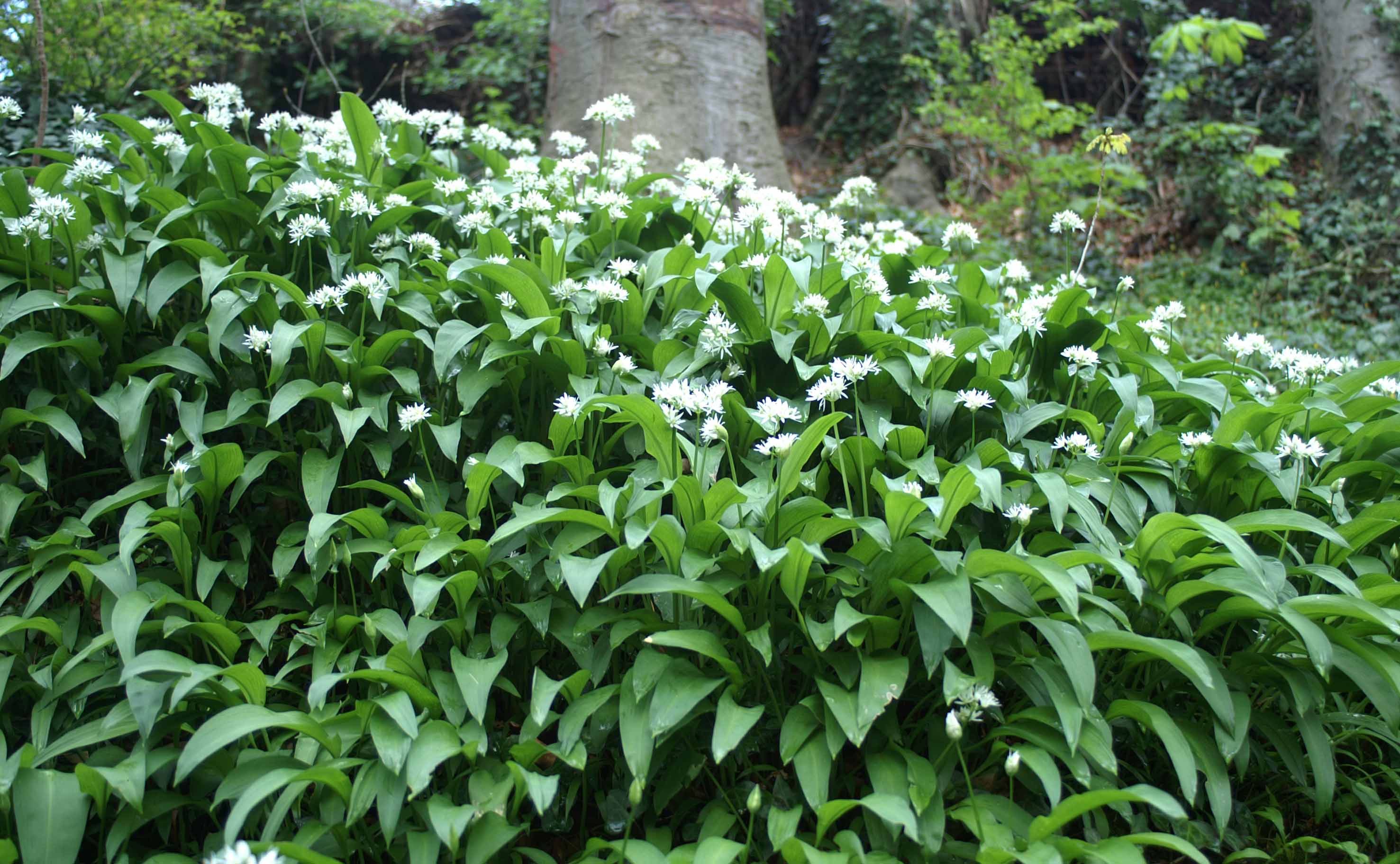
In local woodlands Ramsons, or wild Garlic has been showing blooms for several weeks now and is fast approaching its flowering peak. A wild relative of chives, all parts of the plant have a characteristic garlic or onion scent, and where there are masses of them their pungent scent fills the air; you can often smell their presence before seeing them.
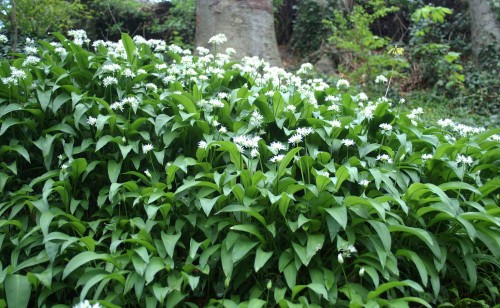
Ramsons, Wild Garlic – Alium ursinum -Fairy Glen, Old Colwyn

Ramsons, Wild Garlic – Allium ursinum

Other common names include  buckrams, wild garlic, broad-leaved garlic, wood garlic, bear leek, and bear’s garlic
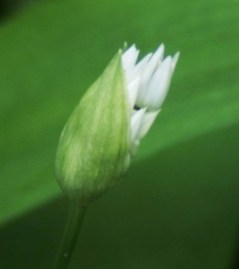
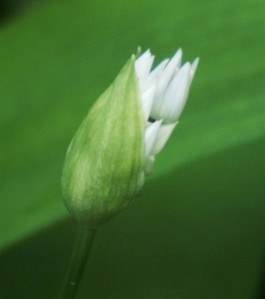
The flower heads are enclosed within a papery two-lobed spathe

Native to Europe and Asia, Ramsons may be found growing  in deciduous woodlands with moist soils, preferring slightly acidic conditions. It is a perennial herb, growing from a narrow white bulb that produces two or three oval-elliptic leaves with pointed tips and long stalks that twist through 180 degrees. The leaves are similar to those of the lily of the valley and where the two plants are known to grow together, care must be taken not to confuse them should you be picking them to eat; those of the lily of the valley are highly poisonous.
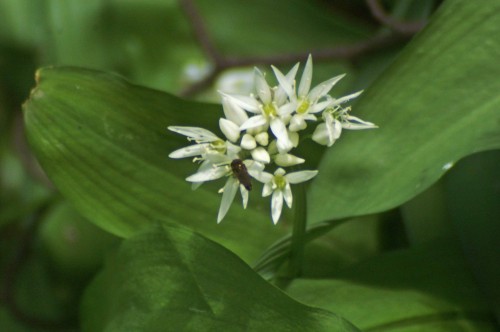
A Ramsons flower visited by a tiny hoverfly. The flower-heads consist of six to twenty white star-like flowers held in dense flat-topped umbels atop a bare triangular scape (stem). Each flower is 16-20mm across and has six stamens.

Ramsons leaves are edible and are fashionable currently as ‘foraged food’; they have been traditionally used as an addition to a green salad,  boiled as a vegetable, added to soup, or as an ingredient for pestoin lieu of basil.  The bulbs and flowers are also very tasty.

A pretty clump of Bluebells – hyacintha non-scripta

A bluebell is visited by a small hoverfly

Bluebells are probably the most characteristic of all woodland flowers. The magnificent carpet of blue its massed blooms  produce, sometimes spreading throughout an entire woodland is a glorious spectacle. It epitomises spring woodlands, but is also a special feature of the British Isles and a rarity over most of continental Europe, either because the winters are too cold or the summers are too hot and dry.

The flowers are indisputably beautiful and release a lovely perfume, but the small bulbs they spring from are rather poisonous if eaten. Traditional medicinal uses of the bulb are based upon their diuretic and styptic properties. The toxic substances they contain also made them useful for a more unusual and practical purpose, as a source of glue used in bookbinding; apparently the toxins discouraged silverfish from eating them.  The toxicity may also be the origin of the superstitious belief that anyone who wanders into a ring of bluebells will fall under fairy enchantment and die soon after. Now I must confess that last little snippet of superstition was passed down in country areas well into my childhood- we lived on the edge of a wood, part of which was (happily still is) carpeted with bluebells in May and I spent many happy hours wandering through them. I was always very careful to make sure there were none growing in a ring.

Shrubs and bushes form the under-story level below the trees – they are woody but not normally tall enough to reach the woodland canopy. The blackthorn and hawthorn are two closely related shrubs, both members of the rose family and both contributing a great deal to our countryside. The blackthorn is usually the first of the two to flower and is familiar for its mass of white flowers produced in early spring before the leaves appear and for the purple sloes in autumn.

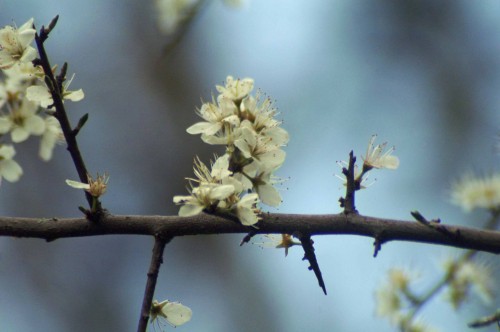
Sloe, Blackthorn – Prunus spinosa

The Blackthorn or sloe – Prunus spinosa  is native to Europe, western Asia, and locally in northwest Africa. It is also locally naturalised in New Zealand and eastern North America.

It  is a deciduous large shrub or small tree growing to 5 m tall, with blackish bark and dense, stiff, spiny branches. The shrub protects itself from animal consumption with particularly long and very tough thorns, which has led to a long traditional use as boundary hedging around fields in Northern Europe and Britain, to contain animals.

The flowers are 1.5 cm diameter, with five creamy-white petals; they are produced shortly before the leaves in early spring, and are hermaphroditic and insect-pollinated.

The leaves are oval, 2 – 4.5cm long and 1.2-2cm across, with a serrated margin.

Blackthorn is the larval food plant of several butterflies, including the Black Hairstreak (Strymondia pruni), which feeds on both the leaf buds and mature leaves of the shrub. This butterfly is a rare species in Britain, restricted only to ‘a narrow belt of mature woodland areas, between Oxford and Peterborough.’  Diversifying a little, there’s a fascinating account of one man’s quest to find this butterfly, together with the rest of our British species in a book I have in my collection titled ‘The Butterfly Isles – A Summer in Search of our Emperors and Admirals’, written by Patrick Barkham. I’d love to know if anyone else has read it; I really enjoyed it, but it seems to have had mixed reviews.

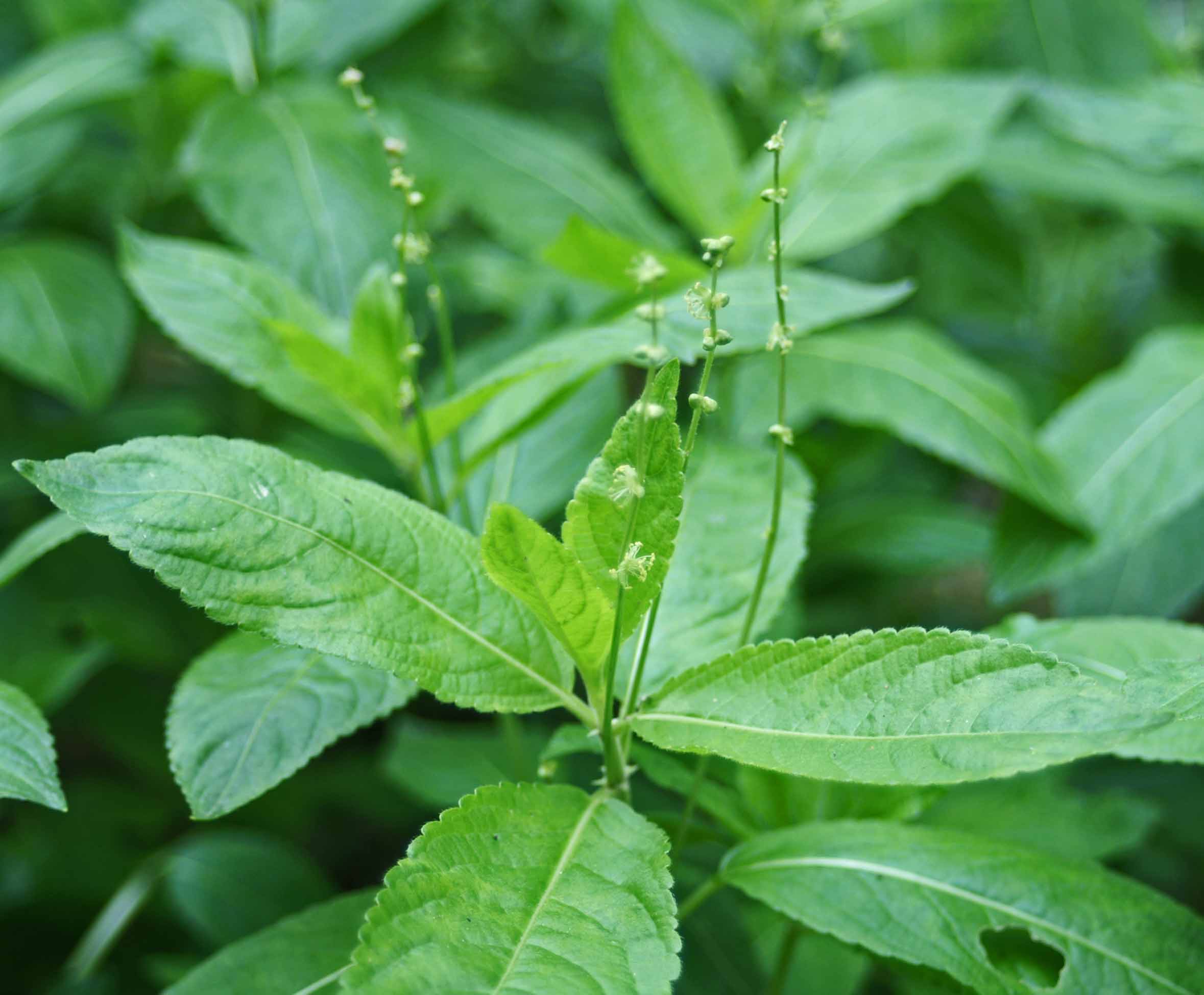
Back to the plants. I’ve mentioned Dog’s Mercury in an earlier post, but didn’t say anything about it. It is actually quite an interesting one as its a bit of a beast appearing alongside the host of beauties featuring in our woodlands at this time of year.

To begin with the name, a  ‘dog’s’ plant is traditionally one with no medicinal uses and it may have obtained this name to contrast it with annual mercury which was used in cleansing enemas. Other slightly less common names are ‘Adder’s Meat’ and ‘Lasting Mercury’. The Mercurialis is open to some debate, although most sources I have come across favour Pliny who said the plant is named after Mercury, the messenger of the gods, who discovered it. The word ‘mercury’ itself is, however, said to be related to ‘merx’ meaning ‘wares’. With its alleged property of being able to determine the sex of an unborn child, it may be that this plant was traded and was ‘merx’.

29/4/12 – Dog’s mercury is fully grown now and flowering

The plant is poisonous; it contains methylamine, trimethylamine, saponins and a volatile oil. This would give it  emetic and purgative properties, meaning consumption would most probably lead to nausea, vomiting and diarrhoea. Larger doses cause lethargy, jaundice, painful urination (apparently by making the urine acid) and coma before death. Reported instances of poisoning are few, perhaps because the plant is not particularly attractive and also because it had no tradition of medicinal use.
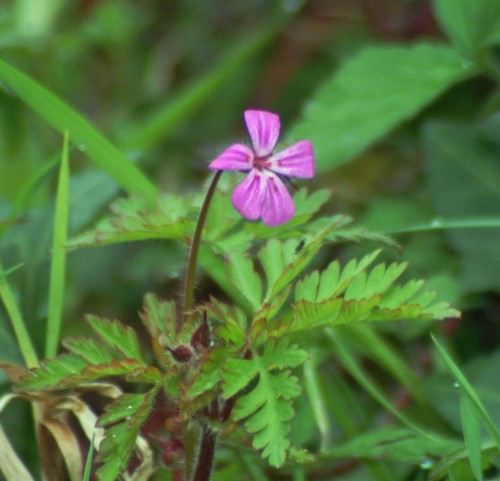
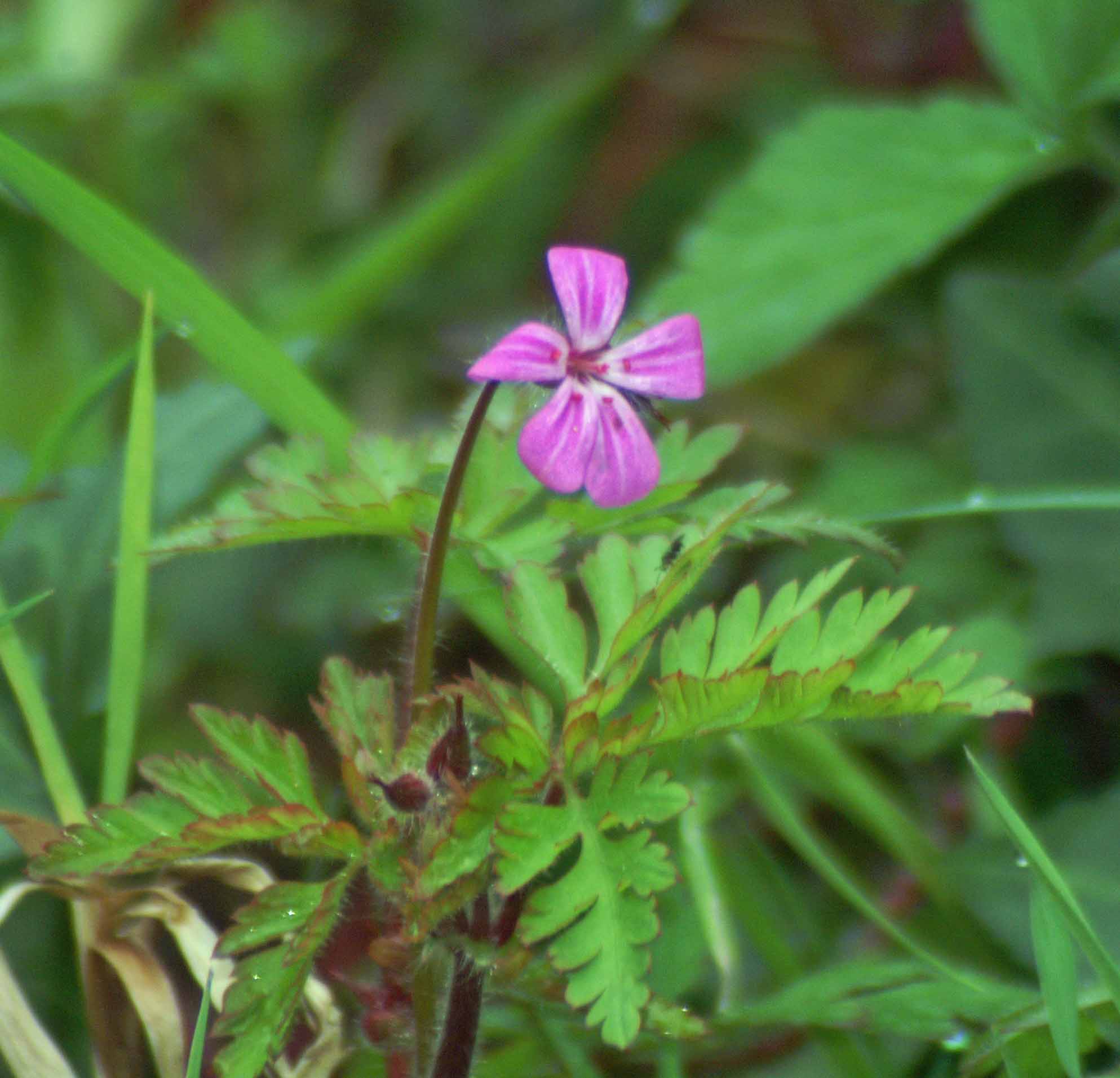
Pretty pink-flowered Herb Robert – geranium robertianum

Another of my all-time favourite little woodland plants is also beginning to appear, the pretty delicate and highly aromatic little Herb Robert. It is a common species of cranesbill in Europe, Asia, North America, and North Africa, and in Britain it is by no means confined to woodlands and may turn up anywhere it can get a hold, even on stony seashores.

The pungent aroma of the leaves is said to act as an insect deterrent and it does seem to be that no insect pest bothers it;  it has traditionally been used in bedding for animals for that reason.

Herb Robert is known to have many medicinal qualities, it is astringent, antibiotic, antiviral, styptic, tonic, diuretic, digestive, sedative and antioxidant. Of these properties, the main action of the herb is regarded to be astringent, which gives it the ability to treat external conditions such as bruises and skin irritations. From medieval times the herb has been applied as a compress to stop bleeding and heal wounds and because of its astringency it is also used to treat diarrhoea.
Share this:

  • Share on Facebook (Opens in new window) Facebook
  • Share on Pinterest (Opens in new window) Pinterest
  • Share on X (Opens in new window) X
Like Loading...
What a beautiful day

24 Friday Feb 2012

Posted by theresagreen in birds singing, Nature, nature photography, woodland birds, woodlands

≈ 4 Comments

Tags

birds singing, blackbird, lesser celandine, miniature daffodils, river Colwyn, song thrush, starlings roosting on Colwyn bay pier

Today was officially the  warmest February day recorded since 1998, with temperatures reaching 18 degrees in some parts of the UK. These are some of my views of this unseasonally beautiful day.

8.15am - Sunlit tulips

The sky was blue, birds were singing, the sun eye-squintingly bright and the sea calm and almost lake-like.

8.35am-View to Rhos-on-Sea showing the headland of the Little Orme & Bryn Euryn

8.37am-Calm, sunlit sea beneath a blue sky

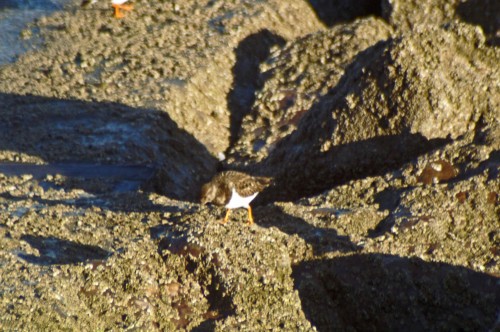
8.38am-Turnstone foraging on barnacle-encrusted rocks

During my lunch break I spent a few minutes in the small wooded area at the bottom of Beach Road.

2pm-River Colwyn at the Beach Road end just before it runs into the sea

The river Colwyn flows through the original township of Colwyn. There are many brooks of the same name in Wales. It means ‘a young animal’ or ‘a pet dog’ and was probably used to describe the playful movement of the water.

Miniature daffodils flowering in the woodland garden

Carved wooden seat alongside the path

Lesser celandines open in the sunlight that filters through the bare tree branches

A wren was singing from a low branch close to the path, a chaffinch from higher up in a neighbouring tree and a robin from somewhere within the shrubbery. I caught sight of two long-tailed tits and a song thrush as it flew down onto the wall alongside the stream.

A blue tit low in a shrub beside the stream

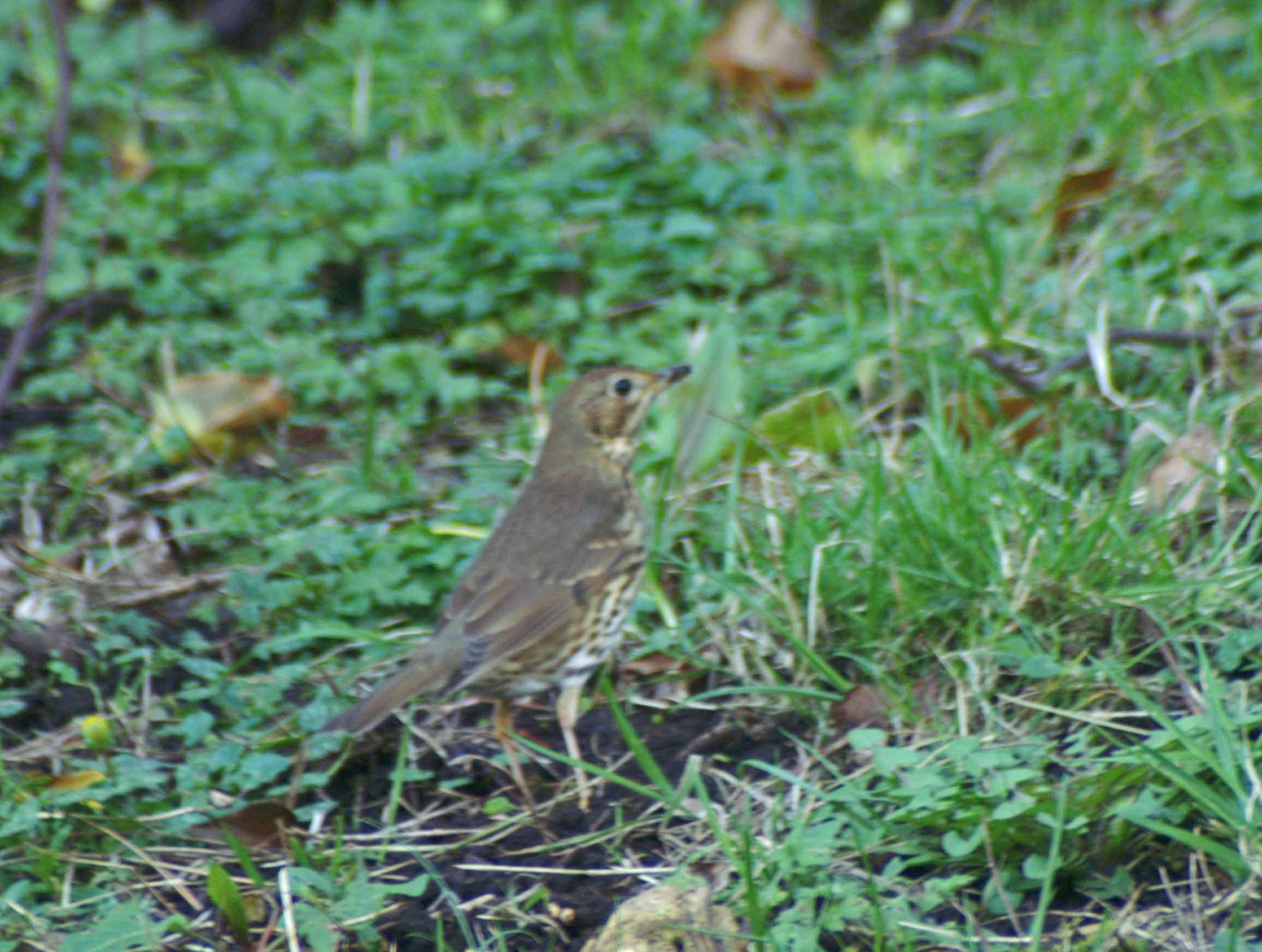
I thought I’d missed the opportunity of a good look at the thrush, but as I was leaving there was another on the bank very close to the path that wasn’t bothered by me being there, even when I pointed the camera at it.

A beautifully marked thrush

Thrush from the front

A successful hunting blackbird

The views on the way home in the evening light were enhanced by the pink glow from the setting sun.

5.50pm - Evening view of Rhos-on-Sea

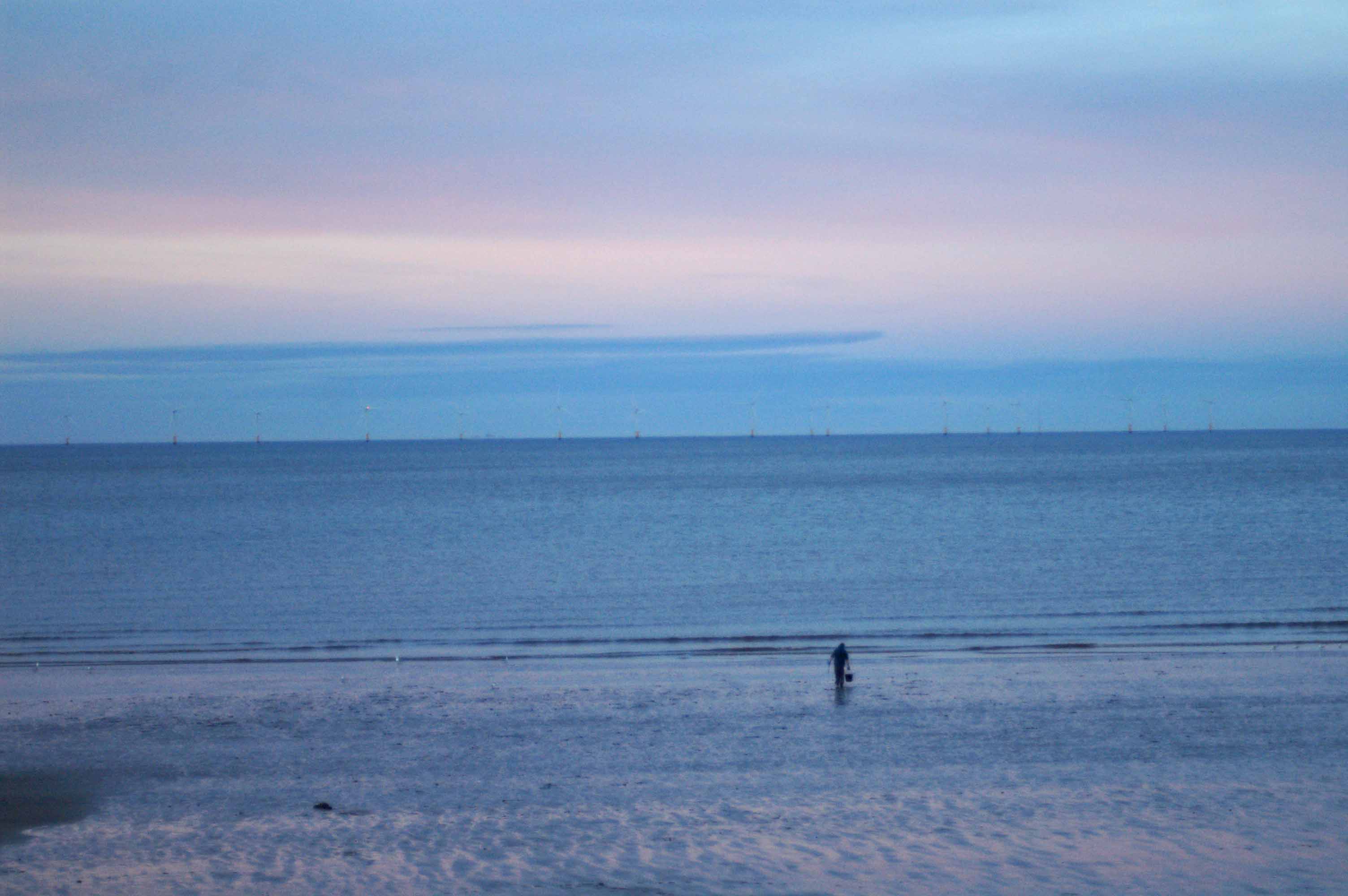
The tide was fully out and although the light was fading there were several people on the beach walking their dogs and a man probing the sand with a stick that I thought may have been searching for razor clams (?); he was too far away to see what he was putting into his bucket.

Man collecting razor clams

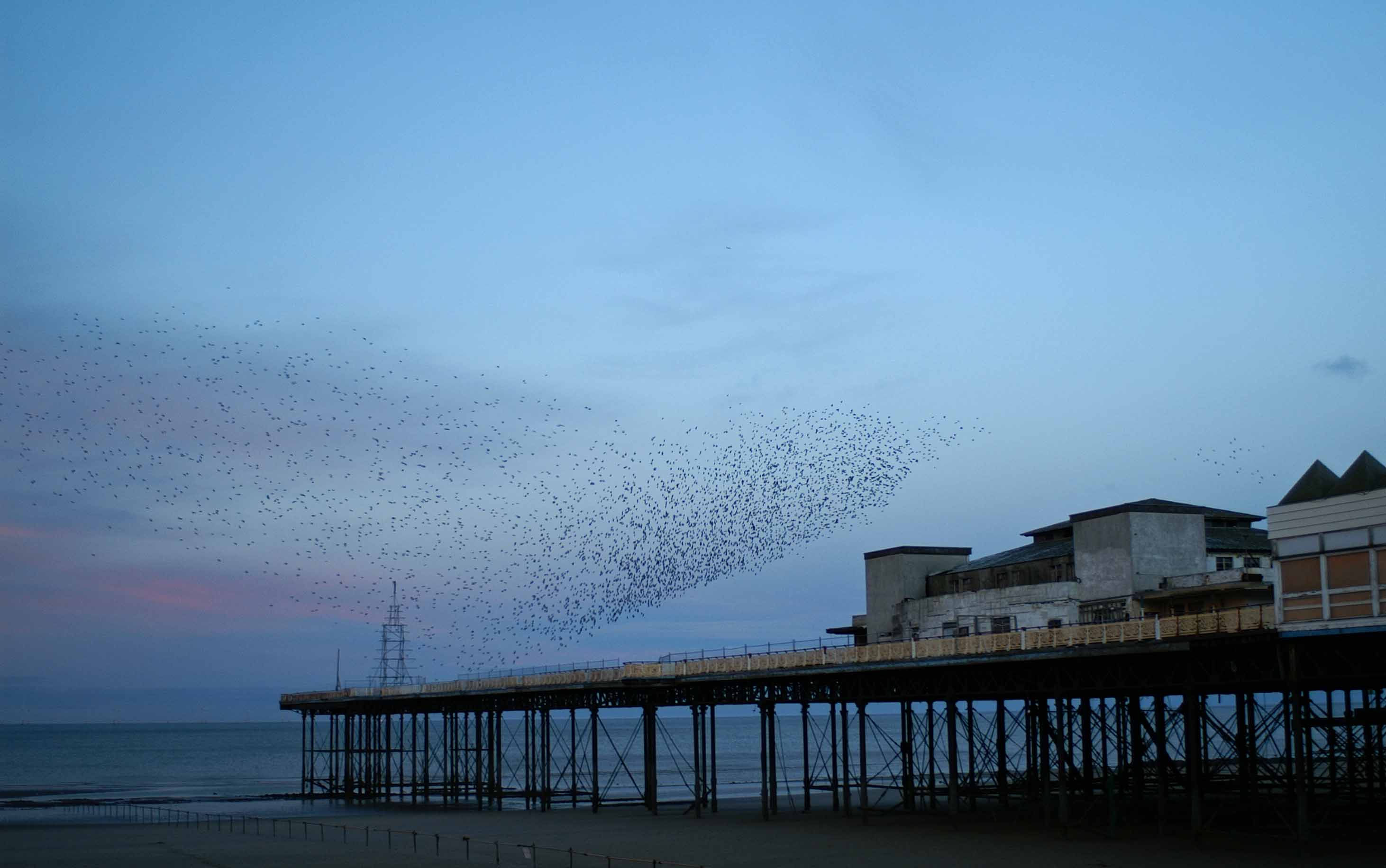
As I hoped, I arrived at the old pier at more or less the same time as the starlings.  The majority had already gathered into a large flock, a smaller flock arrived and blended seamlessly into the outer edges as they wheeled around across the sea then back to the pier. They settled quite quickly this evening, showering down like falling leaves to settle beneath the floor of the pier on either side of the structure.

5.50pm - Starlings arriving at the old pier to roost for the night

Starlings shape-shifting across the pink-tinged sky

Starlings flying out over the water

6pm-A final view of the rosy pink sunset

Tomorrow is predicted to be colder, ‘freshened’ by a NW wind …..


Share this:

  • Share on Facebook (Opens in new window) Facebook
  • Share on Pinterest (Opens in new window) Pinterest
  • Share on X (Opens in new window) X
Like Loading...
Follow everyday nature trails on WordPress.com

Enter your email address to follow this blog and receive notifications of new posts by email.

‘But it is the common species that keep the living world ticking over and provide most of our experiences of wildlife, and I would argue that maintaining the abundance of these is as important a conservation priority as maintaining the existence of rarities’. Richard Mabey

MOST RECENT POSTS

  • A Glimpse of Spring to Come January 22, 2025
  • Hunting the Wren December 28, 2024
  • Oh, Christmas Tree December 18, 2024
  • In and Out of the Ivy February 15, 2024
  • Nature’s Fireworks November 30, 2023
  • Wild Autumn along the Coast Path November 3, 2023

OLDER POSTS

LOOKING FOR SOMETHING IN PARTICULAR?

  • Sights and Sounds from the Little Orme 1
    Sights and Sounds from the Little Orme 1
  • Things Bright and Beautiful
    Things Bright and Beautiful
  • Catchers, a Duck and Divers
    Catchers, a Duck and Divers
  • May Bee Appearing on Ivy near You
    May Bee Appearing on Ivy near You
  • Following a river to a Fairy Glen
    Following a river to a Fairy Glen
  • Shades, Sounds and Scents of the Woods
    Shades, Sounds and Scents of the Woods
  • A Windy Wildflower Trail
    A Windy Wildflower Trail
  • The Windhover
    The Windhover
  • Fine Dining for Crows
    Fine Dining for Crows
  • A Window on the Woods-Winter 1
    A Window on the Woods-Winter 1

nightingale trails

The Walk of the Monarch Butterfly-Sendero de la Mariposa Monarca

The Walk of the Monarch Butterfly-Sendero de la Mariposa Monarca

MY WILDFLOWER BLOG: where the wildflowers are

Snowdrop

Snowdrop

most recent posts

Follow everyday nature trails on WordPress.com

Social

  • View teresamaygreen’s profile on Twitter

Enter your email address to follow this blog and receive notifications of new posts by email.

Website Built with WordPress.com.

  • Subscribe Subscribed
    • everyday nature trails
    • Join 359 other subscribers
    • Already have a WordPress.com account? Log in now.
    • everyday nature trails
    • Subscribe Subscribed
    • Sign up
    • Log in
    • Report this content
    • View site in Reader
    • Manage subscriptions
    • Collapse this bar
 

Loading Comments...
 

    %d