• Home
  • about
  • about the photographs
  • Local Nature Reserves
    • Bryn Euryn Local Nature Reserve
    • Mynydd Marian
  • Wales Coast Path
    • Grey Seals in North Wales
    • St.Trillo’s Chapel
    • Wildflowers of North Wales Coastal Paths, Cliffs and Dunes

everyday nature trails

everyday nature trails

Category Archives: nature of woodlands

A wander through Pwllycrochan Woods

12 Monday Sep 2011

Posted by theresagreen in nature of woodlands

≈ 2 Comments

Tags

brown-lipped snail, ferns, large trees, mosses, pathways through trees, pwllycrochan woods, rose-bay willow herb, woodland walks

This prominent woodland stretches across the slopes behind the town of Colwyn Bay. The wood is almost entirely deciduous with a variety of native trees and exotic species such as sweet chestnut and firs. Mature trees impart character to the woodland whilst two streams provide an attractive feature as they forge their way through deep dingles in the ancient part of the wood. Birds to be seen and heard in the wood include Jay, Buzzard, Nuthatch, Great spotted woodpecker, Treecreeper and Tawny owl.

The name “Pwllycrochan” is thought to translate to mean ‘Cauldron Pool’. The pool referred to lies at the bottom of a steep wooded dingle and was created by the stream that runs down into it.  The stream probably used to run much faster than it does now and created a pool of well oxygenated, bubbling water at its base. 


This remnant of ancient woodland covers 21 hectares in total, but it is divided into three ‘islands’ by roads that bound it and cut through it ; i.e King’s Drive and Llanrwst Road. However, despite the proximity of the highways, the woodlands retain much of their tranquility and walking between the wonderful towering trees, some of which must have been growing steadily throughout at least a couple of centuries, instills the feeling of calm and peace that I believe is intrinsic to old woodlands.

Today, in the middle of August, it was exceptionally quiet here, with no birdsong and very few other people around, so the sudden sounds made by a grey squirrel foraging through the branches of a beech tree above my head made me jump. Apart from a couple of glimpses of Robins, a Blackbird, and at the end of my walk a Jay, there is little else to report in terms of sights and sounds of fauna.

This was my first visit to this woodland and although I had it in mind to find the pool that gives it its name, I had no idea where it was to be found, so I just wandered along sections of tracks that wind around through the trees. Most are easy walking, either flat or slightly sloping, while others require a bit more of an uphill effort and I imagine could get quite slippery in wet weather.

I think the photographs I took are descriptive enough to convey the essence of a wander through this lovely woodland, so here are just a few of the many I took:

Shaded pathway between the trees passing beneath a huge beech tree with moss-covered roots
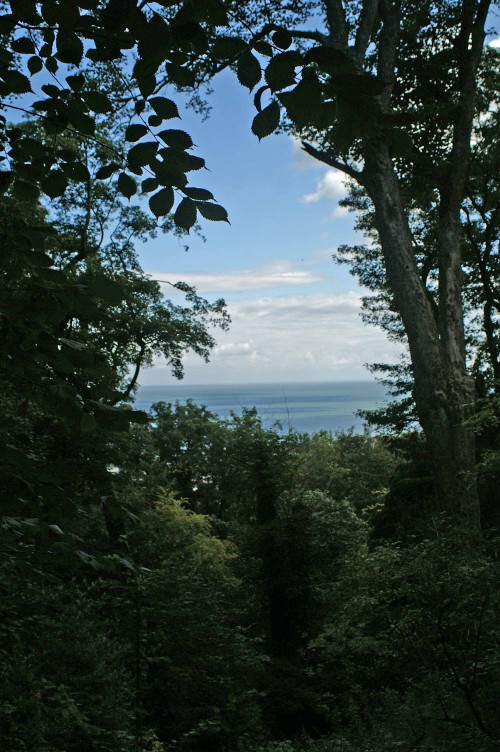
Sea view through the trees

A sun-dappled uphill pathway with steps
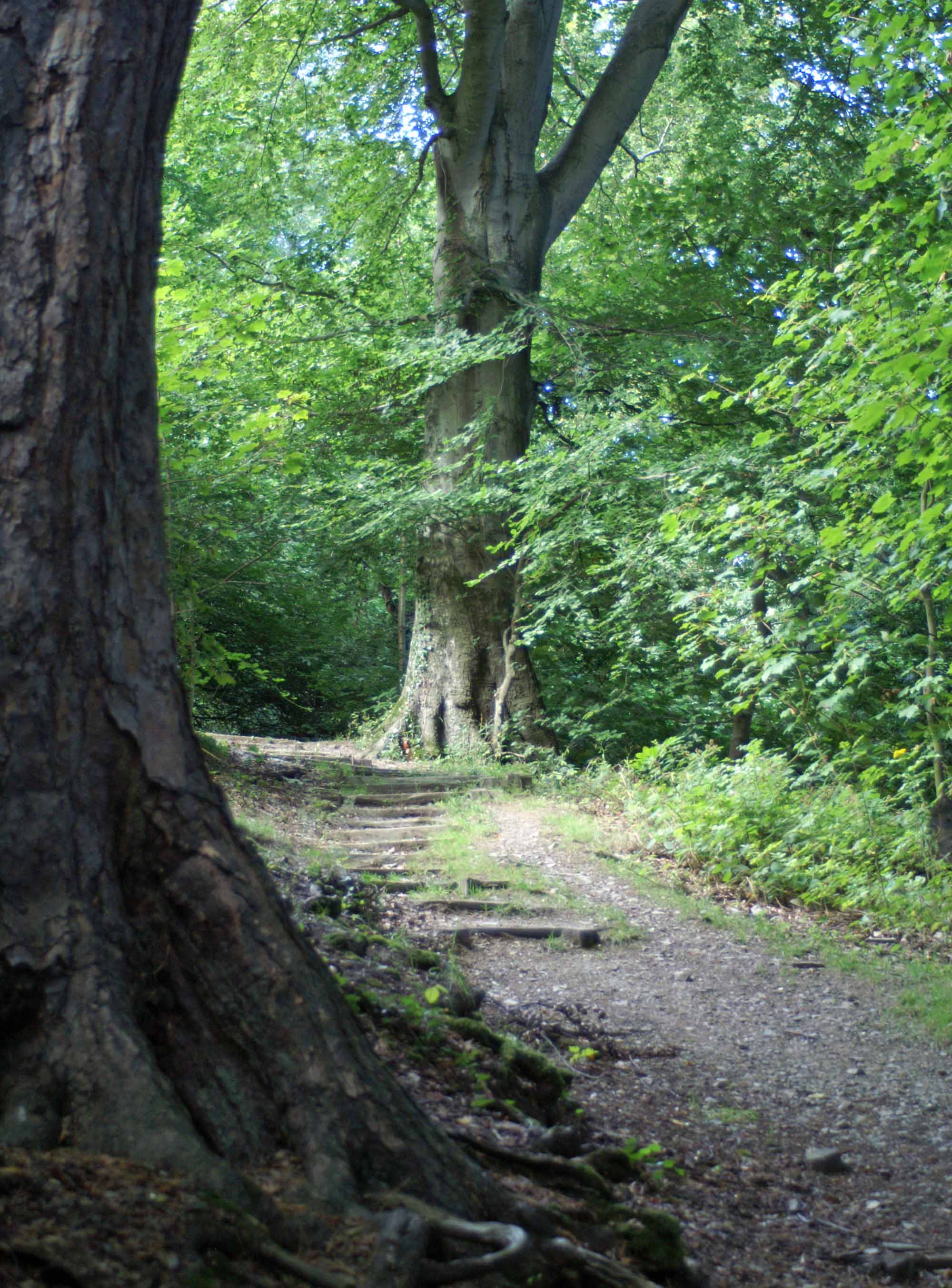
Steps leading to the top of a pathway

One of the impressive ‘exotic’ Sweet Chestnut trees

Another chestnut specimen, this one the more familiar Horse Chestnut or conker tree

A true native Ash Tree

A fern-fringed stream trickling down over rocks

A fern covered bank

Speckled Wood butterfly resting on a fern frond

A decaying tree stump surrounded by fresh green moss

Tree stump supporting moss & lichen

Part of the trunk of a towering Scots Pine tree

Pine cones

This impressive beech tree is so tall I had to take the photograph in two parts and merge them together

I finally came upon the famous ‘cauldron pool’, but probably due to the lack of rainfall earlier on this year, its water level was low and despite some recent renovations to its retaining walls, it was looking rather sad, so I decided to protect its reputation and not take a photograph this time.

Finally, on the woodland edge:

A stand of Rose-bay Willow Herb on the woodland edge

A brown-lipped snail tucked beneath a leaf

Share this:

  • Share on Facebook (Opens in new window) Facebook
  • Share on Pinterest (Opens in new window) Pinterest
  • Share on X (Opens in new window) X
Like Loading...

On the trail of native woodland flora

02 Friday Sep 2011

Posted by theresagreen in ferns, fungi, nature of woodlands

≈ Leave a comment

Tags

feathery moss, holly, native trees of Wales, orange lichen on tree trunk, silver birch, turkey-tail fungus, woodland walk

Bryn Euryn’s woodland is home to a good number of native species of trees, including Ash, Beech, Silver Birch and Sessile Oak. There are also many large Sycamore trees, which although well-recognised and widespread in Britain are the true natives of woodlands of Central Europe.

11/8/11-Steps wind uphill through the trees

Amongst the large trees are sprinklings of native shrubs or smaller trees of Holly and the occasional Yew, with Hawthorns on the woodland edges.

11/8/11-European Holly -Ilex aquifolium

Ivy is another plant that is so widespread and commonly occurring that I was quite surprised to find it is not a native plant in Northern Europe, but hails from western, central and southern Europe.

11/8/11-Ivy-Hedera helix

11/8/11- An impressive Silver Birch -Betula pendula

11/8/11-Moss growing on the trunk of a silver birch tree

The cool shady and damp woodlands provide perfect habitat for various species of ferns, mosses and lichens too.

“Wales only occupies about 10 per cent of the land area of the British Isles but it has an extraordinary diversity of lower plants and fungi including 75 per cent of the mosses and liverworts, 74 per cent of the lichens and 80 per cent of the rust fungi. This diversity is probably thanks to Wales having such a broad range of relatively un-disturbed habitats and a small population”

http://www.plant-talk.org

11/8/11-Common Feather-moss-Kindbergia praelonga

I love coming across little ‘scenes’ such as the one below, where moss partially clothes a craggy rock which also supports a blue-green lichen and is surrounded by dried leaves and twigs. So many textures shades of colours in a very small area of the woodland floor, and doubtless many insects and micro-organisms are there too.

11/8/11-A mossy rock in a bed of dry leaves

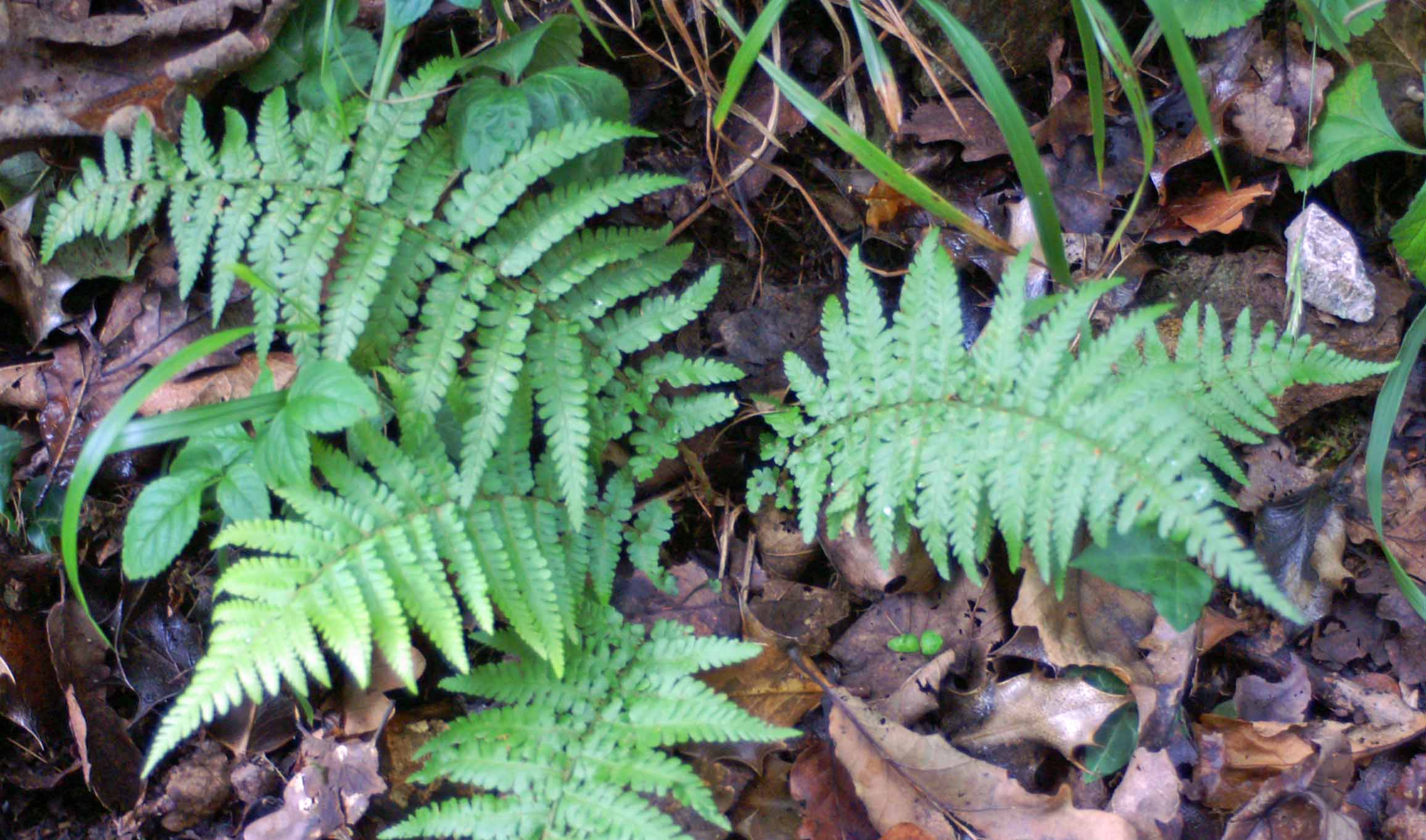
11/8/11- Male Fern-Dryopteris filix-mas

In open spots on the woodland edge there are brambles, flowering at the moment and attracting lots of little hoverflies.

11/8/11-Hoverfly-Melangyna cincta on bramble flower

11/8/11- Mustard Powder Lichen-Chrysothrix candelaris on a sycamore trunk

The bright yellow Mustard Powder lichen or Gold Dust lichen– Chrysothrix candelaris  commonly grows on tree bark. It is widespread and common in the United Kingdom, being found on the bark of deciduous trees, especially rugged old specimens, such as sycamore, alder, oak, willow, beech, and Pinus species, normally in dry shaded parts.

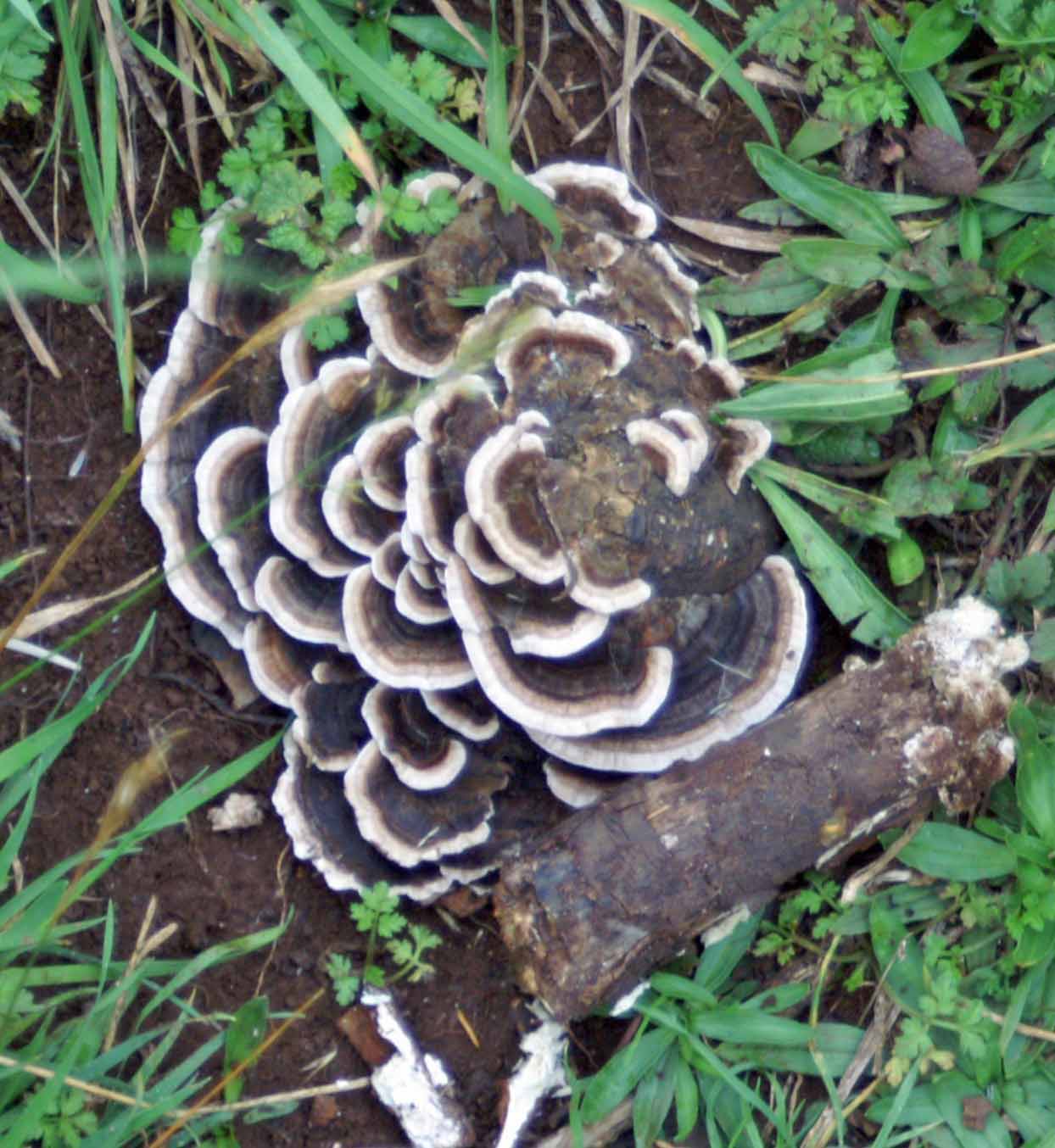
11/8/11-Turkey- tail fungus - Tramates versicolor

I came across the ‘Turkey-tail’ fungus on a path around the summit of the hill and thought it was fascinating. It takes its common name from the way in which the patterning and the cup or spoon shaped fungus resembles, well, the shape and patterning a turkey’s tail. It is a common bracket fungus which grows on the sides of logs or trees and occurs in a variety of colours including brown, tan, orange, white, red or purple, sometimes all together (Versicolor means ‘of several colours’). Turkey Tails are not poisonous to people but they are not eaten either.

Share this:

  • Share on Facebook (Opens in new window) Facebook
  • Share on Pinterest (Opens in new window) Pinterest
  • Share on X (Opens in new window) X
Like Loading...

Red-berry trail

31 Wednesday Aug 2011

Posted by theresagreen in Bryn Euryn Nature Reserve, Nature of Wales, nature of woodlands

≈ Leave a comment

Tags

cotoneaster in the wild, cuckoo pint, haws, hawthorn, hawthorn berries, poisonous berries, red berries, wild arum

11th August

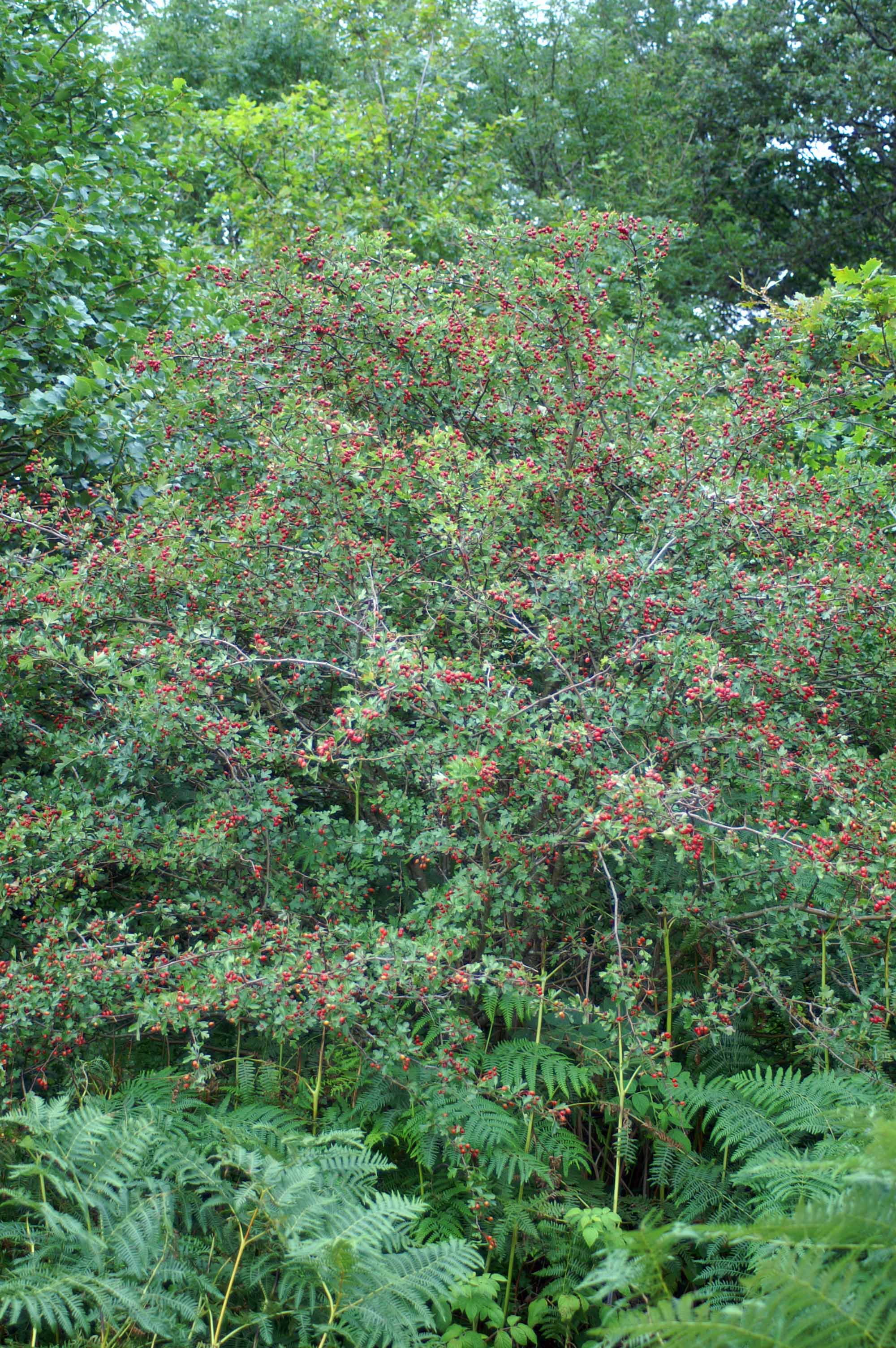
I resumed my woodland walk, passing by a Hawthorn tree laden with red berries.

11/8/11-Common Hawthorn -Crataegus monogyna, fully laden with a crop of berries

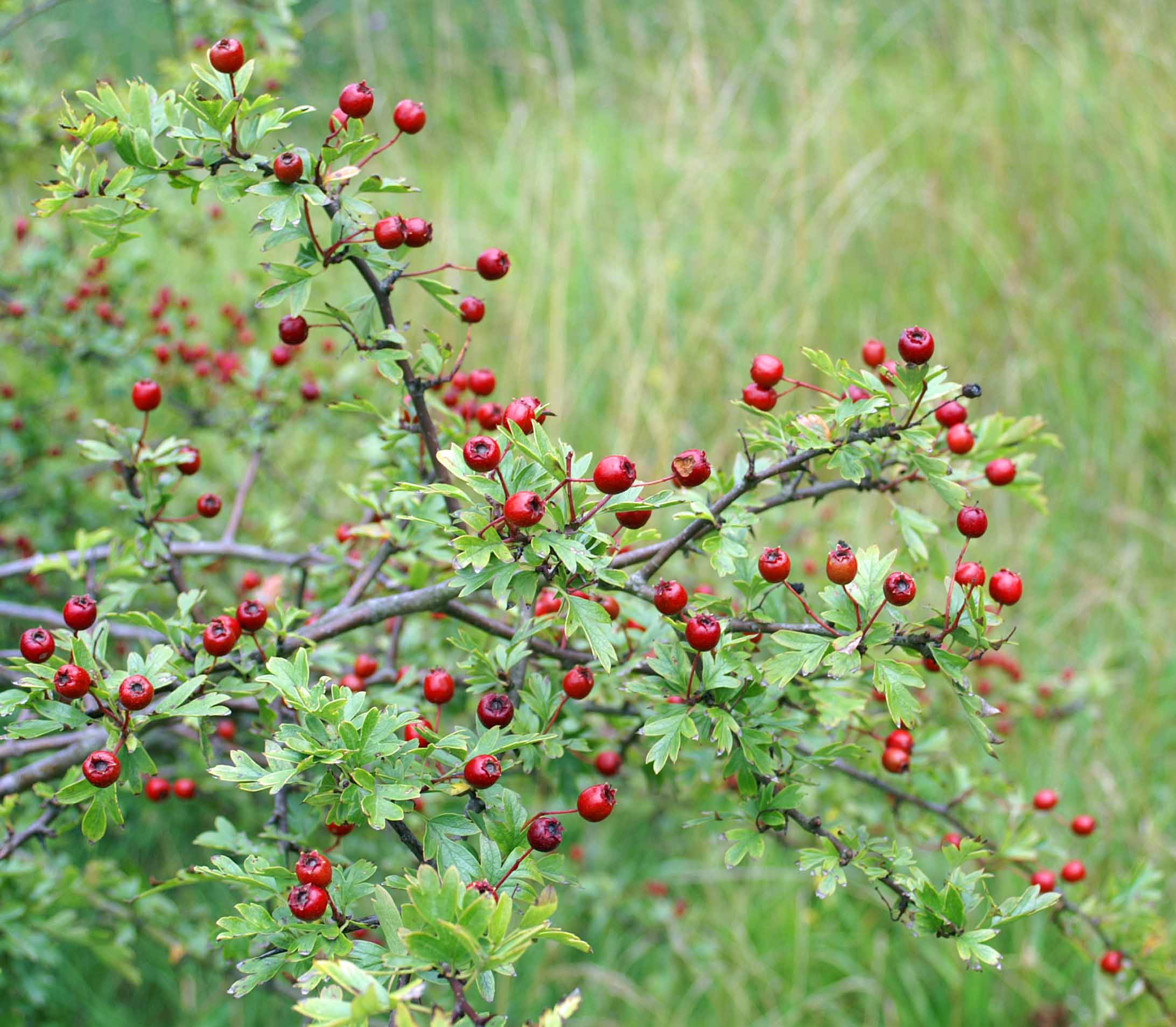
Crataegus commonly called hawthorn or thornapple, is a large genus of shrubs and trees in the rose family, Rosaceae, native to temperate regions of the Northern Hemisphere in Europe, Asia and North America.  They are shrubs or small trees, mostly growing to 5–15 m tall, with small pome fruit and (usually) thorny branches. The thorns are small sharp-tipped branches that arise either from other branches or from the trunk, and are typically 1–3 cm long.  The fruit, sometimes known as a “haw”, is berry-like, but structurally a pome containing from 1 to 5 pyrenes that resemble the “stones” of plums, peaches, etc.

11/8/11-Hawthorn berries, or haws

Hawthorns provide food and shelter for many species of birds and mammals, and the flowers are important for many nectar-feeding insects. Hawthorns are also used as food plants by the larvae of a large number of Lepidoptera species and haws are important for wildlife in winter, particularly thrushes and waxwings.

I have noted several cotoneaster shrubs growing throughout this site, which I have assumed to have arrived there via bird droppings as the shrub is not generally a native of Britain, but is widely planted in gardens.

11/8/11-Berries of Cotoneaster horizontalis

* * There is an indiginous native cotoneaster that is found growing only on the Great Orme: Cotoneaster cambricus (Wild Cotoneaster;  Welsh: Creigafal y Gogarth “rock apple of Gogath”) is a species of Cotoneaster endemic to the Great Orme peninsula in north Wales. It is the only species of Cotoneaster native to the British Isles. It has never been found naturally at any other location.

______________________________________________________

I very recently came upon the following on the ‘Plantlife’ website on the very subject of ‘escapee cotoneasters’:

Cotoneaster species

Non-native invasive plants.

Cotoneasters provide an important reminder that even with the best intentions of gardeners, the wind, birds and other animals can help plants to ‘escape over the garden wall’.

Plantlife is particularly concerned about four types of cotoneaster:

  • Hollyberry cotoneaster (C. bullatus)
  • Wall cotoneaster (C. horizontalis)
  • Small-leaved cotoneasters (C. microphyllus agg.)
  • Himalayan cotoneaster (C. simonsii).

What’s the problem?

These popular garden and landscaping shrubs are also popular with birds who enjoy the berries and spread the seed. This can spread cotoneasters in the wild, where they can be difficult to eradicate.

What are we doing about it?

Find out more about Plantlife’s invasive plant programme by clicking here

_____________________________________________________

Another probable garden escape is Hypericum – St. John’s Wort, also growing in various spots throughout the site and also now bearing red berries.

11/8/11-berries of St John's Wort-Hypericum

A native plant, the Arum lily or as I know it, Cuckoo Pint or Lords and Ladies, is also bearing bright scarlet berries now. I found them in a few places, mostly tucked almost out of sight beneath other shrubbery.

11/8/11-The poisonous berries of the Wild arum

Arum maculatum is a common woodland plant species of the Araceae family. It is widespread across temperate northern Europe and is known by an abundance of common names including Wild arum, Lords and Ladies, Devils and Angels,Cows and Bulls, Cuckoo-Pint, Adam and Eve, Bobbins, Naked Boys, Starch-Root and Wake Robin.

Share this:

  • Share on Facebook (Opens in new window) Facebook
  • Share on Pinterest (Opens in new window) Pinterest
  • Share on X (Opens in new window) X
Like Loading...
Newer posts →
Follow everyday nature trails on WordPress.com

Enter your email address to follow this blog and receive notifications of new posts by email.

‘But it is the common species that keep the living world ticking over and provide most of our experiences of wildlife, and I would argue that maintaining the abundance of these is as important a conservation priority as maintaining the existence of rarities’. Richard Mabey

MOST RECENT POSTS

  • A Glimpse of Spring to Come January 22, 2025
  • Hunting the Wren December 28, 2024
  • Oh, Christmas Tree December 18, 2024
  • In and Out of the Ivy February 15, 2024
  • Nature’s Fireworks November 30, 2023
  • Wild Autumn along the Coast Path November 3, 2023

OLDER POSTS

LOOKING FOR SOMETHING IN PARTICULAR?

  • Catchers, a Duck and Divers
    Catchers, a Duck and Divers
  • Following a river to a Fairy Glen
    Following a river to a Fairy Glen
  • A Windy Wildflower Trail
    A Windy Wildflower Trail
  • Things Bright and Beautiful
    Things Bright and Beautiful
  • Sights and Sounds from the Little Orme 1
    Sights and Sounds from the Little Orme 1
  • The life of a Yellow Dung-fly
    The life of a Yellow Dung-fly
  • May Bee Appearing on Ivy near You
    May Bee Appearing on Ivy near You
  • Fine Dining for Crows
    Fine Dining for Crows
  • Butterflies and more rare treats
    Butterflies and more rare treats
  • A Window on the Woods-Winter 1
    A Window on the Woods-Winter 1

nightingale trails

The Walk of the Monarch Butterfly-Sendero de la Mariposa Monarca

The Walk of the Monarch Butterfly-Sendero de la Mariposa Monarca

MY WILDFLOWER BLOG: where the wildflowers are

Snowdrop

Snowdrop

most recent posts

Follow everyday nature trails on WordPress.com

Social

  • View teresamaygreen’s profile on Twitter

Enter your email address to follow this blog and receive notifications of new posts by email.

Website Built with WordPress.com.

  • Subscribe Subscribed
    • everyday nature trails
    • Join 358 other subscribers
    • Already have a WordPress.com account? Log in now.
    • everyday nature trails
    • Subscribe Subscribed
    • Sign up
    • Log in
    • Report this content
    • View site in Reader
    • Manage subscriptions
    • Collapse this bar
 

Loading Comments...
 

    %d