• Home
  • about
  • about the photographs
  • Local Nature Reserves
    • Bryn Euryn Local Nature Reserve
    • Mynydd Marian
  • Wales Coast Path
    • Grey Seals in North Wales
    • St.Trillo’s Chapel
    • Wildflowers of North Wales Coastal Paths, Cliffs and Dunes

everyday nature trails

everyday nature trails

Category Archives: Birds

New gulls on the block

17 Tuesday Jul 2012

Posted by theresagreen in bird behaviour, Birdwatching on North Wales coast, Nature, nature photography

≈ 3 Comments

Tags

coastal birds, herring gull, herring gulls in towns, larus argentatus, rhos on sea

I’ve been away quite a bit lately, so there’s quite a bit of catching up to do  here in Rhos-on-Sea. The weather here, as everywhere else has not been conducive to venturing far, but I have been able to do some very productive birdwatching from my bedroom window, which I probably would not have done had I been out and about, so some clouds do have silver linings. In this case the silver has been in the shape of Herring Gulls – (the scientific name larus argentatus translates as silver gull). The activity has been brought about by the recent fledging of the single offspring produced by the pair that nested atop our next-door neighbour’s chimney pot.

At first the young gull spent a lot of time resting on the flat roof, where it is surprisingly well camouflaged.

The newly-fledged gull resting

In between bouts of resting it wandered around the rooftop picking at the odd collection of sticks, shells, bones and other random items brought there by its parents hoping to find something edible it may have missed.

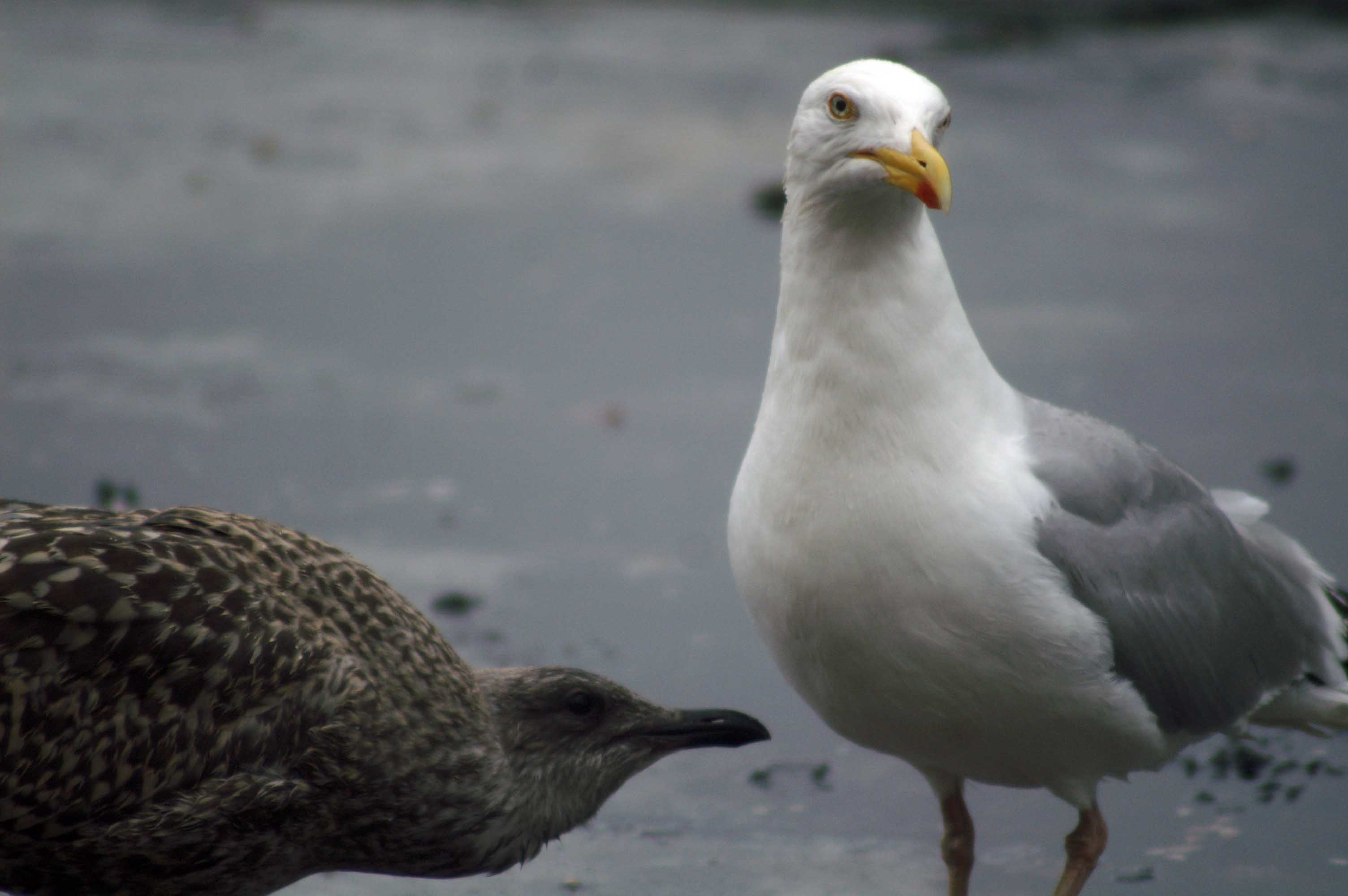
First portrait of the new arrival

I don’t need to sit and watch and wait for the parents to arrive with food as both adult and their young one set off such a cacophony of noise at the sight of one another I can hear them from wherever I am in the house. Once a parent lands the youngster automatically adopts the typical crouched, hunched shoulder begging posture that makes it look a bit like a small vulture.

In begging posture

The loud communication between the two birds continues for a minute or so, then the parent allows the young one to approach and finally to tap the red spot on its beak to stimulate the regurgitation of the food it has brought.

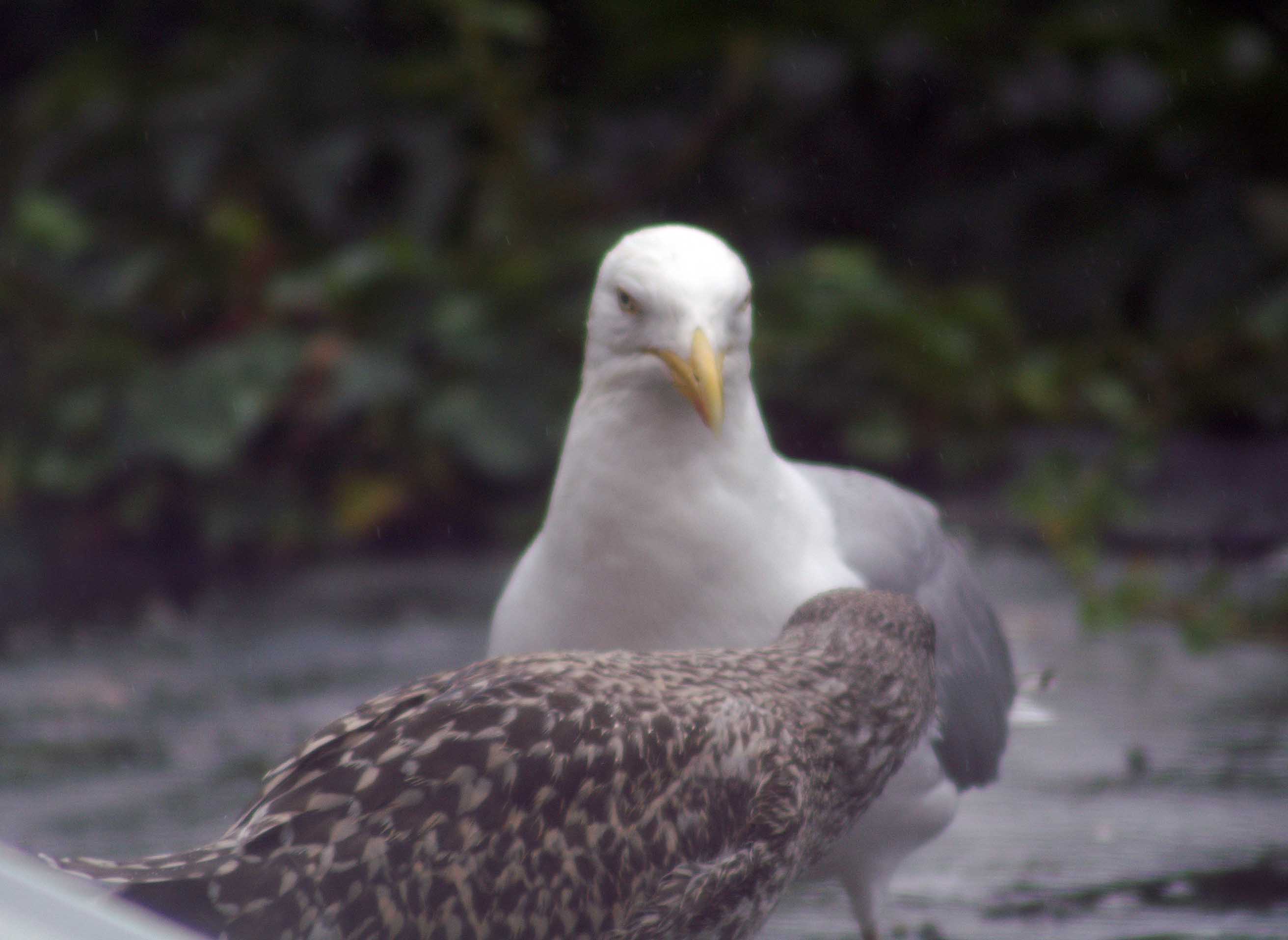
The young gull approaching its parent

Getting into position

The young gull taps the red spot on its parent’s beak  to stimulate regurgitation of its lunch

What follows is not pretty as the parent brings back whatever food it has managed to find and deposits it in front of its youngster. It seems to be thriving on a diet that does not always look particularly healthy; in the following pictures the meal is raw chicken, but on another occasion it was a pile of french fries. There have also been more natural offerings of crab, which is consumed shell and all and small fish.

The adult regurgitating raw meat, maybe chicken

Fortunately the young gull is not a fussy eater

Once the food has been swallowed by the young one the parent leaves immediately, its departure once more accompanied by more loud cries.

Over the course of the last few days the young gull has gained much in confidence and now flies off  to spend much of the day elsewhere, but it is still returning to the high roof in the evenings with its parents and to the flat roof for intervals, maybe to rest where it feels safe.

The young one is gaining in confidence and strength daily

Share this:

  • Share on Facebook (Opens in new window) Facebook
  • Share on Pinterest (Opens in new window) Pinterest
  • Share on X (Opens in new window) X
Like Loading...

Not a trip to Skomer but a great day out

21 Thursday Jun 2012

Posted by theresagreen in birds singing, coastal habitat, coastal walks, Nature, Pembrokeshire coastal path

≈ 2 Comments

Tags

barn swallow, birds singing, common dolphin, cormorants flying, gannet, grey seal, herring gull, lesser black-backed gull, Linnet, marloes peninsular, martin's haven, meadow pipit, Northern Wheatear, razorbill, stonechat, wooltack point

The Saturday following the Friday of the terrible weather dawned bright and sunny and apart from a few lurking clouds the sky looked innocently down upon us as though nothing had happened. We were still hoping for a trip over to Skomer Island, so set off to drive the hour or so that it takes to reach Martin’s Haven, from where the boats depart. We were not too hopeful of being able to get to Skomer today; Saturday’s are popular anyway and as no boats would have gone out yesterday, we expected it to be busy. A first sight of the car park, already overflowing onto adjacent land brought that sinking feeling, compounded by the attendant informing us that all 150 of the day’s landing ticket allocation had been sold by 9.30am. We were somewhat taken aback to learn that some people had begun queuing for places at 5.30am; the first boat for the island leaves at 10am. So, no Skomer for us today.

We had made some effort to get here though and determined to make the best of our situation decided to explore the area around the headland instead. The headland is known as the Marloes Peninsular; the land is owned by the National Trust and for some reason we have not managed to establish is named “Deer Park”, although there are no deer here. There are however spectacular rocks, sea views that take in most of the Pembrokeshire Islands, wildflowers and, we were fairly confident, there would be birds.

We set off to walk up to the highest point of the peninsular, Wooltack Point, distinguished by the small white building on the top that is now an active coastwatch point operated by the National Coastwatch Institute.

We were soon distracted by the small birds we began to see around us almost immediately: Stonechats, Linnets and Meadow Pipits, all species that can make homes in this rather bleak windswept habitat, carpeted with grass and heather and furnished only with low-growing tangles of gorse bushes, brambles and generally scrubby vegetation.

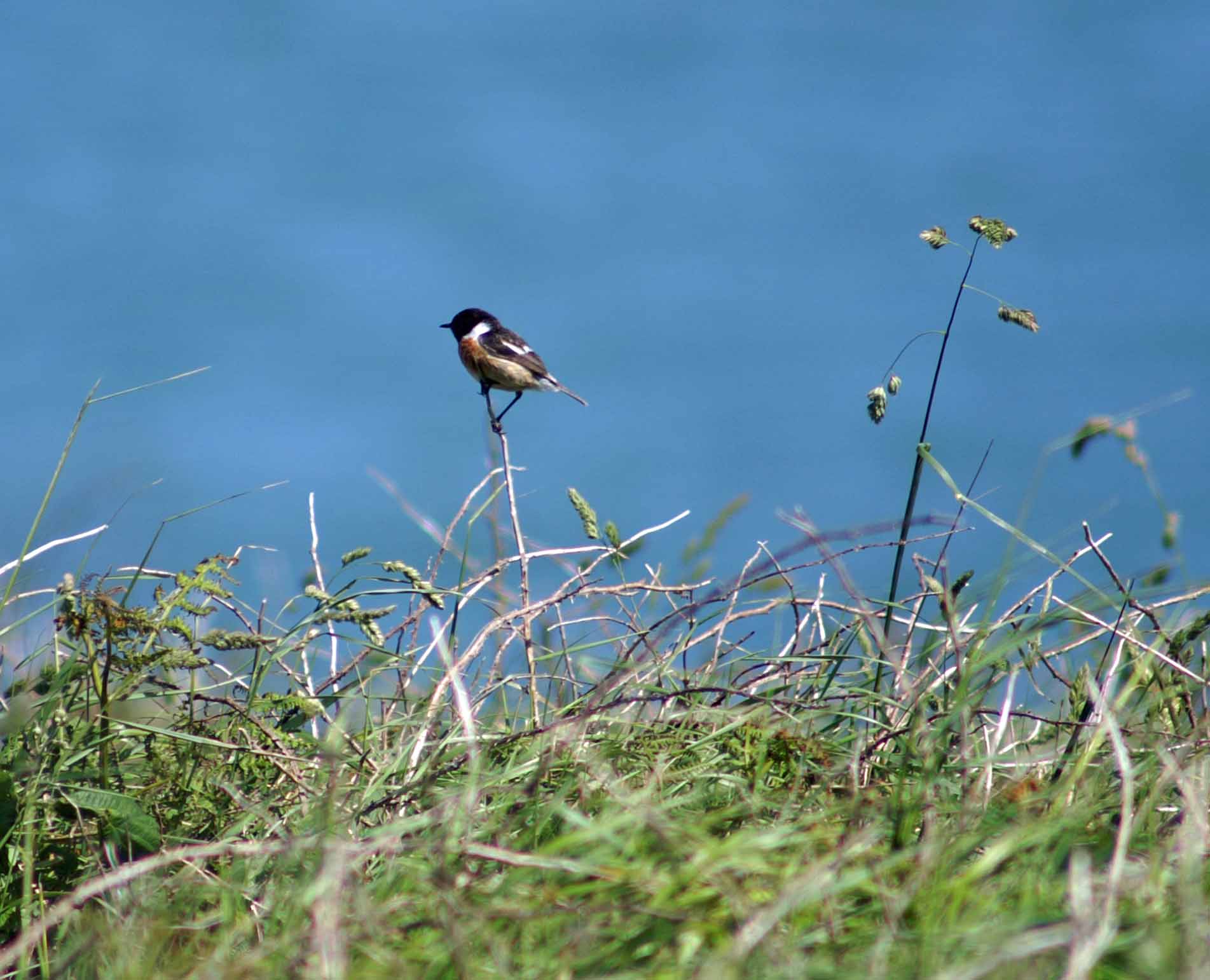
The first bird we had a good view of was this little Stonechat female (Saxicola torquata), who was very shortly joined by a male.

The Stonechat male perched just a short distance away from his mate

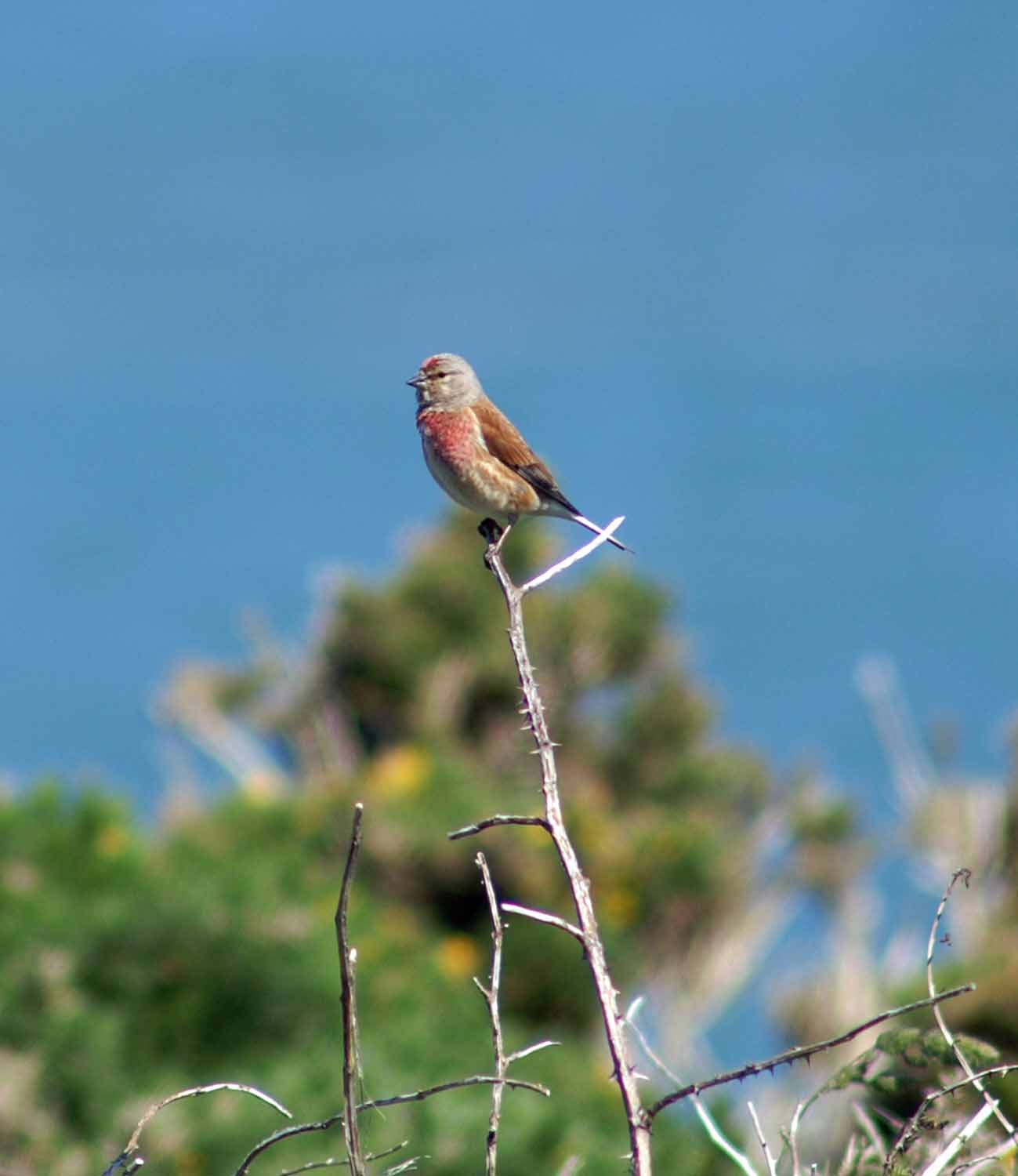
There were several Linnets flying around and one beautiful male landed quite near us on a bramble and began to sing.

This beautiful male Linnet was singing from atop a dead bramble stem

It was sunny here, but windy too, so it was some consolation to think that those on the boats travelling across to Skomer would probably be feeling the combined effects of the cold wind and choppy sea in a not-too-pleasant way. Yes, very immature, especially as we have actually made the journey in even rougher conditions, survived and gone on to have a spectacular day. Anyway, onwards and upwards to Wooltack Point. The views out over St.Bride’s Bay are truly spectacular, but the sea around this point can be treacherous with concealed rocks and strong currents, hence the presence of the Coastwatch.

The incorrectly marked compass (click to enlarge)

We attempted to work out the layout of the islands we could see, picking out Skomer easily as it was close by and Ramsey Island as we recognised the shape of St. David’s Head, but were guessing at the others. I spotted a compass of sorts on a plinth outside the door of the stone hut and as I leaned in to take a picture of it the coastguard popped out to tell us that its directions are useless as all points are wrong. Apparently even the North marking is incorrect. He was quite amused by the fact that “there is nowhere in the world from which that plaque would be correct” and has no idea why it has never been replaced.

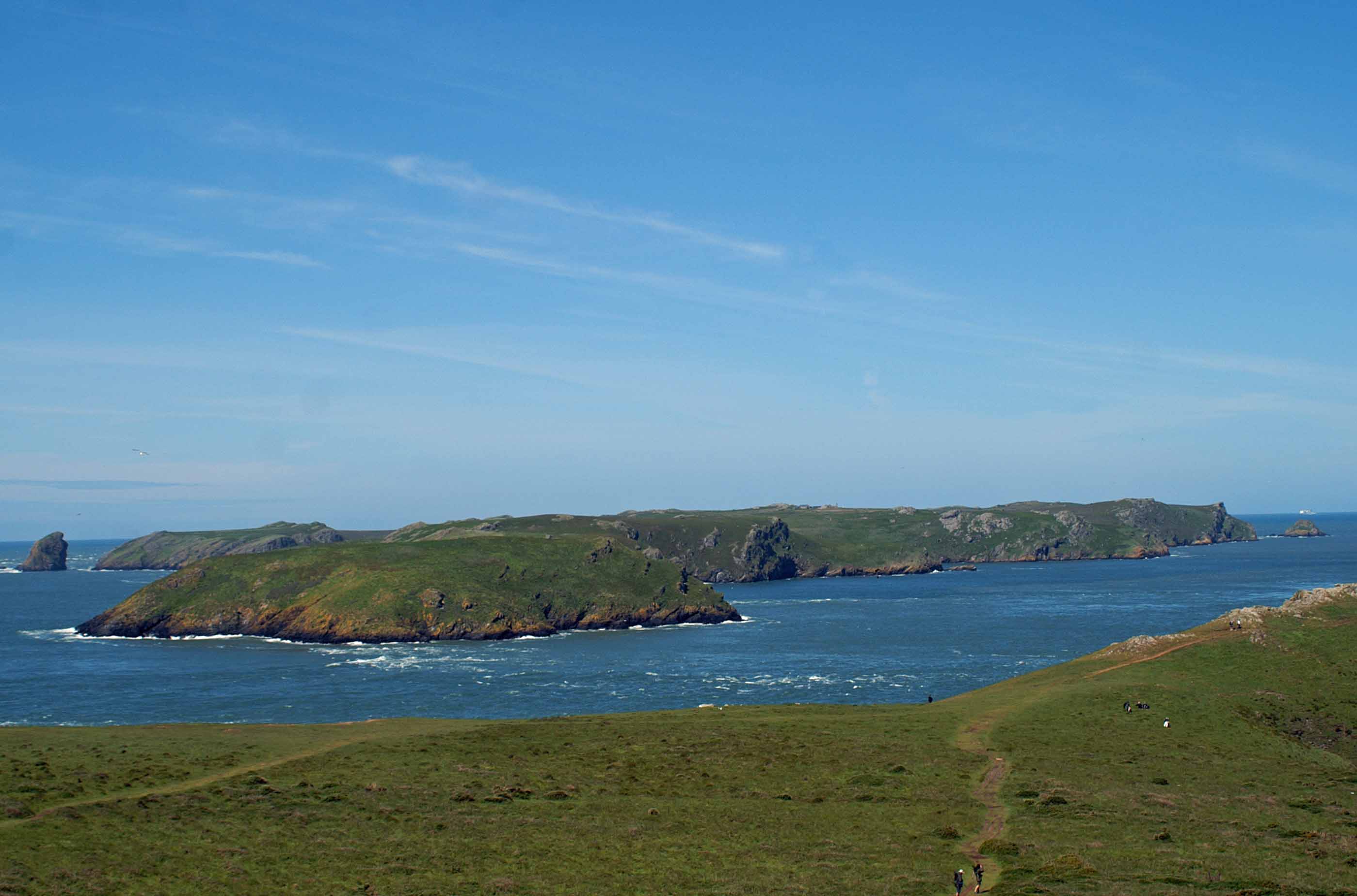
The nearest we got to Skomer Island today, just 2 miles across the Sound

Ramsey Island, 9.5 miles away is located off St David’s Head

Dropping down onto the cliff in front of the hut we discovered it to be sheltered from the wind and much warmer. We sat there for at least an hour watching the array of seabirds flying back and forth or swimming and diving around the rocks below us.

Razorbills were the most numerous birds on the water, but there were a few guillemots and cormorants too.

Razorbills swim on the surface then suddenly make a synchronised dive and disappear underwater for ages, eventually reappearing some distance away

Cormorant flying close to the rocks, low over the water

Herring Gulls passed us by very closely

Lesser Black-backed gulls were another frequent sight

We were delighted by the appearance of Grey Seals in the sea just below us, and even more thrilled when we realised there were dolphins too. The first dolphin we picked up on was following the Skomer boat on its return trip to Martin’s Haven, but soon realised there were at least three in total.

Grey Seal

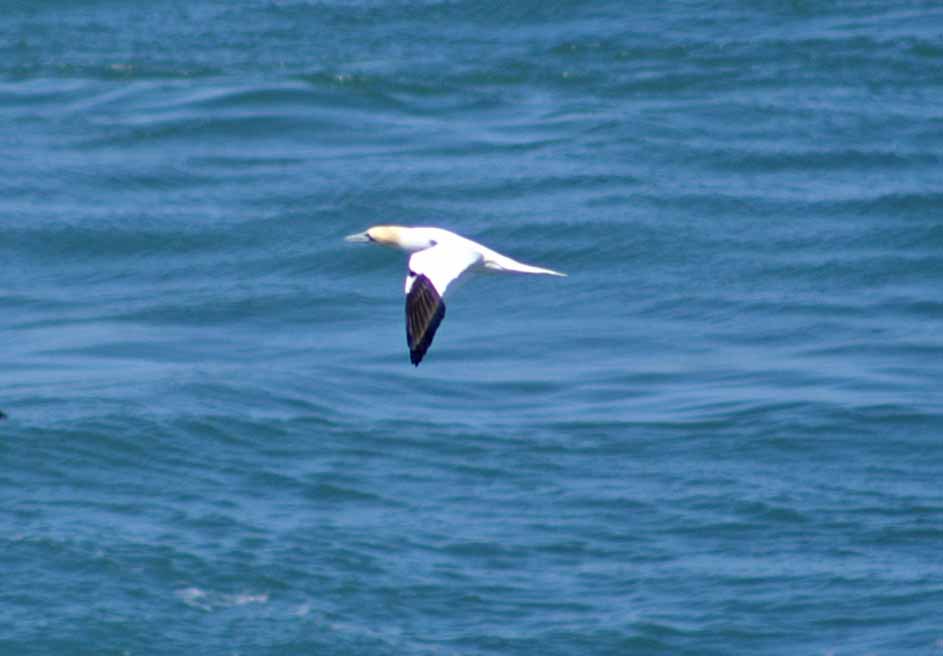
The island of Grassholm is occupied by an enormous colony of breeding Gannets (another highly recommended trip to take) and although it is 10 miles away from where we were today we kept a hopeful look out. We were rewarded with an initially distant sighting of a number of the birds circling and diving, but over the course of twenty minutes or so they gradually worked their way towards us, clearly following the progress of a shoal of fish. This is why the dolphins were there too. It would have been lovely to have had closer views, but both they and the birds were near enough to be seen well through binoculars.

One of a number of Gannets closely following a shoal of fish

The spot we had chosen to settle in seemed to be within the territory of a Pipit. He made several tours of the rocks immediately around us, making some rather disgruntled noises, clearly not happy with us, but otherwise undeterred by our presence.

I think this is a Meadow Pipit, but going on its location, it could be a Rock Pipit

The Pipit demonstrating his ‘parachuting’ display flight whilst singing

This is undoubtedly a tough environment for wildflowers, but there was thrift and sheep’s bit flowering and almost squashed into the short grass several tiny specimens of pretty blue spring squill.

There were bumblebees visiting most of the available flowers

Leaving our sheltered viewpoint we continued our walk around the remainder of the headland then cut back inland towards the car.

Rocky coves with sheltered beaches such as the one below the cliff here on the far side of the peninsular are perfect places to see grey seals and their pups. The land in the top right of the picture is the tip of Skomer.

Next on the agenda was to seek out another sheltered spot in which to eat our lunch. With hindsight we did consider that perhaps if we had not stopped at M & S in Haverfordwest for decent sarnies we may have squeezed onto that boat … ? (Normally we would have made our own, but pinned in by the tree we couldn’t get out to the shops yesterday and had no suitable supplies.) But, on the bright side,  it was more than pleasant here and we had had some very fresh air and some wonderful sights. We located another likely spot to enjoy our food in and settled down. We soon realised we were being watched; a baby bunny was peeking through the grass at the top of a sandy hillock close by that we could now see was above the entrance to a warren.

Baby rabbit on the roof of the family home

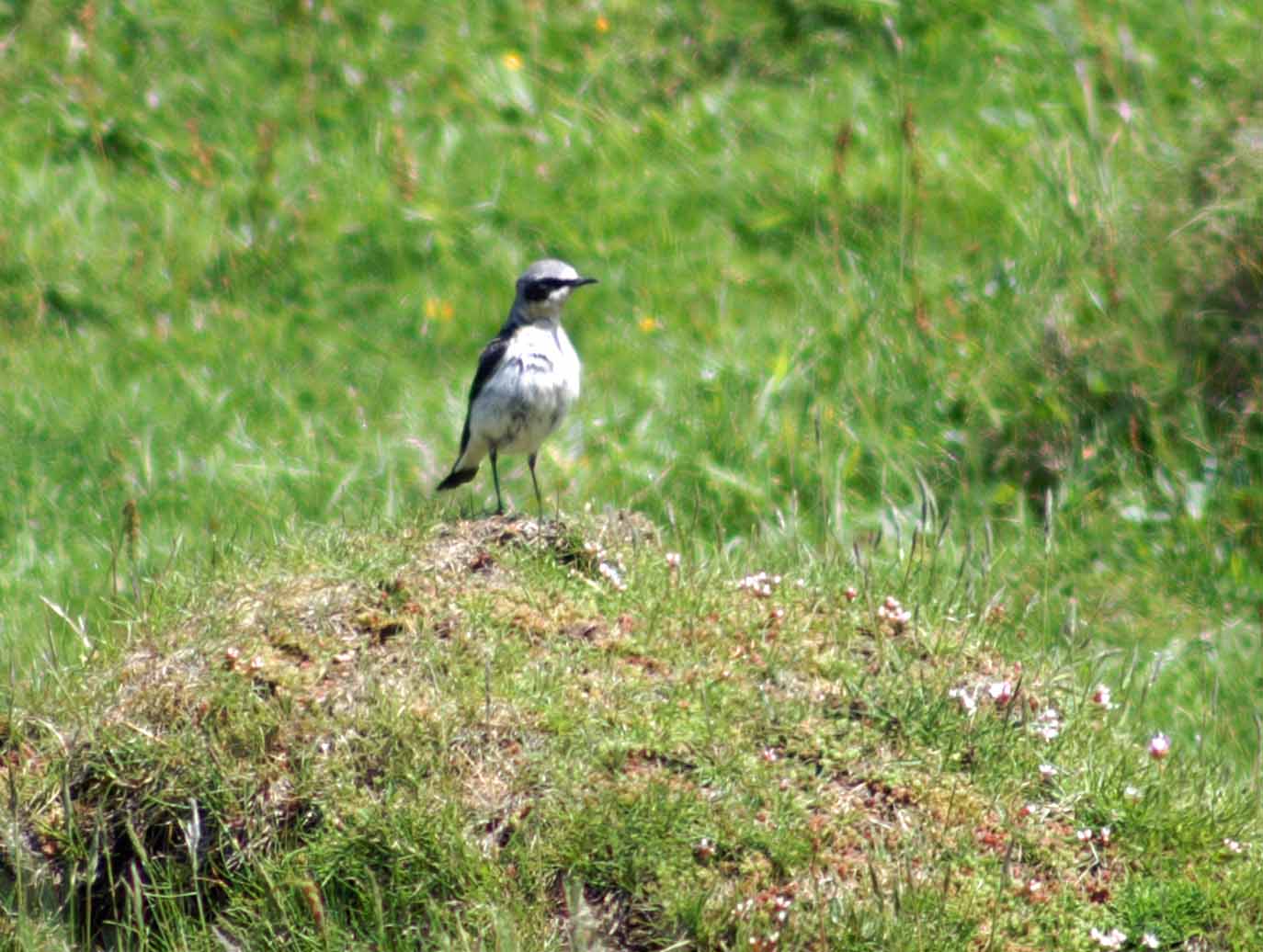
We were thoroughly enjoying our lunch sitting on a grassy bank in a warm and sunny spot, appreciating our beautiful surroundings and reviewing the wealth of sights we had enjoyed, when another bird appeared in front of us. This was a handsome jaunty male Wheatear and once again we seemed to have settled ourselves in the middle of his territory. He seemed to be making a point of travelling around us, settling on rabbit hills, brambles, rocks and the like. We did feel a little guilt but carried on enjoying the sight of him quietly, staying as still as is possible whilst yielding a hefty camera lens.

A female appeared too from the same direction and made a similar circuit, so we surmised that they had a nest located somewhere behind the bank occupied by the rabbits. Beautiful birds.

The very handsome male Wheatear asserting his territory from the top of a rabbit hill

The female Wheatear with her browner plumage is also a very attractive bird

Arriving back at the lane leading to the beach we headed for the loos to find there was an unusual queue to enter the building. A number of Barn Swallows were waiting for people to leave, taking their opportunities to swoop in to their nests built in various places inside.

One of a pair of Barn Swallows waiting to get into the toilet block and back to their nests

Although they are a familiar sight swooping and gliding over the countryside, it’s not often you get such close views of these elegant birds and to appreciate their very glossy plumage.

This bird was taking advantage of the waiting time to thoroughly preen its feathers

I was listening and watching for a sight of a Whitethroat, as we have always seen them here in the past, but not so today. As we made our way up the hill towards the car park we did see another Wheatear and had a quick glimpse of the back of a Dunnock singing from a bramble patch.

A quick glimpse of a Dunnock that was singing from a bramble patch

Not the outing we had planned, but a thoroughly enjoyable few hours spent in a beautiful place and still with a bit more to come….

Share this:

  • Share on Facebook (Opens in new window) Facebook
  • Share on Pinterest (Opens in new window) Pinterest
  • Share on X (Opens in new window) X
Like Loading...

Bird study: Blackcap

14 Monday May 2012

Posted by theresagreen in bird behaviour, Nature, nature of woodlands, nature photography, woodland birds

≈ 14 Comments

Tags

Blackcap, breeding warblers, Gibraltar, migrant birds, nature, sylvia atricapella, woodland birds

As soon as I heard the notes of its lovely melodious song, I knew I was looking out for a  blackcap amongst the trees growing by the river in Fairy Glen. Often singing from a perch in deep cover, I was quite surprised to find him quickly and easily, openly warbling from a branch in a smallish sycamore.

A blackcap singing beautifully from a tree next to the river, Fairy Glen

Blackcap– Sylvia atricapilla. The majority of  Northern European breeders winter in southern Europe and north Africa, where the local populations are resident. I enjoy the close company of these birds all round when in Spain as once established in a territory they tend to stay within it to live and breed.

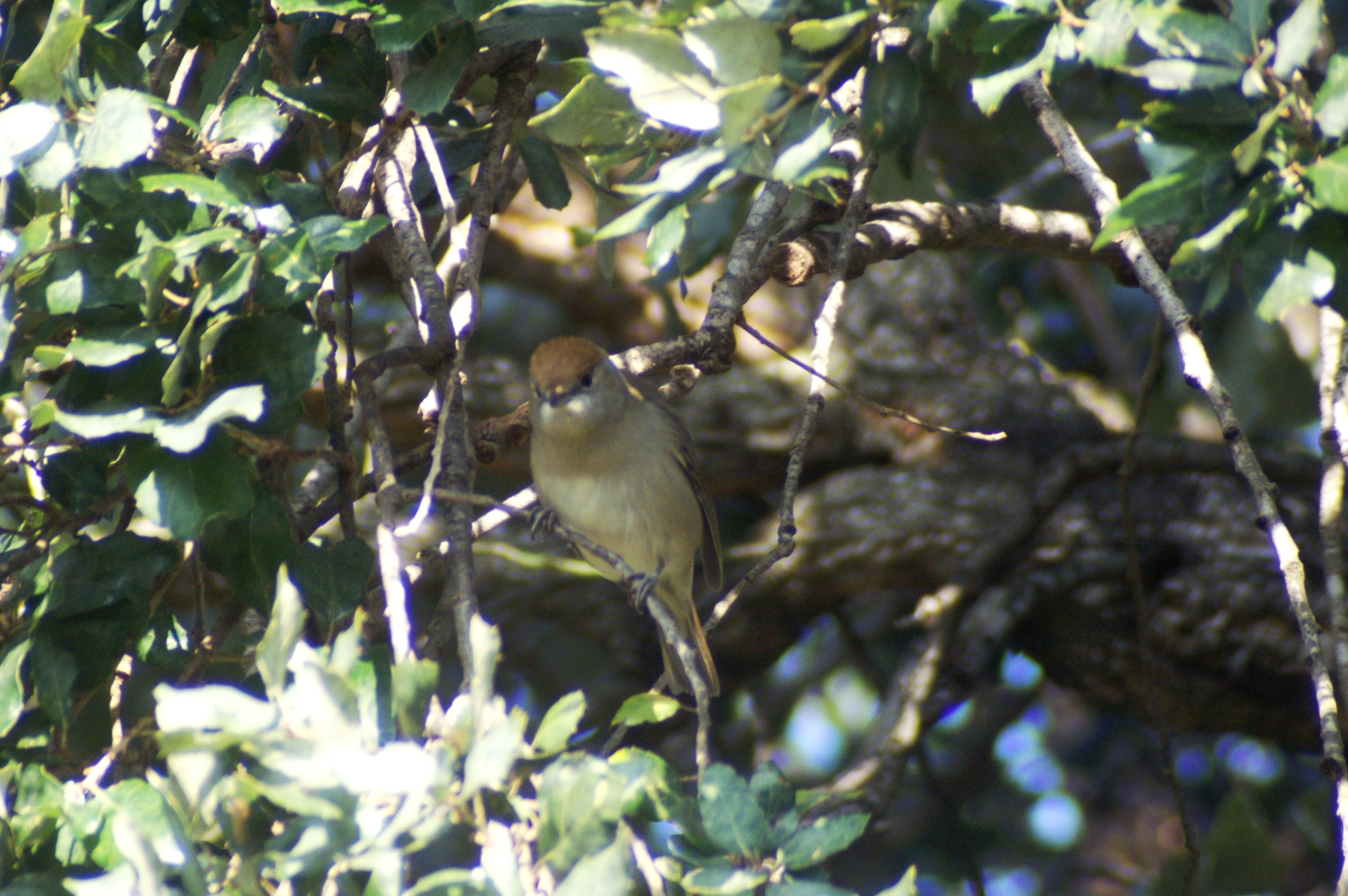
This must be one of the easiest species of British breeding warblers to identify due to their distinctive caps; this is glossy black in the male but rusty red-brown in the female, so as usual the male gets precedence in the naming; even the latin ‘atricapilla‘ translates as black-haired. The birds’ upper parts are grey-olive brown and the underparts are a paler grey-buff. The other main distinguishing feature is its lovely clear melodious song which brought about its reputation in Britain as the ‘northern nightingale’.

The majority of  blackcaps we hear and see in Britain are summer visitors that arrive during April to breed in most parts of England and Wales, with sparser numbers venturing into Scotland and Ireland, then leaving again in October. (Although it has been recorded that blackcaps from Germany and north-east Europe are increasingly spending the winter in the UK, mainly in England.)

In common with other warbler species, other than when the male is singing, they may be difficult to spot as in general they spend much of their time hidden amongst shrubs and bushes within which they forage for food. When changing location they emerge abruptly from the cover of one bush and make a short, low jerky flight to another. Their presence is often given away by their call-notes, a rather harsh ‘churr’, also used as a contact call between a pair or parent and young and an excited ‘tac-tac’ rapidly repeated if the bird is alarmed.

A female in a cork oak tree in the garden in Sotogrande,Spain

Blackcaps nest in woods, on heaths and sometimes gardens where there is a good density of undergrowth or coarse vegetation within which to build their nest and to ensure a reliable supply of food. The nest is a surprisingly frail construction for such a sturdy bird; built mainly by the hen of dried grass and lined with hair and other fine material, it is attached to the surrounding vegetation with ‘basket handles’. Both parents  will incubate the eggs and both will also feed the nestlings.

Caps of young birds begin brown as those of the female, males gradually turn black. Plant is American poke-weed, blackcaps love feasting on its ripe berries. Sotogrande, Spain.

The Blackcap is hardier than most other warblers, partly because of its adaptation to a more variable diet. Food is mostly flies, caterpillars and other insects, but they also avidly consume a wide variety of  fruit and berries as and when it beomes available.

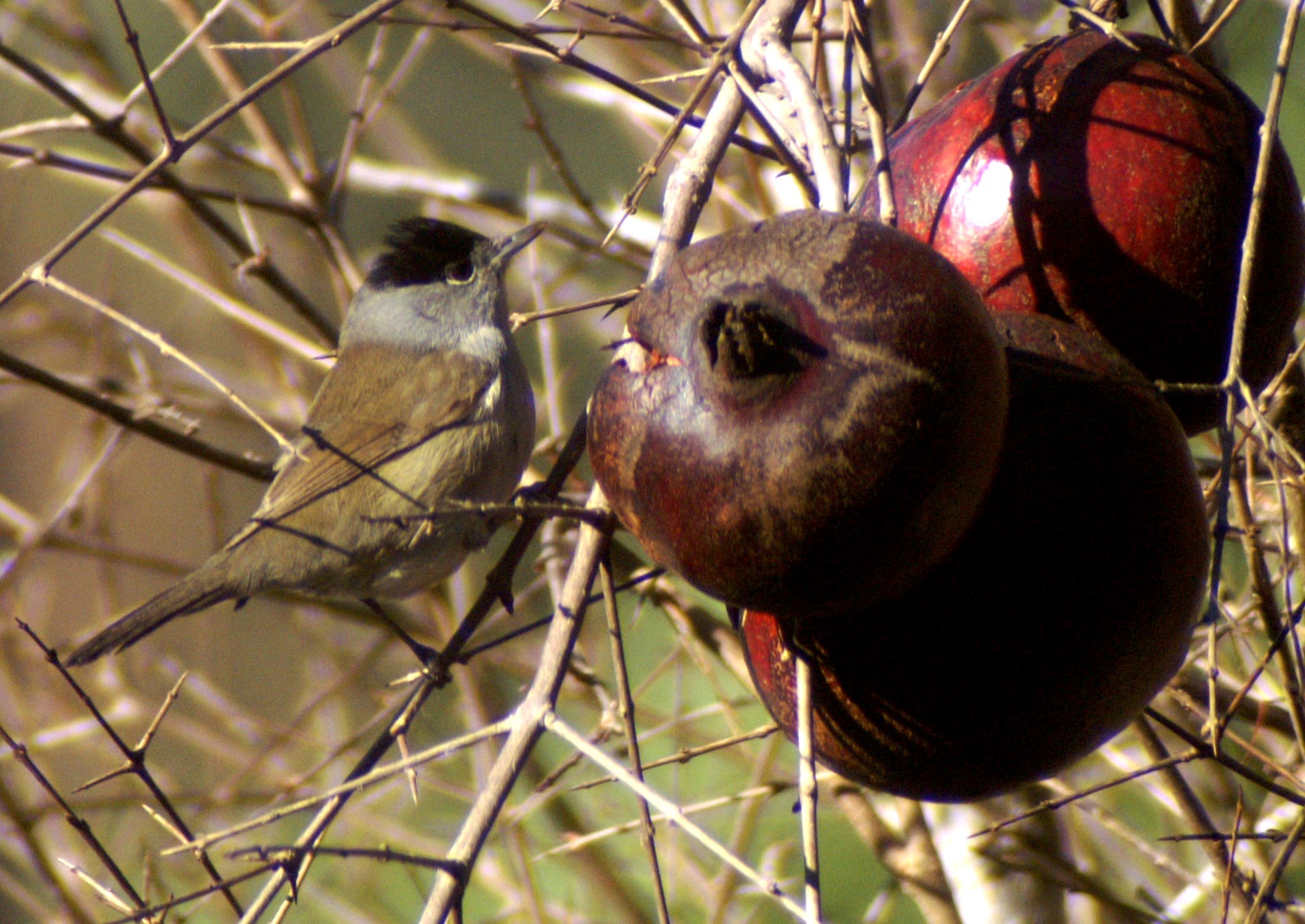
The blackcaps wait for the pomegranate fruit to ripen and split then gorge themselves on the fleshy seeds until all that remains is the husk. Sotogrande, Spain

20/2/10-Feasting on nectar from aloes growing in the garden, Sotogrande, Spain

The Blackcap in other countries

Gibraltar – where they count and ring them on migration…

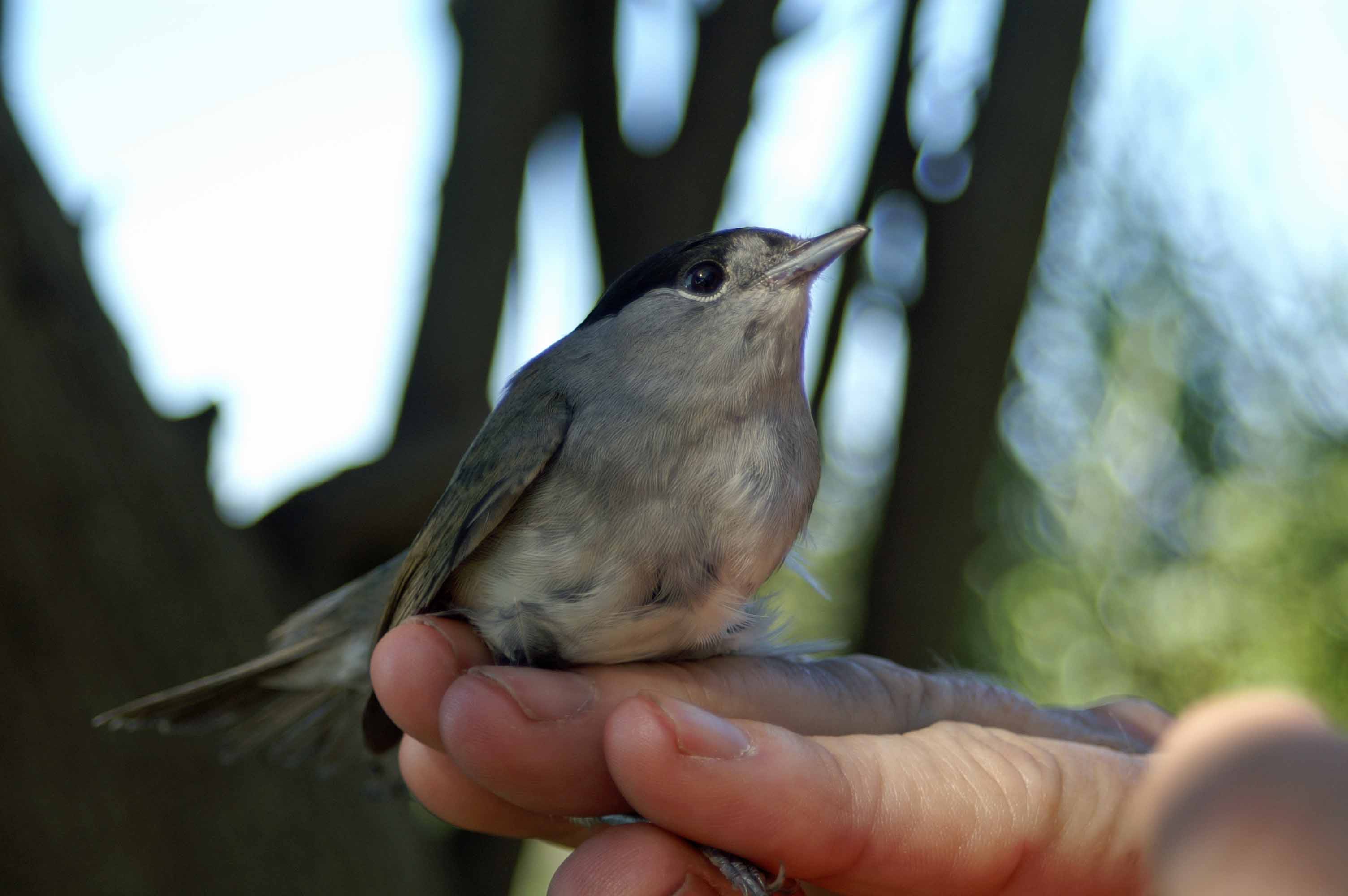
21/10/11-A very healthy blackcap enroute to Africa, ringed, weighed and measured and about to be released

Cyprus – where they eat them ….

The blackcap has been considered a culinary delicacy from the Middle Ages and to this date thousands of them fall victim to the lime-sticks set out by the villagers. John Locke, an Englishman who visited the island in 1553, makes the first reference to the trade in pickled or marinated “Becaficoes”, which was well established even in those days; he adds that “they annually send almost 1200 jarres of pots to Venice”. Many subsequent writers refer to this article of diet, still a favorite dainty. In 1576, the well educated traveller Porcacchi notes:… “there are birds of all kinds: in most esteem are those found nowhere else as certain little birds called vine-birds”. Keeping an itinerary of his visit to Cyprus between September 1598 and March 1599, Ioannes Cotovicus, a Professor at the University of Utrecht writes about the famous birds: “Infinite numbers of them are preserved in jars with vinegar and savory herbs and sent for (950 725 B.C.) Cyprus Museum sale to Venice, making a dainty dish greatly in request with princes and lords throughout Italy”. Later on, Pietro Della Valle recording his visit to Ayia Napa in September 1625 writes: “We found and ate in this place a large quantity of beccafichi, called by the Greeks sykalidia which at this season are caught in such abundance that besides the numbers that are consumed in the island itself, thousands are exported in vinegar to Venice and elsewhere” (Excerpta Cypria, pages 72, 166, 200, 213).

Over the last years the number of blackcaps has dropped dramatically, as they keep falling prey of lime-sticks or nets.

http://www.kypros.org/Cyprus/cap.html

Finland – where they are celebrated in poetry ….

The official song: Sylvia´s song

Once upon a time, a poet spent his summer at the beautiful Franssila manor in Kangasala, Finland. Sitting on the veranda, he heard a small bird sing. It was the blackcap (Sylvia atricapilla) that inspired Zachary Tope-lius, the poet and writer of children´s fiction, to write the poem “Sylvia´s son”, known today as “A Summer´s Day in Kangasala”. Put to music, the poem became Finland´s best-loved song and choral work and the official song of the Tampere Region. The “Harjula Ridge” of the song is today´s Haralanharju, a place of pilgrimage for every lover of scenic beauty. http://www.pirkanmaa.fi/en/tampere-region/emblems-tampere-region

Share this:

  • Share on Facebook (Opens in new window) Facebook
  • Share on Pinterest (Opens in new window) Pinterest
  • Share on X (Opens in new window) X
Like Loading...

Bird study : A Chiffchaff’s year

26 Thursday Apr 2012

Posted by theresagreen in Nature, nature of woodlands, nature photography, woodland birds

≈ 5 Comments

Tags

birds singing, Chiffchaff, Fairy Glen, Gibraltar, migrant birds, migrant birds, Phylloscopus collybita, warblers

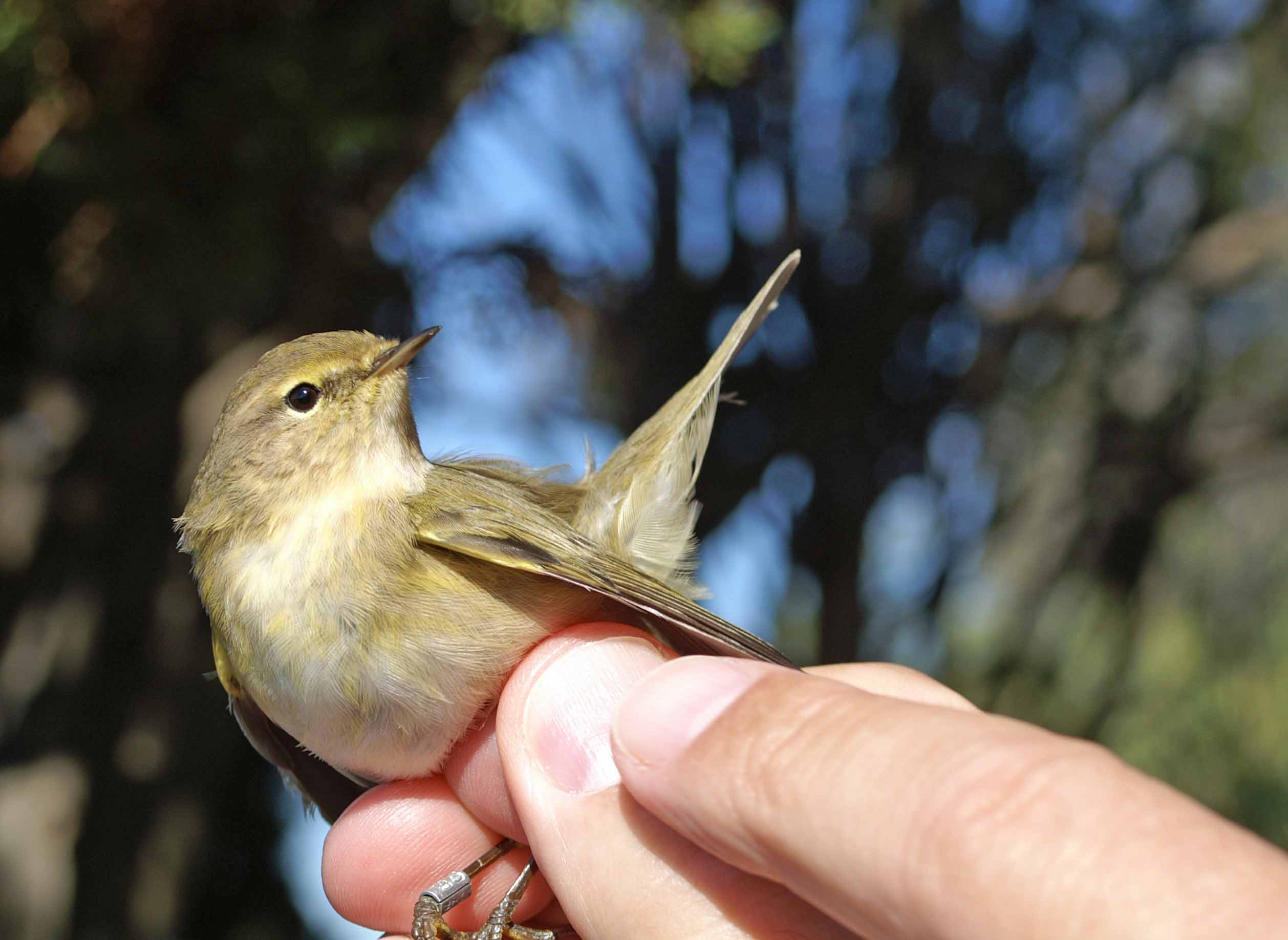
I spotted my first returned migrant Chiffchaff of this year about three weeks ago, flitting about in low vegetation by the side of the river Colwyn. Since then I have heard the unmistakeable call several times in various places, but didn’t have a good sighting of one until last Thursday in the Fairy Glen. They may not be the most colourful or tuneful of our woodland birds, but their return and the sound of their repetitive and cheerful chiff-chaff  is, for many of us, confirmation that spring has truly arrived.

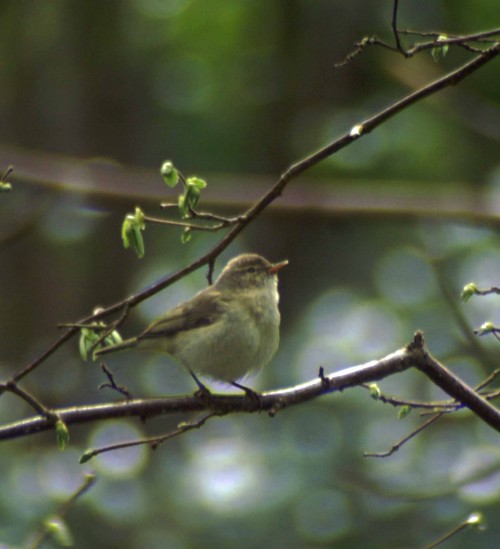
19/4/12 -Chiffchaff singing. The song is unmistakeable, a cheerful repetitive chiff-chaff. Call is a short 'hweet'.

The Chiffchaff, or Common Chiffchaff (Phylloscopus collybita) is a common and widespread leaf-warbler which breeds in open woodlands throughout northern and temperate Europe and Asia.

April to August – North Wales

Chiffchaffs are insect eaters, so most of the chiffchaffs we see in Britain are migratory, arriving here during late March and April, remaining throughout the spring and summer to breed, then leaving in late August/September to winter in the warmer locations of southern and western Europe, southern Asia and north Africa.

The chiffchaff is a small bird with olive green/brown upperparts, buff/off-white underparts becoming yellowish on the flanks and an off-white supercilium (eye-stripe). The beak is fine, generally dark and legs are always dark-coloured.

Habitat and breeding

The male Chiffchaff returns to his breeding territory two or three weeks before the female and immediately starts singing to establish ownership and attract a female. When a likely female is located, the male shows off his considerable aeronautical techniques, performing a slow butterfly-like flight as part of the courtship ritual. It is considered unlikely that chiffchaff select the same mate more than once, even though males and females return to the same areas each spring; but once a pair-bond has been established, any other females will be driven from the territory.

The birds’  favoured breeding habitat is open woodland with some taller trees and ground cover for nesting purposes. The preferred trees are typically at least 5 metres (16 ft) high and have an undergrowth that is an open, but consisting of a poor to  medium somewhat scrubby mix of grasses, bracken, nettles or similar plants.

The construction of the nest is carried out by the female who selects a site on or near the ground that is concealed amongst brambles, nettles or  other dense, low-growing vegetation. The outer layers of the nest are constructed from coarse materials such as dried grasses and leaves with inner layers woven of finer materials and finally an insulating layer of feathers. The nest is built in a domed shape with a side entrance and is typically 12.5 centimetres (5 in) high and 11 centimetres (4 in) across.

The male has little involvement in the nesting process, but he becomes  highly territorial during the breeding season and will fiercely defend his space against other males. Inquisitive and fearless, the feisty little male has been known to attack  even dangerous predators such as the stoat if they approach the nest, as well as large and notorious avian egg-thieves such as magpies and jays.

The chiffchaff is insectivorous, moving restlessly though foliage, constantly flicking the wings and tail, occasionally darting out to take insects on the wing. Its diet consists mainly of flies, along with other small and medium-sized invertebrates. It will take the eggs and larvae of butterflies and moths, particularly those of the Winter Moth.

After breeding has finished, this species abandons its territory, and may join small flocks including other warblers prior to migration. At this time the birds also go through a  prolonged and complete moult.  A newly fledged juvenile is browner above than the adult, with yellow-white underparts, but moults about 10 weeks after acquiring its first plumage. After moulting, both the adult and the juvenile have brighter and greener upperparts and a paler supercilium.

Etymology

The bird’s common English name is onomatopoeic, derived  from its simple and distinctive ‘chiff-chaff’  song. The Welsh common name is very similar, being ‘siff-saff’.

The binomial name, Phylloscopus collybita, is of Greek origin; Phylloscopus comes from phyllon, translating as ‘leaf’ , and skopeo ‘to look at’ or ‘to see’, presumably referring to the fact that the species spends most of their time feeding in trees, where they pick insects from leaves: collybita is a corruption of kollubistes, or ‘money changer’, with the song being likened to the jingling of coins.

September to March – Southern Spain

Although there is an increasing tendency amongst the species to winter in western Europe, well north of the traditional areas, especially in coastal southern England and the mild urban microclimate of London, the majority of chiffchaff  breeding in northern Europe migrate to the warmer climes of western and southern Europe, southern Asia and north Africa.

One of the joys of living in the south of Spain is to have the privilege of the company of some of the migratory bird species that breed in the north of the continent at the other end of their journey, during the autumn and winter months. Chiffchaff are one such species, arriving in great numbers from around the middle of September. Many are just passing through on their way to north Africa, pausing in their journey to take advantage of local feeding opportunities, but for others the area is their winter home and they can regularly be spotted in a wide range of habitats from gardens and woodland to reedbeds, scrubland and even on beaches where they are backed by  vegetation.

11/9/06-Chiffchaff on fennel plant picking off small insects; Manilva, Southern Spain

The appearance of newly arrived individuals often varies considerably; some have noticeably more yellow in their colouration, particularly in the underparts, but in general all appear sleek and well-fed.

October 09-A chiffchaff, most likely a juvenile. My garden, Sotogrande, Southern Spain

The behaviour of the birds outside the pressurised breeding season is quite different; in my garden they will readily leave the trees and cover of shrubs, venturing down  to pursue insects at ground-level. This is delightful to watch as they skip and flutter across the grass in an almost butterfly-like manner.

November - A particularly 'yellow' chiffchaff on the lawn in my Spanish garden

I have also been entertained by as many as 9 or 10 of the little birds at once that have perched on palm leaves then launched themselves off to pursue insects demonstrating their considerable aeronautical skills. Clouds of gnats are another target for them and they fly at the tightly packed circling insects, hovering in the air to pick them off.

They are keen bathers too, regularly using the bird bath in the garden as well as any available puddles. In shallow water they drench themselves, flicking and fluttering wings and tail, but if the water is too deep for them they flutter delicately across the surface, splashing themselves as best as they can. After their ablutions they sit on a nearby perch to dry themselves and preen meticulously.

30/1/08-Chiffchaff come to the birdbath regularly to drink and to bathe; Sotogrande, Spain

The local reserve, where an extensive reedbed backs the beach, is always  popular with chiffchaff . Many roost here amongst the reeds and use the area as a ‘staging post’ before making the relatively short flight across to North Africa. It is impossible to tell whether the birds you see regularly are on passage or here for the winter, but the spots I see them in are pretty consistent.

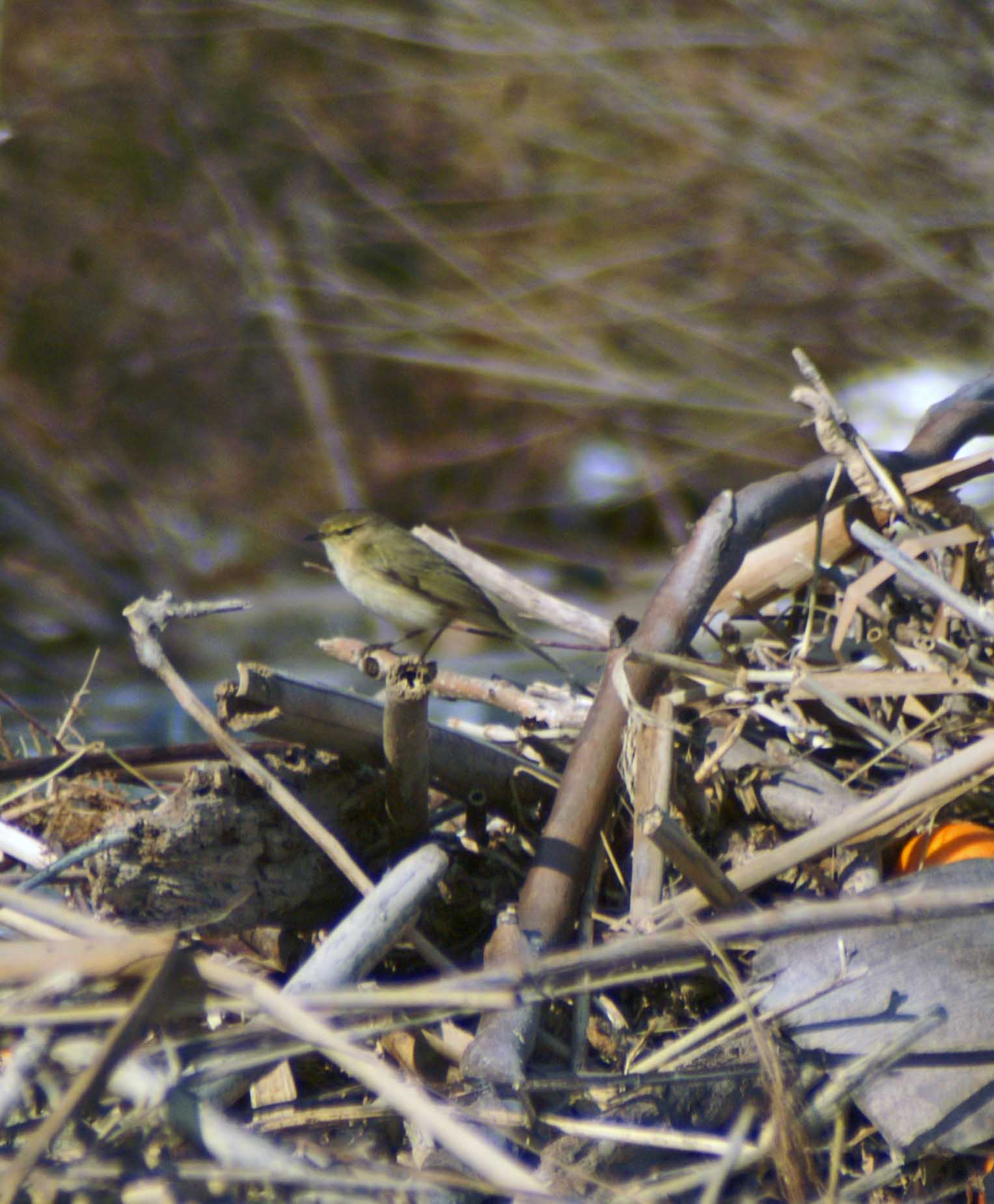
1/1/08 - Chiffchaff on Sotogrande beach, perched on debris washed up by a winter storm

Migration

The flow of migration is spread throughout the autumn months as birds in no particular hurry take feeding opportunities as and when they are presented along their route. Many of the birds leaving northern Europe at the end of August or beginning of September may not make the crossing to North Africa until November. Chiffchaff are amongst the most numerous birds to be caught and logged by ringers working at the bird observatory on the Rock of Gibraltar. The majority of those crossing the Strait to Africa on this route will have originated in Scandinavia, with maybe a few from Great Britain.

311011-A newly-ringed chiffchaff about to be released-bird observatory, Gibraltar

The return migration begins as early as January – the following is an extract from the gonhs recent records:

18 Jan:  After a few days with some heavy rain showers the weather cleared a bit but temperatures had dropped substantially and an influx of Chiffchaffs arrived on the Rock with many birds seen in the Botanic Gardens feeding on the nectar of flowering Aloes.

Iberian Chiffchaff

It would be remiss of me not to mention that Spain is also home to a similar but distinct species of chiffchaff, the Iberian Chiffchaff. This species breeds in Iberia and has been noted quite frequently on our outings with the Gibraltar Ornithological & Natural History Society, although most of us would confess that recognition is mostly on song and  known breeding areas.

P. ibericus, the Iberian Chiffchaff is brighter, greener on the rump, and yellower below than P. collybita and has a tit-tit-tit-tswee-tswee song.  This species is found in Portugal and Spain, west of a line stretching roughly from the western Pyrenees via the mountains of central Spain to the Mediterranean; the Iberian and Common Chiffchaffs co-occur in a narrow band along this line. Apart from the northernmost section, the precise course of the contact zone is not well documented. A long-distance migrant, this species winters in western Africa. It differs from P. c. collybita in vocalisations, external morphology, and mtDNA sequences. There is hybridization in the contact zone, almost always between male P. ibericus and female P. c. collybita, and hybrids apparently show much decreased fitness; hybrid females appear to be sterile according to Haldane’s Rule. Regarding the latter aspect, it is interesting to note that the Iberian Chiffchaff apparently is the oldest lineage of chiffchaffs and quite distinct from the Common Chiffchaff.(extract from wikipedia)
Share this:

  • Share on Facebook (Opens in new window) Facebook
  • Share on Pinterest (Opens in new window) Pinterest
  • Share on X (Opens in new window) X
Like Loading...

Fairy Glen Friday

07 Saturday Apr 2012

Posted by theresagreen in Local Nature Reserves, Nature, nature of woodlands, nature photography, woodland birds

≈ 2 Comments

Tags

bluebell, chaffinch, Fairy Glen, grey wagtail, long-tailed tit, nesting birds, ramsons, river Colwyn, spring flowers, woodland flowers, woodland walk

Friday seems to have become my day for a walk around the Local Nature Reserve of Fairy Glen, Old Colwyn. It is just a short walk from my current workplace, the busy post office, and very handy for an hour of fresh air and a chance to catch up with the progress of the season. The following pictures are those I took on the last Friday of March in less than an hour.

Bluebells are beginning to open

The wild garlic, or ramsons, is also showing one or two blooms

The horse chestnut leaves have grown significantly since last Friday and there are already flower buds appearing

It was quite a dull, cool day compared with last Friday and shady in the woodland. I didn’t have very long to linger, so I headed straight for the sycamore tree where the nuthatch and  blue tit pairs are nesting. I was hoping to get some better views of a nuthatch, but although I could hear the male’s distinctive calling from close by and followed his movements through the trees, he stayed away from the actual nest site. However, the blue tits were working hard furnishing the nest box and I had some lovely views of them both with beaks stuffed with moss.

The blue tit was waiting to carry material into the nest box

I carried on along the path, watching out for great tits, a species that I have heard calling and singing and seen here, but that continues to elude my camera. There was a pair flitting about in the trees and shrubbery close to the path, but they don’t stay still or visible for long. I did manage to get a quick shot of the male which is not great but included for the record.

The male great tit has a much broader black breast stripe than the female

Following after the great tits I stepped off the path a short way and caught a glimpse of bird in a tangle of brambles that turned out to be a male blackcap, yet another species to add to the list for this small area of woodland. He disappeared very quickly and quietly, but then I realised there was another bird in there too, a single long-tailed tit. As I stood watching it emerged from its cover and spent quite a few minutes foraging around the twiggy branches of a nearby small tree, allowing me some lovely close views.

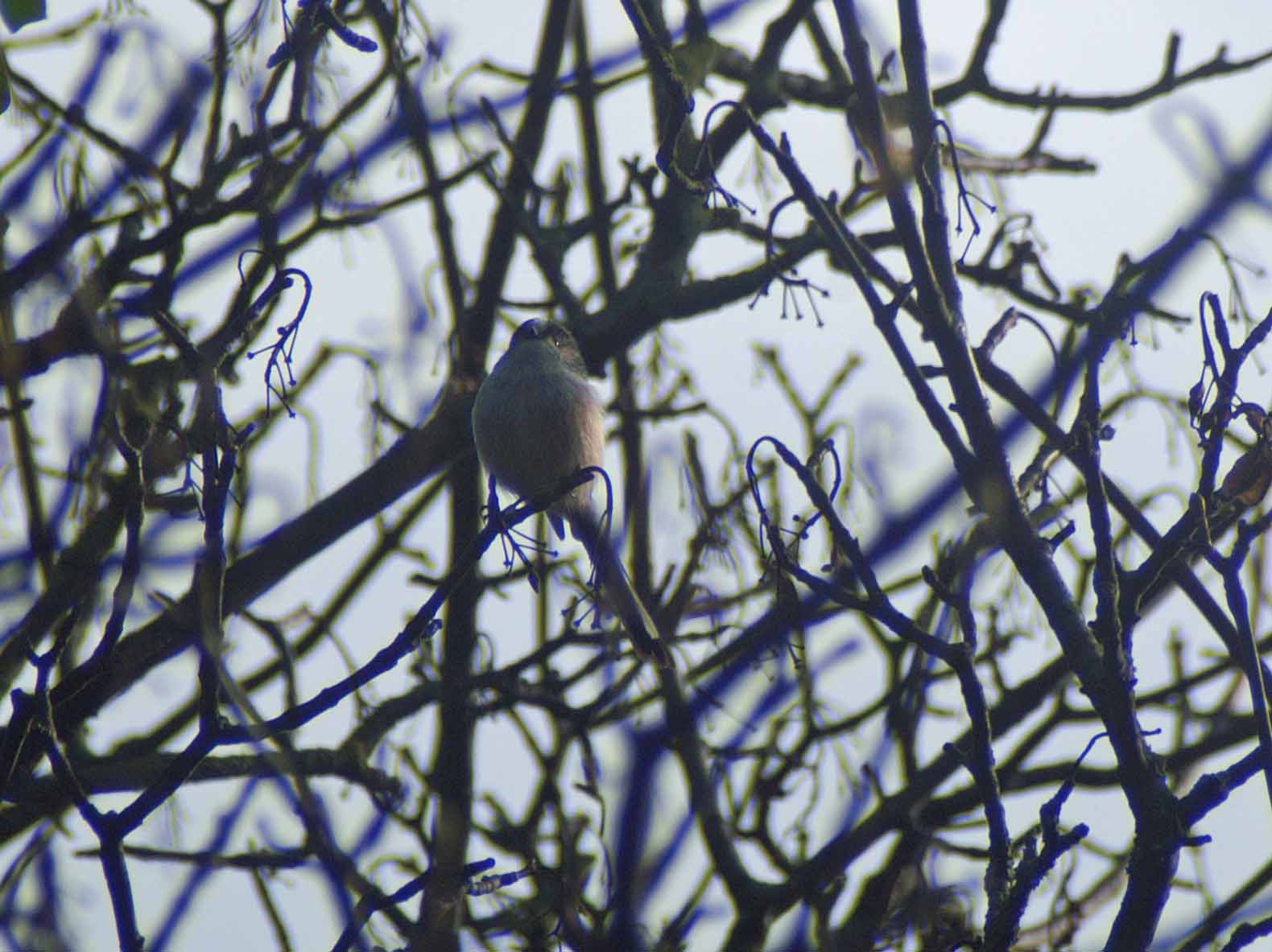
Long-tailed tit, front view

Long-tailed tit from the back

A privileged view of a lovely bird. Long-tailed Tit – Aegithalos cordatus

The recent dry and warm weather has been a treat, but the effect of lack of rainfall is very evident in the current shallowness of the river. I wandered along the path,  lost in contemplation about water levels and was taken completely by surprise when, rounding a bend I spotted a pair of grey wagtails hunting in the shallow water. I have  no idea if this was the same pair that I have seen lower downstream, although I suspect it may be. I watched them flitting gracefully over the water, balancing on small rocks and darting out to chase flies, flashing their yellow underparts as they lived up to their name, wagging their long tails. A man and a dog finally disturbed them and they flew up into  nearby trees before heading back downstream.

Male grey wagtail showing a small amount of black around the throat area

Where the kingcups are  growing there is now also a large clump of  yellow flowered arum. This is an exotic plant of South African origin, but clearly flourishing in the boggy ground of this part of the riverbank.

An arum with large leaves and a yellow sheath; this is Lysichiton americanus

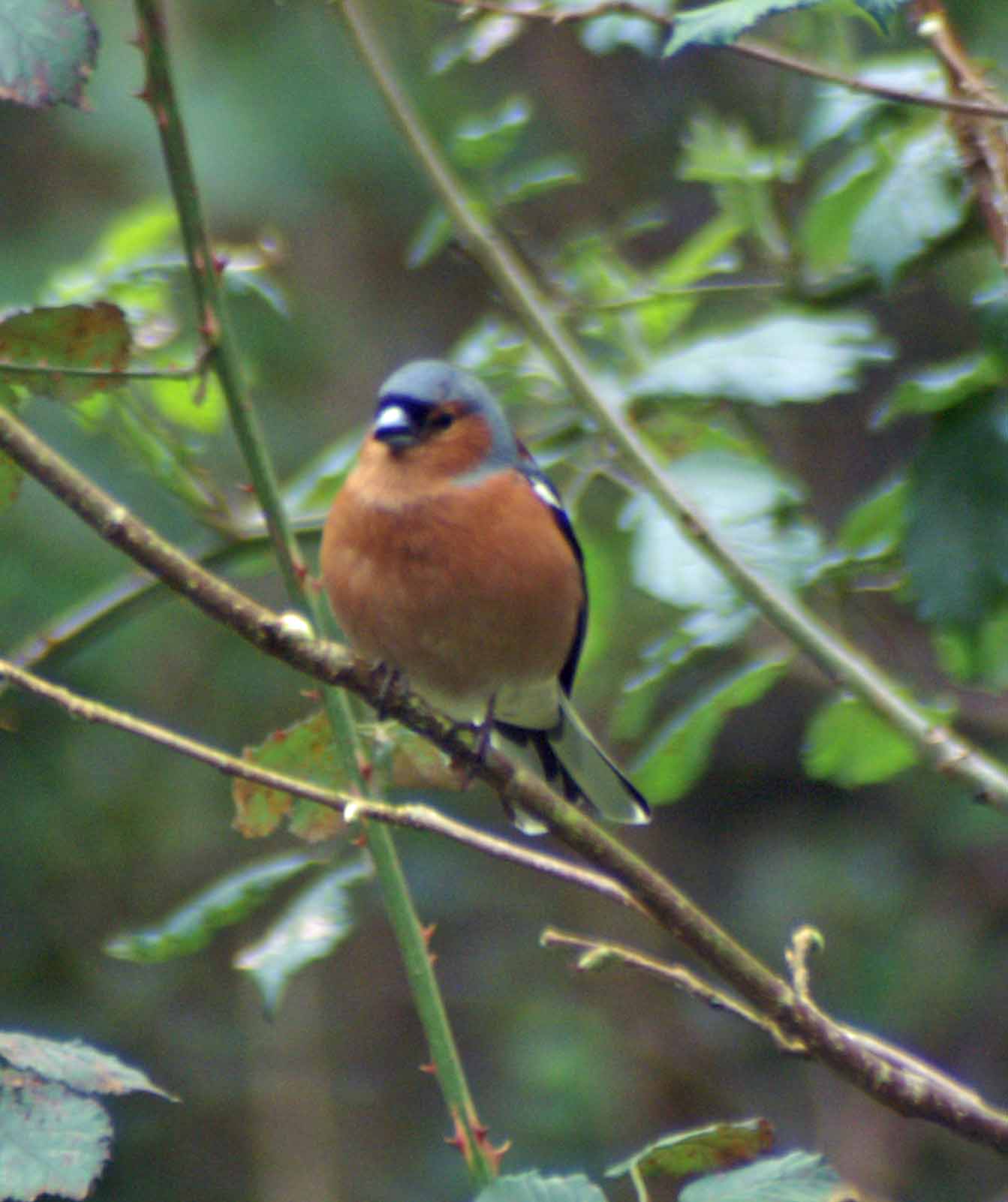
Close by I watched a male chaffinch hunting around an area of shallow water that then flew up into some twiggy shrubbery overhanging the water. He was gorgeous, plump and healthy and with a shiny beak and strong vibrant colours.

A colourful male chaffinch that was foraging on the riverbank before flying up onto a low shrub

The vibrantly coloured chaffinch from the front. Chaffinch – fringilla coelebs; the ‘coelebs’ translates as ‘bachelor bird’.

Further along the path I stopped to watch a subduedly plumaged female chaffinch searching the ground for nesting material. She picked up what I think may be strands of dog hair; holding them in her beak she flew up to a tree branch away from me.

The female Chaffinch is much more subtle in her appearance

Share this:

  • Share on Facebook (Opens in new window) Facebook
  • Share on Pinterest (Opens in new window) Pinterest
  • Share on X (Opens in new window) X
Like Loading...

Farmland fields,rooks, ducks & waders

20 Tuesday Mar 2012

Posted by theresagreen in Nature, nature photography, wading birds

≈ 5 Comments

Tags

corvus frugilegus, pochard, rhos on sea, rook

On a recent drive back from the supermarket in Llandudno. It was a lovely sunny afternoon and the countryside looked so beautiful I made a couple of stops to take these photographs. I love this time of year when the shape and structure of the fields and the architecture of the trees and hedgerows is visible and highlighted by the bright sunlight.

There is a rookery located in a stand of  trees close to the road I was driving along; rooks are early nesters, sometimes having eggs in the nests by the end of February. I was hoping to get a couple of  pictures that would show them in some detail to compare against the related carrion crow, but although there were plenty about they were all either  flying or  foraging in the nearby fields.

Three Rooks flying contrasted against a white cloud

Rook – Corvus frugilegus. The species name frugilegus is Latin for “food-gathering”. The adult rook is the only large black bird with a bare grey/white face patch. They can be told from the similar-looking Carrion Crow by the purplish gloss to its  plumage and the baggy appearance of the thigh feathers.

The UK has the largest population of rooks in Europe. They are gregarious throughout the year, characteristically nesting communally in the tops of trees in ‘rookeries’ and collectively known as a ‘parliament’. Nests are built from twigs freshly picked by industrious individuals and are very likely to be plundered by unscrupulous neighbours. There is a distinct ‘pecking order’ in the community; the oldest bird lives at the centre of the rookery, best protected and sheltered from the wind. When the flock is feeding, rook sentries are posted to warn the others when danger threatens.

In folklore they are reputed to be able to predict the weather; rooks feeding in village streets or close to nests in the morning means inclement weather is to come – usually storms or rain. Conversely, rooks flying far from their nest means fair weather.

The presence of a rookery on your land is considered to be lucky in many parts of the country and that should the birds decide to abandon the rookery ill-fortune would befall the family. Rooks used to be told of a landowner’s death. The new landowner would stand under a rookery and give the news, usually adding the promise that only he and his friends would be allowed to shoot the birds in future. If he neglected the ceremony, the birds would desert the rookery – an evil omen in itself. This forecast the loss of the land and downfall of the family through poverty.

A Rook & a wing tip

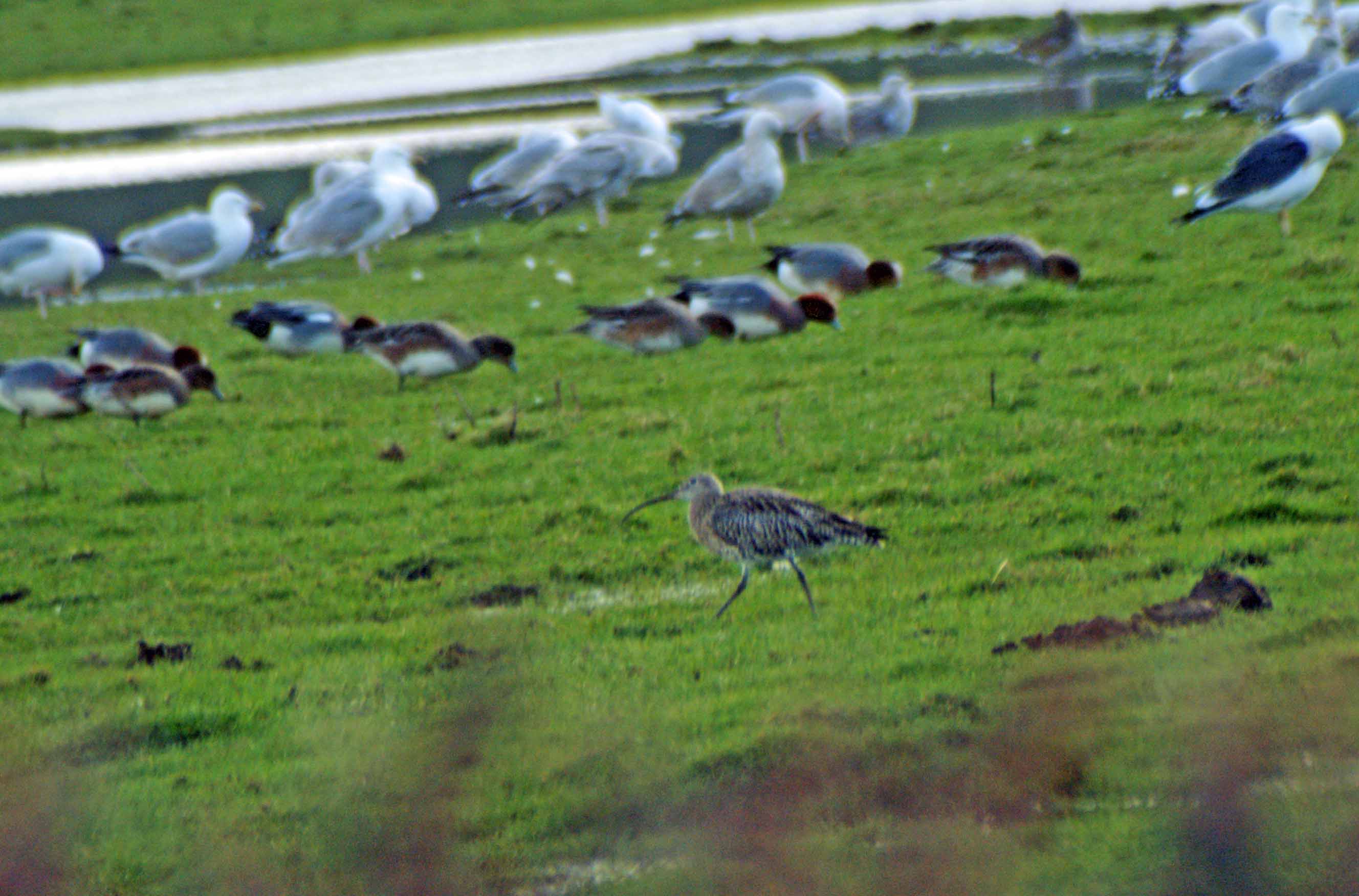
Passing by the  field the curlew occupy I noticed a number of ducks on the water that pools there when it rains. As I already mentioned, it was a very bright sunny day and unfortunately the only vantage point I had from which to photograph the birds involved shooting into the sunlight, rarely a good move, but I wanted to record the sightings. I thought the ducks were Pochard, but could not really see properly. As I watched they left the water and began moving over the grass, heads and beaks down, almost perfectly synchronised. I’m not great at duck identification, so if anyone can tell better  from my rather blurry image that they are not pochard, please let me know.

The field opposite the golf course, Llandudno Rd. Herring gulls, Lesser Black-backed gull, grazing Pochard & a Curlew

I had no problem identifying the male shelduck there all alone.

a single male Shelduck making for the water

Redshank

Share this:

  • Share on Facebook (Opens in new window) Facebook
  • Share on Pinterest (Opens in new window) Pinterest
  • Share on X (Opens in new window) X
Like Loading...

Bryn Euryn in preparation for Spring

12 Monday Mar 2012

Posted by theresagreen in Local Nature Reserves, Nature, nature of woodlands, nature photography, woodland birds

≈ 1 Comment

Tags

Bryn Euryn Nature Reserve, catkins, dunnock, long-tailed tit, pussy willow, Robin, treecreeper

I hadn’t visited the Bryn Euryn Local Nature Reserve for quite some time and thought I would rectify that last weekend. The morning weather had been varying between sunshine and showers, and arriving at the site during a sunny spell I  walked first around the edge of the small quarry field to see what was growing there.

Lush growth of leaves of Arum maculatum -cuckoo pint, or lords & ladies

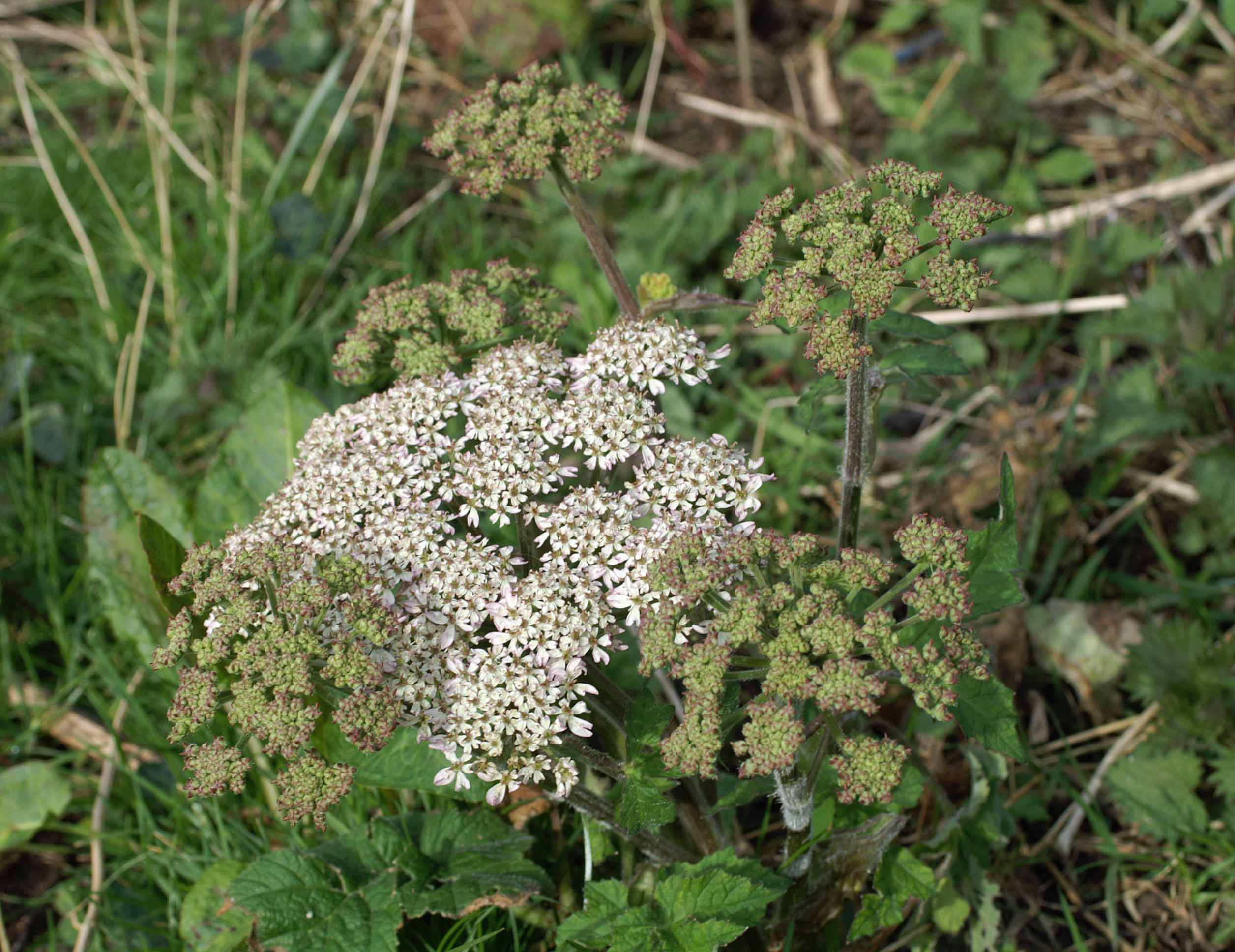
A very early flowering specimen of Heracleum sphondylium - common hogweed or cow parsnip. This is a herbaceous perennial or biennial belonging to the family Apiaceae. It is an umbelliferous plant, in the same group as fennel, cow parsley, ground elder and giant hogweed.

Dry seed heads of burdock

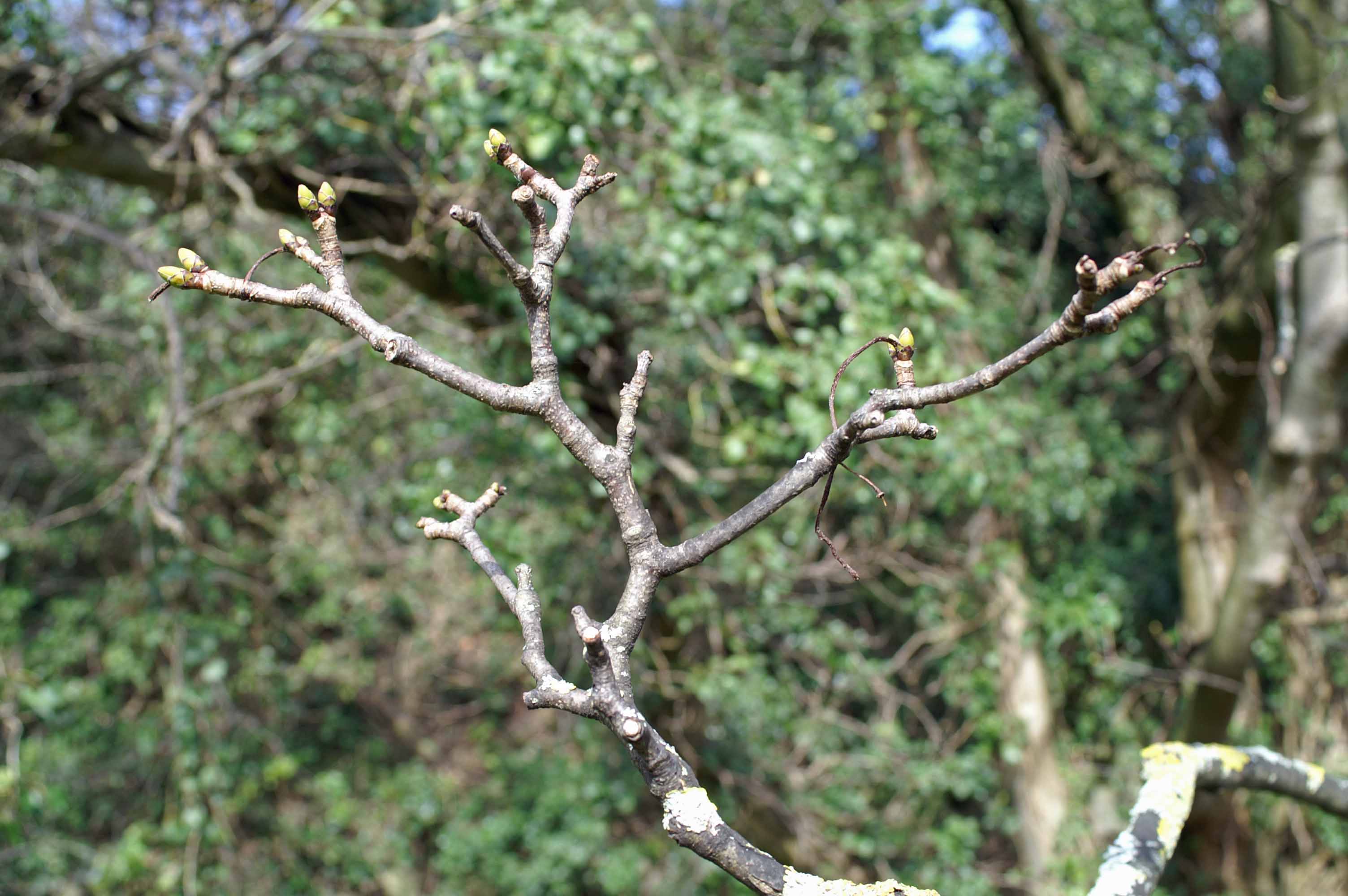
Swelling leaf buds

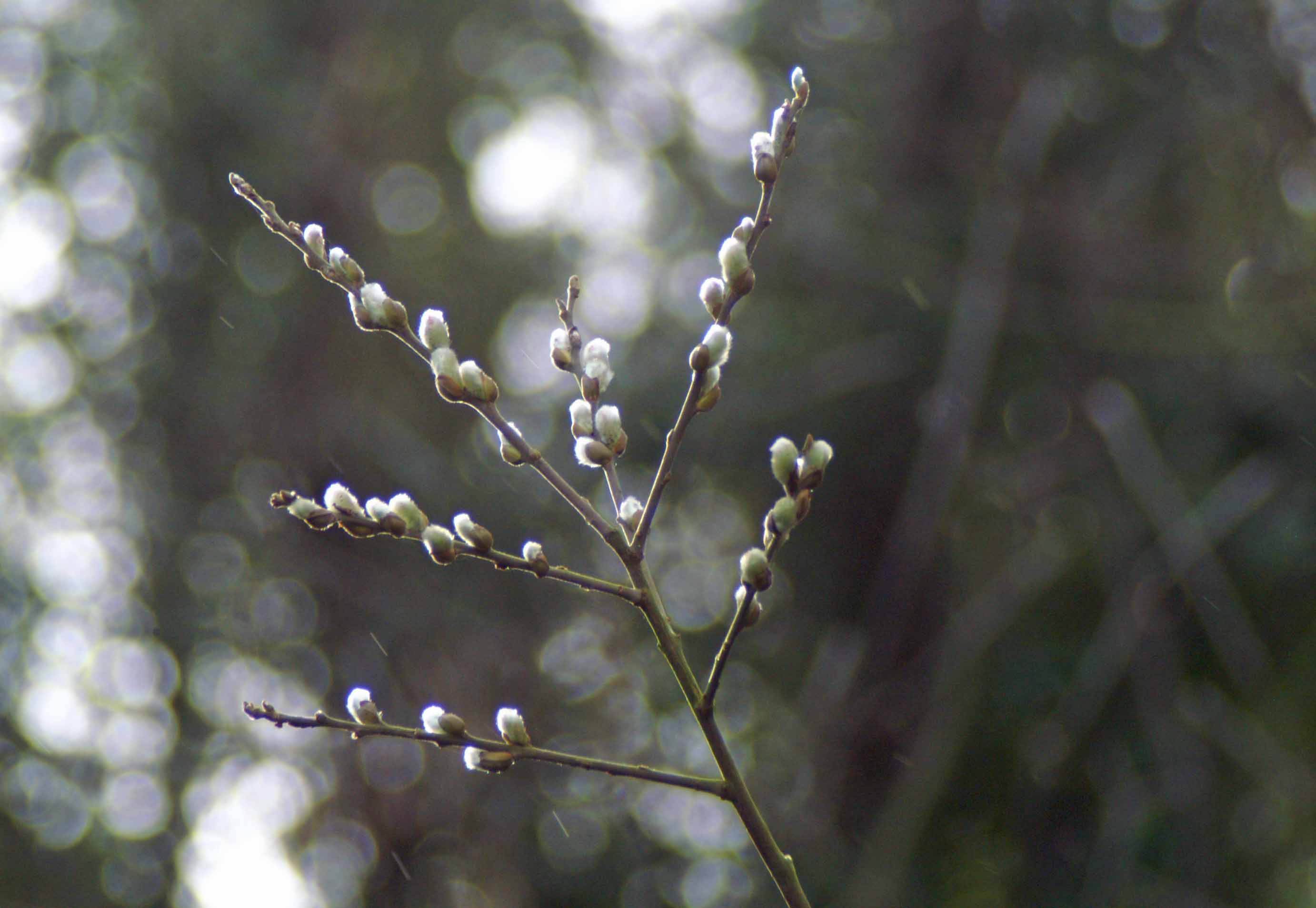
Silvery pussy willow

Pussy willow is a name given to many of the smaller species of the genus Salix (willows and sallows) when their furry catkins are young in early spring. Before the male catkins of these species come into full flower they are covered in fine, greyish fur and hence likened to tiny ‘pussy cats’. The catkins appear quite some time before the leaves, and are one of the earliest signs of spring. It is customary to gather branches of  pussy willow to decorate the house in the springtime, particularly on Palm Sunday, as a substitute for palm branches.

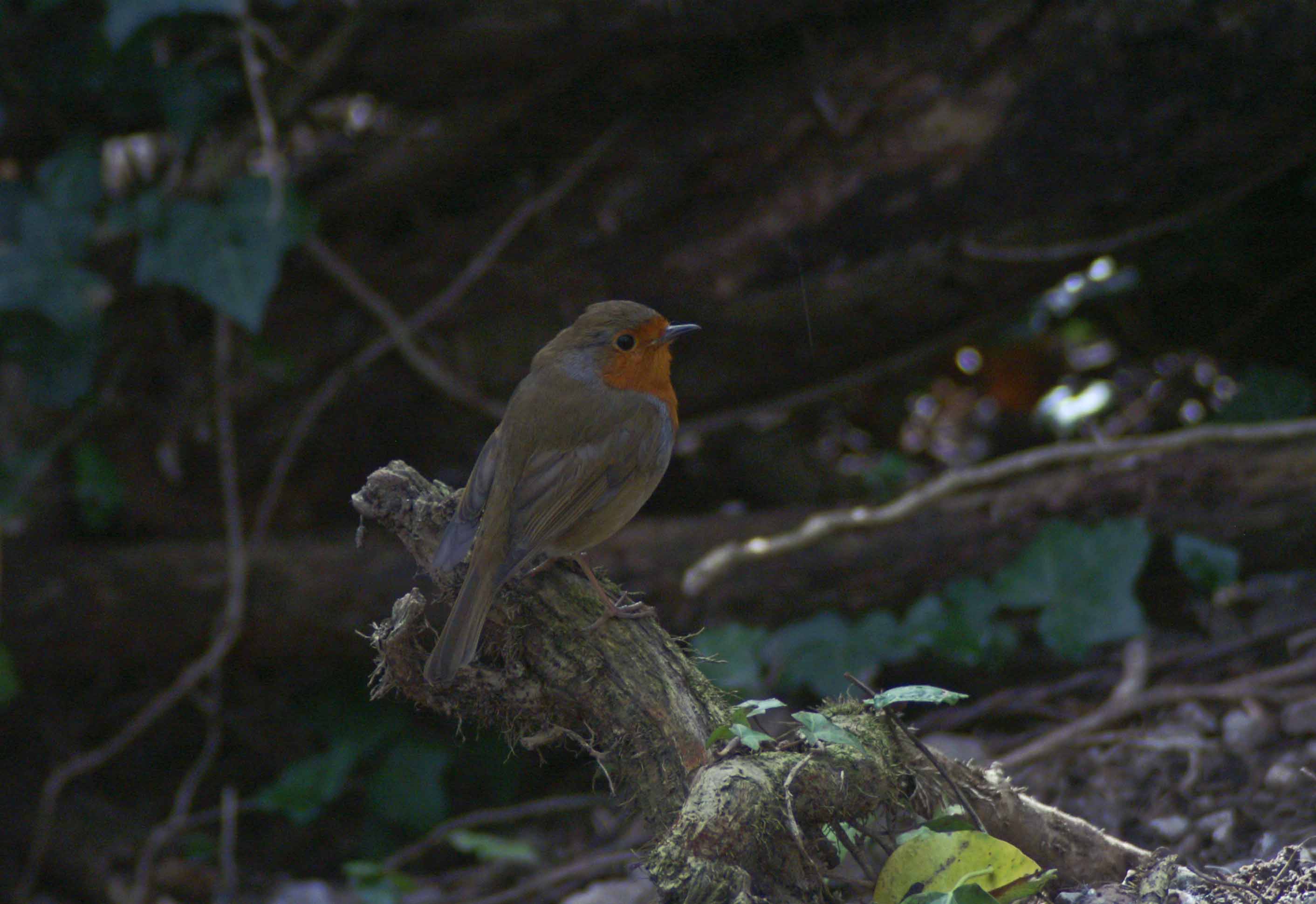
From the field I crossed onto the track on the edge of the woodland which passes by an open area of allotments. There is often  a robin  to be seen here, which today continued with its foraging regardless of me being very close by, even stopping to pose on a nice mossy wooden perch in a patch of  sunlight.


Posing robin

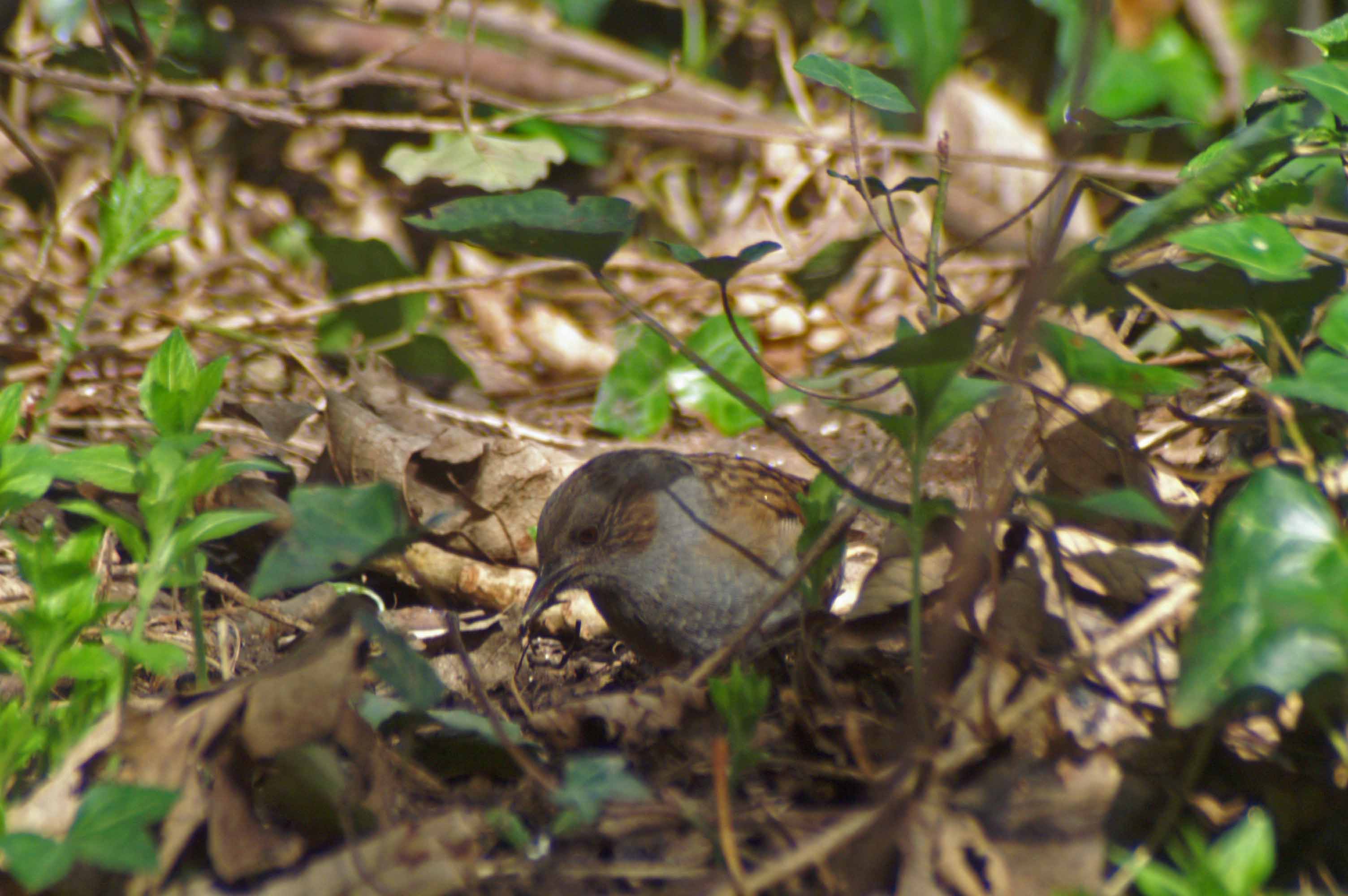
I had some good views of a dunnock there too as it pecked around amongst the dry leaves beneath the trees.

Dunnock -Prunella modular - almost at my eye-level

Dunnock-back view

Moving on towards the bottom of the steps, another brown bird flew past me and landed on the trunk of a big sycamore tree; a treecreeper. I was delighted to recognise it as a treecreeper, the first and only one I have seen so far in this location. I watched it or quite some time as it explored the tree trunk and higher branches, probing its beak into nooks and crannies searching or insects and spiders.

Treecreeper - the first I have sen in this location

The Treecreeper– Certhia familiaris is small, very active, bird that lives in trees. It has a long, slender, downcurved bill, patterned brown upperparts, whitish underparts, and long stiff tail feathers which help it creep up tree trunks. It breeds in the UK and is resident here. Birds may leave their breeding territories in autumn but most range no further than 20 km.

In Spain the very similar short-toed treecreeper – Certhia brachydactyla occurs. They are frequent visitors to our garden there, where they are equally as comfortable scuttling up the tall straight trunks of the palm trees as they are exploring the nooks and crannies of the native cork oaks. They are much easier to photograph there too being more in the open and in better light.

e

A short-toed treecreeper on the trunk of a palm tree, Sotogrande, Southern Spain.

According to my bird books, the main points of difference between the two species are location and that the short-toed species has brownish flanks and a different voice: the short-toed’s song is said to be louder and less high-pitched and the call note louder, more piping and sometimes trilling. However, it is a possibility that there is in actuality only one species as presented convincingly in this brilliant blog:  http://10000birds.com/short-toed-treecreepers-do-not-exist.htm 

Catkin - A long, thin, indeterminate inflorescence of tiny, petalless flowers growing on willows, birches, oaks, poplars, and certain other trees. The flowers on a catkin are either all male or all female. The female flowers are usually pollinated by the wind. Also called ament.

The woodland was full of birdsong and following the track up through the trees towards the summit of the hill (bryn) I was accompanied by a chorus of robin, blackbird, chaffinch, blue tit and great tit with stand-out performances from a couple of  wrens and intermittent coo-ing interventions from wood pigeons. As I neared the top it began to rain quite heavily so I stood under an ivy-clad tree branch for a few minutes just listening until it stopped.

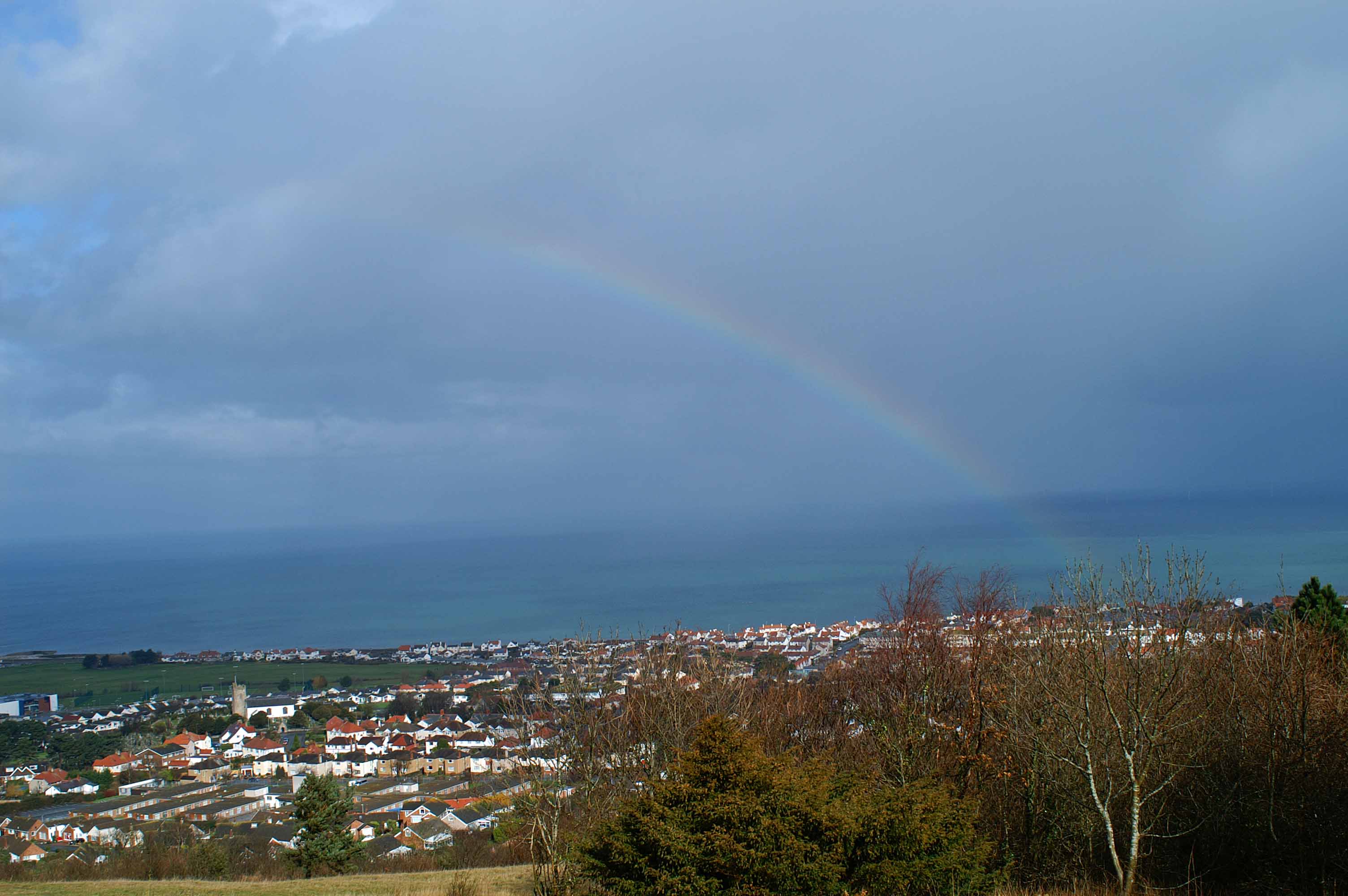
I carried on up to the summit, passing the trig point and over onto the open meadow or downs area that covers one slope of the hill. I was greeted by the sight of a complete arc of a rainbow that  spanned a width far greater than I could fit into my viewfinder.

A rainbow arced across the sky bridging Rhos-on-sea and Penrhyn Bay

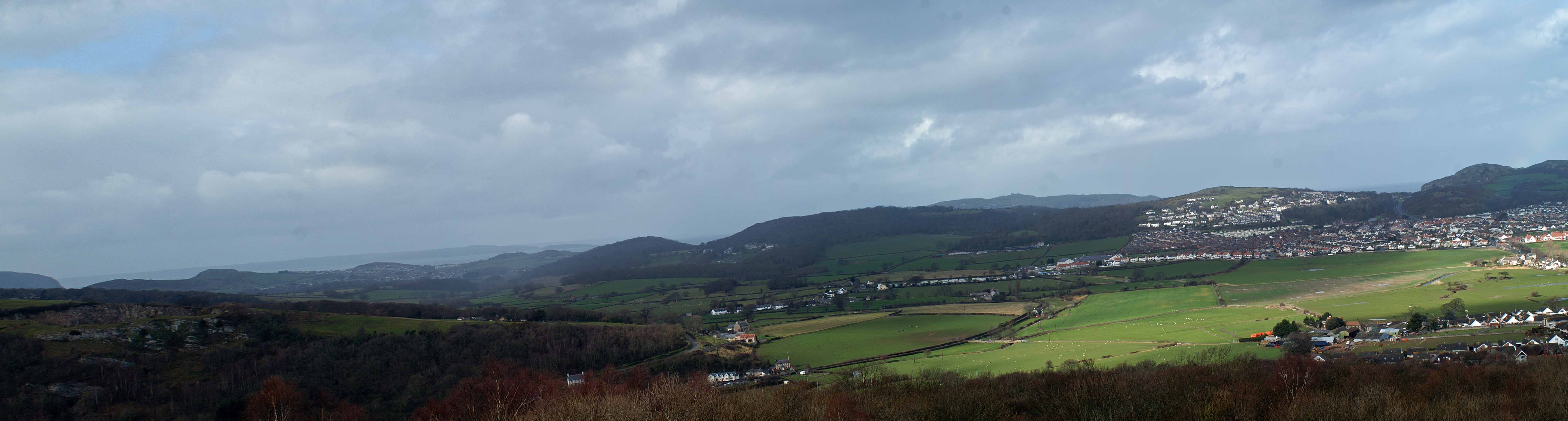
Part of the spectacular view from the summit of Bryn Euryn (click on photo to enlarge)

A close up of golden common gorse flowers and spiky leaves

On the path back down to the bottom a female blackbird was taking a bath in a newly filled puddle, disturbed from her ablutions by, yes, you’ve guessed, a bounding unleashed dog. I had been standing watching a small number of goldfinch foraging in the tops of a stand of tall trees, but I know when it’s time to leave and let the dogs have their share of the day.

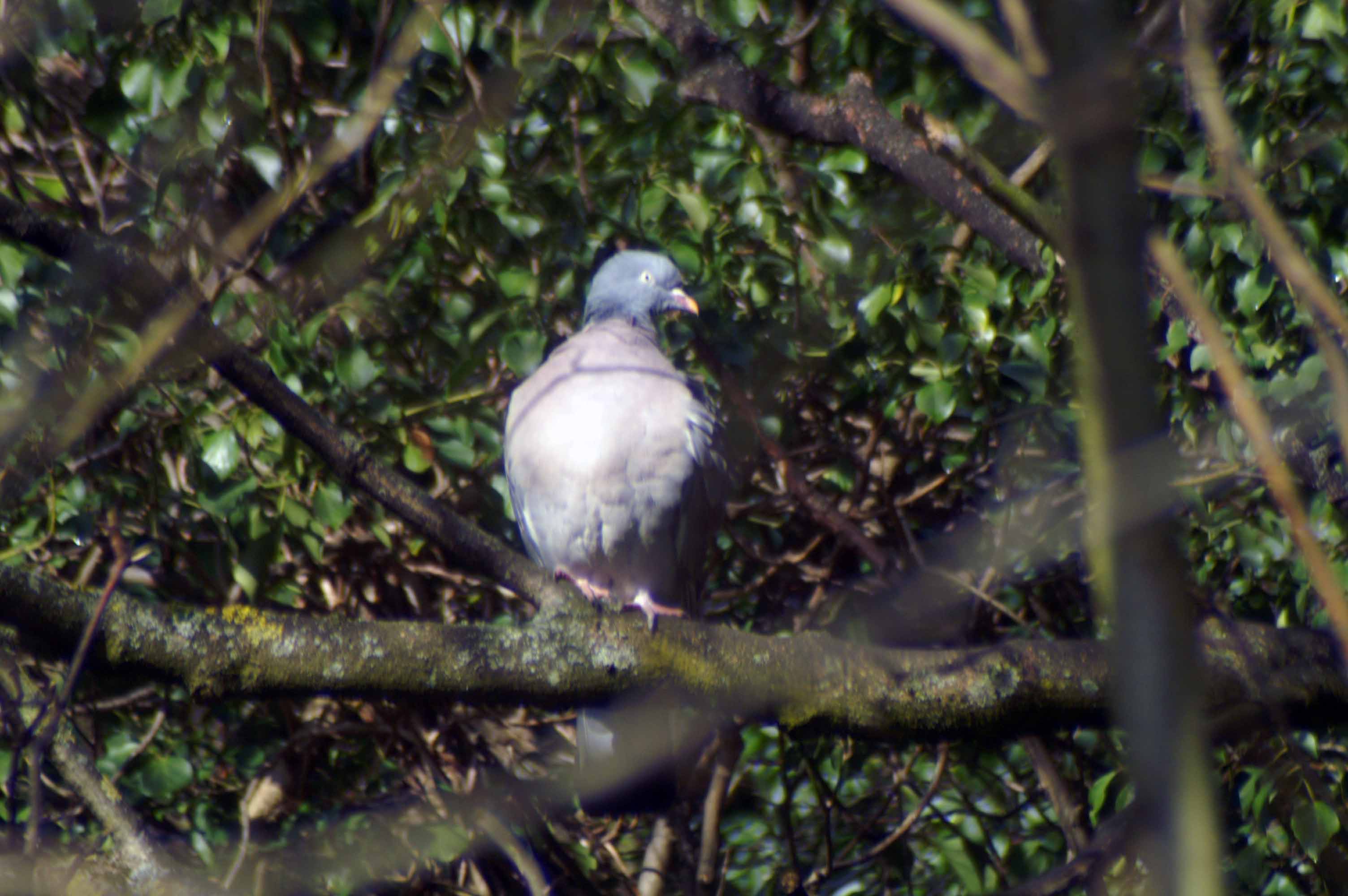
There were a few more treats awaiting me in the car-parking area however. Two wood pigeons, probably a pair, sat preening on a branch in a patch of sunlight and a pair of great tit were foraging around the fenced part of the field.

Wood pigeon - Columba palumbus

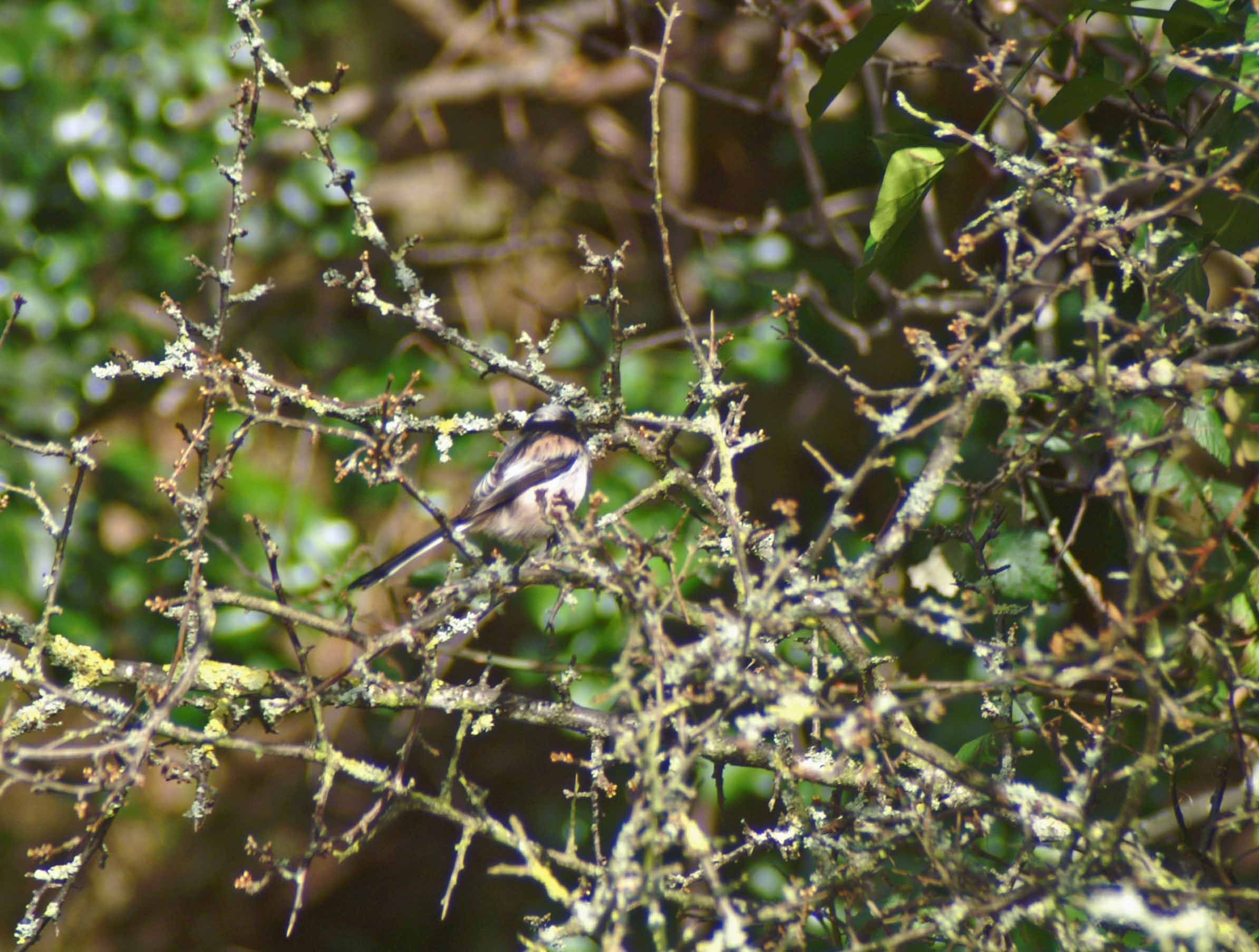
I have always found great tit elude me when it comes to photographing them, so I hung around for a while hoping to capture an image or two. They flew across the car park into the low trees there and attempting to pick up on them I found four long-tailed tits instead. A special favourite of mine, I was more than happy with that, especially as they stayed around acrobatically and thoroughly scouring the intricate twigs of the trees.

Long-tailed tit - Aegithalos caudatus

Long-tailed Tit, back view

A robin was investigating the ground beneath the shrubbery the long-tailed tit was photographed in, then unexpectedly flew up onto a branch in full sunshine and began to sing.

Another robin singing, but this time in sunshine

Share this:

  • Share on Facebook (Opens in new window) Facebook
  • Share on Pinterest (Opens in new window) Pinterest
  • Share on X (Opens in new window) X
Like Loading...

Fairy Glen

04 Sunday Mar 2012

Posted by theresagreen in Local Nature Reserves, Nature, nature of woodlands, nature photography, woodland birds

≈ 2 Comments

Tags

blackbird eating berries, Blue tit, coal tit, Fairy Glen, Old Colwyn, Wren

I am currently working in Old Colwyn and as it would have been a pity not to take advantage of some of last week’s sunny spring-like weather, so I ventured out during my lunch breaks to explore some  of the locality. In a recent blog – What a beautiful day- I featured photographs that I had taken in the small area of woodland alongside the final stretch of the river Colwyn. This is called Min-y-Don woodland and is a remnant of an ancient woodland that would once have covered the whole valley. From there it is possible to walk along a footpath leading up to the village that follows the course of the river. At the top, if you cross the Abergele Road and follow the signs to ‘Fairy Glen’, you reach a narrow wooded dell that the river runs through, bounded by roads and houses.

In present day Old Colwyn, much of which sadly has seen better days, Fairy Glen seems an incongruous name for a part of it, but it harks back to when this whole area was wealthier and hugely popular with well-to-do Victorian holidaymakers. This area of woodland was said to contain many different spirits including fairies, hence its name, which dates from the Victorian era and is a common name from that period (another local one being the “Fairy Glen” in Penmaenmawr).

The wooden road sign for Fairy Glen

Fairy Glen has recently been designated as a Local Nature Reserve and has undergone  regeneration with funding from the local council and it is now possible to walk through it easily. Presently the Fairy Glen is subject to an ownership dispute between Conwy County Borough Counciland the water company, Dŵr Cymru, each claiming that the maintenance of the area is the responsibility of the other. The trail was funded by Cydcoed Forestry Commission Wales.

“A path broadly follows the Afon Conwy which, with the Fairy Glen (then known as Y Nant), was mentioned by the traveller Edward Llwyd in 1699. He described the area as having seven wells and being completely wooded. There are, in fact, remaining indicators in Fairy Glen which identify it as an ancient woodland.”

I doubt that today’s Fairy Glen would have suited the Victorian visitors romantic aesthetic, but it is a pleasant enough place to spend half an hour. It is barely a five minute walk from work and I headed there for my first ‘reccie’ last Friday afternoon; I was very pleasantly surprised by the sightings I had there.

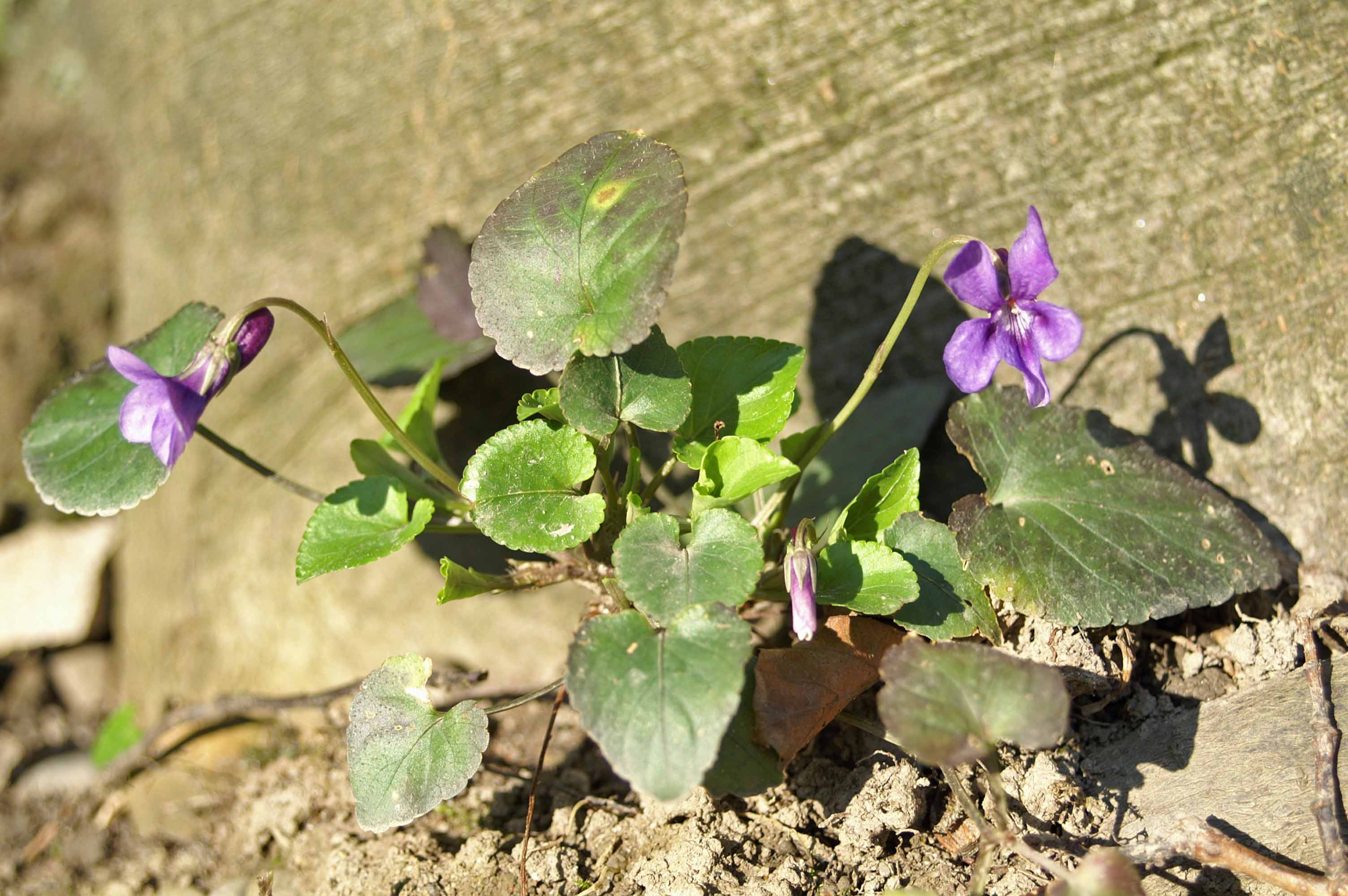
My first surprise was finding this violet plant flowering at the base of a large tree

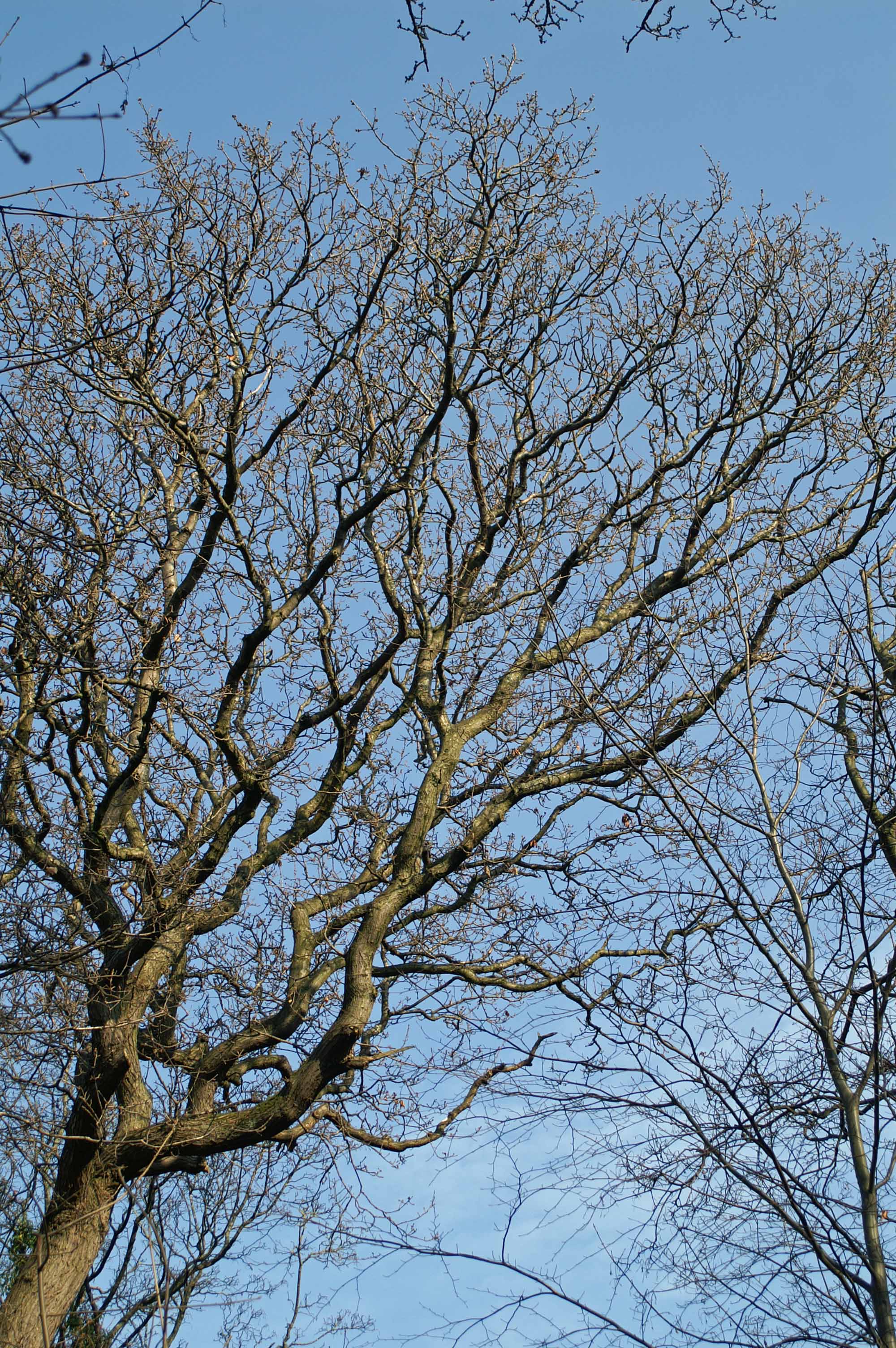
A tracery of bare twigs and branches against a perfectly blue cloudless sky

Blue Tits seemed to be everywhere

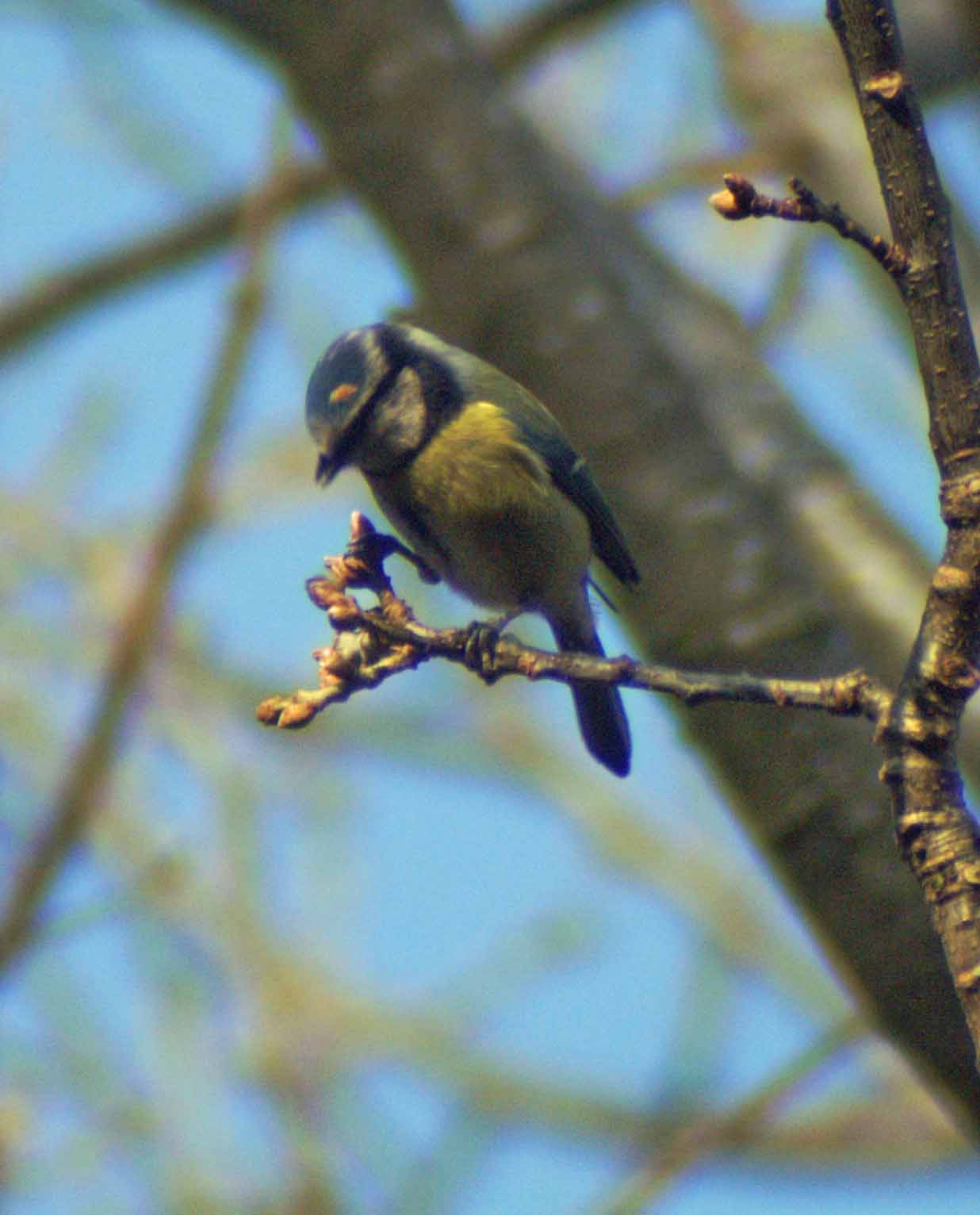
Blue Tit picking delicately around the sticky leaf buds

Hazel catkins

A grey squirrel sat on a tree branch eating something held in its paws, possibly an acorn it had buried back in the autumn

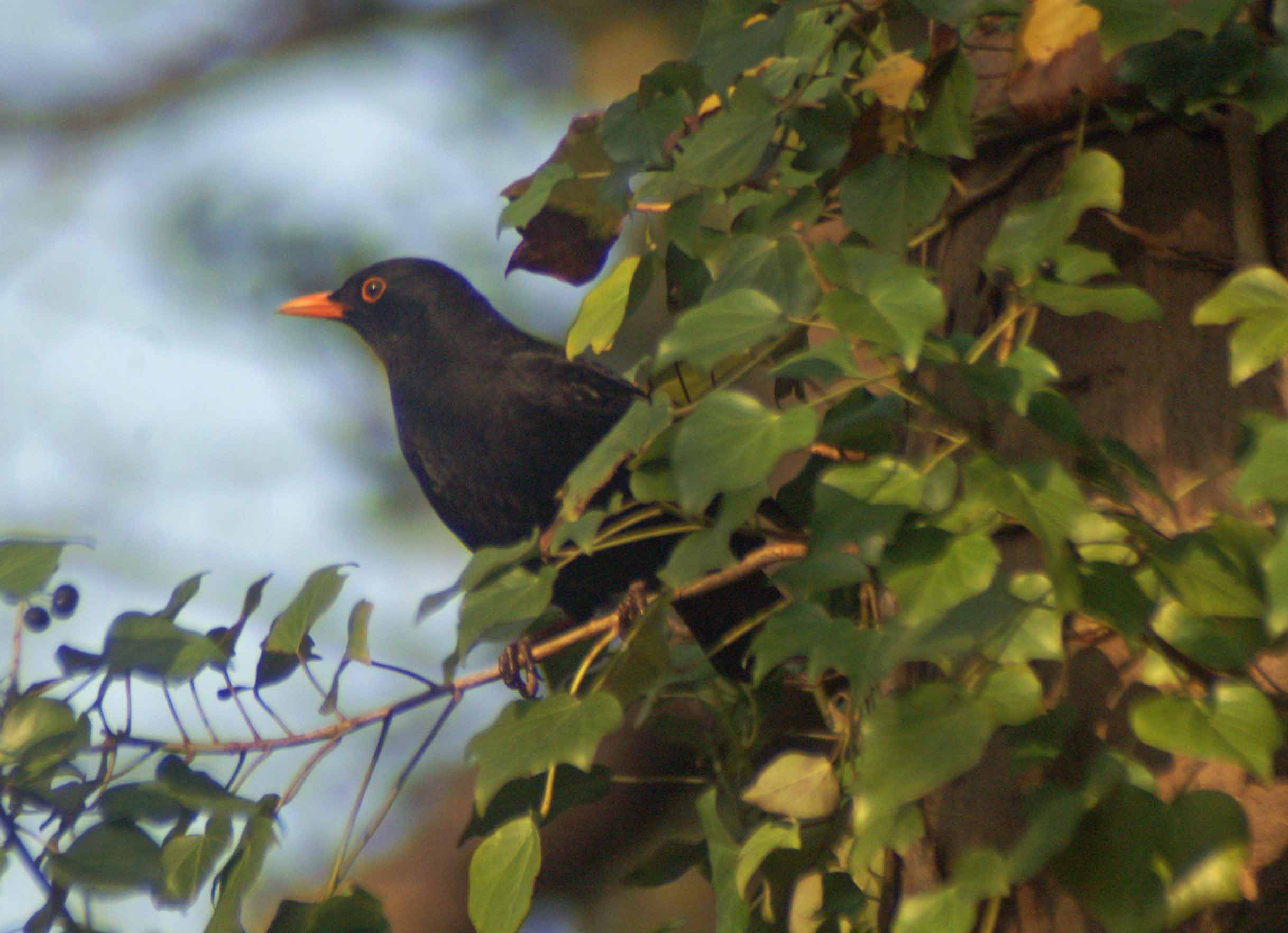
A beautiful male blackbird was picking off ripe ivy berries

The blackbird contorted himself to reach a berry

The blackbird with a berry in his beak

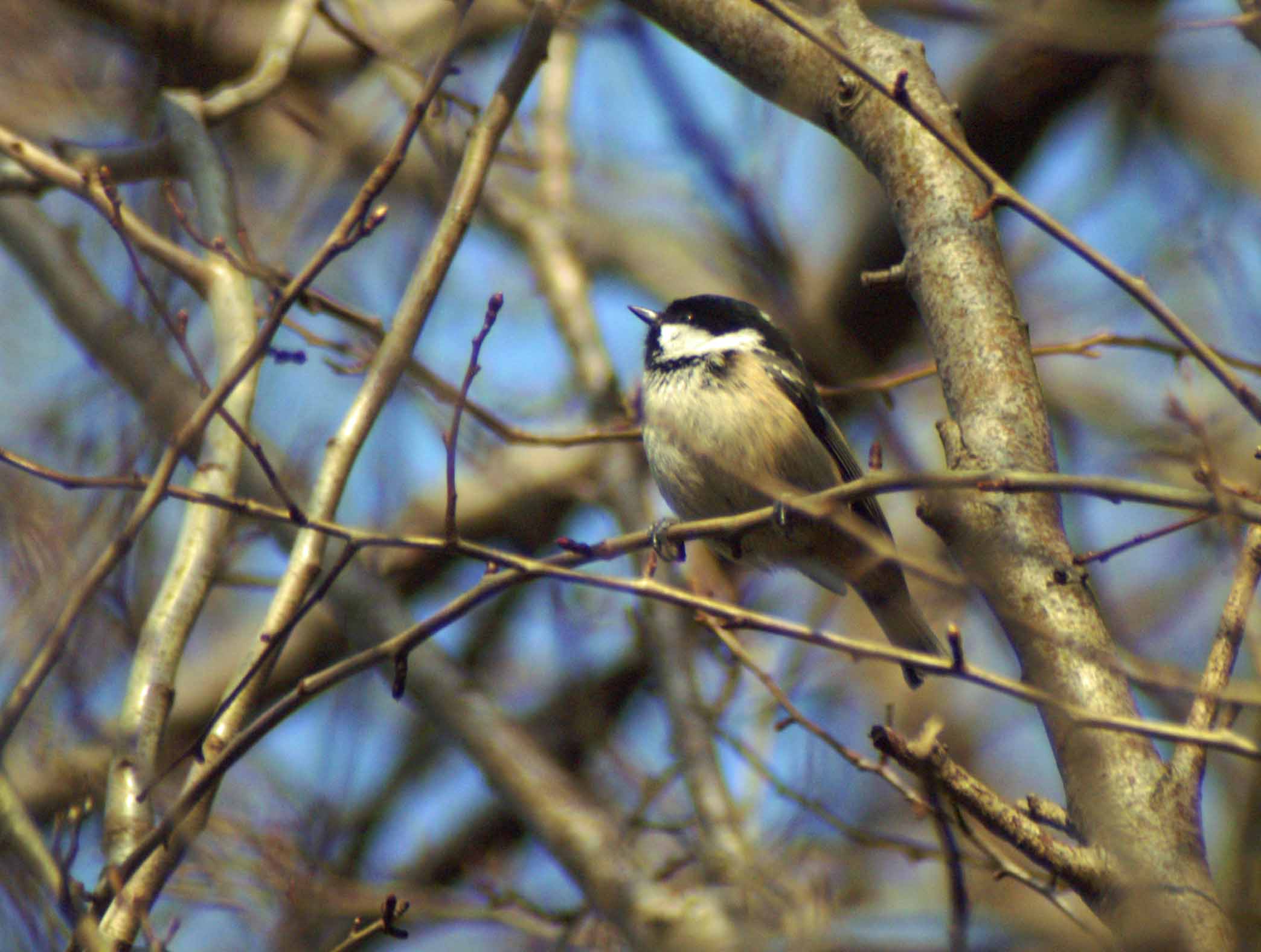
A big surprise was the sighting of this lovely coal tit

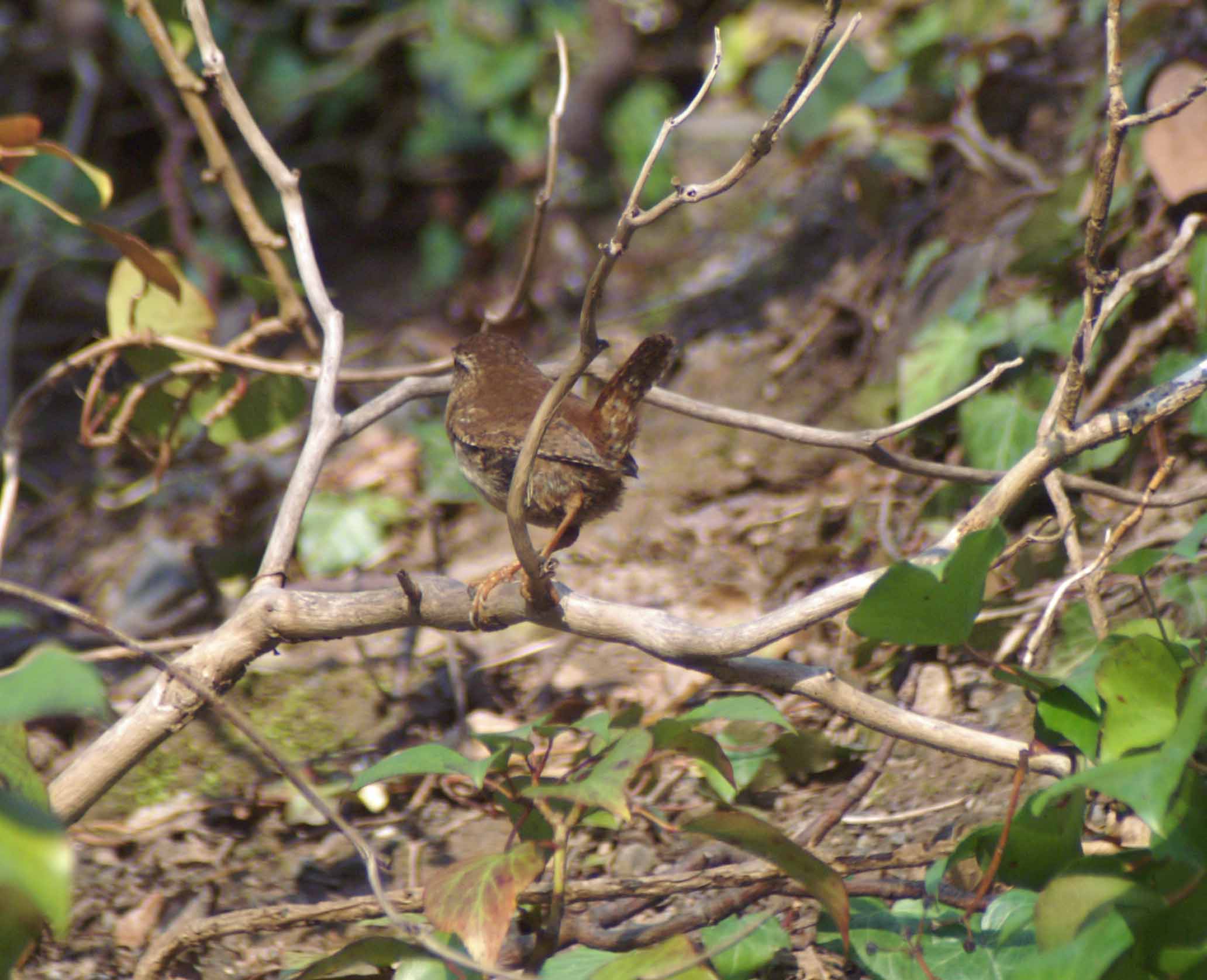
A wren singing from a low branch

Another wren flew across the path and perched on the fence. It looked a little odd, but it took a few seconds to realise it was because he was missing his characteristic upturned tail

The missing tail did not seem to be inhibiting the little bird too much – he was bright eyed and flitting around singing enthusiastically

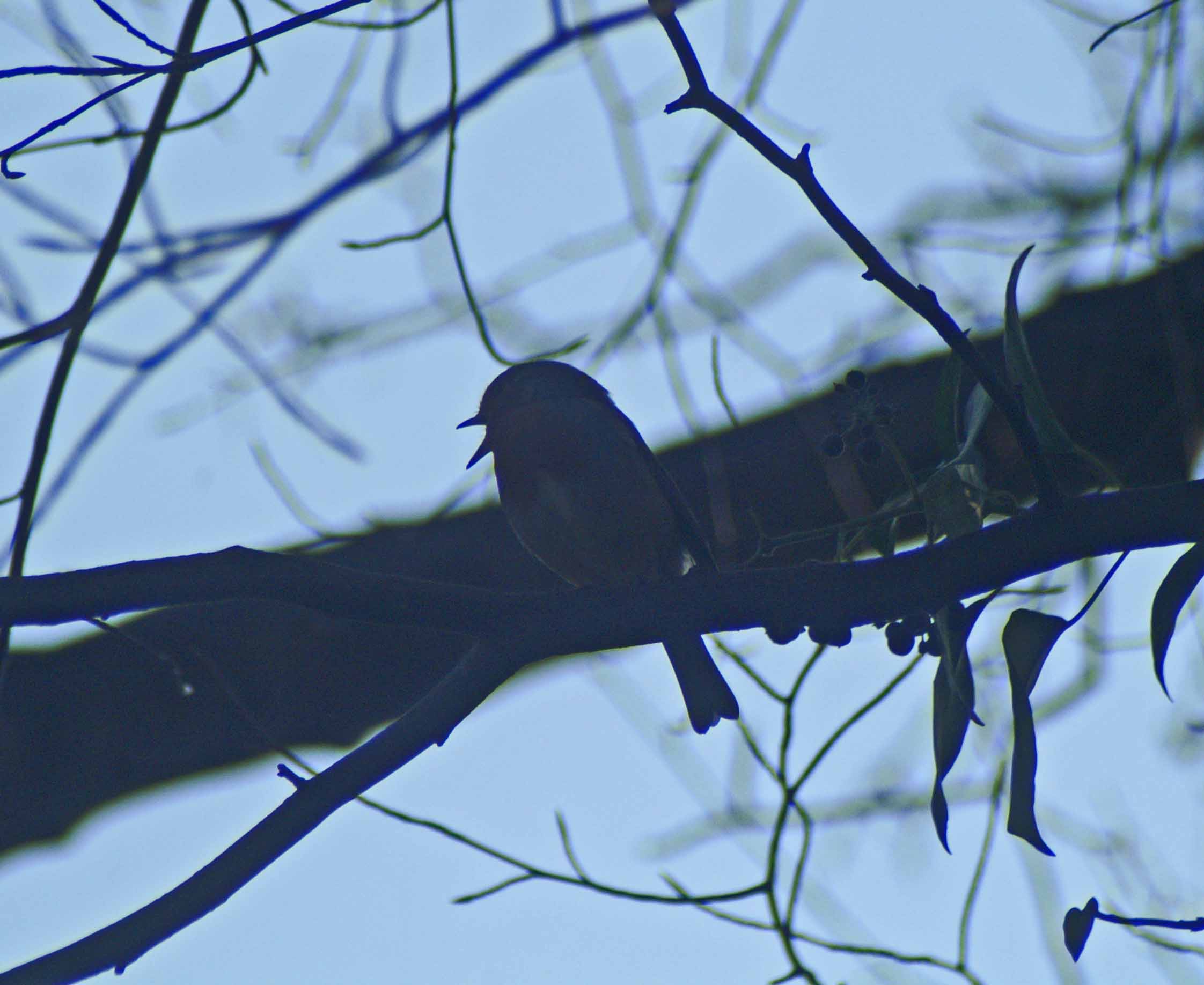
A robin singing beautifully, but in the shade

A pair of nike trainers thrown up into a tree. A reminder that this is a just an oasis in a small urban jungle

Share this:

  • Share on Facebook (Opens in new window) Facebook
  • Share on Pinterest (Opens in new window) Pinterest
  • Share on X (Opens in new window) X
Like Loading...

Blackbird battles in Spain

27 Monday Feb 2012

Posted by theresagreen in bird behaviour

≈ 1 Comment

Tags

blackbird behaviour, Blackbirds battling, garden birds, turdus merula

I’ve just read the latest  fascinating post from one I follow – Finn Holding’s ‘Naturephile’– on the topic of the territorial battles between male blackbirds and was transported back to my garden in southern Spain, where I witnessed similar dramas on several occasions. Spring arrives slightly earlier there, so the breeding cycle and related territorial skirmishes are about a month to six weeks ahead of the UK.

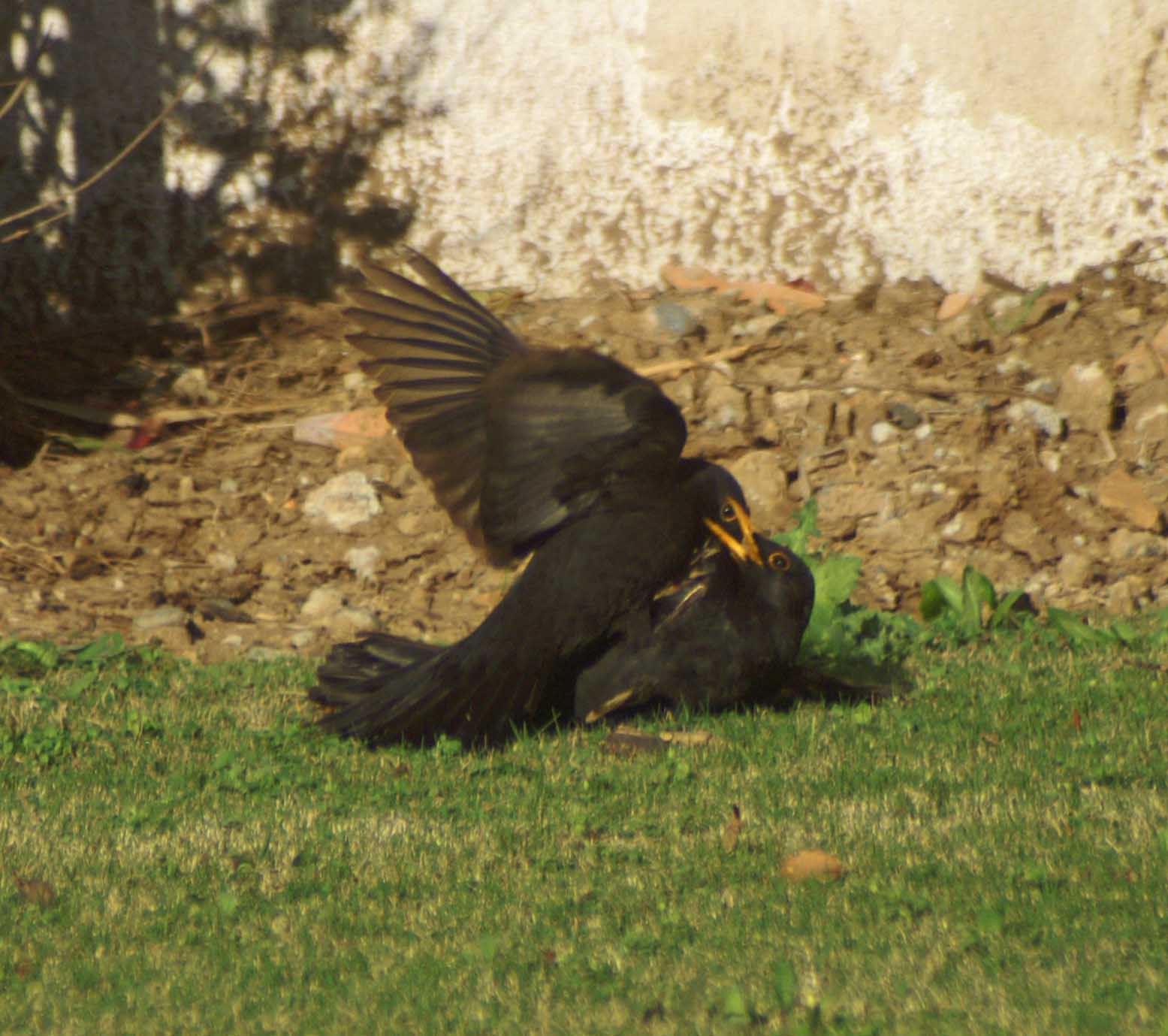
The following is an extract from my Spanish blog dated January 2011; my pictures were taken in 2008 and some are not quite as clear as Finn’s, but I think they similarly portray some of the real fierceness of these encounters, particularly those of the pair on the ground.

“Blackbirds are very numerous hereabouts, thanks no doubt to year-round access to plenty of well-watered lawns, berried shrubs and trees and safe places to build their nests. We have had a pair nesting in our garden each year we have lived here so far, most years successfully raising a family of three, and a few times managing two broods. This breeding success, repeated throughout the area, often results in a local population explosion, which come the onset of the next breeding season means there’s a lot of competition for the best territories.

At this time of year I have seen as many as six males in the garden at any one time demonstrating the familiar challenging routine that generally involves a lot of following and retaliatory chasing between two or sometimes more birds, with one usually succeeding in sending the rest packing, often protesting loudly as they retreat over a wall or hedge.

The fight I photographed, (25th January 2008), took the competition to a whole new level the intensity of which  I had never witnessed before. The duelling began in pretty much the same way as usual, with one of the birds shadowing the other as it ran between shrubs or along the corridor between the hedge and the wall, then the one being followed would turn and lunge at its follower and chase it purposefully, attempting to intimidate it into leaving. This behaviour went on for days, with each challenge lasting for quite some time, which must have been very tiring for the birds. The contenders must have been very equally matched and more determined tactics called for, and chases began to be more aggressive, with the birds flying up at one another, bill to bill until one departed. This happened over several mornings, but the incidents were so brief, or in an awkward place that I failed to get anything on camera. Then one day one of them must have decided that enough was enough and that there would be no more Mr. Nice Bird, as the following pictures show……….

Despite the apparent ferocity of the attack, I don’t think either bird was seriously hurt, but as they were very similar in appearance and well-matched too, I have no idea which one emerged as the victor.

On a good note, later in the year a pair of Blackbirds nested in a fork of the branches of our big yucca tree raising three very healthy young.”

via January | 2011 | nightingale trails.

Share this:

  • Share on Facebook (Opens in new window) Facebook
  • Share on Pinterest (Opens in new window) Pinterest
  • Share on X (Opens in new window) X
Like Loading...

What a beautiful day

24 Friday Feb 2012

Posted by theresagreen in birds singing, Nature, nature photography, woodland birds, woodlands

≈ 4 Comments

Tags

birds singing, blackbird, lesser celandine, miniature daffodils, river Colwyn, song thrush, starlings roosting on Colwyn bay pier

Today was officially the  warmest February day recorded since 1998, with temperatures reaching 18 degrees in some parts of the UK. These are some of my views of this unseasonally beautiful day.

8.15am - Sunlit tulips

The sky was blue, birds were singing, the sun eye-squintingly bright and the sea calm and almost lake-like.

8.35am-View to Rhos-on-Sea showing the headland of the Little Orme & Bryn Euryn

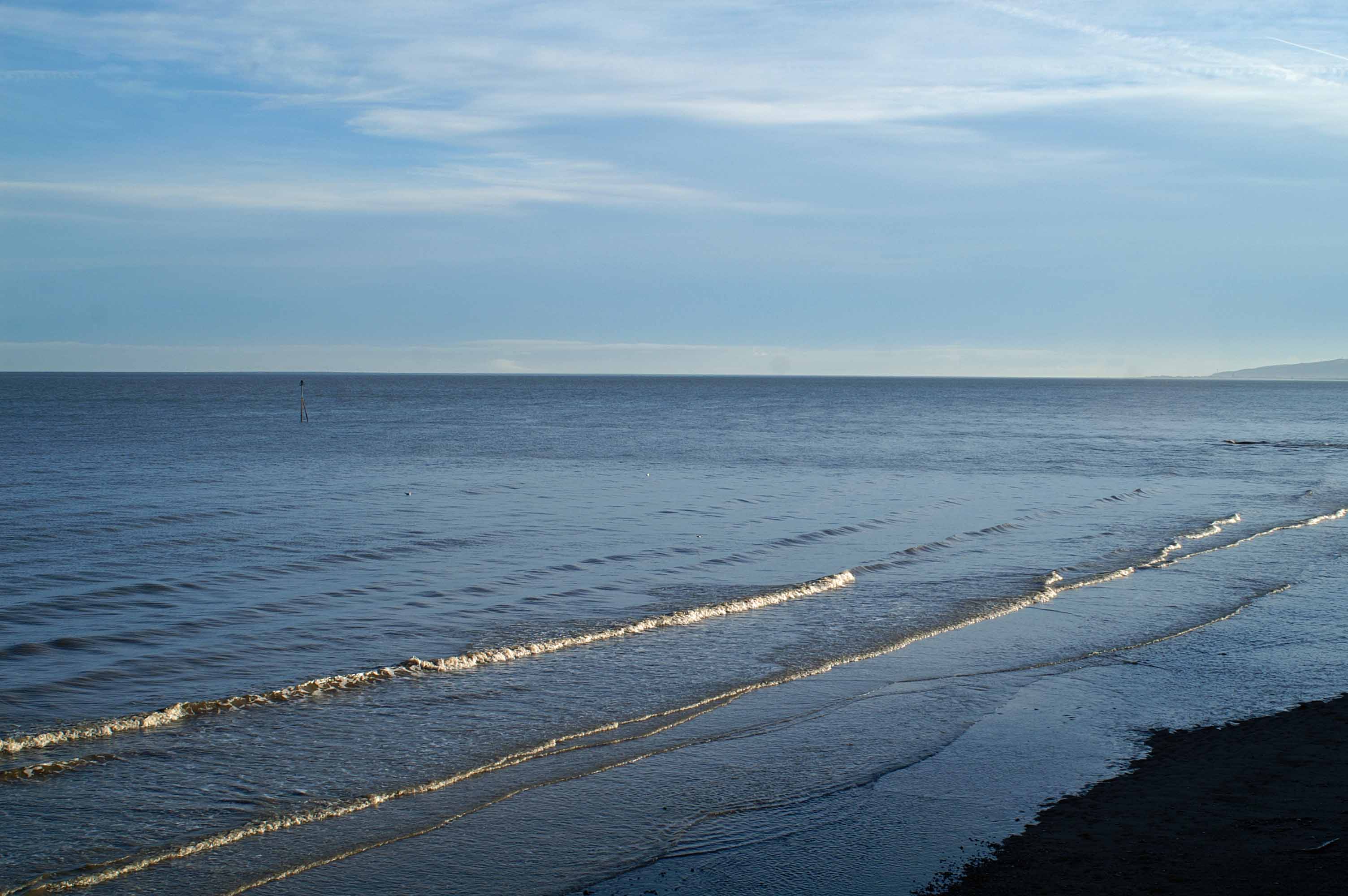
8.37am-Calm, sunlit sea beneath a blue sky

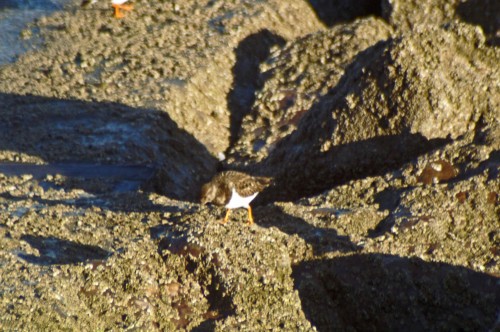
8.38am-Turnstone foraging on barnacle-encrusted rocks

During my lunch break I spent a few minutes in the small wooded area at the bottom of Beach Road.

2pm-River Colwyn at the Beach Road end just before it runs into the sea

The river Colwyn flows through the original township of Colwyn. There are many brooks of the same name in Wales. It means ‘a young animal’ or ‘a pet dog’ and was probably used to describe the playful movement of the water.

Miniature daffodils flowering in the woodland garden

Carved wooden seat alongside the path

Lesser celandines open in the sunlight that filters through the bare tree branches

A wren was singing from a low branch close to the path, a chaffinch from higher up in a neighbouring tree and a robin from somewhere within the shrubbery. I caught sight of two long-tailed tits and a song thrush as it flew down onto the wall alongside the stream.

A blue tit low in a shrub beside the stream

I thought I’d missed the opportunity of a good look at the thrush, but as I was leaving there was another on the bank very close to the path that wasn’t bothered by me being there, even when I pointed the camera at it.

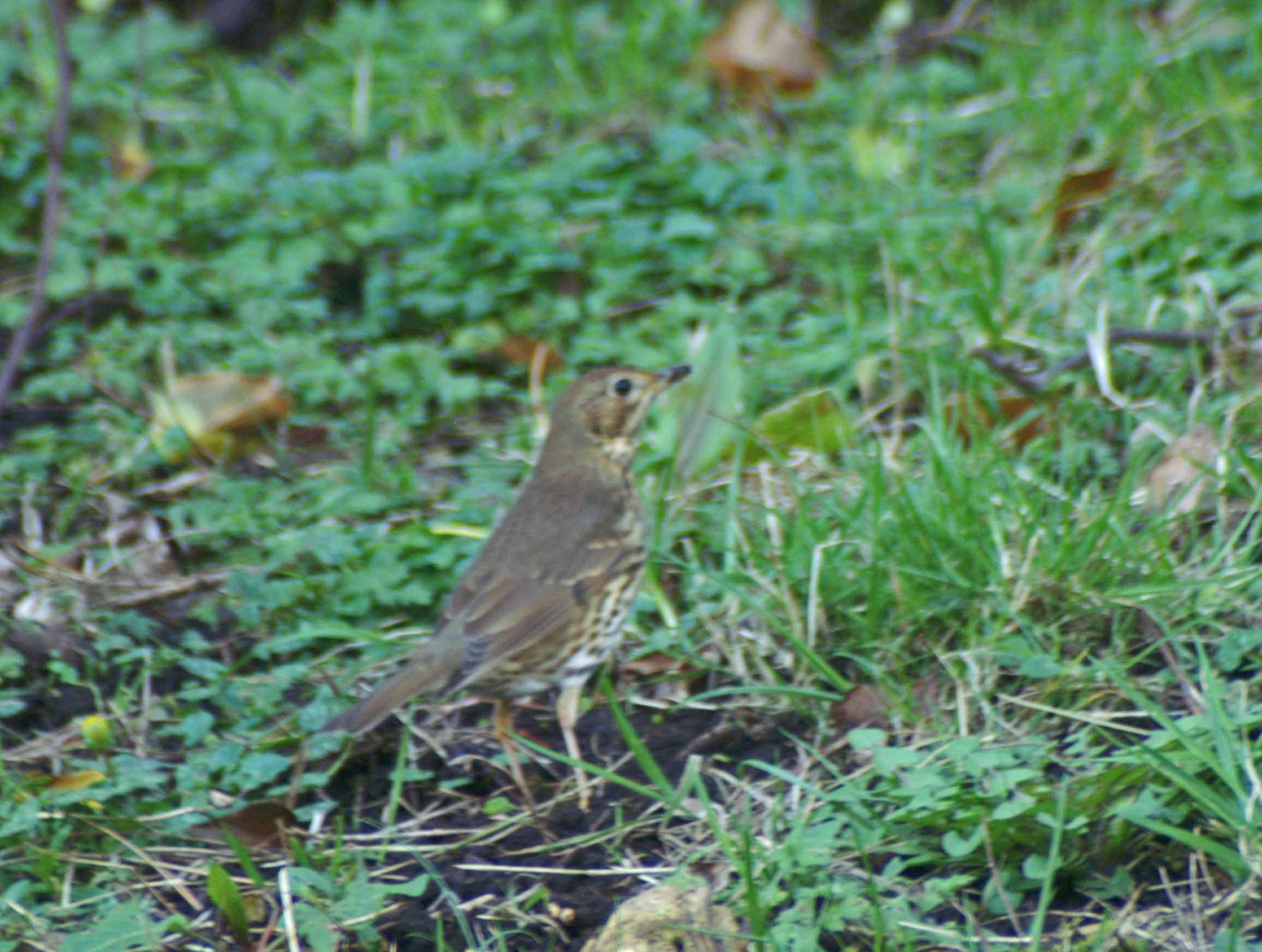
A beautifully marked thrush

Thrush from the front

A successful hunting blackbird

The views on the way home in the evening light were enhanced by the pink glow from the setting sun.

5.50pm - Evening view of Rhos-on-Sea

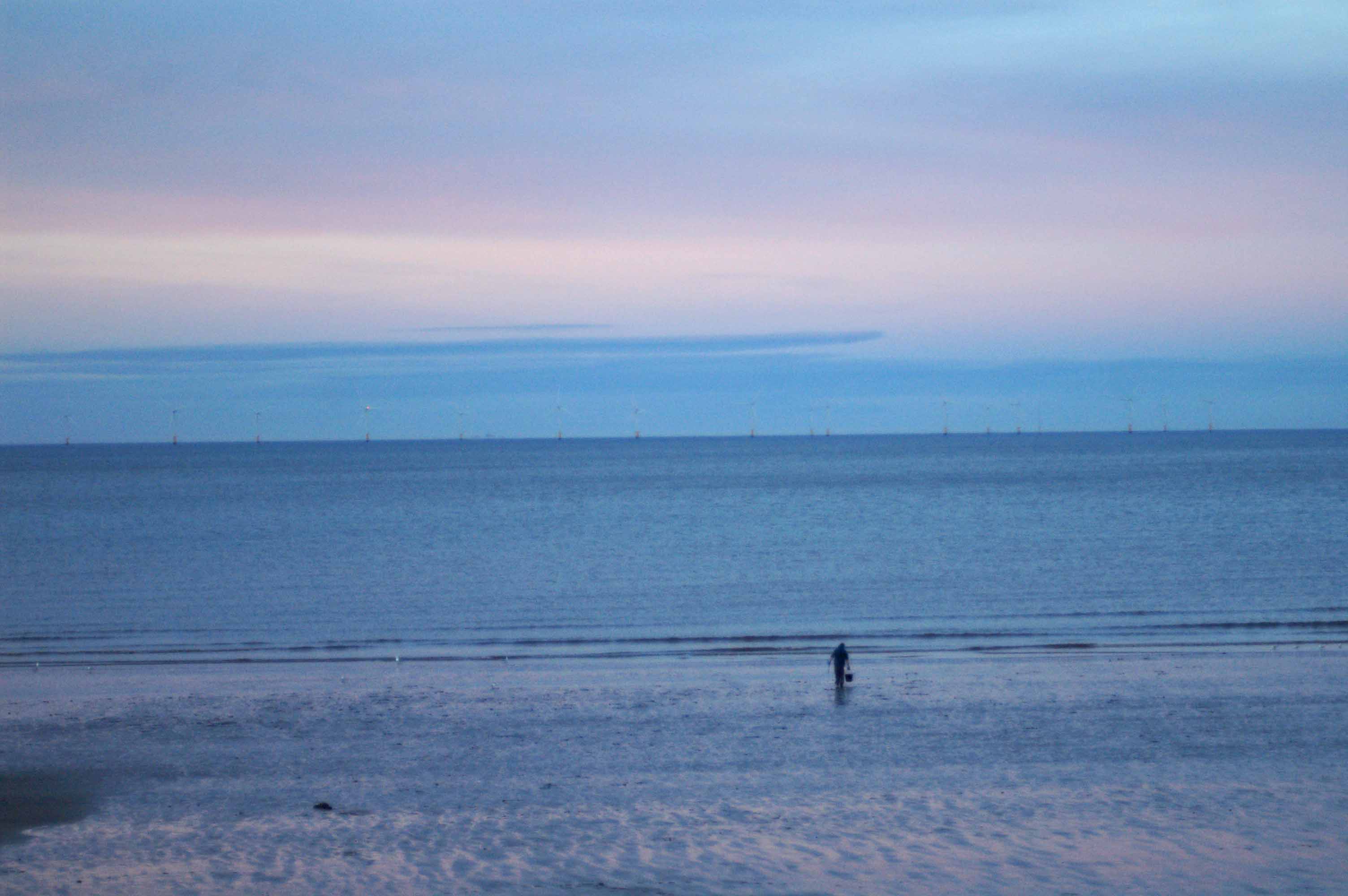
The tide was fully out and although the light was fading there were several people on the beach walking their dogs and a man probing the sand with a stick that I thought may have been searching for razor clams (?); he was too far away to see what he was putting into his bucket.

Man collecting razor clams

As I hoped, I arrived at the old pier at more or less the same time as the starlings.  The majority had already gathered into a large flock, a smaller flock arrived and blended seamlessly into the outer edges as they wheeled around across the sea then back to the pier. They settled quite quickly this evening, showering down like falling leaves to settle beneath the floor of the pier on either side of the structure.

5.50pm - Starlings arriving at the old pier to roost for the night

Starlings shape-shifting across the pink-tinged sky

Starlings flying out over the water

6pm-A final view of the rosy pink sunset

Tomorrow is predicted to be colder, ‘freshened’ by a NW wind …..


Share this:

  • Share on Facebook (Opens in new window) Facebook
  • Share on Pinterest (Opens in new window) Pinterest
  • Share on X (Opens in new window) X
Like Loading...
← Older posts
Newer posts →
Follow everyday nature trails on WordPress.com

Enter your email address to follow this blog and receive notifications of new posts by email.

‘But it is the common species that keep the living world ticking over and provide most of our experiences of wildlife, and I would argue that maintaining the abundance of these is as important a conservation priority as maintaining the existence of rarities’. Richard Mabey

MOST RECENT POSTS

  • A Glimpse of Spring to Come January 22, 2025
  • Hunting the Wren December 28, 2024
  • Oh, Christmas Tree December 18, 2024
  • In and Out of the Ivy February 15, 2024
  • Nature’s Fireworks November 30, 2023
  • Wild Autumn along the Coast Path November 3, 2023

OLDER POSTS

LOOKING FOR SOMETHING IN PARTICULAR?

  • Sights and Sounds from the Little Orme 1
    Sights and Sounds from the Little Orme 1
  • Things Bright and Beautiful
    Things Bright and Beautiful
  • Following a river to a Fairy Glen
    Following a river to a Fairy Glen
  • Catchers, a Duck and Divers
    Catchers, a Duck and Divers
  • Fine Dining for Crows
    Fine Dining for Crows
  • A Windy Wildflower Trail
    A Windy Wildflower Trail
  • A Window on the Woods-Winter 1
    A Window on the Woods-Winter 1
  • Shades, Sounds and Scents of the Woods
    Shades, Sounds and Scents of the Woods
  • Butterflies and more rare treats
    Butterflies and more rare treats
  • Bird study: Blackcap
    Bird study: Blackcap

nightingale trails

The Walk of the Monarch Butterfly-Sendero de la Mariposa Monarca

The Walk of the Monarch Butterfly-Sendero de la Mariposa Monarca

MY WILDFLOWER BLOG: where the wildflowers are

Snowdrop

Snowdrop

most recent posts

Follow everyday nature trails on WordPress.com

Social

  • View teresamaygreen’s profile on Twitter

Enter your email address to follow this blog and receive notifications of new posts by email.

Website Built with WordPress.com.

  • Subscribe Subscribed
    • everyday nature trails
    • Join 359 other subscribers
    • Already have a WordPress.com account? Log in now.
    • everyday nature trails
    • Subscribe Subscribed
    • Sign up
    • Log in
    • Report this content
    • View site in Reader
    • Manage subscriptions
    • Collapse this bar
 

Loading Comments...
 

    %d