• Home
  • about
  • about the photographs
  • Local Nature Reserves
    • Bryn Euryn Local Nature Reserve
    • Mynydd Marian
  • Wales Coast Path
    • Grey Seals in North Wales
    • St.Trillo’s Chapel
    • Wildflowers of North Wales Coastal Paths, Cliffs and Dunes

everyday nature trails

everyday nature trails

Monthly Archives: May 2018

The Place for Wheatears,Pipits & Chough

08 Tuesday May 2018

Posted by theresagreen in Birds, Birdwatching on North Wales coast, Great Orme, Nature of Wales, The Wales Coast Path, Wildlife of the Wales Coast Path

≈ 10 Comments

Tags

birds on migration, chough, Greenland race of wheatear, meadow pipit, Northern Wheatear, Oryctolagus cuniculus, Pyrrhocorax, rabbit, Red-billed chough

April 25th – Great Orme 

A bright sunny morning prompted me to leave early for the Great Orme today, giving myself time to walk at least part of the way up to the summit and arrive on time to do my shift in the Wildlife Trust shop. Bearing in mind that wherever I walked up from I would have to walk back down to later on, regardless of what the weather may be doing by then, I decided to park in the layby just beyond St. Tudno’s Church. It was much fresher up here, still sunny and clear but a strong breeze made it feel cool.

view from half-way up looking down onto St Tudno’s church

13:05 From here at the bottom of the steep slope, there are obvious short-cropped grass trails that lead off in various directions including up to the cable car station and the Summit Complex, where I was heading. Walking at a good speed it may take 10 minutes to get up to the top if you’re reasonably fit, or a bit longer if you stop to admire the views behind you or need to stop for breath on the steepest part nearer the top. Of course you all expect by now that I would take longer, as I would inevitably find things of interest that I would need to stop and photograph.
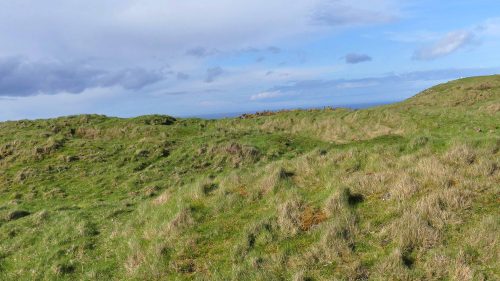
Either side of the tracks the hillside is lumpy and bumpy, with hillocks and hollows clothed with long tussocky grass and bushes of dwarf gorse; perfect terrain for the Meadow pipit that I was hoping to see. Birds foraging here are often well concealed, suddenly appearing and disappearing like this Magpie, one of a pair out hunting.

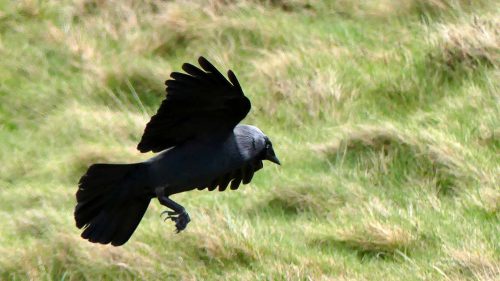
Sometimes they leave flying off until you’re almost on top of them, as this Jackdaw did.
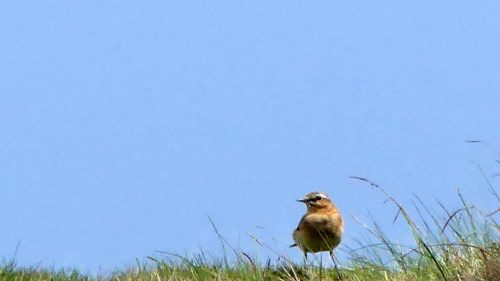
Fond as I am of the Corvids, the unexpected sight of this elegant male Northern Wheatear was a lot more exciting.

Northern Wheatear-Oenanthe oenanthe- Welsh: Tinwen y Garn

and the excitement was doubled when a more softly plumaged female popped up onto the top of a hillock.
Absorbed with the female wheatear a distance away, a Meadow pipit popping up onto a hummock close by me took me by surprise, but a sighting at last and some photographs! It was hunting and I was pleased to get a pic of it with an insect in its beak.

Meadow pipits, in common with the majority of basically brown birds don’t get much of a write-up in the bird books. They’re mostly described as something like ” a small, brown, streaky bird, the most common songbird in upland areas, where it’s high piping call is a familiar sound’. Perhaps because of their lack of glamour we take them too much for granted, as according to the RSPB, ‘Meadow pipit numbers in the UK have been declining since the mid-1970s, resulting in this species being included on the amber list of conservation concern.’

Meadow Pipit- Anthus pratensis- Welsh-Corhedydd y Waun

Meadow pipit with insect

It’s strange that we  give such high praise to the similar-looking Skylark and the not-dissimilar Song Thrush and are so dismissive of the pipits. Is the bias based on the fact that the latter sing delightfully and pipits not so much? For sure our hills and uplands would be lonely without them, so perhaps we could appreciate them more and enjoy them at every opportunity.

There are little wildflower treats hidden down in the grass like this pretty violet.

13:25 As usual I’d been led astray by the birds and had to put a spurt on and get to the top in time to start my ‘shift’. As I said earlier it was breezy on this side of the Orme, but crossing the top and starting down the other side I was suddenly fighting to make progress against a continuous very strong head wind! Checking the wind gauge inside the visitor centre it indicated it was blowing in from a North-north westerly direction, so it felt cold too despite the sunshine. I anticipated selling more hats and gloves!

4:50 Finished for the day I retraced my steps along the trail back down towards where I left my car. On my own time now I was free to take my time and paused to admire the view over towards the Little Orme and beyond. The post tells you that this is the way to The Town (Llandudno).

A closer view of the Little Orme shows its intact, non-quarried side which was deliberately preserved to present a much prettier view to visitors and residents of Llandudno.

A little further on there is an interpretation panel that reminds you that this is the ‘Historic Trail’ and informs that 800 years ago you would have been looking down onto one of perhaps three villages established on the Orme, whose inhabitants would have grown crops and raised animals to eat or trade. I was hoping the wheatears may still be around and I was in luck – I soon spotted a female.

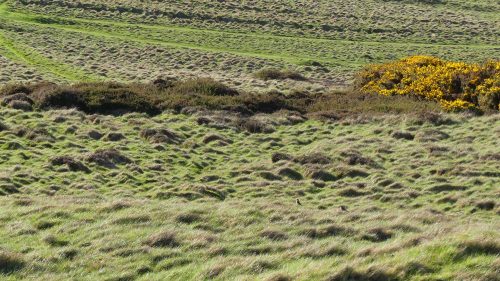
The sun was lower now, creating shadows and highlights and the wind, stronger now, rippled across the long silvered grass, creating a magical almost alien landscape. In amongst it I realised there were more Wheatears, another three birds.
All Wheatears spend winter in tropical Africa, heading northwards via Spain in the spring. Those that breed in the British Isles sometimes arrive on our coast as early as late February, but mainly during March, with males arriving ahead of females. They move inland to  breed.
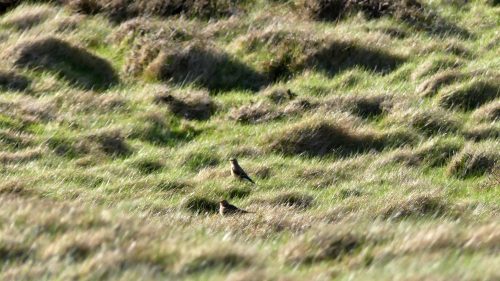
GREENLAND WHEATEAR

It is possible that the birds I saw here today belong to another race, known as the Greenland wheatear, which arrives a little later in April. Many wheatears make a refuelling stopover in North Africa, but as the Greenland wheatears fly furthest, they need to put on more fat before leaving and spend longer at stopovers. They have a long journey ahead to their breeding sites on the other side of the Atlantic. From Britain they fly northwest across the sea, via Iceland, until they reach the Arctic tundra of Greenland and northern Canada. By June they will have started to breed there.

Wheatear & Meadow pipit

Whichever they were I was appreciating some lovely views of the two males and two females foraging together in the long grass, using the little hillocks as look-out platforms to survey the ground around them for likely prey.

Female wheatear

Then a distraction; a black bird flew in that I may have dismissed as a Jackdaw had it not called out. This was a Chough. It had landed somewhere behind a particularly hillocky part of the hillside, which is also pitted with well-disguised sunken craters. You have to watch your footing if you risk going off the proper trails.

Landscape pitted with sunken craters

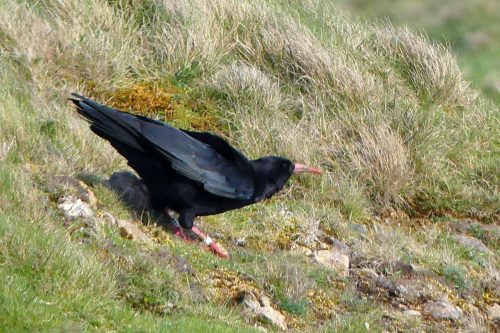
I walked carefully until I spotted the bird, almost up to its beak in the long grass.
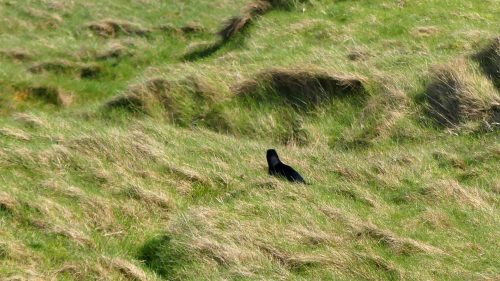
It had its back to me, eventually turning enough to show its diagnostic curved bill and legs, these are bright red in an adult bird, but this was a juvenile so it hasn’t quite got that far yet and its are more of a dull orange colour.
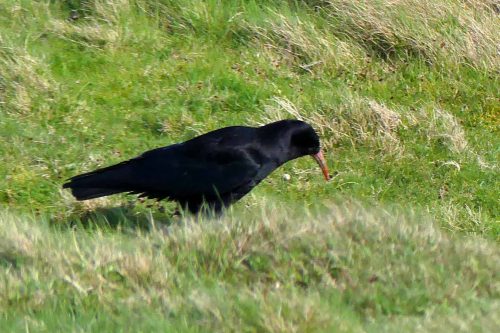
Chough, Red-billed chough – Pyrrhocorax

It didn’t stay for long before taking off, but it’s always a treat to see them at all, especially this closely.
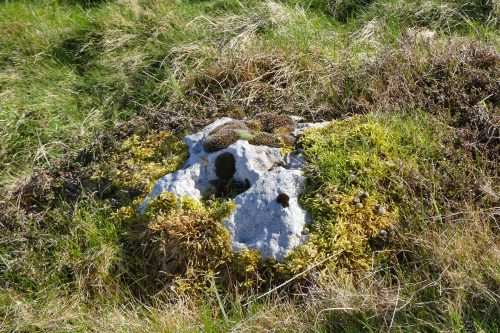
Making my way back to the main track I noticed this rock, a little island rising out of a sea of grass and heather, it was almost totally encrusted with white lichen and embellished with mosses.
There was a lovely patch of violets growing in a grass-lined crater too.

I spotted two Wheatears perched on the top of a gorse bush; a male and a female. The birds spend most of their time on the ground, travelling in hops or runs on the ground, so it’s quite unusual to see them perched up higher.

I couldn’t have asked for a prettier picture than a handsome male Wheatear perched amongst golden-flowered gorse.

I liked the two images below too; perfect records of the birds’ exact location!

180425-GO-1709-Female wheatear on post
180425-GO-1709-Male wheatear next to post

Two males together on the short turf of the trail
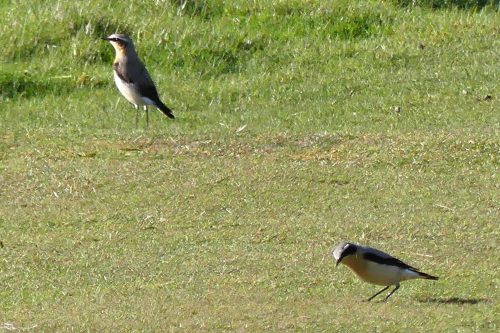
And one last image of a nicely posed one on his own.

17:16 Walking on down I spotted three bunnies on high alert, in poses that could have come straight out of Watership Down.

Rabbit-Oryctolagus cuniculus


But then I saw the new Peter Rabbit film during the Easter holiday too and thought this one, which I think may be the ‘big bunny’ of a previous post, may have seen it too – he’s got Peter’s pose to a ‘T’.


180425-GO-1716-Bunny 1
180425-GO-1716-Bunny3

And wouldn’t you know? After all my efforts to find a Meadow pipit, there was one posing on a rock almost in front of my parked car!

It flew down to the ground and looked back over its shoulder at me as if to say

“what kept you? I’ve been here for hours waiting for you!”

It allowed me a couple of photographs, then took off, leaving a lone Jackdaw to patrol the layby edge for his supper.

On the way down I had to stop just past the church as these little Goldfinches fluttered down onto the bare ground of a bank where they must have spotted food potential.

180425-GO-1730-Goldfinches on bank past church 1
180425-GO-1730-Goldfinches on bank past church

The views were stunning as always; good today as the mountains were more clearly visible than usual and the clouds above added to their drama.

17:45 The view of the Conwy Estuary was stunning too, the sun was hitting the castle perfectly so it stood out from the trees, you can clearly see the road bridge that takes you across the river to the town and there were boats on the water….. the perfect scene for a painting.

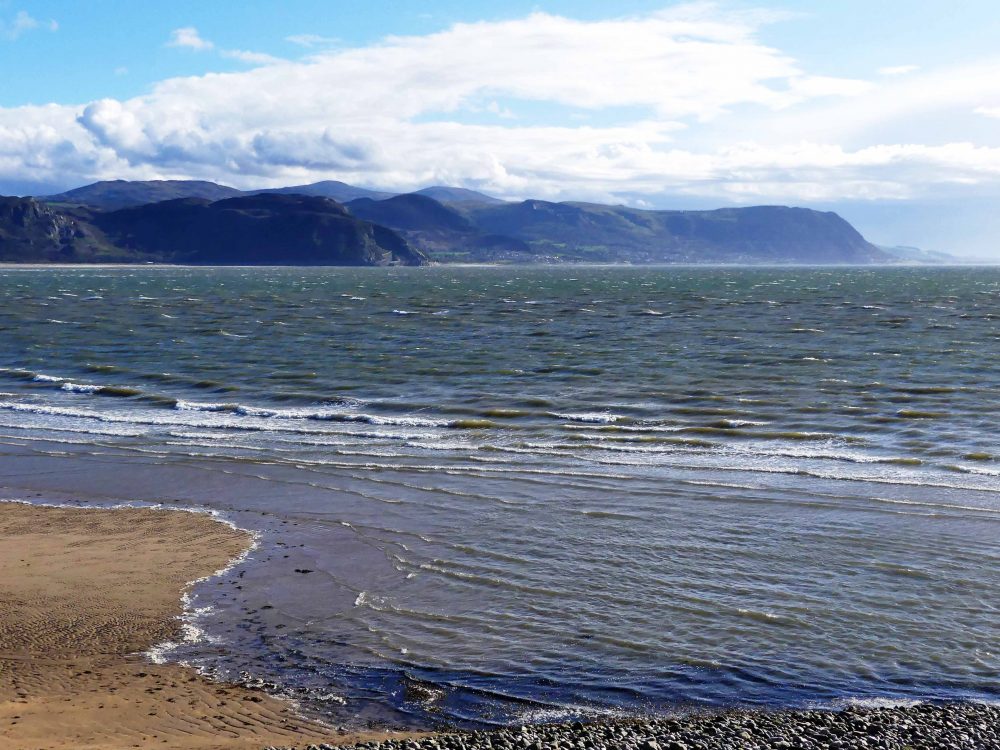
The view of the sea meeting West Shore wasn’t bad either.


Share this:

  • Share on Facebook (Opens in new window) Facebook
  • Share on Pinterest (Opens in new window) Pinterest
  • Share on X (Opens in new window) X
Like Loading...

On a Perfect Spring Day

03 Thursday May 2018

Posted by theresagreen in birds singing, British hoverflies, Bryn Euryn Nature Reserve, Butterflies of Wales, Local Nature Reserves, Nature of Wales, North Wales, Wildflowers of Wales, woodland birds, woodland walks, woodland wildflowers

≈ 11 Comments

Tags

ashy mining bee, Bee-fly, Blackcap, blackthorn blossom, Chiffchaff, comma, cowslip, Greater Spotted Woodpecker, hairy-footed flower bee, tawny mining bee, tree bumblebee

April 19th – Bryn Euryn

Today was the middle day of the three consecutively warm sunny days that tantalised us with the notion that Spring had truly arrived, and judging by the activity here today it had a lot of our wildlife fooled too. The sky was clear and that almost-unbelievable shade of deep blue, the birds were singing and best of all, it was warm!

WOODLAND PATH

A few metres along the Woodland Path of my patch is an untidy-looking stretch, divided by the narrow path, where missing trees have opened up the canopy, letting in the light and warmth of the sun. Somewhat mysteriously, it holds great allure for diverse species of insects, some of which at certain times can be found here in surprising numbers. At the right time on the right day, ten minutes spent in this  ‘hotspot’ can be as productive as two hours spent ranging over the rest of the site.

11:44 Today I was here at the right time to see a surprising amount of insects. Most prolific were hoverflies in all shapes and sizes from big and bulky to teeny-tiny and dainty.

Eristalis sp hoverfly
180419-BEWP- (6)-1148

Syrphus sp.

There were few flowers here for nectaring upon, so that wasn’t the attraction for the majority of the hoverflies; I caught just one on the tiny flowers of Dog’s mercury. There were dozens of this small black and yellow striped species here, all very fresh and shiny and mostly basking on the sun-warmed leaves of brambles and nettles.

One side of the ‘hotspot’ is open to sunlight, clear of trees but sheltered by those standing behind it and by large shrubs of laurel and holly on either side. A large tangle of bramble fills the gap in the vegetation and is the only barrier between you and the Expressway below at the bottom of an almost-vertical slope. (Only joking, there’d be plenty of trees to stop you if you fell!) On the other side is a large patch of nettles, the aforementioned Dog’s mercury, more bramble and a pretty patch of periwinkle, all growing through a ground-covering of ivy.

Periwinkle
Periwinkle
Dog's Mercury
Dog’s Mercury

A lone Tree bumblebee flew in, visited a couple of the periwinkle flowers then stopped to bask on a last-year’s half-eaten bramble leaf. I think it was a male (no pollen baskets) and was looking a bit the worse for wear. He seemed to have a burden of mites and I wondered if exposing them to warm sun might dislodge them. I’ve seen birds do that.

180419-BEWP- (4)-1146
180419-BEWP- (18)-1155

A smaller bee caught my eye as it came to rest on an ivy leaf. I didn’t realise what it was until I saw my photograph, then was excited to see it was a Hairy-footed Flower Bee, this one a male and my first record of this species here.

Hairy-footed Flower Bee – Anthophora plumipes (male)

Hairy-footed Flower Bee (m)-Anthophora plumipes

A species common and widespread in much of England and Wales, especially in towns, cities and villages. Often nests in the soft mortar and exposed cob of old walls, but occasionally will nest in the ground, preferring bare compacted clay soils. Flies from late February to mid-June, and is particularly partial to Lungwort (Pulmonaria) flowers.

Males and females look very different from one another: the female resembles a small, black bumblebee with orange-red hairs on the hind leg and a rapid-darting flight; she’ll  often approach a flower with her long tongue extended. Males are mostly brown with a dark tail (fresh specimens are gingery). Cream markings on face distinguish it from all bumblebees.They are often among the first bees of the year to emerge and often hover in front of flowers and when pursuing females.

Another little bee came to rest on a nettle leaf, this one I recognised as an Ashy mining bee and another male.

Ashy mining bee – Andrena cineraria (male)

Ashy mining bee (m)-Andrena cineraria 

A distinctive and obvious spring-flying solitary bee. Females are black, and have two broad ashy-grey hairbands across the thorax. Males emerge well before the females. They look similar, but their thorax is entirely covered with less dense grey hairs, and there’s a pronounced tuft of white hairs on the lower face. Species has a single flight period each year from early April until early June. Nests are constructed in the ground; entrances are surrounded by a volcano-like mound of excavated spoil; often in dense aggregations in  lawns, flower beds, mown banks and in field margins.

And where there are mining bees there are those who would prey upon them….. Bee-flies: quirkily-cute in appearance but not good to know if you’re a hard-working mining bee; they’ll spy out your nest-hole and craftily kick their eggs inside with those long legs, then later their hatched larvae will feast on yours.

Bee-fly-Bombilius major
180419-BEWP- (15)-1150-

Wasps were out on the prowl too; I didn’t get a clear enough image to tell if this was a German or Common Wasp – the latter have a distinctive anchor mark on their face; this image is a bit fuzzy.

180419-BEWP- (26)-1203
180419-BEWP- (28)-1203

12:07 I could have lingered longer, but birds were singing, I’d been serenaded by a Song thrush and a Robin as I stood watching insects, Blue tits twittered on all sides and I was keen to see what else was happening.

Bluebells are beginning to flower and offer nectar to those that can reach it, there’s also Greater Stitchwort and lots of Dog Violets. A male Orange-tip butterfly raced past me over the bluebells and through the trees, clearly on the trail of a female and not stopping for an instant.

180419-BEWP- (39)
180419-BEWP- (39)-1217

Greater Stitchwort – Stellaria holostea

There are masses of glorious glossy golden yellow lesser celandines shining in the sunlight too.

I stopped to admire the celandines lining a section of the path and not at all concerned by my presence, a Blue tit perched above me and began to sing.

180419-BEWP- (48)
180419-BEWP- (44)

Beneath him dozens of shiny new flies arrived to bask on soft sun-warmed new bramble leaves.

There’s one special spot I know where Wood Anemones light up the woodland floor like fallen stars, turning their faces to the sun

180419-BEWP- (56)
180419-BEWP- (57)

and another where those of the shamrock-leaved Wood sorrel shyly hide theirs.

Over the boundary fence, the formidable thorny boundary hedge of gorse and blackthorn is softened now with their fragrant gold and white blossoms.

I heard a bird singing, a short loud burst of notes that I thought at first was a Wren, but it wasn’t quite right. I’d forgotten that another tiny bird, the Goldcrest also has a disproportionately loud song, remembering when he broke cover and flitted about in shrubbery in front of me. He wasn’t going to oblige me with a photograph, much too busy! So I stood gazing upwards for a while – you can’t get too much beautiful blue sky…

… or pretty blossom, can you?

WOODLAND TRAIL

12:58 There’s another hotspot around the junction of my Woodland Path with the reserve’s Woodland Trail, this one for birds. Here there is a territory of both Blackcap and Chiffchaff so there is the possibility of hearing if not seeing both species here. Today I was lucky; I heard the Blackcap’s song as I approached and walking slowly and as quietly as I was able I spotted him. He continued to sing but moved restlessly through the branches as I got nearer then flew off across the other side of the track.

While he sang from behind foliage over there I watched a pretty female Tawny mining bee feast on Blackthorn blossom.

180419-BEWP- (73)
180419-BEWP- (71)

Then the Blackcap came back to where he’d started, so I think perhaps his red-headed mate may be on their nest somewhere close by.

This gorgeous gorse is below his singing tree. It would make a safe place to nest and the flowers would attract insects for dinner.

I had heard a Chiffchaff singing nearby too but was pleasantly surprised when he appeared, continuing his song while flitting about amongst the twiggy branches searching for insects.

13:21 Further along the trail I spotted a flutter of orange – a lovely fresh Comma butterfly  basking on dry leaves at the edge of the path. As I watched it moved, (look away now if you’re squeamish) onto a thankfully dryish dog poo deposit. I had to take the picture as it nicely presented its underside showing off the distinctive white mark for which it is named.

180419-BEWP- (85)
180419-BEWP- (86)

The disturbed ground of the pathsides supports some of the ‘weedier’ wildflowers like dandelions which provide important nectar when there’s not much else in flower.

You’d be very unlucky not to hear and see a Robin singing along here, there seems to be one at regularly spaced intervals. They sit and watch out over the track then dart out to pounce on any potential prey they may spot. This one had been singing but stopped to watch me.

I waited to see if he’d start singing again and was distracted by a bird whistling loudly. I scanned around searching for whatever was making the sound, one I didn’t recognise at all but that sounded to be being made by quite a large bird. After a few minutes the whistler appeared and to my amusement turned out to be …. a Great Tit! Of course it was, one of the basics of birdsong recognition is ‘when you don’t recognise it or haven’t heard it before, chances are it’ll be a Great Tit’; they have an incredible repertoire of sounds to call upon. I was thankful to him for keeping me in that spot though, as this gorgeous Greater Spotted Woodpecker flew onto a tree trunk literally right in front of me.

The Woodpecker stayed there, keeping a watchful eye on me. This bird is a female and is holding something small in her beak, so I imagine she has a nest nearby and was unwilling to reveal it. I moved away quickly, thanking her for the photo opportunity as I did.

Great Spotted Woodpeckers are about the same size as Starlings. Their plumage denotes their age and sex. Juvenile birds have red foreheads that are replaced by black as they moult in the autumn. Adult males then have a red nape while females have no red on their head at all.


The Lesser Celandines have been late flowering this Spring but are glorious now and more prolific than I’ve seen them before. It’s not just the flowers that are prolific, so too were hoverflies and Bee-flies seemed to be everywhere.

180419-BEWP- (106)
180419-BEWP- (103)

Approaching the entrance to the meadow another Robin, which looks as though it is singing, but was actually ‘ticking me off’, let me know it didn’t appreciate my disturbing it.

THE UPPER MEADOW (ADDER’S FIELD)

The grass of the meadow was cut back hard last autumn and so far there’s not much happening there yet, but the grass is beginning to grow and the cowslips are starting to come out. They’ll be later on the more exposed ‘downland’ side of the hill.

180419-BEWP- (115)
180419-BEWP- (120)

Another Bee-fly settled on an exposed rock in the pathway, fluttering its wings rapidly and making flicking movements with its legs as they do when depositing their eggs, but there was no sign of a mining bee nest anywhere near, so not sure what it was doing.

Summer Rainfall Prediction:

If oak is out before the ash, there’ll be a splash ; if ash is out before the oak there’ll be a soak…

180419-BEWP- (121)
180419-BEWP- (117)

Keep the brollies handy, looks like ash is furthest on so far….!

Wriggling across the still-damp ground on the way to the Summit Trail was an earthworm. Double jeopardy came to mind – exposure to warm sunshine and hungry birds; foolish worm.

Last year I noticed spots along the trail here where Mining Bees were making nests. having seen a few about today I kept an eye out for more signs of their activity and spotted these little ‘volcanoes’, evidence of their presence. I waited a while but no bees showed, so I don’t know which species had made them, but I think maybe Tawny Mining Bees.

180419-BEWP- (128)
180419-BEWP- (126)

THE SUMMIT

It was cooler and breezier up here. I walked carefully, hoping there may be Small Tortoiseshell butterflies basking on the bare earth of the path, but not today, although I did see two busily chasing one another at speed as they disappeared over the edge of the cliff.

The mountains and the distant Conwy valley were veiled by a misty haze.

The blackthorn is smothered with blossom and looking beautiful. It will be interesting to see how much of it gets pollinated and develops as fruit this autumn. Sloe gin comes to mind.

Blackthorn – Prunus spinosa

The path back down to the Woodland Trail felt almost bridal with falling petals showering down onto the ground like confetti. A pretty way to end this account of a lovely walk.

Share this:

  • Share on Facebook (Opens in new window) Facebook
  • Share on Pinterest (Opens in new window) Pinterest
  • Share on X (Opens in new window) X
Like Loading...
Follow everyday nature trails on WordPress.com

Enter your email address to follow this blog and receive notifications of new posts by email.

‘But it is the common species that keep the living world ticking over and provide most of our experiences of wildlife, and I would argue that maintaining the abundance of these is as important a conservation priority as maintaining the existence of rarities’. Richard Mabey

MOST RECENT POSTS

  • A Glimpse of Spring to Come January 22, 2025
  • Hunting the Wren December 28, 2024
  • Oh, Christmas Tree December 18, 2024
  • In and Out of the Ivy February 15, 2024
  • Nature’s Fireworks November 30, 2023
  • Wild Autumn along the Coast Path November 3, 2023

OLDER POSTS

LOOKING FOR SOMETHING IN PARTICULAR?

  • Sights and Sounds from the Little Orme 1
    Sights and Sounds from the Little Orme 1
  • Following a river to a Fairy Glen
    Following a river to a Fairy Glen
  • Catchers, a Duck and Divers
    Catchers, a Duck and Divers
  • Fine Dining for Crows
    Fine Dining for Crows
  • Things Bright and Beautiful
    Things Bright and Beautiful
  • Shades, Sounds and Scents of the Woods
    Shades, Sounds and Scents of the Woods
  • A Windy Wildflower Trail
    A Windy Wildflower Trail
  • The Windhover
    The Windhover
  • Butterflies and more rare treats
    Butterflies and more rare treats
  • Keeping up with the Herring Gulls
    Keeping up with the Herring Gulls

nightingale trails

The Walk of the Monarch Butterfly-Sendero de la Mariposa Monarca

The Walk of the Monarch Butterfly-Sendero de la Mariposa Monarca

MY WILDFLOWER BLOG: where the wildflowers are

Snowdrop

Snowdrop

most recent posts

Follow everyday nature trails on WordPress.com

Social

  • View teresamaygreen’s profile on Twitter

Enter your email address to follow this blog and receive notifications of new posts by email.

Website Built with WordPress.com.

  • Subscribe Subscribed
    • everyday nature trails
    • Join 358 other subscribers
    • Already have a WordPress.com account? Log in now.
    • everyday nature trails
    • Subscribe Subscribed
    • Sign up
    • Log in
    • Report this content
    • View site in Reader
    • Manage subscriptions
    • Collapse this bar
 

Loading Comments...
 

    %d