Tags
birds of conservation concern, black-headed gull changing plumage, Curlew, dunlin, dunnock, overwintering birds, purple sandpiper, Rhos Point, ringed plover, Robin, rock pipit, winter wildflowers
January 2nd 2018
The Promenade runs unbroken from Old Colwyn at one end to Penrhyn Bay at the other, following the contours of Colwyn Bay, Rhos Point and the seashore of the aforementioned Penrhyn Bay. It is well-used, particularly so in the warmer seasons and weekends, but also on sunny days throughtout the year; it’s also a part of the Wales Coast Path and is both a walking and a cycling route. The section I walk most often these days starts close to the tiny St.Trillo’s chapel, passes Rhos Point and continues into Rhos on Sea village.

St Trillo’s Chapel, Rhos-on-Sea
This strip of coastline is fascinating. The Promenade and the busy road that runs alongside it form a corridor between land claimed for human habitation, travel and recreation and a rugged seashore and mussel bed, regularly washed over by the Irish Sea, that provides for a variety of species of wildlife, including large numbers of over-wintering wading birds. There is also an interesting ‘cross-over’ by some birds that have learnt to utilise the opportunities offered on both sides of the corridor.
This morning I’d visited my daughter & grandchildren who live just a couple of hundred metres from the Prom and I thought while I was this close I’d check up quickly on a very special winter visitor – a Purple Sandpiper. I knew there was one here as I’d found it in the same spot on the rocks frequented by one lone individual last winter. (I posted about it earlier last year as The Lonely Purple Sandpiper.) The times whilst the tide is high and for a short while as it begins to go out again are the best times to get close-up views of them.

23/12/17-1432-Purple sandpiper
Walking down the slope near the chapel I couldn’t fail to notice a huge photographic lens fitted to a camera on a tripod angled down onto the rocks below, with a man standing behind it. I guessed all would be aimed at the Purple sandpiper, and so it was, but rather than there being the one bird I’d expected to see, there were six. Four were out in the open, tucked up and fast asleep, but the photographer said there were at least two more a bit lower down behind rocks. These lovely little winter visitors are famous and people travel here from miles around in hope of seeing them. This guy had come from Wigan and here on his third visit in recent weeks to attempt to see them. There was no way he was leaving until he’d got shots of them doing something more interesting. He was also willing the sun to come out to light them up better against the dark rocks. You really do have to catch these birds at high tide when they rest up on the rocks of the rip-rap, as once the tide goes out, so do they and you’ve lost them.

2/01/18-1105-Rhos Point-Purple Sandpipers
Great Crested Grebes regularly cruise the bay and there was one out there now. Although not appearing to be travelling at speed, they are tricky to catch an image of; you just get them in focus and they dive. I get a lot of images of empty sea. They can travel good distances underwater in pursuit of fish so you can’t predict where they’ll pop up again.
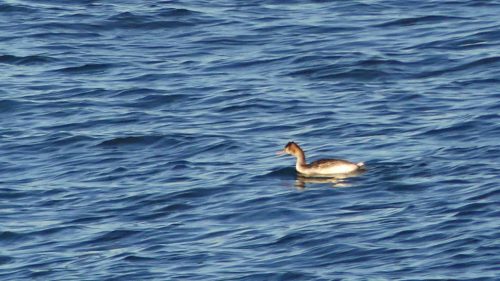
Following last night’s Super Moon, there was a Spring Tide this morning, at its highest at 10:40am (the Spring Tides are the highest ones). It was windy here as it is at most high tides, but not blowing in across the sea, so its surface was barely rippled. At just past 12 noon, the water was beginning to recede but it would be a while before the sandpipers responded and became active; they’re used to arctic conditons, but it was way too cold for me to stand still. I wondered about the lone bird I’d seen before Christmas. Was it now part of this little group? Surely it was, but I walked the short distance along to where I’d seen it before to make certain. No sign of it, but I did see the biggest jellyfish I’ve ever seen stranded on top of a rock by the tide. It looked a bit battered but don’t know how you tell a live one from a dead one when they’re out of the water.
 I walked as far as the steep concrete steps that go down to the shore that are becoming increasingly smoother and their edges more rounded year on year. They were wet right to the top showing how high the water level must have reached earlier on.


Now I’d seen the Sandpipers and knowing I could come back and see them again I thought I’d get into my car out of the cold and go home. But then there might be more to see, I was here now and at least it wasn’t raining like it was yesterday. I also had the luxury of being able to walk here without a grandchild in a pram as I often do, so could stop as often as I liked without protest from a little companion. I walked on towards the village.
It’s not only birds that have ‘crossed-over’ to the wild side of the road. The huge, predominantly limestone rocks of the rip-rap support an increasing variety of plants too. They are mostly garden escapes such as buddleiah and michaelmas daisies and just past the chapel is a bushy shrub. This established bush is sometimes full of one of the local House sparrow tribes adding their cheerful chirping to the more expected sounds of the seashore. There are often House sparrows foraging amongst the rocks of the seashore, especially when they’re nesting and have young to feed. They come after it’s rained too, to drink from small pools of fresh water briefly held by the limestone rip rap.

1/10/17-Rhos Point-A bush full of House sparrows
The bush has shed its leaves now and there were no sparrows today. Someone has put up a bird feeder filled with nuts, maybe for them or maybe for the Robin that is also often around here.

The sea had begun to recede here on the Point, so I began to walk down the ramp to see if any birds had arrived to forage in its wake and was surprised by a Dunnock that popped out from the base of the bush.

2/1/18-1218-Rhos Point-Dunnock
It moved back down to the rocks beneath

and was joined by a Robin.

 The big patch of Winter Heliotrope on the grassy embankment is flowering prolifically now as it has been since last December. This is another plant that started out as a garden plant that escaped and is now also accepted as a wildflower. It’s widespread around the village but this location, facing straight out to sea is not its usual habitat; it’s supposed to go for damp shady places, often under trees. It is thriving here though, this patch is now huge. It’s perhaps not the most beautiful of plants, but it’s a joy to see anything in flower at this time of year and the flowers have a delicious scent, heliotrope is widely used in the perfume industry, but you have to get down to their level to check that out!

Round about this spot I’d seen a little party of Ringed Plovers on Christmas Eve, when walking into the village with my own family party. There’d been a group of about 15 gathered on the rocks waiting for the tide to turn (birds that is, not family members). No sign of them now, so this is an image I got that day.
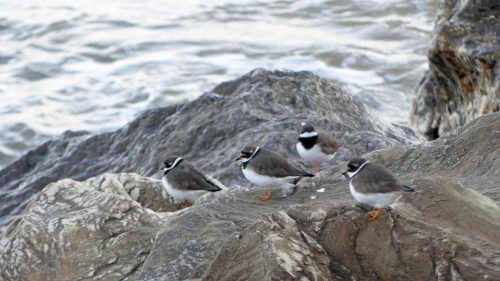
24/12/17-Rhos Point-Ringed Plovers
There was a single Dunlin there then too, resting with its head tucked under its wing just peeping out to check it was safe to carry on napping.

24/12/17-Rhos Point-Dunlin
Reaching the harbour the calm appearance of the sea belied the fact that it was actually quite windy and with no sunshine still really cold, not a day for sustained birdwatching from one spot. I loved the view though in these misty muted winter shades.
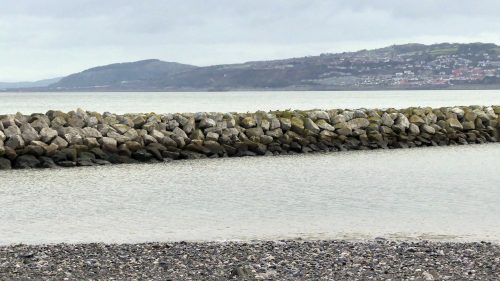
The harbour wall provides the perfect place for birds the sit out the high tides to wait close by for that magical moment when as it recedes it reaches the perfect point for them to make the short flight back to the shore. There are always oystercatchers and often gulls and a crow or two. A couple seeking shelter from the biting cold against a wall were viewing it with binoculars; they’d seen Ringed Plovers there too. At the far end sat a group of Cormorants; in my photograph you can see Colwyn Bay’s sadly dilapidated Victoria Pier behind them.


Across the road is the park which has a children’s play area, a good old-fashioned paddling pool, empty now of course and open grassy areas that is currently wet and muddy, perfect for blackbirds, thrushes and starlings digging for worms. Here with my slightly bigger granddaughter a few days ago there were two Mistle thrushes in addition to today’s blackbirds and starlings.


Starling – juvenile
I watched a Black-headed gull, its head is just beginning to show the beginnings of darkening to the chocolate-brown of the birds breeding plumage. It too was digging successfully for worms in the soft mud. I like these neat little gulls with their red bills and legs.
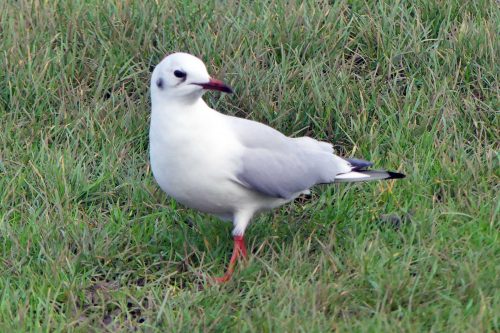
Black-headed gull

Heading back down the slope to walk back I was pleased to see a rock Pipit hopping and flitting between the rocks and the Prom edge before disappearing into plants on the grassy embankment

2/1/18-Rock Pipit
A Robin popped up too – maybe the one I’d seen earlier further along by the bush. He/she was quite likely warning off the Rock Pipit.

2/1/18-Rhos Point-Robin
Daisies are flowering, only a few bravely showing their faces, but a reminder that despite their dainty fragile looks they are as tough as old boots!

2/1/18-Rhos Point-Daisy
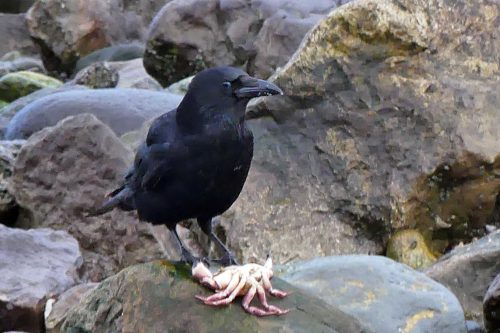
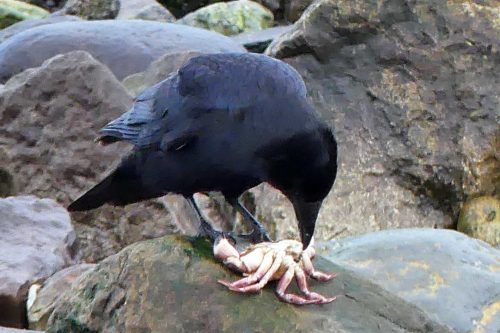
Canny Crows are frequent visitors to the rocky shore and search amongst the rocks for anything edible from scraps of left-over food left by visitors to accessible shellfish.
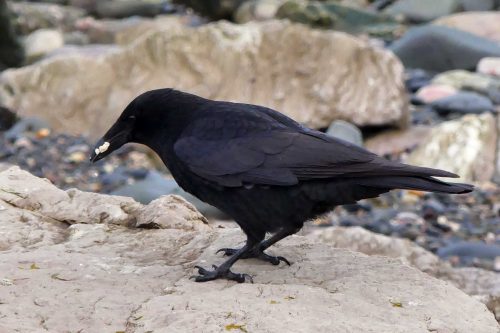 This one had found the remains of a sizeable crab and that look in its eye says it wasn’t about to share it!
 The tide was a little further out now and oystercatchers were beginning to arrive back. They didn’t begin foraging though, instead they quickly settled and resumed their rests.
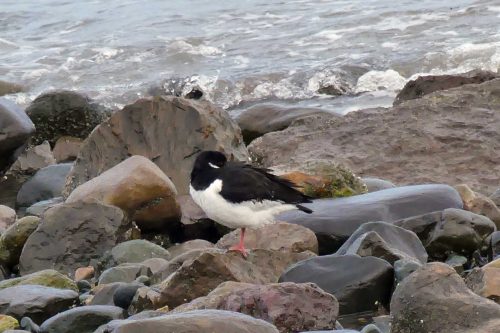
The two in the pictures below have pointed beaks so would probably be waiting for the softer ground to be revealed in which they probe for their food. Those that hammer away at shellfish have bills that are blunter and more squared off.


The people with the binoculars told me they’d come down here via Penrhyn Bay where it was apparently even colder than here. They reported seeing a Grey plover there on one of the breakwaters, so I decided to go that way home and stop and have a look. I didn’t hold out much hope of seeing anything without binoculars and had no idea which breakwater it might have been on either. It was definitely colder here, and I was not going to hang about, but I was really pleased to discover that this is where the Redshanks come to roost between tides! I’ve often wondered where they go and here they were; dozens of them tucked up in the shelter of the rocks.

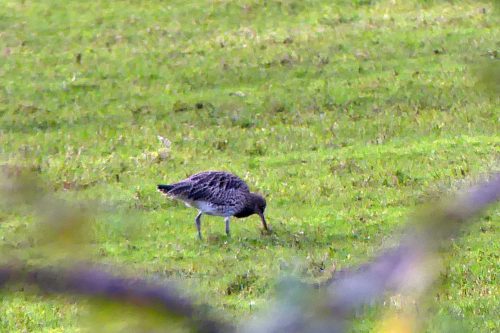
Seeing the Redshanks still waiting for the signal to make their move back to the Point made me hope that Curlews would also be in the field they frequent when not on the seashore. They were! And they come with the added bonus that you can stop on the roadside and watch them from inside your car. The brambly hedge on the field boundary gets in the way of the camera lens somewhat, and they were a distance away, but in this setting they are a wonderful sight.
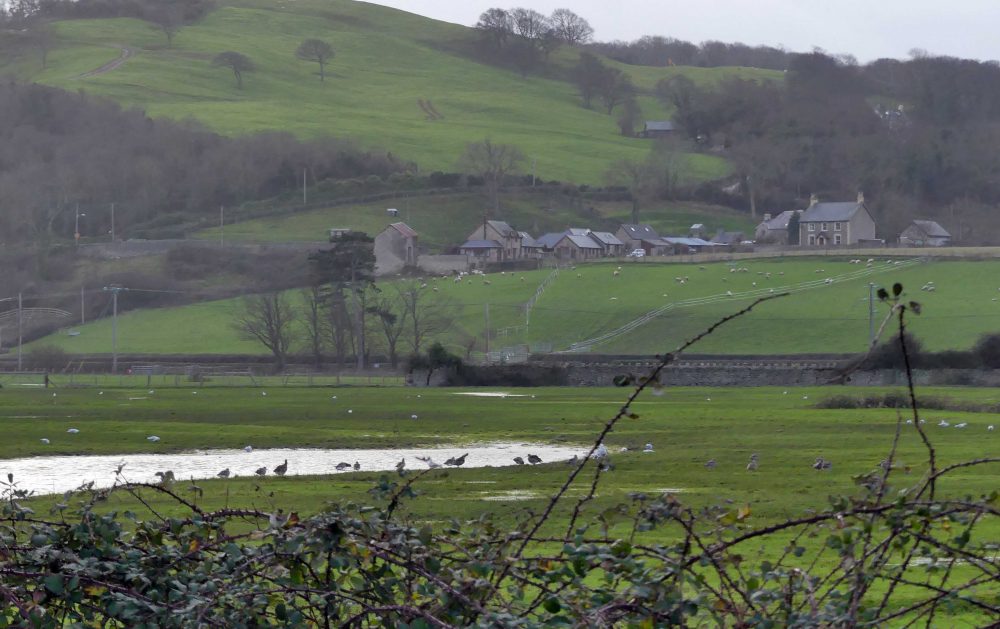


Curlew bathing












 everyday nature trails